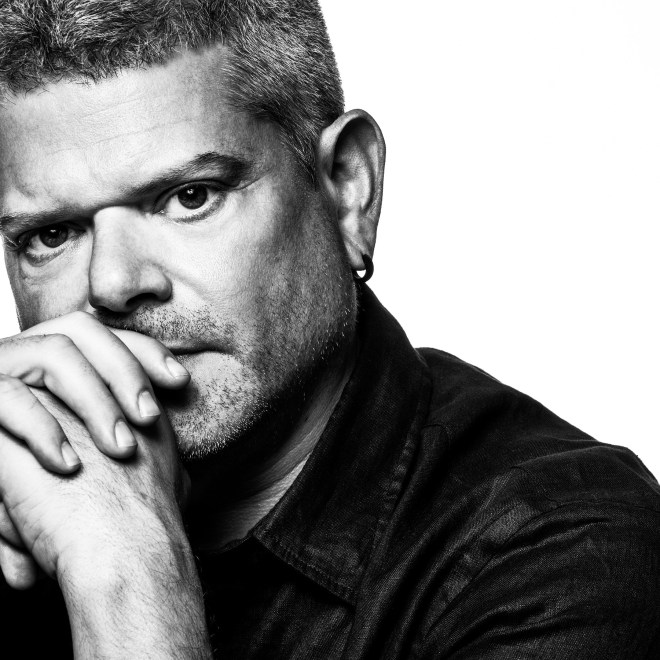
I met Shalom Auslander in 2013 when my wife Ferne Pearlstein and I interviewed him for our film The Last Laugh. Born and raised in the ultra-Orthodox Jewish community of Monsey, New York, Shalom documented his dramatic break with that world in scabrous, hilarious, poignant detail in his 2007 book Foreskin’s Lament: A Memoir. (Winner of The King’s Necktie Prize for Best Title.) His subsequent debut novel, Hope: A Tragedy (2012)—featuring a foul-mouthed Anne Frank still living in an attic in upstate New York—cemented his reputation as one of the darkest, funniest, and most lacerating literary voices in America today, drawing comparisons to Roth, Vonnegut, Heller, and even Twain.
Shalom’s unique background put him high on the list of people I wanted to interview for this site.
In the fifteen months that I’ve been writing this blog, one of the sub-strains that has emerged—to my surprise—is a discussion about religion, and in particular, the political and personal impact of its most extremist forms. Building on my conversations with the novelist and author James Carroll—a former Roman Catholic priest who writes frequently about the Church (“The Invention of Whiteness” and “The Disadvantages of Decency”)—and the legendary 92-year-old documentary filmmaker Bill Jersey, who escaped a fundamentalist Baptist upbringing (“Jesus Wept: The End of Evangelicalism, Part 1” and “Truth or Consequences: The End of Evangelicalism, Part 2”), who better to represent the Jewish side than Shalom?
**********
THE KING’S NECKTIE: First of all I want to say, now that Philip Roth is dead, you are surely the preeminent purveyor of onanistic Judaica in American literature. So congratulations.
SHALOM AUSLANDER: Thank you. Please let my mother know as soon as you can.
TKN: I was hoping you could talk a little bit about your experience of having grown up in such an extreme religious environment and then breaking out of it.
SA: Well, you come out of it physically, but the damage is still there for sure, but in ways that would be very surprising for people who know me or think they know me. It still has a certain amount of what Vonnegut called “hocus pocus” in your head that’s hard to get out. For example, my family and I recently moved to LA and we’re very happy, and that makes me very anxious. (laughs)
TKN: (laughs) Why?
SA: Because usually bad things happen after joyful things. I always found that with the Old Testament. “Oh, we’re going to get to Egypt? But oh….slavery. We’re gonna get out of slavery? Then oh, we’re stuck in the desert. We get out of the desert? Then, oh, every person in the world wants to kill you.” It just keeps going that way. And it’s always because you did something, you fucked up somehow, and God is always pissed off at you one way or another. It’s just this gnawing sense throughout your whole life that joy is punishable or suggests impending doom.
That’s not to say that I wouldn’t have had that even if I hadn’t been raised with God— it might just be a side effect of my father. But it’s this weird thing that you never totally get rid of. I always refer to it as “theological abuse.” It’s a lot like sexual abuse, where you can get past it and move on, but for people who’ve suffered from it—or some of them anyway—there is always that underlying discomfort with sexuality. So I have that underlying discomfort with existence. (laughs)
TKN: That’s a nice controllable, manageable thing.
SA: Yes.
TKN: But at the same time it seems to me that it’s part and parcel of your comedic sensibility and your literary sensibility. If you didn’t have that dark take, you would be far less interesting as a writer, yes?
SA: Yeah, I have had people suggest that. Not the way you’re saying it, but I’ve had people who dislike what I have to say suggest to me, “Well, shouldn’t you be thanking religion and your parents?” And it’s sort of like, “Yeah, and after that I’ll thank the priests who raped me and the neighbor who made me suck his dick when I was seven. I’ll just have a big party for everybody who fucked me up.” Because, trust me, I would rather have joy and no writing ability than a writing career and endless angst. Whether it’s good or bad, profitable or not, it’s a survival mechanism. And if you need a survival mechanism it’s because you’re constantly surviving.
The experience of growing up in that type of community left me feeling like an alien in the secular world. But at this point in my life, with more time now in the secular world then I had in the Orthodox world, I realize what a gift it was to be able to leave, to be able to go see something entirely new. So many people are locked into their communities—and it may not be religious, it could be political, racial, sexual, economic, whatever.
Seeing that probably colored my worldview more than anything about God or the specifics of my relationship with Him, which is not great. (laughs) You know, God and I fight a lot and we have keep a hundred feet away from each other by law.
NOT THE WORST ANIMALS
SA: I’d love to hear the explanation behind The King’s Necktie. I know that it’s primarily political.
TKN: Yeah, but occasionally I stray into something that’s just cultural or interests me for one reason or another, just to change the pace, because otherwise it‘s too grinding and relentless. And they’re all connected anyway. I know you said you don’t really follow politics, but obviously you wrote that very influential Washington Post piece right before the election, “Don’t Compare Donald Trump to Adolf Hitler. It Belittles Hitler.”
SA: I actually feel a little bit ashamed of that piece.
TKN: Why do you say that?
SA: Because it proved that I had fallen for the game a little bit. I got caught up in it, as I always do with the election. It’s kind of like how I’m not really a basketball fan but around the finals I get ridiculously into it.
Politics is just a trap. It’s always been a toilet, it will always be a toilet. Even when you think it’s not a toilet it’s a toilet. Even when it’s your turd and you think this is our time, it’s still a load of bullshit. The worst people in the world.
I’m at the point now—and this may be a function of growing and moving out of the community that I was born into, completely leaving it behind and literally never going back—where I think the biggest issue isn’t Trump or war or taxes or whatever else. I think all of that comes out of these fictional differences that we have created between us that aren’t real.
To me, there is no such thing as a Jew or a Christian. Skin color is just an effect of biology. When we have nations and governments and leaders and hyphenates galore we’re just reaffirming these differences, and they aren’t real. They’re created. They may have served a purpose once, but so did a lot of things that early man did that we don’t anymore—like religion. There is no way to be engaged in it without there being Us and Them. Whether it’s left or right, Democrats or Republicans, Americans or Russians, these are all made up things. They don’t exist, and the more we kind of engage with them as if they do, we’re never going to get past the point where we want to kill each other.
If you look at the history of man, and migration, and where we came from, the story is one of us coming together despite ourselves. We have to stop fighting the process and just embrace that fact, because “I’m chosen” or “I’m white” or “I’m black or ‘I’m Asian” or “I’m this” or “I’m that” isn’t working. I feel like that is behind so much what is wrong with the planet right now. And maybe that’s a function of having left a place that is very insular and then finding out, “Wow, the stuff they told me about the outside world wasn’t true. It was make believe.” So there is a sense of, “Well, if everyone else is in that same make-believe world, no wonder we’re in the place we are.”
So, then you have politics and people like Trump or whoever might come along who are very very good at profiting off that. It’s negative and we don’t even have to play the game. That’s what kills me is that there is no need for the game at all, if we just stop with insisting that we are different of special or this or that. We suffer from all these differences that now have thousands of years of history behind them, of complaint, and wanting vengeance, of oppression and suffering, and there is no escaping it. We just keep running around in circles. When I realized that I was like, wow, this is so fucked up. We are all just people and we’ve allowed these fictions, these walls, to be built between us for somebody else’s profit.
TKN: That is such a humanistic, and idealistic, and almost sweet perspective….which is not what people expect from you.
SA: (laughs) It’s funny, because what I’m pissed about is the way we are. Not what we could be. I don’t think we are particularly special animals, but I don’t think we are the worst animals. The reality is that we evolved from some pretty shitty monkeys. (laughs) Monkeys are assholes. If you ever go to the zoo, they are the biggest fucking assholes in the zoo. They are the only ones with barbed wire, and signs that say, “Don’t stare at the monkey, don’t look at the monkey, don’t taunt the monkey, don’t feed the monkey.” That’s our grandfather. They don’t do that with squirrels, or rabbits, or giraffes. You can make faces at giraffes all day long.
So I don’t think we’re great, I don’t think we’re awful, but I think that there is just a lot of residual shit from when we were animals.
But that’s fine. I mean, my writing heroes and my comedy heroes were the same way. Vonnegut was a humanist and everything he wrote was about how shitty, dark, and funny the world is….what do they call him, the Laughing Prophet of Doom? That’s not a bad title. Twain was the same way, Bill Hicks, Pryor, Beckett: a lot of these guys laughed at the darkness. They all had high hopes. For me it’s the same way.
YOUR TRIBE IS MORE TRIBAL THAN MY TRIBE
TKN: Well, I was joking a little before, about how people don’t expect idealism from you. I think you are completely right, of course: the great black comedians and satirists that we think of, Swift and all the rest, their dark view isn’t nihilism. It all comes out of disappointment with humanity and the frustrated idealism that’s underneath that. And you’re the same way.
SA: Beckett had this great thing where he had been labeled a pessimist, and he said that to him the real pessimists were the optimists who are so afraid that the world can’t be fixed that they won’t even look to see what’s wrong with it. Whereas the pessimists believe things can be fixed and so they point out what’s wrong in the hope that it will get better. And that’s either Trump-level spin—but very funny spin—or really a great insight into the whole argument. But I think it’s a good argument.
TKN: It’s interesting about tribalism, because to me that’s the whole issue. When you look at Trump’s supporters—and also the other side, but particularly his supporters—it’s pure tribalism to such an extent that it defies reason. You can’t even argue with these people because they are in a kind of psychosis—like a cult—which is no different than a religious cult. They have abandoned all reason, and that’s a form of the divisiveness that you were talking about.
SA: Yeah, but I’m in Santa Monica now, and I was in Woodstock before, both famously left wing communities, my kids go to left wing schools, and that’s as tribalistic if not more. It’s fucking crazy, in fact, that they have taken my son—(laughs) who is the furthest thing from right wing ever—and made him go, “What the fuck is wrong with the left? I can’t say anything. Everything is a microaggression. I’m a white male so I have no point of view and I have no feelings and I’m nothing but a bad person.” And I’m like, “Dude, I fucking left God because they told me I was bad from the day I was born.”
I remember saying to him, “Listen, buddy. Do you own slaves? Because if you do we are going to have a big problem. We’re going to need to talk about that. But if you don’t, then they should shut the fuck up. You didn’t do anything wrong. You’re twelve.”
TKN: Obviously, it’s not fair to put all that on a twelve-year-old, and it’s not the lesson kids ought to be learning anyway, in terms of the broader legacy of privilege. It’s a distortion of that—well-meaning maybe, but still a distortion. Not to mention the almost comic absurdity of certain kinds of left-wing gymnastics in trying to make amends. Though I would still argue that that’s preferable to the alternative that used to predominate, and still does in a lot of the country.
SA: All of my son’s friends, for school they have to write “My Autobiography,” and all they write about is how terrible they are because they are white males, or because they made a joke and someone was offended by it. I have friends who make a living writing funny things and they get into huge shit now from the left for making jokes.
Just the other day I pointed out to somebody the famous story of Bill Hicks, where he did a set on Letterman and they pulled it. Twenty years later, after Bill died, Letterman had Bill’s mother on to make amends. There’s a letter that my wife gave me as a gift in a book she found; it was like a 20-page letter Hicks sent to the head of CBS, arguing his side of the story. I got the chills reading it recently, where the letter said, “Is this what we have come to in this country? This is our big fear, jokes?”
TKN: Of course, that’s the topic of Ferne’s film, The Last Laugh: Where is the line for what’s acceptable versus what’s off limits for comedy? And it’s all about context, which includes time, and membership—or non-membership— in a given group and the presumption of good or ill intent. (NB: See also “The Last Laugh: Ferne Pearlstein on Humor and the Holocaust”).
SA: I think that anytime you tell people that there’s something to be gained by being a victim they’re going to go for it. And Trump’s supporters think they’re victims in the same way that left wingers think they’re victims. Everybody’s a victim. And politicians have played victim politics on both sides of the net for a very long time.
So to me it’s yet another function of this tribalism. We recognize that the other side is really tribalistic but we don’t realize that we are as well. The really funny thing is when one side says, ”Oh, they’re much more tribalistic than us. I wouldn’t be so tribal if they weren’t so tribal.”
TKN: (laughs)
SA: Again, we are monkeys and monkeys are very tribal. Monkeys are one of the few animals that rape just for vengeance. So you can see where we come from. But we are supposed to be working our way out of that. All this fucking shitstirring and throwing shit back and forth at each other over an arbitrary line in the sand—that’s what kills me.
The thing that has surprised me about all of this isn’t that there are some people who are hateful and would follow a leader who manipulates that. I know that. What always surprised me and scared me as a kid learning about the Holocaust—which they never stopped talking about in my community, and this was sort of what that Washington Post thing was about—is the question, “Are we the type of nation that can be driven apart like that?” Can we get to a level where we hate each other so much? And the answer is “Of course we can.” Because there is nothing special about this hemisphere or this soil or us at all. And the sooner everyone realizes that the better.
In my last novel, Hope: A Tragedy, I have Anne Frank still alive, and like 85 years old, having survived the Holocaust and still hiding in an attic in upstate New York. And she talks about how she prefers self-hating Jews and self-hating Germans and self-hating Americans and that if more people had the courage to be self-hating there would be less war in the world. That’s a version of this whole discussion of why do we let ourselves do this? We all want the same things, we all fear the same things, that should in and of itself be enough. If we could put away the monkey part of our brain for just one fucking minute it would be different.
I know it’s hard. I ride motorcycles, and one of the main things about learning how to ride a motorcycle at speed is to ignore what the brain wants to do because it’s going to get you killed. When you’re coming into a corner fast, your brain says, “Hit the brakes, hit the brakes, hit the brakes!” But if you listen to your brain, you’re going to die. But paradoxically, if you do the opposite, and roll on the gas a little bit, then you’re going to get through fine. Our brains are ancient and there is a part of them that doesn’t know what we need right now. So it’s getting past that. Because otherwise we are just kind of laughingstocks, we’re just silly, and whatever happens to us we kind of deserve.
TKN: Well, that’s the unfair question I was going to ask you. How do we get to that point? How do you overcome that monkey part of the brain, that divisiveness, which is so intense right now—certainly as intense as I have ever experienced in my lifetime, or at least giving 1968 a run for its money? How do you break it?
SA: It’s a very slow-moving boat. It’s hard to turn. I think if I had not left my world I’d be just as insular as they are right now. I was forced to climb out the window, scramble over the fence, and see that the people living next door were no different than me. That’s obviously not something that most people go through, but it should be something that people perhaps train their kids to do.
There’s always that hope that maybe it’s the next generation—and I do feel that way—until we fuck it up. So when my son comes home and on the one hand he’s like, “What the fuck? Nazis are marching in America? What is this?” And then two weeks later he’s like, “I made a joke about homework and now I’m in trouble because the girl I made the joke to said it was threatening to her.” I don’t know the answer to either of those things, so all I can tell him is maybe it’s somewhere in the middle. And I think that we are in the middle more than we know.
WHO WILL ANSWER FOR THE CRAWL?
SA: I wish everybody would turn the fucking news off, right now, because it’s absolutely poisonous. I don’t even care what the intention is. I have friends who are journalists and news reporters; I don’t even give a shit that they think they are helping. It’s not helping. It’s a terrible, terrible influence. I think social media drives people apart. I think the name “social media” is hilarious because it’s so divisive.
I feel like there are things you can do, but you have to want to do them. It’s really comforting to sit at your desk and look at the same three news sites that you look at and feel validated in your beliefs and your suspicions and your paranoias and then go back to sleep, or try to sleep, and then go back the next morning and do the same thing all over again.
I don’t watch the news. I don’t need to. It’s been years since I have and every time I end up seeing it again—if I’m stuck in like an airport or something where they have endless TVs, or Los Angeles for example, where you can’t walk three feet without seeing a TV—the news hasn’t changed. It hasn’t changed since I was in high school. The scumbag president is doing a scumbaggy thing and manipulating scumbaggy people. They’re killing each other in the Middle East. Someone famous did something horrible. Someone powerful took advantage of someone weak. Nothing has changed. But if you watch it and get involved in the game you’re just letting it win. The only way to play the game is to not play the game. That’s the only way win, to turn your back on it and just go through life trying to be human being.
TKN: But to be the devil’s advocate, if there is a clear and present threat, which arguably there is right now, do you not think people should organize and resist it?
SA: Clear and present threat to what?
TKN: Well, there are various versions of it. Let’s say, immigrants are being detained at the border, or….
SA: Right, but did you need to watch the news for the past five years to know that was going on? I don’t watch the news and I knew.
TKN: Well, I didn’t know it was going on in that particular fashion. In fact, it wasn’t going on in that particular fashion….
SA: But that’s what I’m saying. I don’t watch the news and I know about it. I’ve gone to the marches and I know about the school shootings and I take my kids to the anti-gun rallies. I don’t need to be poisoned day in and day out.
That’s part of the trick, right? They want you to think that if you don’t watch it then you’re not going to know anything. Bullshit. You can’t walk a fucking block in this city or anywhere in this world without knowing just about everything that’s going on one way or the other. You’ll overhear it, you’ll see it. If it rises to the level of that, you’re going to know about it.
Back in Woodstock there’s a group of old, cranky, funny Jews that used to go to the coffee shop where I would write every morning, and it was great because someone would come in bitching about Trump, and the end of the world, and Kim Jong-un,and they would laugh about it. Because they were like 80 years old and they were there through the Cuban Missile Crisis and they were there when Kennedy got shot. They’d go, “Fuck you, this isn’t the worst by a long shot.” And that wasn’t the worst by a long shot.
But now the chyron goes all the time. You’re old enough to remember when news didn’t have that. The crawl at the bottom of the screen did not exist. It started on 9/11, and they will not let it go. Who’s going to answer for that? I think somebody should answer for that.
Do you know what the crawls are now? If I’m in a any cab in the city in America, the crawl is like, “Jennifer Aniston gets a new haircut.” It makes you tense, it makes you feel like something is going on right now and you have to know. So to me there’s got to be a movement of disconnecting.
I bought my son a t-shirt at H&M or something—I know, it’s horrible, I don’t even watch the news and I know they use slave children to make that shit. But again, you don’t need to watch the news to know that; I go in there and a shirt is $3.00 and I know it’s not made in America. I know someone got fucked for that. But anyway, the shirt said “Offline is the new black.” There was a life before this.
I’m not saying there is not good stuff about the Internet. We’re doing it with this blog right now: we can criticize the Internet in a medium that takes place on the Internet and I love that. So I understand there are some good things. But I think you really have to tilt yourself over like a lawyer for the defense to not be able to see that there is something incredibly dangerous and divisive about the kind of life we lead now.
GOD SAID TO ABRAHAM KILL ME A SON
TKN: I know you have written a lot about this, but for people who don’t necessarily know all the details, as somebody who escaped an incredibly tribal upbringing and community, how did you make that psychological break?
SA: Well, it wasn’t heroics. It wasn’t because I thought that people needed to get together more. I left because if I had stayed I would have killed myself. I would have died on the vine. I did not fit. I was lucky enough—this sounds like a joke, but it’s not—I was lucky enough to have such a severely dysfunctional family that I couldn’t just put up with it (laughs). I had to leave. If my family had been even 5% healthier I probably would have found a way to deal with it.
But it was intolerable. And I know lots of people who have severely fucked up families who will say, “Yeah, but it’s not that bad.” When, really, from my vantage point, it’s killing you. But they find a way to stay. It was so bad for me on every level—parents, siblings, community, school, friends—there was no choice but to go.
So to say that I jumped off the Titanic because I was against metal isn’t exactly true. I was going down; I had to do something. The silver lining to that storm was that, thirty years later, I’ve seen a version of the world that I don’t think everybody else has.
TKN: Other people that I have spoken with who have come out of similarly extreme backgrounds—whether it’s archconservative Catholic or fundamentalist Protestant, or whatever—describe that same damage, but they often have a kind of residual fondness for it too, or at least some aspects of it. Sometimes it’s just nostalgia or sentimentality, or just something in the marrow that they can’t escape, but it can also be something more substantive. Bill Jersey, who was raised in a fundamentalist Christian community, told me that he still carries with him certain lessons that he thought were legitimate and valuable from that otherwise toxic environment. And Jim Carroll is still a practicing Catholic, even though he is a ferocious critic of the Church. Do you have any positive feelings at all for your upbringing?
SA: I think there are myths and legends and tales that could be useful and that have meaning. They’re hocus pocus, because they’re stories about God and things that didn’t really happen, but I don’t hate Cinderella because it wasn’t real. I’m less a fan of the Disney version to be honest, but there are philosophies and ideas in anything that have some benefit.
I think it would be a sign of an unhealthy separation if you couldn’t admit anything good. When it’s a really rancorous divorce, and the guy is like, “She was a complete bitch from top to bottom; there is nothing redeeming about her whatsoever,” that’s when you know, as a friend, “Oh, he’s not really over her.”
I have a dream of writing a commentary on some of the chapters in the Old Testament that I think tell a great story that isn’t told by the people we have entrusted to tell it to us. Rabbis and priests get to interpret those stories, but we can interpret them any way we want. Like the story of Abraham trying to sacrifice his kid: as it stands it’s a horrible story, particularly when they tell you he was doing a good thing because he showed his commitment to God. But I think there’s something in there that’s really fascinating to teach kids. Look, this guy Abraham really scarred his son, and of the three forefathers, Isaac grew up to be the most ineffectual because he was shattered. He was shell-shocked; it was PTSD. That’s not the story, they tell you; they don’t point that out. So I feel like you can take any of those tales and reconfigure them and they have worth, they have value. But that’s a far cry from saying you should stay in that camp.
TKN: As you know, my wife is Jewish and I’ve been to many many bar mitzvahs and bat mitzvahs and it’s always fascinating to me to hear these poor kids and the Torah portions they get stuck with—because it’s the portion for that day, they have no choice—and invariably it’s some horrific tale of mass murder and slavery, and they’re told to relate that to their own life. And it’s always painfully comic to see them try to do it.
SA: Yeah, and they’re all 12, and they’re super innocent, and in beautiful clothing, and they’re reading, “And so he raped 3000 that day and 5000 died the next….”
SEVEN MILLION NINJA THROWING STARS
TKN: Speaking of that, I wanted to ask you about the “Attic Calls” that are on your website. (On his site, Shalom has clips of himself phoning friends like Sarah Vowell, Ira Glass, and John Hodgman, asking if they would hide him in case of another Holocaust.) Because Ferne and I have an English friend, who’s Jewish, and her perspective on the Holocaust is so different from the usual American perspective. When we walk around, she’s always looking at people and asking herself, “Would they hide me? Would they hide me?” It seems like in Europe they’re that much closer to the event and it feels more present in their lives….or at least it did until November 2016.
SA: Yeah, it’s always in the back of your head. I don’t think that’s different anywhere nationally. When you get raised being told you have a target on your back, more so than anybody else—which isn’t true even remotely, I don’t think; I’d rather be Jewish than African, given the whole history of the world—but when you’re raised to believe that they are coming after you, and this is what happens when they get their way, it’s piles of dead bodies, yeah of course you are going to be looking for a way out.
As a kid I slept with ninja throwing stars under my mattress. I thought I could “ninja throwing star” my way out of the Holocaust. (laughs) Seven million throwing stars to defeat the German army. I thought I could do it with that, and with homemade nunchucks that never lasted more than one or two swings without breaking. I had a whole plan.
TKN: So you are an optimist.
SA: (laughs) I’ll be honest with you: one of the nice things about being in Santa Monica and just ten blocks away from the water is I can just run. I’m going to keep one of those lifeboats where you pull the cord and it inflates. My “just in case” boat.
TKN: Like the end of Catch-22, like Yossarian, you’re going to paddle your way to Sweden. The long way around.
SA: Exactly. As it fades to black, just keep paddling. Keep paddling.
TKN: Not to go back to politics, but on the subject of rounding people up, what do you make of the Jewish support for Trump? It’s surprising, wouldn’t you say?
SA: No. I’m surprised there wasn’t more.
TKN: Really? I mean, I get the Israeli thing and I also get the conservative right-wing thing, but it just strikes me as weird that a group of people who have been historically oppressed don’t recognize the pattern, even though they are not the ones being singled out this time. You know, “First they came for the socialists”…..
SA: They are still being singled out, but there’s a greater benefit. It’s all about Israel. That whole thing is so disturbing. I spent like two and a half years there, and my wife is Middle Eastern, but I cannot stand Middle Eastern people. I don’t mean Muslims; I mean Jews and Christian too. Israelis, Palestinians, Jordanians, Egyptians—all of them. They just want to fight all the time. I don’t know why that is. It’s like British people after a soccer match. All the time. I spent two years there, every day I nearly got my ass kicked. You ask how much is the boreka and you get into a fight. It’s horrible.
When I was a kid and even into my 20s everything I heard from every Jew was all about Israel. And Netanyahu plays that so well. I’ve said this before, Netanyahu can’t order breakfast without mentioning the Holocaust. Because it gets him votes. He’s keeping everybody afraid. Why is Trump saying that Mexicans are rapists? Because that tribalism works in his favor. Always. So it doesn’t surprise me at all.
Actually I was quite pleased that the number of Jews who supported Trump was as low as it was—I don’t know exactly what the numbers were—because I thought it was going to be the complete reverse. I thought it would have been a very high number for him, because the way Israel goes, American Jews go. I think it’s actually really great that there is this fracturing and I hope it’s true. I hope it lasts.
TKN: When Ferne interviewed you for The Last Laugh you talked about the reaction to Hope: A Tragedy as opposed to the reaction to Foreskin’s Lament….how Anne Frank is a kind of secular saint among Jews, to the point where you got more shit for satirizing her than you did for attacking God.
SA: Yeah, much more so. I think it’s that way in the Christian world too. You can talk about God, but don’t fuck with Jesus. (laughs)
But the thing that always makes laugh is that most people have not even read her diary. That’s one of the jokes in Hope: A Tragedy, that it drives her fucking crazy how no one has read her fucking book. Because if you do read it, she was a really…..I don’t know if “progressive” is the right term, but she certainly wasn’t a conservative thinker. And had she grown up, I always imagine that it would have been a similar story to Helen Keller. Everyone learns about Annie Sullivan and the poor little blind deaf girl who learned to sign. What they never want to hear about is when she learned to sign and speak she was a radical! She was pro-abortion, pro-gay marriage, you name it. Helen Keller was fucking out there crazy….and no one reads it! No one wants to know! They want that little girl who suffered. “We don’t want your opinions, we don’t want you to think, we just want you to be the suffering girl we like so much.”
If you read her diary, Anne Frank gives her mother shit, she doesn’t follow her parents, she had crushes on boys, she told dirty jokes, she didn’t like religious kids in her class…… I imagine if Anne Frank had grown up, that kid was going to be a fucking handful, in the greatest possible way.
TKN: But the book got sanitized by her father.
SA: Well, understandably. Yeah, he didn’t want people reading about her bickering with his wife and mother. But there is plenty that shows you that, already at that age, this was not going to be a Jew that defends Israel at every turn. I imagine that if she had lived she would have driven everyone a little crazy and taken on the Palestinian cause. She’d be rejected. It’s that whole thing about when Jesus comes back it’ll be the Christians who are going to kill him.
TKN: Right. Like the Grand Inquisitor section in The Brothers Karamazov, or Woody Guthrie’s song “Jesus Christ,” where he imagines the Second Coming, and says, “If Jesus were to preach what he preached in Galilee, they would lay Jesus Christ in his grave.”
SA: And if Anne Frank were to come back, the Jews would kill her, because they are not going to like what she has to say. No way.
TKN: So what is your new book called?
SA: “Mother for Dinner.”
TKN: (laughs) I was going to ask if it’s going to be as controversial as Hope: A Tragedy, but I guess that answers the question.
SA: (laughs) It’s funny and dark, but it is very much about this issue that is very close to my heart: this issue of tribalism, and who are we, and what has it gotten us, and how different is it from what our ancestors may have dreamt about themselves.
TKN: I find that very inspiring. This whole conversation to me has been very inspiring and optimistic.
SA: (laughs) I know. But that’s the problem.
**********
Shalom Auslander’s first collection of short stories, Beware of God, was published in 2006, followed by his breakthrough memoir Foreskin’s Lament in 2012. His first novel, Hope: A Tragedy, won the 2013 Jewish Quarterly-Wingate Prize and was a finalist for the 2013 Thurber Prize for American Humor.
Shalom is also the creator of the Showtime series Happyish, which starred Steve Coogan and Kathryn Hahn, and a frequent contributor to This American Life, The New Yorker, Esquire, GQ, and The New York Times, among others. His soon-to-be-published new novel is Mother for Dinner.
He now lives in Santa Monica, and is prepared to paddle to Sweden in a life raft, if necessary.
Transcription: Izzy Hackett



 thekingsnecktie.com