The Limits of Force and the Endgame in Ukraine

Last week’s essay, “Fighting Fascism Isn’t Fun,” spent some time talking about the foreign policy and national security implications of the newly Trumpified United States. This week let’s look at one piece of that in more detail.

Following the 2022 Russian invasion of Ukraine, I wrote here (and on Consequence Forum, an online journal about violent conflict) about the worrying zeal for military force that had understandably gripped many in the West in response to that brutal aggression. The sheer brutality of Vladimir Putin’s unprovoked attack, and the valor of the Ukrainian people and their leaders in resisting it, were deeply stirring. But the brave Ukrainian struggle also brought out a bellicose wave of enthusiasm for warfighting among many in the West who are usually more reluctant about such things. Predictably, it also elicited a disgusting pro-Putin response from the American right, which lives in an alternate reality where day is night, up is down, and villains are heroes.

Military force was undeniably required to resist the Russian campaign, but the rah-rah cheerleading for it—even among people not usually given to jingoism—and the simplistic grasp of what that entailed, irked and worried me. (Among its risks, it also opened the door for those aforementioned right wingers to justify their own acts of violence when their temporary pacificism inevitably abated.)

When it came to a cause as noble as Ukraine’s, I understood where that aggressive feeling came from, and how seductive it was. It’s very much human nature. But my concern at the time, continuing to this day, is how that justifiably righteous fervor placed far too much faith in the effectiveness of brute force as a tool for achieving national objectives.

To paraphrase a famous Prussian: war is only the continuation of politics by other means. As such, it is not an objective nor an end in itself, and is constrained by multiple other factors in any given conflict.

Now that the endgame in Ukraine—or should I say for Ukraine—is at hand, we see that dynamic demonstrated in its most sobering form.   

CARL IS RIGHT AGAIN

The people of Ukraine fought valiantly against their Russian aggressor, dealt him losses and setbacks that few thought possible before hostilities commenced, and for a time—with Western aid—looked like they might even prevail. But with Putin’s vassal Donald J. Trump back in the White House and US aid to Kyiv is about to be shut off, the strategic situation has irrevocably changed. Now we are faced with a completely different and much more grim scenario: a political solution that renders the bravery and physical courage of the Ukrainian people and their leaders moot in the face of a deal between two despots, Putin and Trump. And won’t Donnie be pleased to mentioned in the same breath with his hero.

Ukraine has been at the center of Trump‘s horrific reign for two administrations now. It’s worth remembering that the “perfect call” to Zelenskyy in 2019 to blackmail him over the Javelin missiles that Ukraine desperately needed to defend itself against an earlier and ongoing Russian incursion, in 2014—and Trump‘s desire for manufactured dirt on Biden for use in the 2020 election—is what got Donnie impeached the first time. And of course there’s the whole Manafort/Yanukovych/Deripaska connection, which is tied to Russian interference in the 2016 election, and Trump‘s acceptance of it. Now, in this third presidential cycle in a row, Ukraine again is front and center.

Trump has never made any secret of his venal, shortsighted view that any foreign aid constitutes the US being “suckered.” Twinned with that, ever since his first KGB/Intourist-sponsored visit to the then-USSR in 1987, he has vocally promoted an isolationist foreign policy that perfectly aligns with Moscow’s goals, both in the Soviet and post-Soviet eras. (Why he feels that way is a topic for another day, or yet another remake of The Manchurian Candidate.)

Atop that broad selfishness and strategic ignorance, we have the added factor of Trump’s adoration of Putin and despots in general. As Robert Kagan wrote in The Atlantic last month, “Trump himself is no ideologist, but his sympathies clearly lie with those around the world who share a hatred of what they perceive to be the oppressive and bullying liberal world order, people such as Viktor Orbán, Nigel Farage, Benjamin Netanyahu, and Vladimir Putin.”

That spells doom for Kyiv—and a painful demonstration of how battlefield success or failure is far from the deciding factor in geopolitical outcomes.

Ultimately, it will be the economic power of the United States—specifically the withdrawal of it—that will doom Ukraine, not military defeat. It’s true the situation would be different if Ukraine had had even more operational success in repelling the Russian invaders, but that too was constrained by non-battlefield factors such as economic and military assistance from the West. One may argue that they are connected, of course, because economic power in the form of money, ordnance, and intelligence furthered Ukraine’s military efforts. Very true—but that is just another way of making my point. All these factors are always inextricably connected. Military force never operates in a vacuum—never. It’s impossible by definition. One cannot untangle military affairs from the broader political context in which they sit.

So now, after three years of courageous self-defense and sacrifice by the Ukrainian people, Ukraine’s fate will not be decided on the field of battle: it will be decided over a conference table, by the US and Russia.

In other words, by Russia.

WELCOME TO THE OCCUPATION

When a Western democracy makes weak-kneed and ill-conceived efforts to mollify a brutal dictator, the specter of Chamberlain and the appeasement at Munich in ’38 is usually invoked. But this is something worse. This is the United States actively aligning with a brutal dictator, and doing his bidding, and sacrificing a smaller democracy on the altar of greed, autocracy, and our own would-be dictator’s pathology.

Ukraine is about to be fed to the lions—or perhaps should I say to the bear?

Trump‘s attacks on Zelenskyy as an unelected “dictator,” (an appellation he refuses to apply to Putin), blaming him for starting the war, threatening him with the obliteration of his country, and faulting his failure to make a deal, are all preludes to Trump throwing up his hands and saying “I did what I could!” as he lets his pal Vlad gobble up an entire country and exterminate its people as if it had never existed at all, which of course Putin claims it did not. Trump is playacting at brokering a lasting peace, but all he’s really doing is the kabuki preparatory to giving Moscow everything it wants on a plate, with only the thinnest pretense of any sort of negotiation. And that should scare the piss out of Moldova, Estonia, Latvia, Lithuania, Poland, and even Hungary.

Of course, short of maintaining US materiel support, which he has ruled out, Trump could probably not save Ukraine even if he wanted to, which he clearly does not. Kagan notes that Trump, for all his bluster, has no leverage with Russia. Putin knows he does not want to carry on supporting Ukraine, so he has no incentive to fold. Trump has a pair of twos and Vlad knows it. So much for the art of the deal.

I’ve quoted Kagan’s juggernaut piece from last month at length before, and I’m going to do it again, because it’s the clearest statement I’ve seen about the dire state of play:

(Putin’s) goal for more than two decades has been to weaken the US and break its global hegemony and its leadership of the “liberal world order” so that Russia may resume what he sees as its rightful place as a European great power and an empire with global influence….

(H)e also believes that victory will begin the unraveling of eight decades of American global primacy and the oppressive, American-led liberal world order.

Think of what he can accomplish by proving through the conquest of Ukraine that even America’s No. 1 tough guy, the man who would “make America great again,” who garnered the support of the majority of American male voters, is helpless to stop him and to prevent a significant blow to American power and influence. In other words, think of what it will mean for Donald Trump’s America to lose. Far from wanting to help Trump, Putin benefits by humiliating him.

So what will the sacrifice of Ukraine and the Ukrainian people mean? Kagan again:

Putin’s aim is not an independent albeit smaller Ukraine, a neutral Ukraine, or even an autonomous Ukraine within a Russian sphere of influence. His goal is no Ukraine. “Modern Ukraine,” he has said, “is entirely the product of the Soviet era.” Putin does not just want to sever Ukraine’s relationships with the West. He aims to stamp out the very idea of Ukraine, to erase it as a political and cultural entity.

And what will life in Russian-ruled former Ukraine look like? Like this, again per Kagan:

Putin has decreed that all people in the occupied territories must renounce their Ukrainian citizenship and become Russian citizens or face deportation. Russian citizenship is required to send children to school, to register a vehicle, to get medical treatment, and to receive pensions. People without Russian passports cannot own farmland, vote, run for office, or register a religious congregation. In schools throughout the Russian-occupied territories, students learn a Russian curriculum and complete a Russian “patriotic education program” and early military training, all taught by teachers sent from the Russian Federation.

The targeting of children in this crusade is among the most despicable and stomach-turning aspect, not unlike Trump’s targeting of children in the “family separation” policy.

Parents who object to this Russification risk having their children taken away and sent to boarding schools in Russia or occupied Crimea, where, Putin has decreed, they can be adopted by Russian citizens. By the end of 2023, Ukrainian officials had verified the names of 19,000 children relocated to schools and camps in Russia or to Russian-occupied territory. As former British Foreign Secretary James Cleverly put it in 2023, “Russia’s forcible deportation of innocent Ukrainian children is a systematic attempt to erase Ukraine’s future.”

In the best case scenario, then, Ukraine will be a hobbled, war-weary fragment of itself, greatly geographically diminished, and living under Russian dominance. The worst case scenario is that Ukraine ceases to exist altogether, its people are exterminated as a nationality, and its entire culture, language, and history obliterated. Whether or not European peacekeeping forces wind up on the ground is meaningless. (Putin has already denied Trump’s claim that he will accept them.) But any way it shakes out, you can mark my words: there will be no peace in Ukraine, except on terms that are onerous to Kyiv and acceptable only to Vladimir Putin.

THE RAISING OF THE WHITE FLAG

Even if you don’t give a shit about your fellow humans in Ukraine or anywhere else, there are tectonic implications for the US in terms of our relationship with our erstwhile partners in what was once called the Free World. “The divisions between the US and its allies, and among the Europeans themselves, will deepen and multiply,” Kagan writes. “Putin is closer to his aim of splintering the West than at any other time in the quarter century since he took power.”

Some of that damage has already been done, and may be irreversible, as these events in Ukraine come on the heels of last week’s appalling and cowardly American abdication of global responsibility by Hegseth and Vance on their respective visits to Europe, and the installation of Russia’s useful idiot Tulsi Gabbard and the pro- authoritarian Kash Patel atop the US Intelligence Community. No one in Europe or anywhere else will ever trust the US again, knowing that we would elect a government like this that would do the things it has done, and with the threat of even worse.

NATO itself may soon since to exist—can you imagine a greater victory for Russia?—or at least be radically reimagined as a Europe-only venture without the participation of the once-indispensable United States. Remember the “end of history,” per Francis Fukuyama, when the West was triumphant and the Warsaw Pact allegedly consigned to the dustbin of history? Well the loser now will be later to win, ‘cause the times they are a-changin’.

(In fairness to Francis, his original earthquake of an article carried a question mark—”The End of History?”—though his subsequent book did not.)

At the extreme end of this trajectory, ask yourself this: If all US forces are withdrawn from Europe, and Article 5 of the NATO charter is no longer in effect, what happens if Vladimir Putin gets the bright idea of invading Germany or France? Not that he would necessarily do that, for various practical reasons, but just as a thought experiment, imagine that he did. Do you think Donald Trump would send US troops back to Europe to defend our old friends? I can’t imagine that he would.

But such baroque scenarios are not really the point. The point is that after eighty years of active US engagement and investment in global security, Donald Trump is now openly surrendering to Moscow and leaving the planet at the mercy of the worst dictators around, whom he actively admires, and doing it without so much as a shrug. More like a rictus of a smile, in fact.

When future historians write about the last two weeks, it will be the most scalding indictment of the United States and its “leaders” that you can imagine. And even worse is likely still to come.

RETURN OF THE PIRHANA BROTHERS

But Trump & Co,. aren’t just throwing Ukraine to the wolves. (Lions. Bears. Whatever. The whole damn zoo.) They’re shaking them down in the process like the two-bit gangsters they are.

The Guardian reports: “White House officials have told Ukraine to stop badmouthing Donald Trump and to sign a deal handing over half of the country’s mineral wealth to the US, saying a failure to do so would be unacceptable.”

The US national security adviser, Mike Waltz, told Fox News that Ukraine’s president, Volodymyr Zelenskyy, should “tone down” his criticism of the US and take a “hard look” at the deal. It proposes giving Washington $500bn worth of natural resources, including oil and gas.

Waltz said Kyiv was wrong to push back against the US president’s approach to peace talks with Moscow, given everything the US had done for Ukraine. He denied accusations the US had snubbed Ukraine and America’s European allies by excluding them from talks earlier this week with Russia. This was routine “shuttle diplomacy”, he said.

Yes—routine shuttle diplomacy. “Nice country ya got here. Shame if somethin’ happened to it.”

The Guardian further reports that there are “signs that the Trump administration now considers Ukraine an adversary, and is working against it on a diplomatic level.” Sure looks that way.

So wtf is this “proposal,” contained in a surprise two-page document delivered to Zelenskyy by US Treasury Secretary Scott Bessent during a visit to Kyiv last week? In The Atlantic, Anne Applebaum writes:

(The document) calls for the US to take 50 percent of all “economic value associated with resources of Ukraine,” including “mineral resources, oil and gas resources, ports, other infrastructure,” not just now but forever, as the British newspaper The Telegraph reported and others confirmed: “For all future licenses the US will have a right of first refusal for the purchase of exportable minerals,” the document says.

These terms resemble nothing so much as the Versailles Treaty imposed on a defeated Germany after World War I, and are dramatically worse than those imposed on Germany and Japan after World War.

The $500 billion figure supposedly is meant to “recoup” the price of military aid the Biden administration provided Ukraine since the 2022 Russian invasion. Where Donald got that figure no one knows. Estimates of how much the US has given Ukraine vary depending on how you calculate it, some as low as $106 billion, but even the very highest no more than $175 billion. (Of that, about $65.9 billion is military aid.)

Comparing US aid to EU aid is also trickly, depending on how one defines the terms and separates grants from loans, but they are roughly on par, despite Trump’s lies to the contrary. Ian Bremmer’s GZERO website reports that “European countries, including the EU, have collectively exceeded America’s support, providing $138 billion in allocated aid compared to America’s $119 billion (though America maintains a slight edge in military assistance). When factoring in additional pending commitments, Europe’s lead increases further. However, nearly 90% of EU institutional financial support consists of loans (albeit with very favorable terms), while approximately 60% of American financial aid has been delivered as outright grants.”

Clear as mud?

Zelenskyy has already refused to sign the document, which apparently would violate Ukrainian law in any event, but he has also offered to resign if that will bring better peace terms for his people. (Again, contrary to Trump’s lies, Zelenskyy is immensely popular with his countrymen, with approval numbers an American president would die for—around 57%. Trump, pulling a number out of his fat white ass, claimed it is 4%.) But that does not mean somehow the bullies that comprise the Trump administration will not succeed foisting this criminal arrangement down Kyiv’s throat.

But it isn’t just the money at issue here; apparently it’s also about Donald Trump’s feelings. The AP reports that Waltz said: “There needs to be a deep appreciation for what the American people and the American taxpayer, what President Trump did in his first term and what we’ve done since. There’s some of the rhetoric coming out of Kyiv, frankly, and insults to President Trump (that) were unacceptable.”

So this isn’t even about policy, or even money—it’s about our infantile leader’s fragile fucking ego.

And what will the betrayal of Ukraine mean for domestic US politics? (The most American question imaginable.) When Donald Trump presides over the violent dismemberment of an ally, sitting idly by while Putin crushes an entire democracy and its people and turns it into a Russian fiefdom, will the American people believe Donald’s bullshit that it was some sort of US diplomatic triumph?

Bobby Kagan doesn’t think so. In fact, he believes that Trump’s entire presidency rests on this decision, and that his chosen path will be disastrous for him as well as for Kyiv:

(Trump) faces the unpalatable prospect of presiding over a major strategic defeat. Historically, that has never been good for a leader’s political standing. Jimmy Carter looked weak when the Soviet Union invaded Afghanistan, which was of far less strategic significance than Ukraine. Henry Kissinger, despite his Nobel Prize, was drummed out of the Republican Party in the mid-1970s in no small part because of America’s failure in Vietnam and the perception that the Soviet Union was on the march during his time in office. Joe Biden ended an unpopular war in Afghanistan, only to pay a political price for doing so.

The fall of Ukraine will be far messier—and better televised. Trump has created and cherished an aura of power and toughness, but that can quickly vanish. When the fall of Ukraine comes, it will be hard to spin as anything but a defeat for the United States, and for its president.

This was not what Trump had in mind when he said he could get a peace deal in Ukraine. He no doubt envisioned being lauded as the statesman who persuaded Putin to make a deal, saving the world from the horrors of another endless war. His power and prestige would be enhanced. He would be a winner. His plans do not include being rebuffed, rolled over, and by most of the world’s judgment, defeated.

AH, BUT THE STRAWBERRIES

In addition to the US surrendering to Russia, and the impending collapse of security alliances that have been a bulwark against authoritarianism for eighty years (while that same vile ideology is on the rapid rise here at home), there are other worrying developments of late.

In Germany, results of the election on Sunday were certainly brow-raising. The neo-Nazi AfD doubled its showing in 2021, to about 20% of the vote, edging the ruling Social Democrats (more or less analogous to the Democratic Party in the US), putting them second after the conservative CDU/CSU. That is by far the best showing for a far right party in Germany since the end of World War II. And—big shock—the Trump administration is openly embracing it. While the conservatives have sworn that they will not form a coalition government with the AfD, and will seek other partners, including the Social Democrats and/or the Greens, the sheer fact that a party like that has jumped in popularity the way it has is extremely concerning to say the least. There is also good reason to fear that the Christian Democrats might break that promise down the road.

At the United Nations, the US voted against a resolution condemning Russian aggression in Ukraine and calling for it to end its occupation. In so doing, we joined Russia itself, Israel, North Korea, Belarus, and fourteen other countries friendly to Moscow in opposition as the measure passed overwhelmingly. (China and India abstained.) Please consider the company we have chosen to put ourselves in, and the side with which we are now eagerly aligned. Following the vote, Heather Cox Richardson notes, “On Google Maps, users changed the name of Trump’s Florida club Mar-a-Lago to ‘Kremlin Headquarters’.”

On the media front, there was a Trump-driven bloodbath at MSNBC this week, taking out a huge number of its most prominent top non-white anchors, almost certainly connected to the network’s parent company, Comcast, currying favor with the administration ahead of a hoped-for merger with Charter Spectrum. But that was nothing compared to the DEI bloodbath at the Pentagon.

In the first week of his second term, Trump fired the commandant of the Coast Guard, Admiral Linda Fagan, because she is a woman, and this past Friday he fired the Navy’s top officer, Chief of Naval Operations Admiral Lisa Franchetti also because she is a woman, and the Chairman of the Joint Chiefs, Air Force General Charles Q. Brown, Jr., because he is Black, and let’s not pretend there were any other reasons.

Trump’s nominee to replace General Brown as CJCS, USAF Lieutenant General Dan Caine, is retired, and was a three-star general, not four-star as the law requires, and would therefore need a waiver to take the job. (That won’t be a problem, though, since it’s up to Trump to issue that waiver.) Nor, evidently, does Caine have the requisite command, staff, and educational experience typical of a Chairman, including graduation from one of the senior service colleges like the Army War College, Naval War College, or Air War College. (You can divine for yourselves what it means that his undergraduate degree is from VMI.)

But apparently Caine impressed Trump during their introduction in 2018, when Trump claims that Caine told him “he could defeat the Islamic State in a week.”

“‘One week?’” Mr. Trump said he asked incredulously. “‘I was told two years!’”

“‘We’re only hitting them from a temporary base in Syria, but if you gave us permission, we could hit them from the back, from the side, from all over, from the base you’re right on right now, sir,’” Mr. Trump quoted him as saying. “‘They won’t know what the hell hit them.’”

I don’t know much else about “Razin’” Caine, the callsign (I presume) by which he likes to be known, but that interaction is a bad omen. The idea that airpower alone can win wars is the oldest canard in modern military affairs, dating back to Billy Mitchell and the advent of the warplane itself, and has had disastrous consequences every time it has been tried. But if Razin’ gets confirmed, can look forward to it being applied a lot in the near future.

So now evidently we’re going to have an underqualified Chairman of the Joint Chiefs (to go without our wholly unqualified SecDef) who believes in Curt LeMay-style “bomb ‘em into the Stone Age” warfighting—the same naïve and wishful thinking that would have you believe that force alone was going to be the solution in Ukraine, any more than it was in Vietnam or Iraq or Afghanistan.

Of course, Trump’s storytelling can’t be trusted. In a later telling, he changed General Caine’s estimate from two years to four, but then claimed that Caine told him that Trump was the only politician ever to listen to his field commanders, donned a MAGA hat (in defiance of regulations against wearing political paraphernalia) and said, “‘I love you, sir. I think you’re great, sir. I’ll kill for you, sir.’”

All of which Caine denies. (Insert Caine mutiny joke here.)

Perhaps even more worrying than the JCS Friday night massacre was the simultaneous purge of all four armed services’ top JAG officers (Judge Advocate General), the senior military attorneys who would decide what presidential orders are legal or not…..such as attempts to involve the active duty military in the mass arrest, detention, deportation of migrants, or deployment against fellow Americans should Trump invoke the Insurrection Act.

And Caine’s appointment plays into that as well. After getting humiliated in his first term by the courageous Mark Milley, who played a key role in preventing a self-coup, Trump is clearly determined to have a compliant lickspittle in that role this time around. I don’t wanna prejudge the guy before he even gets confirmed, but the initial indicators for Caine are not good. In fact, he looks to be the anti-Milley, which is clearly what Donald wants.

We are in a dark place both domestically and internationally. But the impending fall of Ukraine should remind us that wars are not won with bombs and bullets alone, or even principally, and that democracies must fight in many ways—not just with violence—against all enemies, foreign and domestic.

We are living in a time when there are plenty of both.

*********

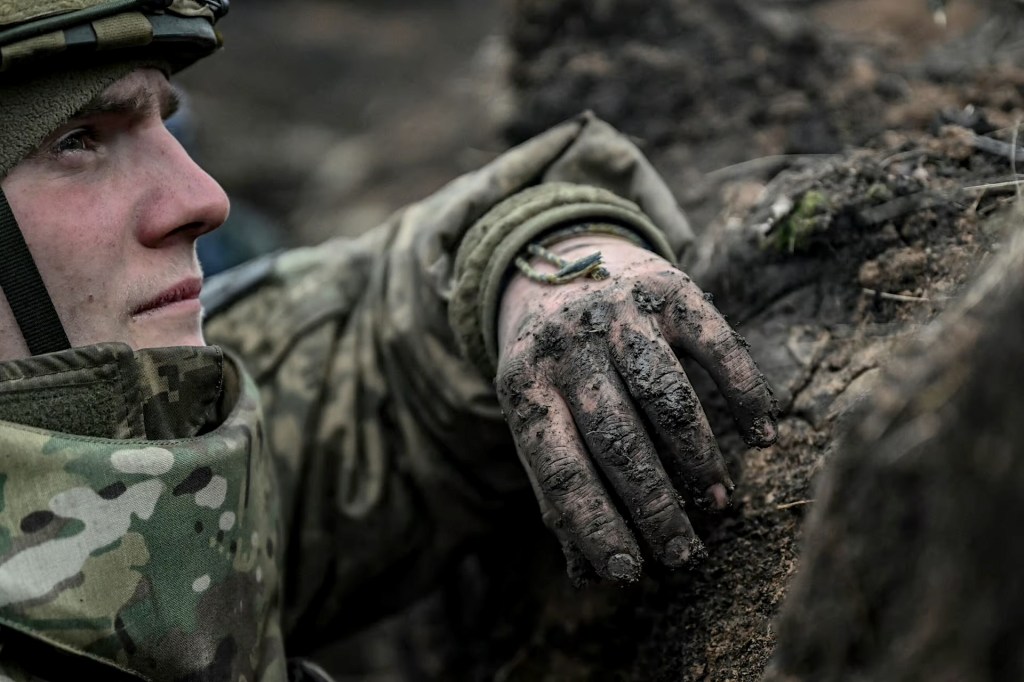
Photo: Ukrainian soldier during the battle for the city of Avdiivka, which fell to Russia in February 2024. Credit: Aris Messinis/AFP via Getty Images.
Everyone Has a Manifesto Now

Today marks the fourth anniversary of one of the darkest days in US history, the violent invasion of the US Capitol and attack on Congress fomented by Donald Trump as part of his attempt to hold onto power after losing a free and fair election. If I had told you on that day that the American people would return the architect of that travesty to the Oval Office, would you have believed me?

Within just a few months, the GOP and even Trump himself went from calling it a “heinous attack” and declaring that “the demonstrators who infiltrated the Capitol have defiled the seat of American democracy” (Trump’s own words, in an address to the nation the next day) to excusing and even celebrating its perpetrators. That is because Trump soon realized that by inverting the narrative, he could help propel himself back into power. And he was right.

In other words, as many have observed, that auto-coup ultimately succeeded, even if it took four years to do so.

Two weeks from today, when Trump is inaugurated for a second term, he may well make good on his promise to pardon those insurrectionists. Can a parade for them down Pennsylvania Avenue at taxpayer expense be far behind? In the current political climate, as Matthew Yglesias cannily noted, even the suggestion that January 6th was in any way “bad” is cause for excommunication from the cult of personality that is the modern Republican Party. And that does not bode well for what will happen in his second term, to say the least.

But I am not here today to write about that, as many others have done so very eloquently. I am here to contemplate what the immediate future holds, and to do that, I want to focus on one recent incident and what it tells us about the current moment.

ALL IS QUIET ON NEW YEAR’S DAY (NOT)

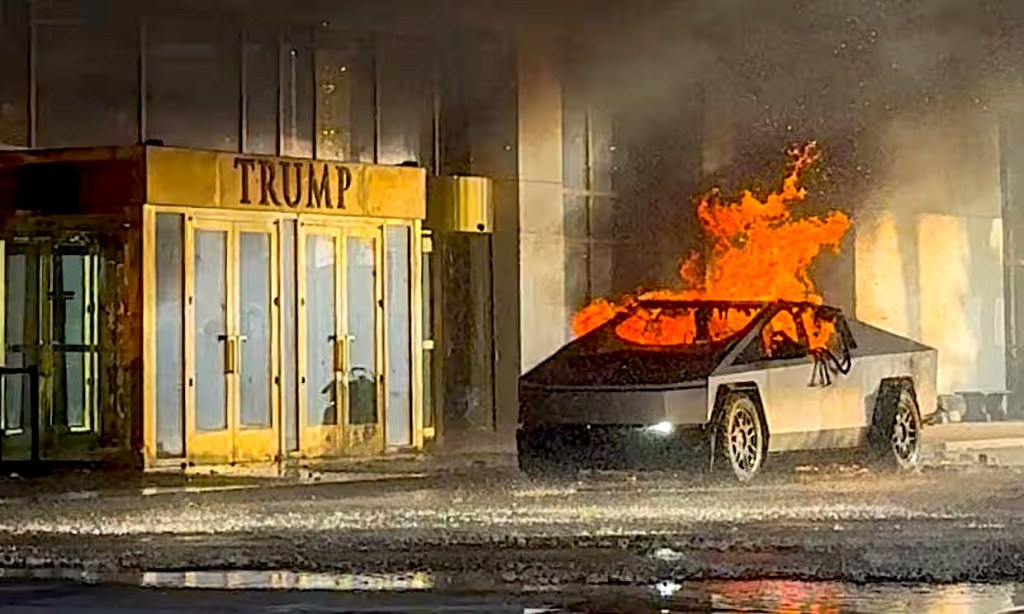
A few weeks ago in these pages, I wrote about the rising tide of political violence in the United States, spurred by the cold-blooded murder of United HealthCare CEO Brian Thompson on a street in midtown Manhattan, and the disturbing public response that lionized the killer as a folk hero. In the two weeks since then, that tide has only increased. In December, the FBI arrested a man in Norfolk, Virginia who had more than 150 pipe bombs and other field-expedient explosive devices, by some accounts the largest stockpile of homemade explosives ever seized in the US. A deadly vehicular attack in New Orleans by a radicalized veteran inspired by ISIS killed fourteen people on New Year’s Day. On that same day, a Tesla Cybertruck packed with explosives was detonated outside the Trump International Hotel in Las Vegas.

Of all these, the Vegas bombing piqued my interest the most.

The man behind that attack was an active duty Special Forces master sergeant named Matthew Livelsberger, assigned to the 1st Battalion 10th SF Group in Stuttgart, Germany. He was a veteran of multiple combat tours in Afghanistan, well-liked and professionally respected by his fellow Green Berets, and a vocal supporter of Donald Trump.

The pattern of veterans bringing the violence of war back home—and of mass murder using the weapons of war like battlefield rifles and car bombs—is largely a post-Vietnam phenomenon, and not unrelated, the writer Roxanne Dunbar-Ortiz has long argued, to the application of violence by the state on foreign enemies. (And increasingly, domestic ones too.)

Livelsberger reportedly struggled with mental health issues related to his multiple deployments (including headaches, sleeplessness, depression, and other symptoms of PTSD), as well as hearing loss, and possibly neurological damage from years of hard parachute landings and exposure to weapons blasts. That shit is no joke. The press reports that his wife had also left him just days before he killed himself, right after Christmas, taking their infant daughter with her.

I have personal reasons for disliking the cliché of the troubled, homicidal vet, but when the combat boot fits….

I’m here to tell you that once those factors are in play, all bets are off. But Livelsberger’s military history is far from exculpatory when it comes to the political aspect of this tragedy. In fact, it only make the role of politics even stronger, marking him as yet another casualty of a previous Republican administration that sent thousands of American troops into harm’s way for a lie.

MUNICH ON THE POTOMAC

In a 400-word missive found on his cell phone in the wreckage of the detonated Tesla, Livelsberger left some clues to his motives, which speak not only to his mindset, but to the political waters in which he and so many others—the majority of whom are not grizzled professional warriors like him—bathe.

Most of it was straight-up, tiresome-by-now Fox News talking points attacking feminism, DEI, and the decline of “family values”; chauvinistic ranting about how America is greatest country on Earth; and a bemoaning of our imminent societal collapse due to liberalism, etc. He took a swipe at Kamala for being the beneficiary of affirmative action, instead of “a real President” like Trump (who totally got no help from anyone, as the white male son of a multimillionaire) and lamented the general lack of “respect for others” in our contemporary culture, even as he supported a politician who is the poster boy for that kind of vulgar disrespect.

That is all part of the anti-government mentality that the American right has been relentlessly propagating since the New Deal. Really, one can take it back to Reconstruction, or even to the dynamics that led to the Civil War itself. As Heather Cox Richardson writes:

Livelsberger’s notes reflect not reality but rather the political rhetoric in which many Americans have marinated since the 1950s: the idea that a government that regulates business, provides a basic social safety net, promotes infrastructure, and protects civil rights crushes the individualism on which America depends.

There was the predictable machismo and sexism. “Focus on strength and winning,” he wrote. “Masculinity is good and men must be leaders. Strength is a deterrent and fear is the product,” He noted that “(o)ur population is too fat to join the military yet we are facing a war with China, Russia, North Korea and Iran before 2030.” (Link mine. See also here.)

Two of the most surprising lines, for me were: “The income inequality in this country and cost-of-living is outrageous,” and “Greed and gluttony has consumed us. The top 1% decided long ago they weren’t going to bring everyone else with them. You are cattle to them.” Dangerously close to Marxist class warfare, no? Of course, he went on to suggest that the best solution would be to turn the government over to two billionaires.

But needless to say, that sort of ass-backwards thinking is commonplace on the right, a measure of how successfully the Barnumesque long con of trickle down economics and faux populism has been perpetrated on so much of the country. (Livelsberger also lamented “self enrichment perpetuated by our senior political and military leaders. We are done with the blatant corruption.” Who’s going to tell him?)

In a more poignant moment, he indicted himself for succumbing to that materialist mindset, writing: “I am a prime example of having it all but it never being enough.” He also cited some more traditional PTSD-driven motives, declaring, “Our soldiers are done fighting wars without end states or clear objectives,” and writing of the bombing he was about to commit: “Why did I personally do it now? I needed to cleanse my mind of the brothers I’ve lost and relieve myself of the burden of the lives I took.”

But amid the self-reflection, there was a much uglier side as well. CNN reports that investigators also released a second, shorter letter also found on his phone, in which Livelsberger proposed a scheme of maneuver for the violent obliteration of Trump’s opponents by way of “saving” America:

Occupy every major road along fed buildings and the campus of fed buildings by the hundreds of thousands. Lock the highways around down with semis right after everybody gets in. Hold until the purge is complete. Try peaceful means first, but be prepared to fight to get the Dems out of the fed government and military by any means necessary. They all must go and a hard reset must occur for our country to avoid collapse.

While he was enthusiastic about using of violence at home, Sergeant Livelsberger was far less keen on using it abroad, which is weird since that was his job. The very first point he made in his list of prescriptions for how to fix America was: “We must end the war in Ukraine with negotiated settlement. It is the only way.”

What the fuck, over?

This is not a sort of coolheaded, sophisticated realpolitik that recognizes the limits of military force as a tool of policy. It is craven, Kremlin-abetting surrender to brutal aggression: the kind of thing that American conservatives once abhorred and derided. (I’m speaking of the right’s longtime hawkish majority, not its isolationist minority.) Once upon a time, Republicans and other conservatives sneered at that mentality. Appeasement, they called it! For decades, in virtually any international crisis, the specter of Chamberlain and Munich was recklessly invoked whenever a politician, journalist, or other figure dared suggest that maybe going to war was not the best idea. But no more.

And coming from a professional soldier, a veteran NCO from 10th Group no less, whose geographic area of concentration is Europe, it’s especially distasteful. The SF motto is De oppresso liber: to free the oppressed. But I guess I missed the fine print that reads, “Except when Putin and Trump aren’t cool with it.”

It’s true that a negotiated solution may be the ultimate outcome in Ukraine, but not because it’s the just and honorable thing to do. The strong take what they will and the poor into endure they must, not to get too Peloponnesian about it. With Trump headed back to the White House and Putin doing cartwheels in hall of the Kremlin as a result, Volodymyr Zelinskyy is considering the best possible deal he can get as his country when facing the obliteration of his country full stop at the hands of Moscow, with Washington’s groveling assistance. For an American warrior to applaud that is appalling. But that is now the Kremlin-driven party line of the erstwhile GOP, as propagated by Putin’s allies at Fox News and the rest of the right wing mediasphere.

MANIFEST DESTINY

So when does a suicide note cross the line into “manifesto”? Livelsberger’s writings are really the former, Luigi Mangione’s self-consciously the latter. But these days any sort of epistle connected to an act of political violence feels like it’s in that category. (Ted Kaczynski’s 75 page screed remains the GOAT, and the model.)

And some of Livelsberger’s musings do sound positively Unabomber-ish. (“A lot of us are just sitting around waiting to die. No sunlight, no steps, no fresh air, no hope. Our children are addicted to screens by the age of two. We are filling our bodies with processed foods.”) There’s also a whiff of Colonel Kurtz-like dictation, harkening back to a fictional Green Beret.

In closing, Livelsberger wrote: “This was not a terrorist attack, it was a wake up call. Americans only pay attention to spectacles and violence. What better way to get my point across than a stunt with fireworks and explosives?” Well, that’s the Fanonist argument that all terrorists make, isn’t it? In Resisting the Right, I make the case that we need to start viewing the American epidemic of mass murders—particularly with firearms, but extending to weapons like cars as well—not as the random acts of disconnected lone wolves, but as part of an ongoing white nationalist insurgency. His car bombing puts a fine point on it.

But even as political theater—which terrorism is a subset of—the act itself made no more sense than the manifesto. If you’re pro-Trump and pro-Musk, why use the latter’s car as the bomb you set off in front of the former’s hotel? Why not a Prius detonated in front of headquarters of the National Organization for Women? (Bizarrely, Livelsberger himself referred to what he was about to do as “a stunt with fireworks and explosives.”)

His closing lines are less Fanon than just standard right wing nutjob:

Consider this last sunset of ’24 and my actions the end of our sickness and a new chapter of health for our people. Rally around the Trump, Musk, Kennedy, and ride this wave to the highest hegemony for all Americans! We are second to no one.

I say all these things not to dunk on Master Sergeant Livelsberger—nil nisi bonum and all that. He committed a terrible act, and took his own life in the process; fortunately no one else was killed, though that was very much a matter of luck. It might easily have gone the other way. (As it was, seven innocent people were injured.)

Even though I have deep contempt for the man’s political views, I have deep respect for his service to the country and the sacrifices that service entailed. Is it unfair and hypocritical that he gets that consideration from me when I do not extend it to so many other perpetrators of psychopathic acts of violence? I suppose it is. But he’s from my tribe, and I take those extenuating factors into account for a man who was obviously unwell, in part because of what our country asked of him, and what he did for it.

But that is not to excuse a political belief system that has already caused untold suffering, and promises to do much worse in the next few years. On the contrary: he was a terrible case study in it.  

FRANKLY, SCARLET

Unlike the late MSG Livelsberger, most Republicans do not have the excuse of a brain injury to account for their nonsensical, neo-fascist beliefs, or for perpetrating violence to further them. But the Orwellian indoctrination that consumed Matt Livelsberger is the same process that Trump and his allies perpetrated on half the country in turning January 6th inside out.

Three days after the Insurrection, I wrote in this blog that if no reckoning was forthcoming for what happened that day and for Trump’s pressure campaign that led up to it, those events “won’t be a low watermark. They will only be a prelude.” 

That piece was called “Will There Be a Reckoning….or a Repeat?”  Now we know.

Let’s also recall what a slightly higher profile thinker, Paul Krugman, wrote at the time:

If you imagine that the people who stormed the Capitol will just go away once Biden is installed in the White House, you’re delusional.

It’s time to stop appeasing the fascists among us…..there needs to be an accounting for whatever crimes took place during the past four years—and does anyone doubt that Trump allies and associates engaged in criminal acts? Don’t say that we should look forward, not back; accountability for past actions will be crucial if we want the future to be better. Appeasement is what got us to where we are. It has to stop, now.

There’s that scarlet letter “A” word yet again. Trump supporters continue to plump for Chamberlain-like deference toward Moscow, even as we collectively offer the same to them for their sins. And now their man is about to be back in power, with more violence sure to come.

********

Photo: Not a publicity still from a dystopian science fiction movie. A Tesla Cybertruck packed with explosives, on fire outside the Trump International Hotel in Las Vegas, after being detonated by a suicidal Trump supporter, New Year’s Day, 2025.

The Siren Song of Violence

Consequence Forum is an online literary magazine that, in its own words, “addresses the consequences, realities, and experiences of war and geopolitical violence through literature, art, and community events.” CF provides “the public with works and voices from around the world to promote a clearer and more nuanced understanding of what’s at stake in choosing to wage war or engage in conflict.”

In the words of Hal David, that is certainly what the world needs now.

It was my pleasure to have a piece there a few weeks ago, on the heels of some previous work over the past couple of years. What follows is a slightly expanded version of that new essay. Thank you to Consequence’s Executive Editor Matthew Krajniak and to my dear friend Alexandra Marshall for putting us together.

*********

The Siren Song of Violence

As we speak, two major land wars are raging in the world, involving two of the most powerful militaries on the planet, with vast assistance from even more powerful players abroad. The level of violence and human suffering is on a scale above and beyond even the already bloodsoaked baseline of the late 20th and early 21st centuries—what we typically call the postwar period. The name is proving a tragic misnomer.

The repercussions of each of these two wars, let alone the two taken together, promise to be so tectonic that they will reshape geopolitics for decades to come. Zhou Enlai-like, it is far too early even to begin to contemplate their long term consequences. But this much we can say with confidence: They have lowered the public’s threshold for the use of force as a tool of statecraft, and prompted a disturbing uptick in self-righteous, even fanatical cheerleading for killing people in pursuit of political ends.

For American observers, the war in Ukraine reignited a World War II-style righteous passion for the use military force that had largely lain dormant since the fall of Berlin. Certainly in the ensuing 79 years there had been idealistic fervor aplenty for using violence to advance the cause of democracy—to a fault, some would say, be it the starry-eyed naivete of progressivism or the self-deluding rationalization of neoconservatism—and often as cover for less noble goals. But brazen Russian aggression against Kyiv had even old hippies waxing poetic about the bravery of the Ukrainian army, adorning their windows and blue-and-yellow flags, and ending their Facebook posts with Slava Ukraini!

They were not wrong. Who could begrudge the Ukrainian people the right to self-defense against a ravenous, bullying neighbor, led by a monstrous despot? Only resort to the force of arms could defend the country, even as the craven, pro-autocratic Trumpist GOP continues to do its level best to stand on Zelenskyy’s neck and prevent that from happening.

But even among Ukraine’s American supporters, that sense of gung ho has noticeably dimmed as the war has grinded on, and the romance of blackening Putin’s eye (remember the sinking of the Moskva?) has given way to the monochromatic tedium of warfare of a nearly Great War variety. Even the proliferation of combat porn on Reddit has grown repetitive. That our solidarity with the Ukrainian people proved so flimsy did not reflect well on the self-flattering fervor of its early days.

The rise of other high-profile conflicts have also intervened—one in particular—eclipsing the sense of Ukraine as a once-in-a-lifetime global conflagration.

For sheer complexity and unyielding, often blind fervor by the two sides, the war in Gaza is surely the most Gordian political crisis of any of our lifetimes. (The Cuban missile crisis still retains the crown for most dangerous, but it lasted only thirteen days.) In the US, it has scrambled old allegiances, created odd new political bedfellows, and even thrown a highly unpredictable new element into the presidential campaign. Among its most disturbing aspects, many supporters both of Israel and of the Palestinian cause show a remarkable lack of empathy for the suffering of anyone but their own…..and that is true not only of the extremists, but of people who heretofore have been widely considered moderates.

Imagine a group of people filled with righteous anger over the injustices they have suffered. Their legitimate pain and frustration and fury is so great that they have come to believe that anything they do in retaliation is justified, to include the most terrible acts of barbarity against innocent non-combatants, little children among them. These people are quick to cite sophisticated intellectual doctrines and theories to support such action, some of which have the imprimatur of the most highbrow, moral thinkers. But the blood that is shed is just as red.

Imagine now that both parties feel this way. Imagine the rest of the world looking on and taking sides, often without a thorough and nuanced understanding of this ancient and byzantine situation.

In purely practical terms, it would have been unrealistic to expect that Israel would not respond militarily to the attack of October 7, and unreasonable to expect that it should not. The contours and duration of that response, however, are a different matter. It was not hard to predict that an overreaction by the Netanyahu government would ensue. In fact, that was surely one of Hamas’s chief goals, and it’s impossible dispute that it succeeded on that count.

Historically, young people—college students especially—have been passionate about protesting human rights abuses. For their trouble, they are frequently scorned by older generations as disproportionately idealistic, uninformed, and immature. Some of that criticism is on the mark, some not. But notwithstanding those qualifiers, just as frequently, those young people prove to have been remarkably correct. At the same time, righteous anger has frequently tipped into apologia for atrocities committed by one’s own side (adopted or otherwise). We have heard the repetition of slogans that the chanters don’t begin to understand, and the name Nat Turner evoked, and comparisons to the Vietnam-era student left, along with debates over whether such activism helps or hurts the cause, and the presidential candidates it might inadvertently elect or defeat. For idealistic and aggrieved young people especially, a Fanonist belief that revolutionary violence is justified, even required is romantic, and intoxicating….and wildly dangerous.

But maybe even Fanon is too tame. Perhaps we are in Robespierre territory.

On the other side of the divide, enthusiasm for an all-but-unrestrained response by the Netanyahu government has gripped a large section of America, cutting across traditional ideological lines. Once reliably liberal American Jews have been heard to comment on how Fox News actually makes a lot of sense. Irrationally, they have allied themselves with the far right wing of American politics—which is to say, the mainstream of the Republican Party—whose affection for Israel is transactional at best, given its simultaneous embrace of neo-Nazis. Jewish Americans who have been critical of Israel haven been vilified by some in their own community, as a vast paradigm shift is underway in both progressivism and American Jewry at large.

Across the board and irrespective of stance on Gaza, many of us have all found old friendships strained and once civil discourse turned into angry recriminations. We have been surprised by the intransigent, doctrinaire views of people we thought we knew, or with whom we presumed to have a shared worldview and set of values. Even Jerry Seinfeld, as apolitical and proudly anti-substantial an entertainer as any in the modern era, has suddenly had an ideological awakening—or alternatively, chosen to voice his political opinions for the first time—and taken significant heat for it. Even the mildest and most anodyne observation can barely be offered these days without giving offense to someone, let alone a stronger opinion—which has not stopped very many people from offering them, with varying commands of the facts.

But what is most disturbing is the casual advocacy for the use of violence, and half-baked ethical justification for it.

Without wading into a doctoral thesis-length discussion of moral philosophy, generally speaking, most people would instinctively agree that there are acts that are beyond the pale, even in a just war. That is why we have the very term “war crime.” But we need not drag morality into it. Whether one supports it or condemns it, Benjamin Netanyahu’s military campaign in Gaza is exposing the persistent delusion that force can solve all problems, and exposing the limits of violence as a tool of national policy. That is a simple matter of pragmatic reality separate from any moral considerations of who is right and wrong. (As if the thorniest geopolitical problem of the postwar era could be broken down into such Manichean terms.) Yet some of Netanyahu’s fiercest critics simultaneously hew to a celebration of force and violence on behalf of the other side that is just as terrible.

Ukraine provided an almost unicorn-rare example of a conflict the cleaved neatly into good and evil, as the naked aggression of one side contrasted so starkly with the valor of the other. Apart from a small—but politically powerful—pro-autocratic faction of Americans that lionizes Putin, overlapping with a miniscule group of no-exceptions isolationists, and a handful of reflexively contrarian elements, it was easy to swell with vicarious passion for the outgunned, beleaguered Ukrainian underdogs. (Unless you’re a Republican.) Almost too easy. As if made to order, the war in Gaza offered a diametrically opposed counterexample, as complicated and morally gray as possible. Yet even that assertion of grayness will rankle some, both pro-Israel and pro-Palestinian, who point to the ghastliness of their antagonist’s actions, eliding those of their own, which only proves the complexity. Even my comment that hackles will be raised is itself likely to raise hackles. The rabbit hole is very deep.

Even calling what’s going on in Gaza a “war” is controversial. It is certainly an armed conflict between two military forces, albeit a highly asymmetrical one. Some will say that October 7 can only be characterized as an act of terrorism, undeserving of designation as a military operation, which lends it undue legitimacy. Likewise, the operational imbalance of the response, and its attendant, near-apocalyptic destruction, felt most painfully by the civilian populace, has led some to argue that a word like “massacre” is more descriptive of ongoing events than “war.”

Both arguments have some semantic merit, but both ignore the quasi-Clausewitzean understanding of war as the infliction of pain to force submission to a desired political end. Everything else is just arguing with the refs. But both Ukraine and Gaza ought to remind us that that technique does not always work, and that a self-congratulatory ruthlessness, even born of a legitimate grievance, cannot justify slaughter without quarter, by anyone, state actor or non.

Even under the best of circumstances, mankind is remarkably quick to reach for the weapons of war…..and we are currently not operating in the best of circumstances. The siren song of violence is at high volume at the moment, loudest of all in places far from harm’s way, where the human toll of the violence is very abstract and distant, where tribal allegiances—as real and as deeply felt as they are—nevertheless feel like those of passionate supporters at a spectator sport. When we calculate the casualties of the Gaza crisis, first and foremost are the very real ones, in flesh and blood. But another more abstract casualty has been the loss of perspective—and humanity—among those observing from the safety and comfort of home.

*********

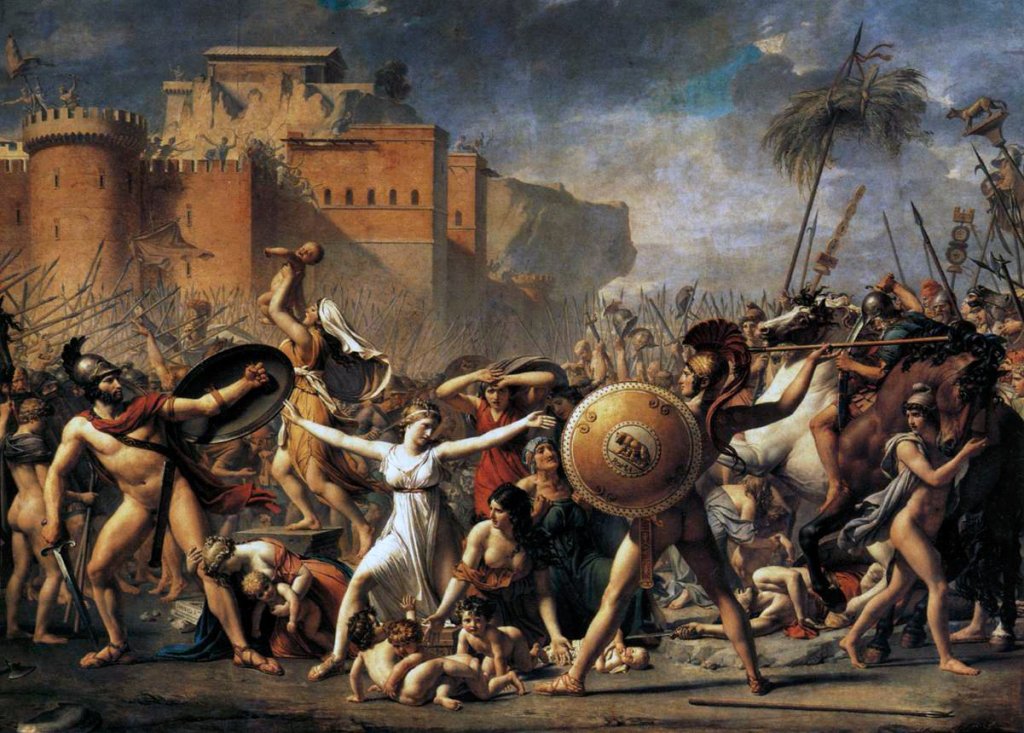
Illustration: The Intervention of the Sabine Women, Jacques-Louis David, 1799