
The Republicans’ Reverse Robin Hoodery

Hey, remember all those stories about how Republicans, led by President-for-Life Donald Trump, were considering raising taxes on the rich? For the past few months the MSM has been full of them, eagerly pushed by the GOP itself. (You can read three of them here, here and here.)

But anyone with even the brains of Ray Bolger’s Scarecrow could have told you that those stories were utter bullshit, mere misdirection ahead of what we all knew was coming, and just this Thursday, did.

In the wee pre-dawn hours of May 22, when almost no one was watching, the GOP-controlled House rammed through a sweeping piece of legislation called—and as Dave Barry likes to say, I Swear I Am Not Making This Up—the One Big, Beautiful Bill. The vote was a whisker-thin 215-214 with every Democrat voting against, joined by two renegade Republicans (Reps. Thomas Massie of Kentucky and Warren Davidson of Ohio), plus one voting “present” and two AWOL altogether, including one who fell asleep.

Does the bill raise taxes on the rich? Hell no. On the contrary, it makes permanent the massive 2017 tax cuts from Trump’s first administration, which otherwise would have expired this year, and which overwhelmingly benefit the richest Americans and corporations. At the same time, it sadistically guts programs that tens of millions of ordinary Americans rely on, like Medicare, not to mention nutrition programs for poor children, funding for cancer research, FEMA, and many other long-standing and invaluable government services.

So the notion that Trump and the Republicans would not do that, and might even raise the share of our collective tax burden that the wealthy bear, has proven to be so much smoke-and-mirrors. (I’m shocked!) Can’t blame them for trying, though: that sort of trick has worked pretty well for them so far.

The other thing that ought to be patently clear is that the Trump-led Republican Party is a truly reprehensible organization, and has just carried out one of the most shameless con jobs in postwar American history, one that represents a fundamental shift in what this country aims to be.

THE PRIME DIRECTIVE

What happened this week—and will be completed when the Republican-controlled Senate inevitably passes some similar version of the “OBBB,” ahead of reconciliation between the two chambers—was the culmination of the entire effort to put Donald Trump back in office. Indeed, it is the whole reason that Donald Trump was elected in the first place. As Jonathan Chait writes in The Atlantic, if enacted, this “massive piece of legislation” would represent “the largest upward transfer of wealth in American history.” And that “is not a side effect of the legislation, but its central purpose.”

From the very start of his political career, this has been the chief goal of the GOP in supporting Turmp™ and represents the only thing that party really stands for: increasing the wealth of its richest members. It’s also a big fat middle finger to the rest of us, including those tens of millions of Americans who believed the GOP propaganda and voted against their own self-interest by supporting Donald and the Republican Party.

As a previous Republican president once said, “Fool me once….shame on….can’t get fooled again.”

Or maybe that was Pete Townshend. The early 21st century is a little fuzzy for me.

Yes, I understand very well that there was and is an unholy alliance between the GOP’s plutocratic faction, which represents its old school base, and the so-called “populist” MAGA wing, which is animated less by stock portfolios than by white nationalist grievance, xenophobia, and a desire to punish everyone they despise, which includes immigrants, Brown and Black people in general, the LGBTQ+ community, liberals, women, Springsteen, etc.

But the plutocrats ultimately are the more important partner in that coalition because they are the ones with the money. It’s true that a some of those plutocrats share those retrograde MAGA opinions on social issues, but many don’t, and many others just don’t care one way or the other. At the end of the day they’re motivated only by the bottom line, and that is precisely what was in play this week with the House budget. As we saw in the H1B visa fight between the Bannonite and Muskovite factions even before Trump was re-inaugurated, the rich guys usually get what they want.

The plutocrat wing of the Republican Party got behind Donald Trump specifically because he would deliver to them the permanent tax cuts for the wealthy that are their prime directive. Everything else—abortion, guns, homophobia, vaccines, deportations—is what apostate GOP staffer Mike Lofgren calls “rube bait.”

MIKE JOHNSON AND HIS MERRY MEN

The other thing worth noting is how this armed robbery flies in the face of Republicans’ longstanding claim to be “the party of fiscal responsibility.”

In the past, this blog has discussed the shameless hypocrisy of the GOP’s so-called “deficit hawks,” who regularly scream bloody murder over what they claim is the impending collapse of these United States because of the deficit…..but only under Democratic administrations. When they are the ones in power, they are as reckless with the taxpayers’ money as a drunken sailor on shore leave in Hamburg.

Non-partisan experts estimate that Trump’s 2017 tax cut added some $7 trillion to the federal deficit; those experts now estimate that this new bill will add another $4 trillion over the next decade. (Some estimates are higher.) In a feeble attempt to pay for these cuts, the new budget bill slashes funding for Medicaid, which provides healthcare for poor and disabled Americans, and adds new work requirements for its remaining recipients (you, lazy cripples!), as well as for people receiving aid from SNAP, the Supplemental Nutrition Assistance Program, commonly known as food stamps. But those requirements are really just a mechanism for booting people off the program. As The Guardian’s Chris Stein writes:

The Urban Institute thinktank, based on an analysis of a similar policy, believes those (requirements) would cost as many as 5.2 million people their health insurance coverage, largely because of enrollees not understanding the requirement or being unable to prove their compliance. People who depend on the Supplemental Nutrition Assistance Program (SNAP), which helps pay for groceries and other essentials, would also face work requirements beginning in October 2027. The left-leaning Center on Budget and Policy Priorities estimates those would put about a quarter of SNAP recipients, or nearly 11 million people, at risk of losing their benefits.

The GOP bill cuts Medicare by about $500 billion, and is expected to cause at least 8.6 million Americans to lose their Medicaid coverage. According to the historian Heather Cox Richardson, “Cuts of about 30% to the Supplemental Nutrition Assistance Program would be ‘the biggest cut in the program’s history,’ Ty Jones Cox, vice president for food assistance policy at the Center on Budget and Policy Priorities, told Lorie Konish of CNBC. They would cut about $300 billion from the program through 2034. More than 40 million people, including children, seniors, and adults with disabilities, receive food assistance.”

This is truly a case of reverse Robin Hoodery. (Watch your lupins, people.)

Carl Davis, research director for the Institute on Taxation and Economic Policy, writes:

The Congressional Budget Office recently predicted that the bill would put the nation on a path toward a future where 13.7 million fewer people would have health coverage. Of that amount, 8.6 million would lose coverage as a direct result of provisions contained in the bill, especially those slashing Medicaid. Another 5.1 million would lose coverage because of the expiration of temporary enhancements to the Affordable Care Act premium tax credits which, contrary to what we have seen in past Congresses, this current Congress appears to have no interest in making room for in its legislation.

The Republicans’ response, Jonathan Chait explains, “is to fall back on wordplay, pretending that their scheme of imposing complex work requirements, which are designed to cull eligible recipients who cannot navigate the paperwork burden, will not throw people off the program—when that is precisely the effect they are counting on to produce the necessary savings.”

Not surprisingly, this is not what the American people want. Gallup reports that a large majority of Americans—58%, an all-time high—believe lower-income people pay too much in federal tax. By coincidence, the exact same share of respondents, 58%, believe rich people pay too little. (70% also believe corporations pay too little.)

Right wingers also want to cut those programs out of sheer cruelty, because the Horatio Alger myth on which their economic ideology depends requires a willfully blind adherence to the fantasy of bootstrapsism to rationalize it. This has always been the GOP’s ur-con, and with the OBBB they are trying to pull it yet again.

Some believe that the dynamic works this way round: that cutting taxes is a deliberate ploy to necessitate cutting spending—on social services; not on the Pentagon of course!—which is what really thrills the far right zealots. Personally I think that the plutocratic impulse for tax cuts for their own sake is the true driving factor, but in a way, it’s a chicken or the egg argument. The relationship within the right wing ecosystem is symbiotic irrespective of which way it flows.

Gifting the rich yet again while cutting crucial social services to the mass of Americans at large is plenty despicable even without taking the deficit into account, but Republican caterwauling about the deficit under Democratic administrations just adds to the outrage. This shit is so far beyond simple hypocrisy that the term no longer even applies.

But the point is that even those draconian cuts will not begin to make up for the lost tax revenue. In fact, as reported by Richardson, the GOP’s proposed budget is so egregious and damaging to the long-term interests of America’s economic health that in anticipation of it, Moody’s stripped the US of its coveted triple A rating, downgrading “US credit for the first time since 1917, following Fitch, which downgraded the US rating in 2023, and Standard & Poor’s, which did so back in 2011,” after Republican brinksmanship over the debt ceiling nearly triggered a default. In explaining its decision, Moody’s noted that if the 2017 tax cuts are extended, the federal deficit will widen, “reaching nearly 9% of GDP by 2035, up from 6.4% in 2024, driven mainly by increased interest payments on debt, rising entitlement spending and relatively low revenue generation.”

So much for Republicans’ self-proclaimed “fiscal responsibility,” so much for the lie that they won’t cut Medicaid, so much for everything except the stark reality that the Trumpist GOP is nothing more than a gang of rapacious assholes who intend to rob this country blind for their own benefit and that of their deep-pocketed patrons.

BAD TO THE BONE

So just how bad is this bill?

Using information on revenue cost and distribution by income level published by Congress’s Joint Committee on Taxation (JCT), ITEP’s Davis reports that the bill “would offer larger tax cuts as a share of income to high-income taxpayers than to either middle-class or working-class families. It also makes clear that most of the tax cuts would go to families with above-average incomes.”

What does that mean in hard numbers? According to Heather Cox Richardson, the nonpartisan Congressional Budget Office reported that Americans “in the top five percent of earners will see a tax cut of $117.2 billion, more than 20% of the tax cuts in the bill.” The highest earners, the top 0.1 percent of Americans, stand to save roughly $390,000 per year. By contrast, when both losses in benefits and  tax cuts are factored in, Americans making between $17,000 and $51,000 will lose about $700 a year. And the poorest Americans, those with annual incomes less than $17,000, will lose more than $1,000 per year on average.

Put another way, The Guardian’s Stein reports:

Taxpayers with the highest incomes will see their household resources increase by 4% in 2027 and 2% in 2033, largely due to the extended tax cuts. The poorest tax payers would see their resources drop by 4% in 2033, largely due to the downsized benefit programs, the (the non-partisan Congressional Budget Office) forecast.

If all that sounds to you like something its perpetrators might want to, you know, hide, you’d be right. (Taking food out of the mouths of hungry children so fat cats can deduct the cost of their yachts and vacation homes is usually bad politics, except in certain parts of ruby red America.)

“Most Americans are strongly opposed to all of these things, according to polls,” writes former Treasury Secretary Robert Reich, now a professor of public policy at UC Berkeley. But many Americans don’t know what’s in the bill.

That’s because of (1) distortions and cover-ups emanating from Trump and magnified by Fox News and other right-wing outlets; (2) a public that’s overwhelmed with the blitzkrieg of everything Trump is doing and can’t focus on this; (3) outright silencing of many in the media who fear retaliation from the Trump regime if they reveal things that Trump doesn’t want revealed.

The bill is so bad that even Obama weighed in on Facebook, saying:

Right now, Republicans in Congress are trying to push through a bill that would put millions of Americans at risk of losing their healthcare. They want to cut federal funding for Medicaid, take away tax credits that help more people afford coverage and raise costs for working-class families. That means some of the most vulnerable Americans—families, the elderly, folks with disabilities—won’t be able to get the lifesaving treatment, medication, or care they need. These are people you know. So let your voice be heard and reach out to your senators now to let them know how much this will impact you.

It’s curious that in this tax battle we haven’t heard much of the old argument that “these cuts will pay for themselves,” which may be a hopeful sign that that tedious canard has been put to rest at last. The fairy tale of trickle down (aka supply side) economics has been essential to the Republican project, as it presents a justification for the implicitly irrational idea that cutting taxes on the rich will help everyone—the claim that “a rising tide lifts all boats,” as yacht-friendly Republicans like to say. Sadly for those sailors, decades of evidence exposes trickle down as an absolute hoax, albeit an enduring one. In reality, the implementation of supply side economics that began with the Reagan administration has vastly exacerbated wealth inequality in the United States, and with it, had a deep perverting effect on our democracy.

Central to this comforting vision is the parallel right wing myth of “makers and takers,” with its undercurrent of racism, even though the American economic system is vastly skewed to perpetuate wealth rather than fostering social mobility. (As Pete Buttigieg quipped in 2020, if you want the much vaunted “American Dream” that we are consistently promised, move to Denmark. The US is a lowly 14th when it comes to social mobility.) Yet it is central to the world view of the wealthy that they earned everything they have, with no government assistance, when in fact the system is designed to benefit them and disadvantage others. No surprise: they run it.

But whether they try to explain it away with what George H.W. Bush once called “voodoo economics,” or by claiming that making poor children go hungry will do the trick, the fact is that the deficit is going to balloon—again—in order to give America’s richest citizens this early Christmas present. (Actually, for extra nauseating symbolism, Republicans are aiming to have the legislation on Trump’s desk for him to sign on the 4th of July.)

THIEVES IN THE NIGHT

It is madness that the Trump administration is ramming through this legislation, which a large majority of Americans oppose, including even its own supporters when presented with the idea in a blind taste test. But it’s not a surprise—it was right there in Project 2025, albeit presented in heavily camouflaged form during the presidential campaign, disguised as something that would benefit the mass of Americans.

Here’s a little insight into how well that gaslighting worked, from ITEP’s Carl Davis:

One of the more remarkable takeaways from the JCT’s revenue estimates is just how insignificant the tax provisions discussed most during the last presidential campaign—especially tax breaks for tips, overtime, car loan interest, and senior citizens—are in the broader context of this very large bill. These core features of the Trump campaign’s platform, which continue to dominate much of the debate over taxes today, come at a total cost of $293 billion. While that amount is not trivial, it equals just 3.8 percent of the $7.7 trillion gross tax cut being offered under this bill. The tax cuts being offered to businesses, by contrast, are more than four times larger.

The surreptitious way the GOP went about passing this bill betrays the party’s bad faith. Jonathan Chait again:

The minority party always complains that the majority is “jamming through” major legislation, however deliberate the process may be. (During the year-long debate over the Affordable Care Act, Republicans farcically bemoaned the “rushed” process that consumed months of public hearings.) In this case, however, the indictment is undeniable. The House cemented the bill’s majority support with a series of last-minute changes whose effects have not been digested. The Congressional Budget Office has not even had time to calculate how many millions of Americans would lose health insurance, nor by how many trillions of dollars the deficit would increase.

Just as Republicans know that the spending cuts in the new bill won’t offset the loss of revenue from these tax cuts for the wealthiest, they also know that once these cuts to Medicaid and other much very popular programs become known, it runs serious risk of ruining them at the ballot box come 2026 and 2028, no matter how hard they try to make people believe the Democrats are to blame. (Spoiler alert: they’re not.) That is why they have pushed the most painful repercussions of those cuts until after the 2028 election.

The members of the Republican majority, Chait writes, “are behaving not like traditional conservatives but like revolutionaries who, having seized power, believe they must smash up the old order as quickly as possible before the country recognizes what is happening.”

But as I’ve noted in previous blogs, it may not matter because the GOP doesn’t really intend to hold any free fair elections ever again. The fact that the Republican Party is taking pains to protect itself against well-deserved electoral blowback is actually a good sign, even as it’s despicable.

Then again, maybe it’s just that Congressional Republicans are not inside the central autocratic planning cell. Hopefully Mike Waltz can loop them into the Signal chat.

AND NOW A WORD FROM THE DEAR LEADER

With characteristic restraint and understatement, Trump wrote on Truth Social: “This is arguably the most significant piece of Legislation that will ever be signed in the History of our Country! Now, it’s time for our friends in the United States Senate to get to work, and send this Bill to my desk AS SOON AS POSSIBLE! There is no time to waste.”

(NB: The ALL CAPS are on brand, but you will never convince me that he used the word “arguably.”)

In The Times, Hugh Tomlinson reports Trump saying, “’This is the biggest tax cut in the history of our country … bigger than any Ronald Reagan tax cut.’ Asked what he would tell fiscal hawks in the party who want bigger spending cuts, Trump replied: ‘I’m a bigger fiscal hawk. There’s nobody like me’.”

In The Guardian, Stein has also written of the bizarre provisions that sunset these benefits when Trump leaves office. (If in fact he does.) The deductions meant as sweeteners for working families are “available only through 2028, meaning that when Trump finishes his term in January 2029, his tax relief will have expired.” The bill would “allow taxpayers to write off overtime, tips and the interest paid on loans for cars assembled in the US, in line with Trump’s campaign promises. Parents would see the child tax credit increase by $500, and be given the option of opening ‘Trump accounts’ to save money to help their children afford a home or schooling once they turn 18, into which the government would deposit $1,000……But once the year 2028 ends, so too do these deductions, as well as the government’s deposits into any Trump accounts and the increased child tax credit.”

In short, the OBBB is a poison pill for Trump’s successors, be they Democratic or Republican. Stein:

(T)he temporary deductions combined with the delayed start of the spending cuts will create a “fiscal cliff” for a future Congress and president, who will face pressure to stop or further delay what could be a politically toxic combination of policies….Cancelling the spending cuts and keeping the new deductions in place would cost $4.8tn, the CRFB forecasts—more than the government spent responding to the COVID pandemic.

Trump of course does not care, and his enablers in the GOP are happy with the short term win, and will worry about the future later. Ironically, it might be the only thing that makes he choose retirement over an attempt to serve a third term and deal with this mess.

And there’s some other weird shit in there too.

The bill includes funding for the southern border wall (hey, wasn’t Mexico supposed to pay for that?) and for the mass deportation program, and ends clean energy incentives passed during the Biden administration. Davis again:

The section of the bill titled “Make Rural America and Main Street Grow Again,” for example, includes everything from cutting taxes on multinational corporations’ offshore profits to repealing an excise tax on indoor tanning services. Similarly, the section titled “Make America Win Again” includes provisions as varied as scrapping tax credits that help homeowners purchase more energy efficient furnaces, significantly raising taxes on nonprofit foundations and colleges, and eliminating taxes on firearm silencers.

Another eyepopping provision buried in the bill strips the courts—including the Supreme Court—from enforcing citations of contempt, which effectively strips them of their powers full stop. The Trump administration and its allies never miss a chance to expand their powers, even when in the midst of a scam that would make Bernie Madoff blush.

#Multitasking

THE OLD DEAL

Ever since 1932, the reactionary faction in this country, led by the Grand Old Party, has been desperately trying to roll back the New Deal and return the country to an unregulated, Darwinian state of affairs in which them that have can do pretty much whatever the fuck they please and the rest of us can just suck on it. (That’s not how most historians and economists phrase it, but trust me—I was a history major—that’s the gist of it.)

The Reagan Revolution of 1980-88 and continuing into the Bush 41 administration was one enormous step in that direction. Now Trump has delivered the coup de grâce. The pain for the rest of us, and the transformation of the United States into a right wing shitshow, will play out over the coming decades.

I’m not an economist, but I did spend the last five years with my filmmaking partner Justin Schein working on Death & Taxes, a feature documentary about wealth inequality, which will be in theaters in July. That topic is wrapped in the story of Justin’s late father, who rose from poverty to become a highly successful record company CEO, but also obsessed with building his wealth and (legally) avoiding taxes. The film includes interviews with thinkers across the ideological spectrum, from Robert Reich, Nobel Prize winner Paul Krugman, MacArthur “Genius” Fellow Matthew Desmond, Roosevelt Institute CEO Felicia Wong, author Anand Giridharadas, New School economist Darrick Hamilton, progressive activist Chuck Collins, and ITEP Executive Director Amy Hanauer, among others on the left, to anti-tax maven Grover Norquist, GOP strategist Frank Luntz, and the Heritage Foundation’s Stephen Moore on the right. The battle they collectively describe over taxation makes it clear: taxes are at the very heart of what we conceive the role of government to be, the values we hold dear, how we direct strategic resources to support those values, and even the very core of how we define ourselves as a country.

Reasonable people acting in good faith can have reasonable disagreements about such issues. But that is not what is going on here. The Republican Party’s budget is a new low in Trumpian megalomania, shameless greed on behalf of the richest among us, and bald-faced lies to the American people, including their own supporters.

Is America great again yet?

**********

Illustration: Errol Flynn in The Adventures of Robin Hood (1938), from Warner Bros., directed by Michael Curtiz (who also helmed Casablanca) and William Keighley.

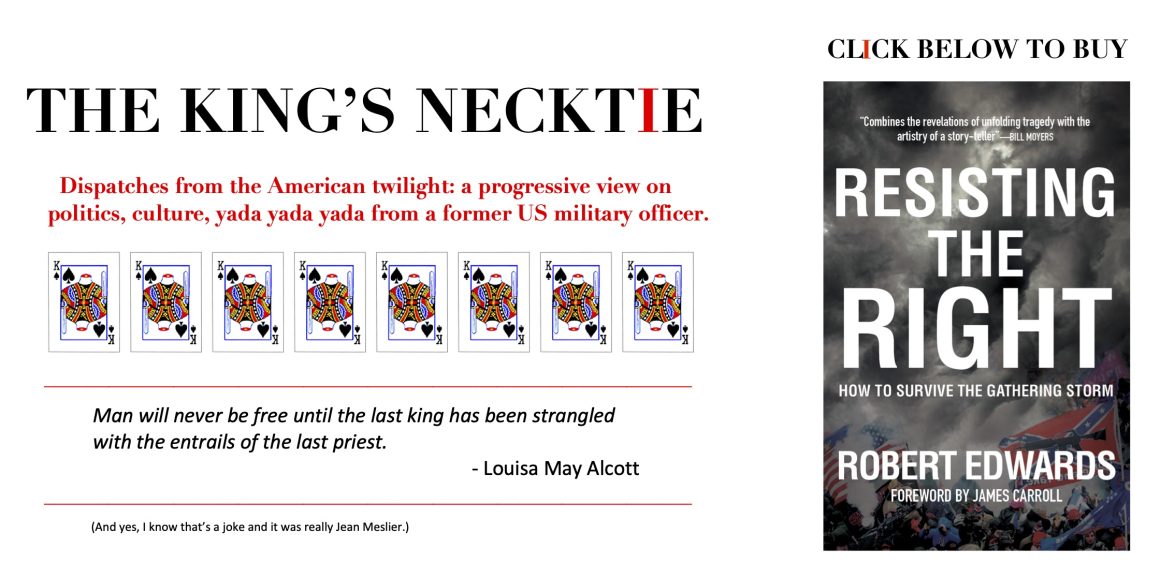
Resisting the Right: A Handbook

Writing this blog for the past seven years (but who’s counting?) has been a profound experience for me, and kept me from losing my mind during the madness of the Trump era and beyond. Nota bene: That madness is far from over. In fact, we’re heading into one of the most fraught phases of this ongoing existential crisis for American democracy.

Case in point, this week Trump called for Russia to attack our NATO allies, which prompted  headlines reading: “Biden is old.”

To that end, the blog also led me to write a book contemplating the worst case scenario of a return to power by The Former Guy and/or the Republican Party, which are now one in the same—a kind of handbook for resistance as we face down the very real threat of American fascism. That book, RESISTING THE RIGHT, to be published by OR Books, is now available for pre-order (click link here), and will ship early next month.

RESISTING THE RIGHT does not resign itself to defeatism or the alleged inevitability of a right wing triumph. Far from it. Rather, it lays out the state of the current crisis, how we came to this pretty pass, and what we can do to prevent the arrival of the autocracy that Trump promises. As a matter of simple prudence, it then looks ahead, not only to how to survive and resist a second Trump regime, but how to overcome it and reclaim participatory democracy in the USA. In the process, it contemplates not just restoring the status quo ante Trump, but ways we can actually make this country better, and build a true democracy that thus far has been largely aspirational for many.

November 5, 2024 is just nine short months away. It’s not hyperbole to say that if things go badly, it may be the last free and fair election we ever see. It’s up to us to prevent that, and to gird ourselves for what comes after. Like the man says, work for the best, but be prepared for the worst.

Here’s an excerpt from RESISTING THE RIGHT’S first chapter.

HOW TO TELL WHEN YOUR HOUSE IS ON F–KING FIRE

Historians have it easy compared to fortune tellers. With the luxury of time and hindsight, it’s relatively simple to connect the dots of what is past; why do we even hand out academic degrees for the people who do that? It’s harder to grasp the contours of events while they are unfolding—the task of journalists—and even harder to predict what will happen next—the task of prophets. But sometimes one finds oneself in such a state of eyepopping emergency that only the somnolent or willfully blind, or the gleeful perpetrators of that very emergency, can deny it.

We Americans are in such a moment right now.

The two-party system under which the United States has operated since roughly 1854 has its shortcomings, but for almost 170 years it has at least provided political stability, if not the best possible public service to the full spectrum of our citizenry. Its most glaring flaw—and inherent danger—becomes apparent, however, when one of those two parties openly rejects representative democracy. Over the past 55 years, and rapidly accelerating in the last seven, the Republican Party has abandoned any pretense of belief in democracy, representative or otherwise, engaging instead in an overt assault on the fundamental principles of the American experiment.

This assault is unprecedented in this country by a major political party, and one aimed at permanent control of these United States. Not two years ago, the undisputed leader of the erstwhile Grand Old Party fomented a violent self-coup in an attempt to overturn the results of a free and fair election. Far from repudiating that attack, the party has since embraced it, defending it as “legitimate political discourse,” lionizing its perpetrators, and alternately downplaying its violence or insisting it was a false flag operation—sometimes both at once.  More importantly, the party has also shielded the senior leaders of that autogolpe and used every available lever to thwart efforts at accountability, including aggressive manipulation of the courts and of Congress. When that has failed, it has turned to brazen defiance.

Even before Trump, the GOP was already engaged in a methodical, decades-long, and highly successful campaign to game the mechanisms of the electoral system to its advantage, through gerrymandering, voter suppression, obstructionist abuse of parliamentary procedure, and a flood of money, among other methods. But now that campaign has reached a chilling new level, as the party has successfully convinced a majority of its members, about 70%—about 30% of the electorate—that the last presidential election was stolen from its candidate. In the process, it has deliberately undermined public faith in the integrity of the election system, with terrifying implications for future votes.

To justify all this, the Republican Party has mounted a propaganda campaign that has swept up tens of millions of Americans who believe that all these measures are necessary, even heroic, in order to “take our country back.” Many of them have stated that they are unwilling to stop there, and would support violence to achieve their ends, if necessary.

As I write these words, the GOP is bluntly announcing that it will not accept the results of future elections unless it wins. Having failed at overturning an election in 2020, it has set about taking control of the electoral process upstream so that no such drama will be necessary in the future, a kind of pre-emptive putsch of an even more insidious order, enabling it to deliver victories to its candidates regardless of the will of the people. Under the Orwellian pretext of preserving “electoral integrity,” it is instituting restrictive new rules for voting, and intimidating election officials in order to replace them with Republican loyalists empowered to reject ballots, turn away voters, and otherwise skew the results. It is full of officials at all levels who refuse to acknowledge that Joe Biden is the rightful president and who refuse to commit in advance to respecting the results of their own elections. To that end, the party is very deliberately focusing on offices that control the vote itself—governors and secretaries of state in particular—as well as members of Congress who might have the final say in any disputes, and the judges who would adjudicate those disputes, including a Supreme Court where it already holds a 6-3 supermajority.

The Republican willingness to go to such extremes is driven by its own existential dilemma, which is a kind of terminal diagnosis. Even as the number of our fellow Americans who are comfortable with right wing radicalism remains alarming, demographics are trending heavily against them. The researcher David Atkins, who runs the qualitative research firm The Pollux Group, reports that “the country is becoming more diverse and more urban every day. Americans under 40 are overwhelmingly progressive. This is the present and future of America.” Unable to win the popular vote in a presidential election (Republicans have done so only once in the last eight elections), and with these trends moving inexorably against them, the GOP has only two options:

1) Change its platform to attract more voters, or

2) Cheat.

No one who has observed the GOP’s wanton lack of principle over the past decades ought to be surprised that it has chosen Door Number 2.

In a free society, reasonable people can disagree and advocate for their positions in the marketplace of ideas using legitimate political discourse that does not involve bear spray. But once free elections have been compromised, and the citizenry no longer has recourse to the vote in a credible way, that society is in a state of dire emergency. “A democracy can survive intense policy disagreements over taxes, government benefits, abortion, affirmative action and more, “ as The New York Times’s David Leonhardt writes. “But if the true winner of a major election is prevented from taking office, a country is not really a democracy anymore.”

BULLET-DODGING AS A WAY OF LIFE

Is it really that bad, you ask? After all, the 2022 midterms were widely seen as a repudiation of Trump and Trumpism, an announcement that Americans were tired of the circus, tired of the politics of grievance and divisiveness and incivility, tired of waking up every morning asking “What fresh hell?”

It is true that the electorate turned back Big Lie candidates up and down the ballot in almost every major race. Even Doug Heye, a veteran Republican strategist, told Fox News that “The MyPillow-ization of the GOP has been a disaster.” One might think such a result might even spur self-reflection within the Republican Party itself. But it did not.

Did anyone really believe that the epic thumping that the GOP took would cause it to come to its senses? As Tom Hall of the political blog The Back Row Manifesto asked, would Republicans really be “chastened into good governance and policies and tack to the center”? On the contrary: even as it was made abundantly clear that the American public by and large does not want Trumpist candidates, the seditionist faction of the GOP will exert even more power going forward, because the so-called “normie” branch of the party made a Faustian bargain with them from which it cannot extricate itself.

In a nation that clearly yearns for small “d’ democratic rule, a party that has thrown its lot in with the global autocratic movement represents a clear and present danger. Electoral defeats render such a party more dangerous, not less, because it knows it will continue to be defeated at the polls and must pursue an alternative strategy.

The much-welcome victory of democracy in the midterms, therefore, is far from the end of this threat. All those election deniers, White nationalists, and would-be theocrats are all still out there, along with a great many kindred spirits. Next time, they may not leave their fate to the will of the American people. The Republicans are like a gang of bank robbers who have brazenly boasted of their plans to knock over the local savings and loan. It does us no good to relax because they have not done it yet.

Even if they are somehow prevented from cheating or from gaming the system, the Republicans will almost certainly regain power sooner or later by simple law of averages.

David Atkins has written of what he calls “thermostatic behavior,” meaning the reliable urge among the American electorate to “throw the bums out.” In an elegant December 2021 piece for Washington Monthly, Atkins laid out in clinical prose how, in “layman’s terms, the electorate grows cranky and dissatisfied for reasons often out of government’s direct control (gas prices, a pandemic, economic fluctuations, and so on), and the party out of power gains an advantage accordingly. Voters of the dominant party become complacent even as the opposition grows angrier and more determined.”

In short, even in a fair system, history suggests that one way or another the Party of the Big Lie will eventually win sufficient power to take control of American governance—if not in 2024, then in 2028, or 2032. That they are willing to rig the system in order to do so, or even openly defy it, only increases their odds of success. What makes that eventuality so terrifying is that the Republican Party has made it clear that, if it does succeed in regaining power, it does not intend to surrender it ever again.

As Atkins writes: “Democrats would need to win every single election from here to prevent the destruction of democracy, while Republicans only need to win one. And the American system is set up so that Republicans will win sooner or later, whether fairly or by cheating . . . Blue America needs to start thinking about and planning for what ‘Break glass in case of emergency’ measures look like—because it’s more likely a matter of when, not if. It not only can happen here; it probably will happen here.”

In 2024, we may well see the GOP regain control of the White House and both houses of Congress. It already has control of the House, and appreciable command of the judiciary at all levels, including the US Supreme Court, with its supermajority of archconservative justices and their lifetime appointments—three of whom are only in their fifties. It also already controls a majority of governorships and state legislatures (including 23 “trifectas,” or full control of both chambers and the governorship), and in many cases, the crucial position of secretary of state as well.  Even as it is losing the demographic battle, its structural advantages in the electoral system allow it to maintain this edge and give it a real possibility of extending it. Perhaps that will occur legitimately, through the thermostatic effect and general American dumbfuckery, or perhaps through electoral suppression, chicanery, or sheer brute force. But when it does, barring internal reforms for which not even the most starry-eyed optimist could hold out hope, the GOP will do its damnedest to install permanent, unvarnished, White nationalist, Christian supremacist authoritarianism in America.

THE DEVIL—YOU KNOW

Should he win in 2024, Trump has made no secret of his plans to institute what can, without exaggeration, be called a dictatorship, and to rule in an unconstrained, vindictive manner that will make his first term look like a garden party. In fact he is campaigning on it, playing to the deep-seated right wing attraction to the so-called strongman, for whom such plans are a feature not a bug. Should he lose, he is sure to insist the election was fraudulent, further inflame his followers, and do still more damage to our democratic system.

The New Yorker’s Jelani Cobb reminds us that Trump was no more the creator of the rancid stew of racism, xenophobia, misogyny, kleptomania, and general sadism that animates the contemporary GOP than he was the developer of the real estate properties, frozen steaks, Chinese-made neckties, and vodka on which he slapped his name as a private businessman. All were rife within American conservatism long before his arrival, and as Cobb writes, “there is no reason to believe that his absence would cause them to evaporate.”

When Trump launched his political career, he latched onto that toxic strain in American culture and it embraced him in return: not just a pre-existing menagerie of right wing radicals who have long been at war with the US government—Second Amendment nuts, sovereign citizen adherents, and neo-Nazis among them—but also garden variety suburban reactionaries who moved comfortably in polite society. Trump “promised to return his constituents to an imaginary past in which their jobs and daughters were safe from brown-skinned immigrants,” Masha Gessen has written, one “in which the threat of what Trump called ‘radical Islamic extremism’ was vanquished or had never existed, in which white people did not have to treat African Americans as equals, women didn’t meddle in politics, gay people didn’t advertise their sexual orientation, and transgender people didn’t exist.“

That promise was a fantasy and a lie, of course. As Cobb observes, “it has always been apparent that everything Trump offered the public came slathered in snake oil,” but “fixating on the salesman misses the point. The problem is, and always has been, the size of the audience rushing to buy what he’s been selling.”

Trump, as has been noted ad nauseam, was never the cause of the Republican descent into madness, only a symptom and accelerant. Did Donald Trump make us worse as a nation? Undoubtedly. But then again, he was never sui generis: we are the soil from which he sprang, and the ones who hoisted him to the heights which he attained. His racism, misogyny, apathy, sloth, and hubris reflected the worst of a country that liked to see only its best. A nation that put this man in power was not a nation that could remotely claim to be in good health. One that is considering putting him in that position again is even more unwell.

Trumpism has undeniably conquered the GOP and that sickness will carry on with or without him. Ten percent of Americans in favor of right wing autocracy is not heartwarming, but it is manageable. Thirty percent, which is roughly where we currently stand, is considerably more worrying.

The threat to the very heart of representative democracy in America could hardly be more dire. We are in the political equivalent of a housefire, and there can be no ignoring the flames licking up the walls and beams and rafters all around us. Perhaps we will get lucky and the fire will die out, but the laws of physics tell us that that is not likely…. particularly when there are enthusiastic arsonists pouring gasoline on the blaze.

SLEEPER CELL

Over our nearly 250 years as a sovereign state, Americans have come to take long-term political stability in this country for granted. We are lucky in that regard, and spoiled.

But autocratic elements have been in play in the US since the very founding of this country, varying from region to region and in prevalence and measure, largely aimed at vulnerable minority populations and women (not a minority), usually defined by race, religion, gender, sexual orientation, economic status, political belief, and place of origin.

In an October 2022 piece for The New York Times, Jamelle Bouie writes that “for most of this country’s history, America’s democratic institutions and procedures and ideals existed alongside forms of exclusion, domination and authoritarianism.” Dating back to the 1890s, “close to three generations of American elites lived with and largely accepted the existence of a political system that made a mockery of American ideals of self-government and the rule of law.” Black Americans who suffered under slavery and under Jim Crow, and then under various other forms of bigotry, discrimination, and oppression—including horrifically violent terrorism perpetrated both by state and non-state actors—have been waging a resistance movement in this nation for more than four centuries. Women, who got the right to vote barely a hundred years ago, were long barred from full participation in the work force, in the military, in athletics, and in numerous other aspects of American life. To this day, they earn only se venty cents on average for every dollar that men do. Gay people, trans people, Jews, Muslims, adherents of other faiths, atheists, immigrants . . . the list of marginalized and openly oppressed communities goes on.

In short, the American promise of “liberty and justice for all” has long been only aspirational….or less charitably, a hoax perpetrated by the privileged classes who had access to those things and did not much care that others did not. What is new in our current moment is the expansion of that autocracy to the broader culture, and to populations that heretofore have escaped its impact.

But the corollary to the long history of autocracy within the American experiment is that resistance to it is not a wheel in need of reinvention. We can draw on the experience and efforts of generations of brave and determined Americans who have fought oppression and injustice throughout our country’s history, and similar movements across the globe.

This is not to say that we should give up on trying to prevent an autocratic takeover; not by any means. But while we are working to stop that outcome, it would be foolhardy not to prepare contingency plans for the worst case scenario. Even if the United States manages to avoid the ascent of autocracy in the near term, we will almost certainly have to confront it sooner or later, so long as the Republican Party remains committed to its autocratic experiment, and a fanatical minority of tens of millions of Americans support it.

But let us be clear and precise in our terms.

In the Trump years, “the resistance” became a commonplace rubric for everyone opposed to that administration, from inveterate left-wingers to anti-Trump Republicans who, for decades prior, had been part of the GOP mainstream. But in September 2018, during the dark heart of the Trump era, Michelle Alexander, author of The New Jim Crow, published a landmark New York Times opinion piece called “We Are Not the Resistance” in which she argued that resistance is a “reactive state of mind,” one that can cause us to “set our sights too low and to restrict our field of vision to the next election cycle,” rather than keeping focused on the broader goal. “(T)he mind-set of ‘the resistance’ is slippery and dangerous,” she wrote. “There’s a reason marchers in the black freedom struggle sang ‘We Shall Overcome’ rather than chanting ‘We Shall Resist’.”

More broadly, then, Alexander argues that the entire view of the pro-democracy movement as “resistance” is backward. Her argument is for a much more far-reaching and sweeping kind of change, rather than the mere eviction of Trump and the reversion to a status quo ante that, while preferable, remains deeply flawed and similarly susceptible to the rise of similar threats in the future.

“A new nation is struggling to be born,” Alexander writes of the United States in the present moment, “a multiracial, multiethnic, multifaith, egalitarian democracy in which every life and every voice truly matters.” The fight against autocracy, therefore, is not a defensive one, but a pro-active one, to create a better world for all, and in it we have the numbers and human nature on our side, no matter how much our foes would like to convince us otherwise. As Rebecca Solnit wrote in December 2021, quoting Alexander (who was herself using the civil rights hero Vincent Harding’s metaphor), we are not the resistance at all, but rather, “the mighty river they are trying to dam.”

This handbook will examine the state of the current crisis, the events that brought us to this precarious point, the likely scenarios we can expect, and what can be done to forestall such a grim turn of events. It will contemplate possible permutations of Republican autocracy, and offer a range of contingencies in response across a broad spectrum of arenas: protest and civil disobedience, economics, the media, education, organized religion, medicine and public health, governmental institutions, the arts, and interpersonal relations. It will also consider the systemic long-term measures that can be taken to reclaim the republic and inoculate it against autocratic assault in the future.

We are a nation that, perhaps to a fault, prides itself on its fortitude. Now is the time to prove it. Most American—White ones, anyway—”have long had the luxury of relying on the mechanisms of official power to protect us from the sinister forces that would do us harm and undermine our free and open society. That is not the norm in most of the world, nor for large chunks of our less fortunate countrymen. As a nation, we now find ourselves in that harsher, more bare-knuckles realm.

We better begin acting like it.

********

Resisting the Right: How to Survive the Gathering Storm, published by OR Books, is available now for pre-order, shipping in early March.

Who Needs Voter Suppression?

“Pure democracies are not the way to run a country,” former Senator Rick Santorum (R-Penna.) told Newsmax last November after voters in his home state and elsewhere protected abortion rights via ballot measures that made the rulers of a would-be Gilead hoppin’ ass mad.

File under: Saying the Quiet Part Out Loud.

But for once, the vile Mr. Santorum—last seen in a hissy fit after LGBTQ+ activist Dan Savage co-opted his surname for biological purposes—isn’t entirely wrong. When we leave governance to the will of the people, we open ourselves up to some bad decisions as well as good ones.

Case in point:

There have been polls of late showing Biden and Trump in a dead heat, and some showing Trump actually winning. One in particular—a credible one from NBC, just this week—is especially worrying, as it has Trump widening his lead slightly since the last NBC poll, taken in November.

Needless to say, it is absolute insanity that the American people would seriously consider putting this human shitstain on the underwear of mankind back in power. (Speaking of santorum.) But here we are.

And these polls are not a matter of the archaic and anti-democratic Electoral College either: they show Trump winning the popular vote in a head-to-head rematch. To be fair, there are also polls—like a recent one by Quinnipiac—showing Biden in the lead. But that it’s close at all is mind-boggling.

Of course, the polls can be wrong. Famously, they were dead wrong in 2016, but not in sanity’s favor. And to hang our hopes on that slim thread would be foolhardy to say the least.

Some of Trump’s support can be attributed to the calcification of American politics along tribal lines, not to mention a right wing propaganda machine that would make a certain Herr Goebbels doff his cap. But you can’t con a man who doesn’t want to be conned. The fact of the matter is that a disturbing percentage of our fellow Americans are cool with Trump’s return to power.

Much has been written, here and elsewhere, about the Republican effort to suppress the Democratic vote, and to seize control of the electoral process to ensure that the GOP wins even when it loses. But none of that really matters when sufficient numbers of our fellow Americans are perfectly happy to put Donald J. Trump back in office, the cost to democracy, to the United States’ standing in the world, to human lives, and to AAWOKI be damned.*

(*America As We Once Knew It.)

Who needs voter suppression when you can get people to vote for a tyrant of their own free will?

DEFYING GRAVITY

So WTF is wrong with America that we’re at this pretty pass?

The great Tom Nichols, who is both a columnist for The Atlantic and a professor emeritus at the US Naval War College, addressed this question just this week, in a piece called “The Weirdest Presidential Election in History.” It might as easily have been titled “The Scariest.”

Nichols wrote of “an unserious nation” facing “dire choices,” and marveled at “a reversal of the laws of political gravity, mostly because so many American voters are now ruled by vibes and feelings rather than facts.”

By any standard, Biden’s first term is perhaps as consequential and successful as Ronald Reagan’s first four years. With achievements including holding together a NATO coalition in the face of genocidal Russian aggression and an economic soft landing almost no one thought possible, Biden should be running far ahead of any Republican challenger—and light years beyond Trump.

But he ain’t.

The economy is booming, yet Americans stubbornly continue to believe it’s terrible, and that Trump would handle it better, even though when he was in charge he basically gave the store away to the rich on the backs of working and middle class people.

The economy, Nichols writes, “continues to torment (Americans) with its low inflation, low unemployment, declining mortgage rates, and high growth”—what the Bulwark’s Jonathan V. Last  calls a “mass economic delusion,” that seems beyond the powers of Democratic messengers to correct. Nichols adds that he also suspects “many Americans have not yet internalized the dangers of a second Trump term.” What worries me is that they never will.

It’s true that there is often a lag before good economic news translates into voter approval for a sitting president, and that may yet happen. But something more is in play here. Biden is not getting the benefit of the accomplishments of a normal POTUS because America has become so irrationally hyperpartisan and tribal—and so bludgeoned night and day and day and night by the right wing propaganda machine—that it overwhelms reality. Forget alternative facts—half of America is living in a permanent alternative reality, or what we not so affectionately know as Earth 2.

Trump has openly declared that he wants the economy to crash in order to help his fortunes. (Hey GOP voters: that really sounds like a guy who has your best interests at heart, right?) But he may not need that, because the truth doesn’t matter anymore.

And Joe has other problems too. Nichols:

(A) lot of Democrats, especially younger people, have turned on Biden because of the war in Gaza, This “President Superman” problem afflicts both parties, but if angry Arab and Muslim Americans put Michigan in play—another challenge for the fractious prodemocracy coalition the Democrats hope to create—then Biden’s loss to an anti-Muslim bigot would be among the greatest face-spiting nose removals in political history.

The Republicans, however, have completely departed Earth’s orbit and are now plunging headlong into the destructive black hole of Trump’s personal needs. In the past week, the GOP has moved along toward a Trump coronation, and they have been trying to help Trump’s later general-election chances by hamstringing solutions to the border crisis and holding up important foreign-aid packages—all while the military situation in Ukraine worsens and US and allied forces carry out strikes in Yemen.

House Republicans were even willing to tank an immigration bill that had been agreed upon by both parties and gave them just about all the hardline, heartless xenophobic BS they wanted, just because Trump told them to.

So after years of complaining that Democrats wouldn’t do anything about what Republicans claimed was an existential crisis at the southern border, the GOP itself prevented Congress from doing anything about it, just because they hope it will help Donald win back the White House. Wow.

Nichols again:

The House GOP’s obstruction, however, is beyond partisanship. Republicans are threatening to harm the country and endanger our allies merely to help Trump’s reelection chances, obeying a man under multiple indictments and whose track record as a party leader has been one of unbroken losses and humiliation.

Trump, of course, cares nothing for national policy. He has also clearly abandoned any pretenses about democracy, a position that might seem less than ideal heading into a general election, which is likely why Trump’s campaign has tried to ridicule concerns about its candidate’s commitment to the Constitution. But the former president’s footmen can’t help themselves, and they continue to trumpet their hopes for a dictatorship.

Luckily for the GOP, for a lot of their voters that’s a feature not a bug. On the Sunday morning talk shows recently, Sen. JD Vance (R-Ninth Circle of Hell)—auditioning for the VP spot on the Trump ticket—told ABC’s George Stephanopoulos that Trump ought to just defy the Supreme Court if it issues decisions he dislikes. And he did it in snide, condescending terms—including repeatedly saying “George,” like he meant “Vermin”—until “George” cut him off in mid-sentence and went to commercial.

Scuzzy as it is, Vance’s calculation that this sort of thing is exactly what the MAGA base wants may not be wrong. Because hardcore Trump loyalists don’t really want a democracy anyway, and their “mainstream” GOP enablers are happy to go along, while Low Information America apparently doesn’t care.

ROBIN HOOD IN REVERSE

Joe Biden is fond of saying, “Don’t compare me to the Almighty, compare me to the alternative.” But when it comes to that alternative, plenty of our countrymen don’t seem to think a lifelong con man and pathological liar who has been found guilty of sexual assault and is under indictment on 91 separate criminal charges sounds too bad. So my faith in the judgment of our fellow Americans is not super high.

MAGA hardliners are one thing; they are impervious to reason. Republican cynics like Vance and Tim Scott of South Carolina and accommodationists like Rep. Nancy Mace of SC (to name but a few) are also beyond help. But what I am most worried about are ordinary Americans who are not otherwise predisposed to sign on for fascism, and who should be alarmed by the prospect of Trump’s return, but are not.

By way of saying he would be fine with a second Trump administration, the odious Jamie Dimon, CEO of JP Morgan Chase, went on CNBC and made a series of assertions that were howlingly wrong on a purely empirical basis. (Trump was right on immigration? On NATO? On tax reform? I guess it depends on your definition of “right,” and on whether or not you’re Stephen Miller, Vladimir Putin, or Ebeneezer Scrooge.) And the CNBC anchors went along with and even happily nodded in agreement.

But the fact that many of the ultra-rich support Trump should come as no surprise. the idea that anyone else thinks he ought to be president, or would be good for their pocketbook, is nucking futs.

The main achievement of Trump 1.0—not counting kidnapping and caging children and killing people by the hundreds of thousands in the pandemic—was a massive tax cut for the wealthy that added about $1.7 trillion to the deficit that conservatives claim to care so much about. (That’s trillion with a “t” that rhymes with “p” and that stands for “plutocracy.”)

The economic plan for Trump 2.0 is the same, financed with a tariff, which as Matthew Yglesias explains in his Slow Boring newsletter, would mean “raising taxes on the poor and the middle class in order to finance a tax cut for rich people. It’s cartoonishly evil.”

(“Cartoonishly Evil,” The Atlantic’s Adam Serwer points out, would make a hell of an accurate campaign slogan for Trump, should “Make America Great Again” wear out its welcome.)

Yet that fact, too, is getting precious little airplay in the media, and seems to have no effect on the Republican voters it would hurt most. As Ygleisas writes in another recent piece, “Donald Trump is running on a gigantic regressive tax increase and nobody seems to care.”

SOUNDS LIKE A WHISPER

This past Sunday, Tracy Chapman made a rare live appearance on the Grammys, singing her iconic hit “Fast Car”—which won a Grammy in 1988—alongside country star Luke Combs, whose cover of it hit the top of the C&W charts (well, #2) last summer. Yeah, it was weird, but also poignant. I wrote a whole blog about that phenomenon last July, in which I mused whether one day we would  turn on country radio and hear another of Tracy’s hits, from that same monster debut LP, “Talkin’ Bout a Revolution”:

Poor people gonna rise up and get their share

Poor people gonna rise up and take what’s theirs

Finally the tables are starting to turn…..

The irony is, Trump’s supporters see themselves as those aggrieved and victimized people, and thrill to the idea of rising up and taking “what’s theirs.”

Some of them are indeed poor—which is a bitter irony in itself, seeing as they support the worst plutocrat of them all—but many others are middle class and even more are wealthy, like the grotesque Mr. Dimon. And the people they intend to “take what’s theirs” back from are, you know, the coloreds and the women’s libbers and the fags and the snowflakes and all the others they hate and believe have usurped the birthright of “real Americans.” They want to “take what’s theirs” the same way our forefathers took this country from its original inhabitants and wiped them out in a genocide, so that now American conservatives can keep a straight face while they screech about “securing the border” to keep out “illegal immigrants” trying to come here “the wrong way.”

So as I wrote last summer, “if ‘Talkin’ Bout a Revolution’ were to crack the country charts, I fear the ‘revolution’ in question would be the Capitol insurrection kind, with Confederate flags and AR-15s.”

As I wrote in the wake of Bob Kagan’s “sky is falling” piece of last November, a wakeup call is in order as regards the prospect of a second Trump administration, but self-defeating fatalism is not. The sky IS falling, but we can stop it, if we try…..or we can embrace the “Don’t Look Up” ethos and let the most openly criminal, overtly despotic president in American history come back to power after once trying to overthrow the government, not only with impunity but with reward.

The whole point of the Chicken Little story, after all, is that C.L. was right.

Yes, there is a lot of time left before this next November, but it will go by in a flash. And an October surprise in Trump’s favor—engineered, like Reagan/Tehran in ’80 or Nixon/Saigon in ‘68—is at least as likely as a turnaround that benefits Biden.

Many Republicans who currently support Trump have told pollsters that they would abandon him if he were to be convicted in one or more of his many trials. That surprises me: nothing thus far has dented their obeisance, so why should that? Do they really put that much stock in the wisdom of the justice system? Why not just disregard it, like every other institution and metric over which Trump has run roughshod? But whatever the reason, it offers some glimmer of hope for sanity in these United States.

Then again, the other way of looking at it, as NPR reported the story, is that “Most Republicans Would Vote For Trump Even If He’s Convicted Of A Crime.” Which is appalling. That poll found 70% of Republican voters in the “who cares?” category, against 27% who would be swayed. But in a tight race, losing that 27% could be fatal to the fascist cause.

That conviction scenario, of course, presumes that Trump will not succeed in running out the clock on his various legal troubles, which he has been pretty adept at doing thus far, with some assistance from the justice system itself. Today’s very welcome decision by a federal appeals court affirming that Donald is not a king is a step in the right direction toward stopping that, at least insofar as the January 6th case being prosecuted by special counsel Jack Smith. Let’s hope SCOTUS declines to take the case—the easiest way for it to stay above the fray and salvage what’s left of its credibility—and the trial can proceed forthwith. One hopes that the spectacle of a presidential candidate on trial for some of the worst crimes imaginable by a public servant, even if not yet convicted of them, will change the electoral calculus.

No matter which poll you believe, the 2024 presidential election is going to be a close one—far too close for comfort. And tens of millions of Americans are, in various degrees, thrilled, comfortable, not particularly bothered, or ostrich-like in their unawareness that it may spell the end of participatory democracy in the US of A.

It’s become trite to quote Ben Franklin’s quip, as he left the 1789 Constitutional Convention, about America being a democracy only if we can keep it, but he wasn’t wrong. And increasingly, I’m not sure we can.

And if we put Trump back in office, we won’t deserve one.

********

Illustration: Lemmings.

If you’d like to help support the King’s Necktie, you can make a donation via PayPal by clicking here. Thank you!