An alarming acceleration of Donald Trump’s authoritarian takeover of the United States took place this week when ICE agents went into the home of a legal permanent resident and arrested him simply because Trump and his followers do not like his political views.
That man, you probably know by now, is named Mahmoud Khalil, a recent graduate of Columbia’s School of International and Public Affairs, who was one of the leaders of the student protests at that university over the war in Gaza. The administration most certainly chose him because it believes he is an individual few Americans would rise up to defend, part of a small and very vulnerable minority (see also: trans people), and one who is easily demonized for much of the general public, even if it requires a wantonly dishonest distortion of (if not outright lies about) his views and activities. But that is how the descent into autocracy traditionally begins.
Khalil—who was born in a refugee camp in Syria and is a citizen of Algeria—quickly vanished into the archipelago of ICE detention centers, with his family and lawyer initially unaware of his location and unable to contact him. First thought to be in a jail in New Jersey, he turned out be in one of the government’s most remote and inaccessible facilities, in rural Louisiana, where he now faces deportation on specious grounds that bode ill for us all. What is happening to him is a terrifying precedent and a terrible omen of where the Trump administration is headed, and what it intends to do going forward.
TRIAL AND ERROR
For the rest of this blog, I feel like I could just repost Adam Serwer’s excellent piece about the case in The Atlantic. But since I’m told by some sticklers that that is not journalistically ethical, I will confine myself to merely quoting big chunks of it. (Happy now, hairsplitters?)
Serwer’s piece described Khalil’s detention as a “trial run,” noting that he was arrested without due process simply for exercising his Constitutional right to free speech. The administration’s feeble efforts to gin up a more defensible pretext are deeply alarming in themselves, as they indicate that Trump & Co. intend to criminalize political views they don’t like and dissent full stop.
Khalil has committed no crime. The ICE agents did not even allege that he had done so when they went into his home in university-owned housing, at night, and arrested him in front of his wife, an American citizen who is eight months pregnant, threatening her with arrest as well.
Initially the agents told Khalil that his student visa was being revoked; when he explained that he was not on a visa, but was a legal permanent resident, they quickly changed their story and announced that it was his green card that was being rescinded. (Revoking the status of LPRs generally requires a hearing before an immigration judge and evidence of specific wrongdoing.)
His removal to a mysterious detention center was predicated on the specious claim that he represents a threat to the United States under the Immigration and Nationality Act, a portion of which authorizes the expulsion of an “alien whose presence or activities in the United States the Secretary of State has reasonable ground to believe would have potentially serious adverse foreign policy consequences for the United States.” Pretty goddam vague and ripe for abuse, wouldn’t you say? Especially if—hypothetically—some bad actors were in the White House and were predisposed to abuse it in that way.
You know whose views, in my considered and pretty well-informed opinion, REALLY “have potentially serious adverse foreign policy consequences for the United States”?
Donald J. Trump.
But I don’t see no SWAT team coming to arrest him. (Yet. See: Rodrigo Duterte.)
DHS spokesperson Tricia McLaughlin issued a statement saying that Khalil was detained “in support of President Trump’s executive orders prohibiting anti-Semitism,” and claimed—without evidence—that he “led activities aligned to Hamas.” But the administration has provided no proof of these alleged ties to Hamas, or what unspecified “activities” Mr. Khalil engaged in: ya know, the kind of thing the authorities usually have to produce when they put a person in handcuffs and throw them in jail and then out of the country.
As the blogger John Ganz writes in Unpopular Front:
(T)he law is clear: it’s only unlawful for a person to provide “material support” for an FTO, which is clearly defined as “any property, tangible or intangible, or service, including currency or monetary instruments or financial securities, financial services, lodging, training, expert advice or assistance, safehouses, false documentation or identification, communications equipment, facilities, weapons, lethal substances, explosives, personnel (1 or more individuals who maybe or include oneself), and transportation, except medicine or religious materials.”
But Trump administration officials have not made any such charges against Khalil. Instead, that deliberately ambiguous phrase “aligned with Hamas” is doing a lot of heavy lifting. Serwer:
They do not accuse him of being a member of, fighting for, or providing material support to any terrorist group, all of which are prosecutable crimes. The phrasing aligned to implies that if Trump-administration officials think the views of a green-card holder are unacceptable, they can deprive him of his freedom. How does one even prove they are not “aligned” with Hamas, a subjective and arbitrary judgment that could be thrown at anyone deemed too critical of the Israeli government?
In other words, the administration has bluntly announced that it will find a way to equate dissent with a criminal threat to the security of the United States, punishable under the law. (“Law” in quotes.) This is not a novel strategy for budding authoritarians, which is precisely why we should be alarmed when we see it unfolding. Ganz also notes that Khalil’s ordeal is taking place “in a climate of mob activity and at the incitement of demagogues,” with racist and fascist organizations having specifically targeted him online and encouraging the Trump administration’s actions.
Trump himself bragged about the arrest and incarceration and impending deportation.
The chilling effect of Khalil’s arrest speaks for itself. As Serwer writes, “Trump has styled himself a champion of free speech, but this is what Trumpists mean by ‘free speech’: You can say what Trumpists want you to say or you can be punished.”
Trump has announced as much, declaring that the administration would not tolerate “pro-terrorist, anti-Semitic, anti-American activity”…. The administration is using the power of the state to silence people who express political views that Trump dislikes. And it is worth noting that Trumpists define any criticism of Trump as “anti-American.”
Above all, Serwer warns us that Khalil “will not be the last” to suffer this fate. Indeed, that is the very point of what the administration is doing:
Leaders who aspire to absolute power always begin by demonizing groups that lack the political power to resist, and that might be awkward for the political opposition to defend. They say someone is a criminal, and they dare you to defend the rights of criminals. They say someone is a deviant, and they dare you to defend the rights of deviants. They call someone a terrorist, and they dare you to defend the rights of terrorists. And if you believe none of these apply to you, another category might be “traitor,” the label that Trump and his advisers, including the far-right billionaire Elon Musk, like to give to anyone who opposes them.
Trump’s assault on basic First Amendment principles may begin with Khalil, but it will not end with him. Trump’s ultimate target is anyone he finds useful to target. Trump and his advisers simply hope the public is foolish or shortsighted enough to believe that if they are not criminals, or deviants, or terrorists, or foreigners, or traitors, then they have no reason to worry. Eventually no one will have any rights that the state need respect, because the public will have sacrificed them in the name of punishing people it was told did not deserve them.
See why I saw no need to write this blog, when Adam already said it, and dropped the mic?
ANTI-DEFAMATION FOR ME, BUT NOT FOR THEE
Another sinister aspect of the Khalil scandal is the administration’s cynical claim to be fighting anti-semitism, which is connected to its disturbing equation of unpopular speech with criminal behavior.
The Anti-Defamation League, of all people, which might have stood up against the egregious violation of the rule of law and what it bodes for freedom of expression in America, instead did the opposite, applauding the Trump administration for its “bold set of efforts to counter campus anti-semitism” by “holding alleged perpetrators responsible for their actions.”
To say this view is short-sighted is an insult to the blind. The former US Attorney Joyce Vance notes what should be bleedingly obvious to all but the most deluded MAGA supporters is that “this is not an attempt to protect Jewish Americans from anti-semitism….This is about using anti-semitism to justify unconstitutional actions, and no one, least of all the Jewish community, benefits when a dictator begins to seize people who have not been charged with any crime.”
As Serwer writes, “If there is one obvious lesson of Jewish history, it is that when governments persecute people based on their political views and ethnic background, it is unlikely to end well for Jews.”
This sort of reaction, where a self-styled civil-rights organization endorses depriving people of their basic rights of speech and due process because they find the target unsympathetic, is what the Trumpists are counting on….They are counting on the public deciding that free speech and due process are optional for this category of people or that one, and that they will be safe, as they have done nothing wrong. The Trump administration wishes to lull people into this complacency until it is too late to react….
Despots are always in need of powerful enemies to justify an insatiable drive for absolute power. Where none exist, they will invent them. Mass graves across the world are full of those who believed they had nothing to fear.
Dear Republicans: I regret to inform you that anti-semitism, while vile, is protected speech so long as it doesn’t cross into incitement to violence, which is the standard for defining hate speech. Kinda like your own vile views. Trump can no more sign an executive order banning anti-semitism than he could sign one preventing people from liking Nickelback. (An old and dated dis, I know, but I’m old and dated myself.)
Indeed, it’s rich that a party full of white nationalists, neo-Nazis, and other brazen Jew-haters wants us to believe that it’s a great opponent of anti-semitism. Trump’s Vice President is stumping for the AfD in Germany and lecturing EU leaders to embrace the far right; his Secretary of Defense has Crusader tattoos; and his unelected co-president, a child of apartheid (and also a proponent of the AfD) goes around giving Nazi salutes. Trump even pardoned the J6 insurrectionist who stormed the Capitol in a “Camp Auschwitz” sweatshirt with the motto, “6MWE,” meaning “six million wasn’t enough.” So the administration’s alleged commitment to anti-semitism is rather performative, and shamelessly so. Khalil was chosen to pander to Trump’s right wing Jewish supporters even as the GOP carries on its long tradition of Jew-hating, and as cover for it.
(The Trump administration also recently withdrew $400 million in funding to Columbia, accusing it of being soft on anti-semitism on campus, a crippling blow to an academic institution, and doubly ironic since Columbia was actually among the harshest in cracking down on student protests. In that regard, the Republican auto-da-fé of college presidents in December 2023 looks in retrospect like a calculated preparation of the battlefield for what is happening now.)
I have no idea what Mahmoud Khalil’s specific political views are on Israel or Gaza except in the broadest sense, let alone the incendiary accusation of “alignment” with Hamas, apart from the fact that there has been no allegation of actionable material support, let alone evidence of it. None of that matters, though. All that is protected speech under the First Amendment, and as soon as we say it is not, that is the slipperiest of slopes, which as Vance writes, is something everyone should be worried about, conservatives included:
Perhaps your Christian beliefs run afoul of Christian nationalist designations of some sects as heterodox—maybe you’re suddenly the “wrong kind” of Protestant. Or could it be that this week’s attack is against labor unionists, LGBTQ people, or pro-democracy advocates? Once you accept the arrest of a person for no reason other than their speech, we are all in danger.
We already know that leopards are eating people’s faces right now faster than they can digest them, even as many Trump supporters are convinced that his draconian measures—from mass firings of public servants to the obliteration of the public health system to self-destructive tariffs to extrajudicial deportations—affect only the ”bad people,” and will never happen to them. But conservatives, right wing Jews, and others who are unbothered by what is happening to Mahmoud Khalil, or even openly enthusiastic about it, should take heed. Serwer again:
This is what is important: It does not matter if you approve of Khalil’s views. It does not matter if you support the Israelis or the Palestinians. It does not matter if you are a liberal or a conservative. It does not even matter if you voted for Trump or Kamala Harris. If the state can deprive an individual of his freedom just because of his politics, which is what appears to have happened here, then no one is safe. You may believe that Khalil does not deserve free speech or due process. But if he does not have them, then neither do you. Neither do I.
ALS SIE KAMEN
The title of this essay refers to the German Pastor Martin Niemöller’s famous poem about complacency and complicity under the Nazis. If it has become hackneyed of late, that is even more reason for us to be alarmed, as that would not be the case in a healthy nation. What is happening to Mahmoud Khalil could not be a more perfect illustration of that dynamic if we cooked it up in a lab. (Niemöller himself was put in a concentration camp, though he survived.)
And the authoritarian movement is not even trying to hide it.
“This is the first arrest of many to come,” Donald Trump posted on Truth Social. “We know there are more students at Columbia and other Universities across the Country who have engaged in pro-terrorist, anti-Semitic, anti-American activity, and the Trump Administration will not tolerate it.”
Well, we won’t be able to say he didn’t warn us. Joyce Vance one last time:
This is the moment where we must all stand up for what we believe in. If we are willing to turn a blind eye when other people are at risk, we lose. If we cede our democracy to the Trump administration out of fear—fear that what they are doing to other people, they might do it to us—we lose. There is no reason to believe they will stop; they will be emboldened. For people who believe they have the ability to sit it out without being affected personally, just how much are they willing to watch happen to others while they continue on with their own lives?
A federal judge has ordered the government to not deport Mahmoud Khalil until the court has a chance to review the case: a hearing on that matter is scheduled for today, March 12, followed by an initial hearing in immigration court in Louisiana on March 21. What happens after that will tell us a lot about what is going to happen in the United States of America over the coming months and years. As John Ganz writes, “The state cannot make it up as it goes along. It can’t seize people in the night and invent flimsy pretexts later. And if it does, then we no longer live under the rule of law, we live in a police state. And don’t kid yourself: They will not stop at non-citizens.”
In other words, this is a test, folks—one very deliberately put before us by Trump and his minions. What happens next is likely to be a harbinger of just how fast authoritarianism is taking hold in the United States, and how readily both “the system,” and we the American people, will allow it.
*********
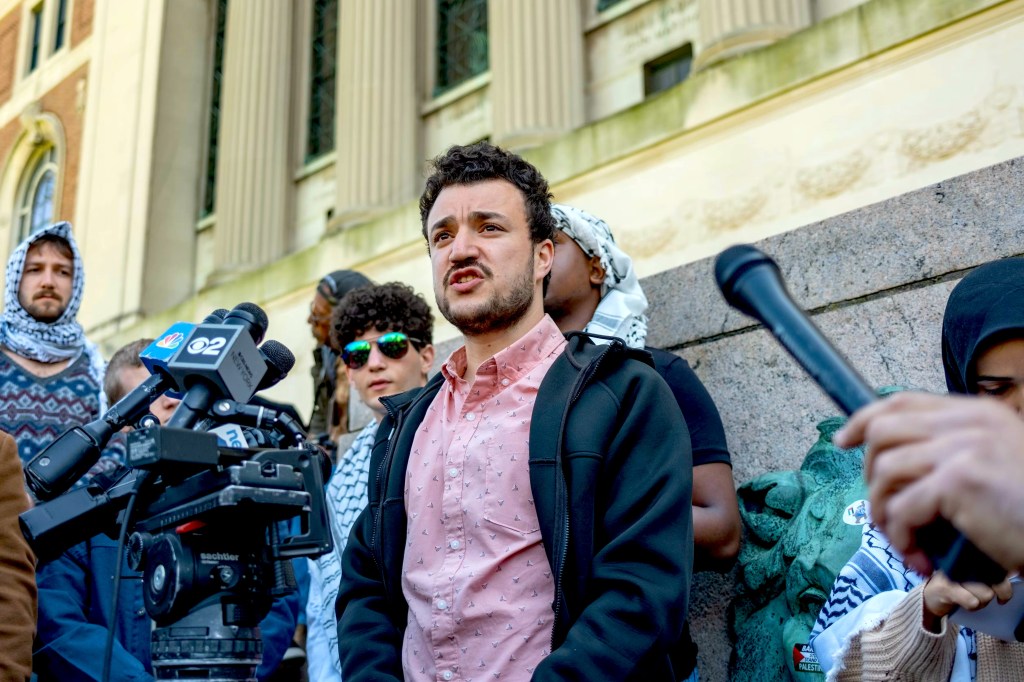
Photo: Mahmoud Khalil speaking to the press in 2024. Credit: Stella Ragas / Photo Editor, The Columbia Spectator
 thekingsnecktie.com