Let’s Put Trump Above the Law

Here at The King’s Necktie we are in the middle of a two-part essay about the incoming Trump administration’s horrific plan for mass deportations, but we interrupt our regularly scheduled programming for a bonus blog post.

I rarely devote a whole essay to commenting on someone else’s work, and I’ve never done it before to push back, only to praise. But a recent opinion piece in The New York Times really caught my eye. It was by Tom Goldstein, the highly accomplished attorney and much-respected founder of SCOTUSblog, the premier online journal about the US Supreme Court. It was called “End the Criminal Cases Against Trump” and that title pretty much says it all.

Goldstein writes:

Democracy’s ultimate verdict on these prosecutions was rendered by voters on Election Day. The charges were front and center in the campaign. The president-elect made a central feature of his candidacy that the cases were political and calculated to stop him from being elected again. Despite the prosecutions, more than 75 million people, a majority of the popular vote counted so far, decided to send him back to the White House.

I know, right?

And this was not the usual gaslighting from a Trump bootlicker, like Tom Cotton or Lindsay Graham or Victor Davis Hanson (or Marc Thiessen, or Jason Willick, or Hugh Hewitt….stop me anytime). Goldstein is a Democrat, a deeply experienced litigator specializing in cases before the Supreme Court, and has taught for many years at both Harvard and Stanford law schools. When it comes to Democratic bonafides, he was even second chair (as they call it) for Laurence Tribe and David Boies in Bush v. Gore in 2000. He is held in great esteem in the legal community and among people on both sides of the aisle.

And who am I? Just an regular shmo. My credentials, such as they are, are in other fields.

Still, as an ordinary citizen, I respectfully submit that Mr. Goldstein is dead wrong. Worse, I would contend that his argument represents a dangerous example of voluntary submission to autocracy at the very beginning of (at least) four years in which the rule of law and the republic itself are already in grave danger.

I CAME HERE FOR AN ARGUMENT

Let’s look at some of the arguments in Mr. Goldstein’s brief but explosive piece. He writes:

A central pillar of American democracy is that no man is above the law. But Mr. Trump isn’t an ordinary man. Moreover, the state cases against him invoke legal strategies that had never been used to criminalize the behavior that prosecutors charge. Rightly or wrongly, they carry the stench of politics and, if pursued, could lay the groundwork for political prosecutions of future presidents.

That paragraph covers a hell of a lot of ground, with some Coltrane-like giant steps.

It’s true that Donald Trump is not “ordinary”—and neither was Jeffrey Dahmer. (Or maybe a better comparison would be Trump’s favorite cannibal, Hannibal Lecter, even though he’s fictional.) But since when is that exculpatory? Is Trump’s position as president the thing that elevates him above accountability? That is literally the opposite of what democracy is supposed to be about. I think you’re thinking of a monarchy, Tom.

The novelty of the prosecutors’ approach is also not reason to dismiss the cases, and it’s a rather ironic tack for Goldstein to take, as he made his name crafting cases specifically aimed to reach the Supreme Court and set precedents.

As for carrying “the stench of politics,” that qualifying clause “rightly or wrongly” is doing a lot of work. Stench or no, it matters a helluva lot if the charges have legal legitimacy or are purely political. We can argue about that, and even disagree, but Goldstein jetés over that distinction completely, suggesting that it doesn’t matter if the charges are legit, because they still look bad to some. But there will always be some people who feel that way about any case. By that standard, we could never charge anyone with anything without an overwhelming plebiscite. And even a plebiscite can result in a decision that is unjust and immoral.

The idea that the electorate rendered the final verdict on Trump’s alleged crimes is especially galling. So if—to take a totally random and not at all deliberately pointed example—I stand in the middle of Fifth Avenue and murder someone, but the American people still like me, I should get off? Worked for OJ I guess.

(Side note: that majority of which Goldstein speaks has already been trimmed to a plurality, and is continuing to decline. So as Gil Scott-Heron says, “Mandate my ass.”)

And lastly, we shouldn’t prosecute Trump because some hypothetical future regime might later take that as reason to exploit and abuse the law? Again, by that logic, why prosecute anyone for anything, as that is always a risk?

Goldstein asks us to imagine charges “brought in Texas and Alabama against Joe Biden using novel and untested approaches challenging how he spent money while campaigning,” cases that would be “brought by hard-core Republican prosecutors, before juries and judges in deeply Republican counties.” Gosh, I sure can imagine that, because the new president-elect has all but promised that very thing.

And I hasten to point out that the charges in Georgia, for example, are not about how the defendant “spent money” but his blatant effort to pressure a state election official into tampering with the vote count, recorded on tape. Obviously, there are genuine banana republic–style pitfalls for an administration that pursues legal action against its predecessor. But when we are dealing with an attempted coup, the greater danger is not pursuing accountability.

POLITICALLY DRIVEN (TO TEARS)

Goldstein comes back several times to the reasoning behind the charges in New York and Georgia (though not the federal cases), and I know he is not alone in that critique.

In both cases, the prosecutors’ legal theories were and are unusual, to say the least. Their premise is that financial shenanigans and political strong arming in hard-fought battles for the presidency are serious felonies that can be pursued by local prosecutors in local courts. But these are fundamentally federal, not state, concerns.

To describe a fascist takeover of the US as a “hard-fought battle for the presidency” betrays a blinkered view of what is going on in the United States, reminiscent of the GOP’s own characterization of an attack on the US Capitol as “legitimate political discourse.” And to begrudge the states any recourse when the federal government is gridlocked by right wing obstructionism feels pedantic and shortsighted to say the least.

Above all, Mr. Goldstein seems to side with those who believe that the prosecutions of Trump were politically driven and without legal merit. (So when he wrote disingenuously of that stench earlier, there was really no “rightly or wrongly” about it, in his view.)

(T)he Constitution trusts the judgment of the American people to decide whether the cases against Mr. Trump, as he has argued, were political and calculated to stop him from being elected. The people had plenty of opportunities to hear both sides, and they have spoken. That judgment is the critical check we have against the possibility of politically driven prosecutions of presidential candidates.

In truth, support for the cases among many Democrats doesn’t seem to be based on confidence in the prosecutors’ legal theories and evidence. Instead, it seems to be driven by politics and hatred of Mr. Trump. That reinforces why they must be dismissed.

You know who disagrees? Twelve impartial jurors chosen from the people of New York, who listened to the arguments in open court and returned a unanimous verdict in 34 felony counts. But Goldstein would have us believe that they are all rabidly consumed with Trump Derangement Syndrome.

Some people will always be convinced that dismissing the charges will let Mr. Trump get away with crimes.

(Uh, that is precisely what that means.)

But the Constitution isn’t concerned with preserving a couple of criminal cases. It is concerned with having a system of government that can hold our democracy together for centuries. So far, it has worked, even if our deep disagreements make that hold seem tenuous right now. Inviting prosecutors of the opposing political party to pursue these kinds of charges in the wake of a presidential election can only make things worse.

“A couple of criminal cases”? A violent attempt to overturn a free and fair election is about the most serious crime of which a head of state can be accused. This week I got a $65 ticket from the city of New York because a rubber gasket on my car’s bicycle rack partially covered a portion of my rear license plate. I’m glad justice is being served!

In all the pending cases Trump’s lawyers employed the Roy Cohn-bred delaying strategy he has used throughout his long, litigious life, which successfully stalled three of the cases against him—forever, it now seems. In the fourth—the Florida documents case, which many national security lawyers saw as airtight—he got his handpicked judicial lackey to dismiss the charges outright. In the most serious federal case he even got the US Supreme Court to protect him with an eye-popping assertion of sweeping, emperor-like immunity that no reputable legal scholar believed possible. At the same time, Trump was also conducting a weapons-grade political campaign of disinformation and demagoguery to regain the presidency, the ultimate safeguard against prosecution and conviction. To reward Trump for all that with a shrug of the shoulders and a cry of “Whaddaya gonna do?” while at the same time perched on the high horse of the Constitution’s broader purpose feels pathetic.

I am quite confident that, armed with all the powers of the US presidency, including some new ones he intends to seize, Donald J. Trump and his nominee for attorney general Matt Gaetz are more than capable of defending him in court. There’s no need for anticipatory obedience by dropping the charges. Indeed, the ultimate refutation of Goldstein’s argument will be when a reinstalled President Trump quashes all the criminal and civil cases against him, including those at the state level in New York and Georgia. Will that be part of “a system of government that can hold our democracy together for centuries”?

On that point, it is especially ironic that Goldstein seems so sanguine about the sturdiness of the Constitution even as the man he would let off the hook is poised to obliterate that document, and has openly suggested that he will. On the cusp of wielding unprecedented (if usurped) quasi-royal power, Trump has brazenly promised to weaponize the full power of his office and the justice system against his political enemies. Goldstein is worried about setting a bad precedent? Trump doesn’t need a precedent: he has told us bluntly that he intends to go after Schiff, Cheney, Smith, Kinzinger, et al, and maybe even Biden, Clinton, and Obama.

So cancel my subscription to SCOTUSblog. (I am leaving Starlink, too.) It would be unfair to say that, like the Supreme Court itself, that much-admired blog has been captured by the right wing, though this piece sure reads like it has. But with all due respect, Tom Goldstein’s absurd and dangerous argument is a measure of how far the US is slipping into willful submission to autocracy.

HOLD THE BASTARDS ACCOUNTABLE

In my book Resisting the Right, I wrote about the importance of legal accountability, even for high-ranking politicians….especially for them, some might argue. That importance has only increased in the months since I published it, and especially since the events of November 5.

It ought to go without saying that a social system cannot function if it doesn’t hold criminals accountable for their crimes. Is there flexibility and discretion involved? Sure. But since we have done it with rank-and-file seditionists who beat police officers and stormed the Capitol and spread excrement in its halls, it is even more imperative to take on those who spurred them to those deeds. If there are no significant consequences for the leader of an attempt to murder the vice president and sitting members of Congress, it will only embolden the perpetrators of those acts going forward and inspire others. No sane country would let a high-powered group of its citizens attempt a violent coup d’état—led by a deposed head of state no less—without consequences, unless that country was keen to have them do it again.

To the extent that they admit Trump did anything wrong at all, Republicans argue for giving him a pass on the grounds that America needs “unity,” and that holding him accountable will somehow prevent us from “healing” and “moving on.” But such appeals for “unity” usually come from the guilty in an attempt to escape repercussions for their misdeeds. Cries for the Democrats to heal the breach are also ironic coming from the party that plunged this country into some of the most bitterly contentious years in contemporary American history under the thumb of the most hateful, bigoted, and divisive president in modern times, who even now continues to insist that the Biden administration isn’t legitimate, and was readying its hockey sticks and fire extinguishers (and guns) for the next attack on the federal government.

Even some Democrats and independents called for Biden to pardon Trump in the interest of this “national healing,” much like Goldstein now calls for the cases to be dismissed. Earlier in the Biden administration, Michael Conway, counsel for the House Judiciary Committee during Watergate, argued that a pardon would free Biden from allegations of pursuing a partisan vendetta, unlike Trump, who wanted to jail his political enemies and was unable to do so only because they’d committed no crimes (the clever bastards). But Republicans certainly never care about the bad optics of their actions. More to the point, Trump’s fans would cheer a pardon as exoneration, and weakness by the Democrats, encouraging further wrongdoing in the future without fear of consequences.

Trump of course has claimed that he will go so far as to pardon the January 6th insurrectionists, and he very well might. He might also forget, which he’s been known to do with his promises. Will his Kool Aid-drunk followers forgive that, even the ones sitting in stir, counting on him? They might. That Kool Aid is strong.

The anxious Mr. Conway writes that “American democracy cannot tolerate the prosecution of political opponents.”[i] But it can and should when they’ve committed unconscionable crimes. What American democracy cannot tolerate is looking the other way when violent, sadistic, openly corrupt kleptocrats hijack it, and then sitting on our hands and hoping it doesn’t happen again.

And guess what? It is, by other means.

Andrew McCarthy, a former federal prosecutor turned contributing editor at the pro-Trump National Review, argues that “Other considerations often apply, such as preserving domestic tranquility and institutional integrity.Yes—two things that immediately leap to mind when one thinks of Donald Trump.

Other advanced democracies have rightly prosecuted corrupt former heads of state without collapsing, including Silvio Berlusconi, the proto-Trump Italian prime minister who was convicted of tax fraud by an Italian court in 2013, or Nikolas Sarkozy, the former French president who was convicted in two separate corruption cases by French courts in 2021. Two of the harshest punishments were in South Korea, which in 2018 convicted and imprisoned two successive ex-presidents—Lee Myung-bak and Park Geun-hye—for various corruption charges, sentencing them to fifteen and twenty-five years, respectively, after having previously convicted two other former presidents. That is not necessarily a model the US wants to emulate, but it is further evidence that other countries do not consider this sort of thing taboo, nor descend into chaos as a result. Peru has a special prison just for ex-presidents, with three of them incarcerated there currently.

PARDON ME, BOY

We’ve been here before, of course. When Gerald Ford pardoned Richard Nixon in 1974, the reasons he gave had to do with healing the nation and sparing the country further trauma and damage. (Try that logic the next time you’re on trial for bank robbery.) I humbly submit that far from allowing us to move on from our “long national nightmare,” Ford’s excusal of Nixon’s crimes, even if well-intentioned—and it’s not clear that it was—did grievous harm. It told America that you were a sucker if you played by the rules; that if you were rich and powerful enough, the laws didn’t apply to you; that there was one set for those folks and another for the rest of us. It was a giant “fuck you” to ordinary Americans who were expected to obey the rules and could bet their bottom dollar that Johnny Law would come after them if they didn’t.

In fact, Ford missed a tremendous opportunity to reinforce the rule of law, as it would have been Nixon’s own party punishing him, rather than the opposition. Instead, Richard Nixon walked off into a well-feathered retirement distinguished by expensive homes in San Clemente and Upper Saddle River, lucrative book deals, and banquets thrown in his honor by his reactionary admirers. He never once admitted his crimes. 

(Decades later, it emerged that Ford also acted out of what he told Bob Woodward was his friendship with Nixon, saying, “I looked upon him as my personal friend, and I always treasured our relationship, and I had no hesitancy about granting the pardon….I didn’t want to see my real friend have the stigma.” So much for the “national healing” theory.)

It will be even worse if we let Trump slide on crimes that make Nixon look like a jaywalker.

If Nixon had been prosecuted and punished for his crimes, how might it have altered the trajectory of the post-Watergate GOP? We can never know. But we do know that just six years after Nixon departed the South Lawn in Marine One, an even more right-wing Republican won the presidency, ushering in a conservative counterrevolution that continues to this day.

Sound familiar?

Absent prosecution, the GOP was able to portray Nixon—at worst—as an unfortunate aberration rather than its natural result. Since then, the Republican Party has carried on with its unabashed grift of the American people, and has even been rewarded for its efforts.

We can go back even further, if we wish, to the 1869 decision not to proceed with trials of Jefferson Davis, Robert E. Lee, and thirty-eight other leading secessionists for fear of public furor, and concerns that the defendants would not be found guilty in the Southern states where the trials were scheduled to take place. This abdication created, as the Civil War historian Elizabeth R. Varon writes, “the myth that the southern cause had been so noble that even the conquering northern armies had been forced to recognize it.” It is little wonder that Trump’s apologists are making the same Br’er Rabbit argument now about the risks of prosecuting a former head of state. 

The New York Times quotes former US Representative Tom Perriello of Virginia, who was a special advisor for the war crimes tribunal in Sierra Leone, that countries that have suffered national trauma and “skip the accountability phase end up repeating 100 percent of the time—but the next time the crisis is worse. People who think that the way forward is to brush this under the rug seem to have missed the fact that there is a ticking time bomb under the rug.”

But there is another kind of accountability, a more abstract and intangible one. In their 2020 book Surviving Autocracy, Masha Gessen recounts the early years of post-Soviet Russia, under Boris Yeltsin, when the country deliberately avoided a reckoning with the crimes and trauma of the USSR in that same sort of misplaced interest of healing, as well as reluctance to deal with the practical implications such a reckoning would unleash. The result was that within a decade a new autocrat came to power. We didn’t even take that long, nor bother with a new one when the old one was still around and eager for an encore.

“The goal of reckoning,” Gessen writes, “is moral restoration.” The Back Row Manifesto’s Tom Hall made that same point to me in the immediate aftermath of Trump’s departure from office in January 2021: “After years of gaslighting and the demolition of belief in the ability of our institutions to stand up to their debasement at the hands of Trump, we need more than just the truth,” he told me. “Without a fundamental agreement about the impacts of Trumpist criminality on the country, and on us as a people, the will and pretexts for justice become impossible. How will we ever tell the truth about the past and build a future if there is no priority given to really grappling with trauma, with using every avenue to tell the story of what happened truthfully? That is the narrative that can deliver justice.”

Preach. What will not deliver justice by any definition is the idea that we should let the most criminal president in American history get away scot free just because lots of people don’t care, or because he might behave badly in seeking retribution.

This just in: He’s gonna behave very badly indeed, regardless.


Bad Moon Rising. Very, Very Bad.

Less than two weeks into the post-election interregnum and we already know a lot about what lies ahead.

Trump rolled out his Cabinet picks with uncharacteristic speed­—a bad sign that his team has a plan, ready to go—and it was a slate that shocked even inveterate Trump watchers accustomed to the absolute worst from this guy. Gabbard, Gaetz, and RFK Jr are in a dead heat for worst choice, with the others in a twelve-way tie for third. A Russian stooge (at best) to control US intelligence, a troll under criminal investigation for sex crimes by the department he’s been tapped to lead, and a cuckoo for Cocoa Puffs anti-vaxxer and conspiracy theorist with a worm in his brain and a penchant for decapitating whales and hoarding dead bearcubs in charge of public health. What could go wrong?

It’s a group so grotesque that it beggars parody; even Trump’s worst critics did not dare imagine picks this ass-wipingly bad. But this is what you asked for, folks. Did you really think the candidate who mimed a blowjob, portayed his Black female opponent as a low-IQ prostitute, and held a neo-Nazi rally at Madison Square Garden was gonna pick sober, qualified veteran public servants?

Truly this is the kakistocracy. That is not new in Trumpworld, but this bunch makes Betsy DeVos and Rick Perry and Scott Pruitt look like Roman statesmen. Funny how the same people who thought Kamala Harris—former DA of San Francisco, AG of California, US Senator, and Vice President of the United States—was somehow “unqualified” are fine with this crew.

And as a buddy of mine—a longtime federal employee—quipped, what does it say that they have two people heading the Department of Government Efficiency?

In several cases the nominees appear deliberately selected to destroy the departments they will head. (“Trump nominates Godzilla for Secretary of Housing and Urban Development” as the Instagram pundit Middle Age Riot posted.) Yale history professor Timothy Snyder, author of On Tyranny, argues that these choices are exactly that:

Imagine that you are a foreign leader who wishes to destroy the United States. How could you do so?  The easiest way would be to get Americans to do the work themselves, to somehow induce Americans to undo their own health, law, administration, defense, and intelligence.  From this perspective, Trump’s proposed appointments—Kennedy, Jr.; Gaetz; Musk; Ramaswamy; Hegseth; Gabbard—are perfect instruments. 

These proposed appointments look like a decapitation strike: destroying the American government from the top, leaving the body politic to rot, and the rest of us to suffer.

Why Trump wants to help our enemies do that I don’t know. Perhaps a special counsel could look into it.

Gaetz was a shock; I really thought it would be Aileen Cannon for AG, but maybe Donald’s saving her for Clarence Thomas’s seat when he strategically retires and hits the road full time in his RV. Though Gaetz is inarguably the most stomach-turning, for me, as someone with a history in the intelligence community, Gabbard is particularly outrageous, an absolute cartwheel-inspiring strategic victory for Vladimir Putin (much like her boss who appointed her). If this were a movie, the audience would throw popcorn at the screen at the implausibilty of it all. I have to believe that career IC officers—whose stock in trade, after all, is subterfuge—will withhold intel from her…..or better yet, jiu-jitsu the situation by feeding her disinformation that will drift back to Moscow. It’s not called a wilderness of mirrors for nothing. But I look forward to the CIA’s new motto: “Why don’t you play a little solitaire?”

And don’t let’s even start on Bobby K. This week on “Curb Your Enthusiasm,” Larry freaks out when Cheryl’s new husband gets a Cabinet appointment. (And Leon becomes ambassador to the Vatican because his name is an anagram for Elon.)

And Pete Hegseth? Cracker, please. How does this guy join the august tradition of Forrestal, Marshall, McNamara, Schlesinger, Rumsfeld, Richardson, Gates, Cohen, Paneta, Mattis, and Austin? Yes, there are a couple real monsters too (looking at you, Rummy), but even those monsters were at least proper, formidable villains. By contrast, Hegseth, like Trump, is a wildy unqualified clown with a disgusting personal history and poisonous policy views, but also like Trump, an incredibly dangerous one. So we’re giving a white nationalist National Guard major turned Fox News host access to the nuclear codes? As the kids say, that tracks. (I feel bad for those folks who have to shake his hand.) Yes, the four-star service chiefs will treat him like an insect, while staying just shy of open insubordination, but in the end, the chain of command is the chain of command. Just ask the Chairman of the Joint Chiefs, US Air Force General Charles Q. Brown, Jr., whom Pete will likely fire just because he’s Black.

It now emerges that Hegseth may be sunk by an allegation of sexual assault—not that that hurt Trump, whom a judge declared had committed rape, or a pattern of credible allegations of that sort against Gaetz. We shall see. Much as I’d love to see him kept out of the Cabinet, the idea that an accusation of sexual assault would do it, and not his sheer lack of qualifications or Wannsee Conference-ready political views, says it all.

At this point, I’m almost more shocked by who’s been snubbed, so far. Giuliani for Secretary of Hair Dye, Cousin-Marrying, and Four Seasons Landscaping? Mike Lindell for head of the Bureau of Pillows, Crucifixes, and Crack? Grenell as US Ambassador to Mordor? How about Sidney Powell? Johnny McEntee? And where is Mad Mike Flynn anyway? Eating Turkish food with Eric Adams somewhere, I presume.

Talk that this rogues’ gallery of Cabinet picks will face trouble getting confirmed is absurd. Does anyone seriously think the supplicant Republican-controlled Senate is going to stand in the way? Donald will get all of them through, via one form of GOP cowardice or another: the Senate will either confirm them without so much as a polite clearing of the throat, or bow to his desire for unconstitutional recess appointments. The only reason Trump would press for the latter is to avoid giving the Democrats a platform for theater. But he may not care.

Clearly, Trump is challenging and testing the GOP leadership (“leadership”) right out of the gate. These are schoolyard bully tactics, which are his stock-in-trade. If any senior Republicans dare push back—and I doubt any will—they will be purged. The rest will have been preemptively emasculated, a humiliation they will meekly accept, setting the tone for all that is to come.

And what is to come promises to be very bad indeed.

MILLER’S CROSSING

I say all this about the Cabinet picks not to dunk just for the sake of dunking, or to comfort myself with a snotty sense of superiority as we careen toward armageddon, but because it’s a grim augury of what’s next.

Two weeks ago I described the presidential election as a test, one that America failed. Another big test is bearing down on us—a pop quiz on the first day of class, and we’re like a bunch of first semester freshmen who didn’t do the reading because we were shotgunning Natty Bo and doing bong hits all night.

Make no mistake: the new Trump administration will immediately launch mass deportations—or an attempt at them—on day one, perhaps even as soon as John Roberts smiles and Trump removes his hand from the Bible, which miraculously has not burst into flame (but it wanted to). Stephen Miller is rock hard just thinking about it.

Remember the so-called Muslim ban? That was Weekend #1 of his first administration. They wanted to make a statement fast and hard and they did, even if it was a disaster that Trump had to back away from, really the only reversal of policy the famously non-apologetic bastard made in his whole first term. They will surely try a similar shock-and-awe maneuver right out of the gate this time, and I don’t believe that the American people are remotely ready for it.

The incoming administration had made it clear that it thinks it has a mandate from the American people to carry out the vile, neo-fascist agenda it promoted on the campaign trail. It would have acted that way even if Kamala had won the popular vote, but the current circumstances, and with the GOP recapturing the Senate and holding onto the House, make it even easier. And sadly, their presumptuousness is not unjustified. After all, Trump didn’t hide what he planned to do: on the contrary, he shouted it from the rooftops. And the American people signed on.

But setting aside the small niche of rabid xenophobes, Trump’s victory at the polls suggests that, broadly speaking, the American people may not have been paying very close attention to what he promised to do in a second term, or at the very least didn’t fully understand it. As Christian Paz writes in Vox, “Support for a policy of mass deportation, while superficially high, rests on….substantial confusion among voters about what it might actually entail.”

Americans might not understand that deportations of all undocumented immigrants would include deportations of DACA recipients and longtime neighbors or friends who have been living normally and are bedrocks of local communities, advocates and researchers say—rather than only recent arrivals, or those few migrants who commit violent crimes.

According to the Pew Research Center, “as many as 40 percent of registered voters who support mass deportations also support a policy that would allow undocumented spouses of US citizens to remain in the country.” That doesn’t square with the draconian ICE raids and mass incarceration of whole families—including children and legal residents of the US—that the Trump campaign has vowed.

And what unholy trinity will oversee this pogrom? Naturally it will be led by famed xenophobic homunculus Stephen Miller, Trump’s cartoonishly evil immigration adviser; former South Dakota governor and dog-killing enthusiast Kristi Noem, who is his nominee to be Secretary of Homeland Security; and border czar Tom Homan, straight from Central Casting, where he could have had a fine career playing redneck sheriffs and sadistic prison wardens.

Experts, current and former government officials, and others interviewed by The Washington Post described Trump’s plans as “alarming, impractical and prone to significant legal and logistical hurdles.”

“You’re talking about officers in tactical gear going into communities, being videotaped in the streets, putting kids in car seats, carrying baby formula. Then what do you do with those families?” said Jason Houser, US Immigration and Customs Enforcement’s chief of stafffrom January 2022 until March 2023. “Are you going to go into neighborhoods in Philly, New York, Baltimore and start tugging people out of communities? That’s what they want. It puts law enforcement and the communities at risk.”

Reflecting on the ideas Trump and his team discussed during his presidency, Houser said, “Their ideas were psychotic.”

FAST, CREEPS, AND OUT OF CONTROL

Per Houser, some argue that mass deportation on the scale Trump promises is wildly unfeasible, even for a well-oiled administration, which this one ain’t gonna be by any stretch. It’s by no means clear that Trump will have the organization or infrastructure to execute his plans, not to mention senior personnel who won’t tear each other apart with Borgia-like zest. No one even knows how mass deportation would work. (Perhaps the ghost of Adolf Eichmann can be consulted via oujia board.)

But they will certainly try. And while it’s true that the Trump Administration 2.0 will surely be a dumpster fire of dysfunction, immigration policy may be the area where it is most effective. As Hayes Brown writes for MSNBC:

Even as the rest of the administration may bumble about and clash with one another, that might not be the case when it comes to enforcing Trump’s dark immigration plan. Miller, Homan and Noem have the potential to be distressingly effective at working together. The only limit they will likely face is how much the public will allow to be carried out in its name.

But the effectiveness of this scheme is almost beside the point. The plan does not have to work well, or work at all, to inflict the harm and suffering that is its actual goal. “The cruelty is the point” as The Atlantic’s Adam Serwer said about the family separation policy of the first Trump administration, and this will make that look like tea at the Plaza. (On that topic, I strongly recommend Separated, Errol Morris’s powerful new documentary on that subject, based on the book by Jacob Soboroff.)

Are we ready? Will the American people, who voted this rancid meatsack back into office, be shocked by what he does? Will they shrug? Applaud? I dunno. A mix, of course. But the Cabinet picks are a sure sign that the mass deporation plan is very real, and will hit with maximum force and no half measures.

Truthout reports that “with Trump’s return, we can expect not only mass raids of homes, worksites and communities, but the stripping of status from millions of people. With the scale of what has been proposed, some 28 million people could be at risk of family separation in 2025.”

Here’s how the The New York Times frames it:

The constellation of Mr. Trump’s 2025 plans amounts to an assault on immigration on a scale unseen in modern American history. Millions of undocumented immigrants would be barred from the country or uprooted from it years or even decades after settling here.

Such a scale of planned removals would raise logistical, financial and diplomatic challenges and would be vigorously challenged in court. But there is no mistaking the breadth and ambition of the shift Mr. Trump is eyeing.

In a second Trump presidency, the visas of foreign students who participated in anti-Israel or pro-Palestinian protests would be canceled. US consular officials abroad will be directed to expand ideological screening of visa applicants to block people the Trump administration considers to have undesirable attitudes. People who were granted temporary protected status because they are from certain countries deemed unsafe, allowing them to lawfully live and work in the United States, would have that status revoked.

Similarly, numerous people who have been allowed to live in the country temporarily for humanitarian reasons would also lose that status and be kicked out, including tens of thousands of the Afghans who were evacuated amid the 2021 Taliban takeover and allowed to enter the United States. Afghans holding special visas granted to people who helped US forces would be re-vetted to see if they really did.

And they will come first for a place like New York City first: the biggest city in the country, the most liberal (sorry, Berkeley), Trump’s hometown, and one packed both with migrants and diversity in general. Eric Adams—scrambling to avoid criminal convictions himself, and about to face a judge who was once a lawyer for the ACLU fighting the family separation policy—may well play along, with the unspoken quid pro quo of a presidential pardon dangling before him. Will the NYPD do likewise? Will the New York State National Guard? If Kathy Hochul balks, will Trump federalize them? Will their chain of command go along, or do their duty and refuse to obey illegal orders, should they be issued?

And it won’t stop with “illegals” either. Miller want severe limits even on legal immigration, including an end to the 14th Amendment’s guarantee of birthright citizenship, and even to strip naturalized citizens of their legal status. (Paging Martin Niemöller.) The WaPo reports that to do so, Trump “would sign an executive order on his first day in office to withhold passports, Social Security numbers and other government benefits from children of undocumented immigrants born in the United States.” Such moves would surely wind up in front of the Supreme Court, the same Supreme Court that recently ruled that a US President can pretty much do whatever he wants.* (And I do mean “he.”) I think we all know how that will go.

(*Fine print: Applies only to Republicans.)

Carrying out this plan will require resources far beyond those currently available to ICE, which presents worrying prospects of its own. The Washington Post reports that ICE only has about 6000 deportation officers nationwide, and that it takes about two years to recruit, screen, and train a new deportation. To provide reinforcements, Miller is a fan of enlisting state police, National Guardsmen, and other federal agencies (presumably FBI, ATF, Secret Service, and the Bureau of Prisons, whose officers—in sterile, unmarked uniforms, a la Putin’s “little green men” in Crimea—figured heavily in suppressing the George Floyd protests in 2020). Speaking to the right wing podcaster Charlie Kirk in November 2023, Miller even proposed “sending National Guard troops from Republican-led states into neighboring states governed by Democrats. ‘If you’re going to go into an unfriendly state like Maryland, well, they would just be Virginia doing the arrest in Maryland.’”

That sounds normal.

Trump himself has long been keen on involving the US military in his anti-immigration plans, almost to the point of fetish, including not just National Guard but active duty forces, befitting his view of himself as a despot. “He was obsessed with having the military involved,” a former senior official in the Trump administration told the WaPo, speaking on condition of anonymity. John Bolton reported that Trump “couldn’t care less” about Posse Comitatus, the law forbidding the US military from undertaking domestic operations; no doubt he will find some Reichstag fire-style reason to get around it, which makes allowances for national emergenices. A salivating Stephen Miller has already proposed invoking the Insurrection Act. (Very ironic, of course, for the party of insurrection.)

It hardly bears mentioning the hypocrisy of this xenophobia and cruelty from a nation that ostentatiously prides itself on being built by immgrants (even as it exists on stolen land), and holds up the Statue of Liberty and Emma Lazarus’s poem as part of national iconography.

I think Emma may have gotten wrong exactly who the “wretched refuse” are.

LOOKING DOWN THE BARREL

So what’s next? I don’t dare guess. I know the Onion bought InfoWars, but when Matt Gaetz is AG and Tulsi Gabbard is DNI and RFK Jr. is in charge of public health, satire is dead.

There are reports of Trump voters already having buyers’ remorse as they learn what a tarrif really is, and there will be loads more once the deportations begin, sweeping up folks who never thought for a moment that Trump meant them. The Leopards Eating People’s Faces Party is going to have a field day.

What does it say when prominent Trump critics and opponents, including high-ranking members of the previous administration, are worried about being jailed, court-martialed, or even executed, or short of that, the subject of freelance violence by Trump supporters acting on their own, but egged on and inspired by their Dear Leader? That is the sort of thing that was unimaginable in America, even in our worst moments. And yet here we are.

An overreaction you say? Hysteria? Trump Derangement Syndrome? I hope that proves true, and I’ll take it gladly. But if past is prologue, there is no reason to think that the worst is not very possible when it comes to what Donald Trump will do.

Trump has said he’ll be a “dictator for one day,” and I don’t suspect that day will be in the middle of his term. In fact, he‘s already talking about a third term. (­That was fast, no?) Just a joke, his GOP defenders say! Sheesh, you libtards have no sense of humor! “That was a joke. It was clearly a joke,” said Rep. Tim Burchett (R-Tenn.) when asked about it. “I leaned over to somebody beside me, Andy Biggs, and I said, that’ll be the headlines tomorrow, ‘Trump trying to thwart the Constitution,’ which—there’s nothing further from the truth.”

Right, nothing is further from the truth than Donald Trump trying to thwart the Constitution.

But that’s the pattern: a trial balloon disguised as a “joke” for plausible deniability that soon becomes hard fact without so much as a shrug let alone an explanation.

It’s hard to imagine how all this will play out, given the speed at which it’s happening. It’s equally hard to see how that pace can be sustained, or where we’ll be in four years, or that this madness can carry on that long without exploding or imploding. But we are headed down a very dark path.

Recall how fast a certain Austrian-born politician consolidated power after ascending to the chancellorship of his grievance-filled nation via legal means. In less than six months, he had the authority to enact laws without the Reichstag’s consent, all other political parties had been banned, and civil liberites had been suspended under the Verordnung des Reichspräsidenten zum Schutz von Volk und Staat (Reich President’s Emergency Decree for the People and State).

See you in July ’25!

In the second part of this essay, we will get into the weeds of what mass deportation would look like, with ICE raids, mass arrests of whole families, and establishment of a gulag archipelago of privately-conracted concentration camps. When it comes, we will see, in the land of the free and the home of the brave, just how free and brave we really are.

**********

Photo: Gleeful Trump supporters at the Republican National Convention in Milwaukee last July, blithely unaware of how they will look to history. Alex Wong/Getty Images.

The Limits of Tyrants

Last week’s blog post, “Deep Dark Truthful Mirror,” was a form of immediate first aid for the psychic wound of Election Day and the appalling surrender of the American people to a fascist candidate……and not just any old fascist candidate, but one who had already been in office and shown us very clearly who he is and how bad he intends to be.

Now we move out of the teeth-gnashing phase of acknowledging what we just did to ourselves, and on to the struggle ahead.

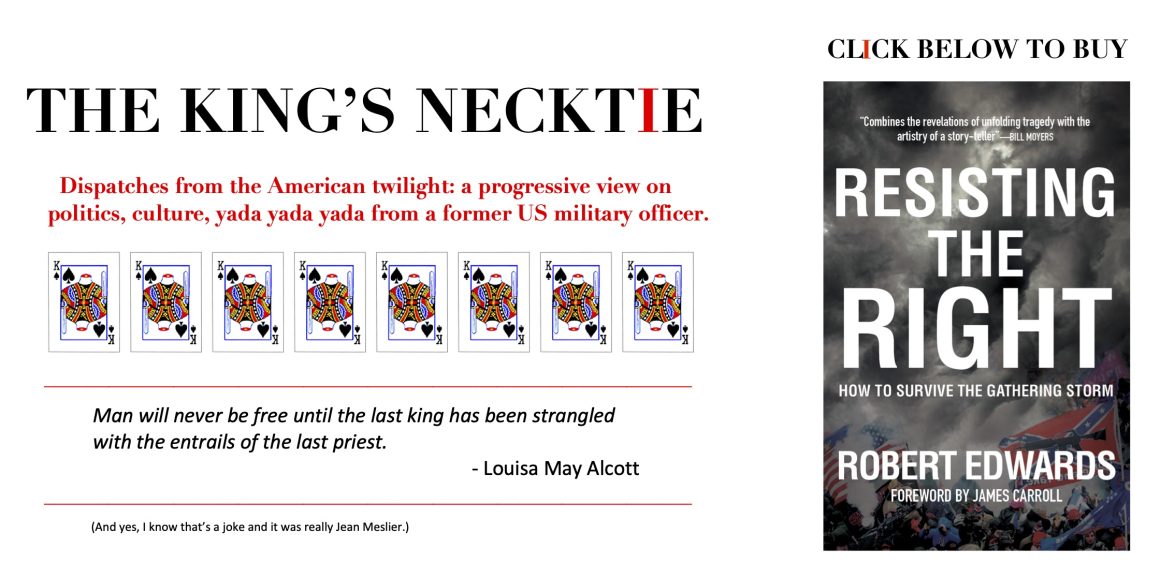
In the coming weeks I will get into the nuts and bolts of what I believe the Democratic opposition in Congress can do, what blue state governments can do, what the courts can do, what the press can do, what civil servants and businesses and healthcare workers and teachers and soldiers and cops and artists can do….and above all, what all of us ordinary citizens can do. Much of that material will be drawn from my book, Resisting the Right: How to Survive the Gathering Storm, a handbook for surviving a second Trump administration that I published last summer and hoped would not be needed. (Buy it please and I’ll stop this pledge drive and send you a tote bag.)

But first we need the philosophical underpinning for this whole endeavor. To crib a famous line from Zen and the Art of Motorcycle Maintenance, “Assembly of Japanese bicycle requires great peace of mind.”

So does fighting homegrown autocracy.

FREDDY GET IT READY

(From Resisting the Right, Chapter 9, with updates)

We are often regaled with Frederick Douglass’s famous line from 1857, that “Power concedes nothing without a demand.” But it’s well worth considering the longer quote, and the context of that maxim:

Power concedes nothing without a demand. It never did and it never will. Find out just what any people will quietly submit to and you have found out the exact measure of injustice and wrong which will be imposed upon them, and these will continue till they are resisted with either words or blows, or with both. The limits of tyrants are prescribed by the endurance of those whom they oppress.

The first thing to understand, then, is that the source of all political power, even in the most repressive police state, is the consent of the people.

Autocrats want you to be discouraged. Instilling a sense of apathy and resignation is one of their favorite and most frequently reached for tricks, as they prefer a public that believes it has no power to improve its lot and can’t change things. But we do and we can—and the ferocity of their gaslighting is evidence of that power and how much they fear it. Human history is thick with examples, even with regimes far more brutal than we have yet faced in the United States.

“Ordinary people are not powerless to challenge the political and economic élite who have such disproportionate authority over our lives,” writes Professor Keeanga Yamahtta-Taylor of Northwestern University. “But our power is often located outside of the institutions of tradition and influence.” In fact, even in the best of circumstances, when American democracy is functioning reasonably well, change typically comes from forces outside the government putting pressure on it—which is to say, from the people. Now that a truly repressive, retrograde right-wing government is coming to power in the US, the onus will shift even more in that direction.

But we need not think of this resistance as some gargantuan political thing, intimidating in its size and scope. The Filipina activist and Nobel Peace Prize winner Maria Ressa has spoken of democracy dying the death of a thousand cuts, and autocracy can be brought down in the same way. Many of those thousand cuts are in the seemingly small, quotidian actions of regular folks like you and me. Our starting point is the simplest of all, which is the very way we think about what we are doing.

The psychological preparation for the pro-democracy struggle requires full-time vigilance to the ways that autocracy demands our complicity.

In the very first chapter of his slim but seminal 2017 book, On Tyranny, Yale history professor Timothy Snyder advises us: “Do not obey in advance. Most of the power of authoritarianism is freely given.” This impulse to bend voluntarily to an oppressive regime is what Snyder calls “anticipatory obedience,” and need not even take the form of active support. It can be simple apathy, and a Niemöllerian indifference to the sound of marching boots and knocks on neighbors’ doors, and to the even almost-inaudible sound of democratic norms falling one by one.

A perfect example—which caused many observers to specifically cite Snyder’s rule number one—was Jeff Bezos’s craven decision, of his own free will, to block a planned endorsement of Kamala Harris by The Washington Post, which he owns. If the world’s richest man (or at least one of the top two, depending on the day) is that willing to bend the knee to Trump before he was even elected, and without even being pressured to do so, it tells you how right Snyder is. (Bezos’s wealth reportedly grew by $7.1 billion dollars in the 24 hours after Trump won the race.)

“Obedience is at the heart of political power,” wrote the political scientist Gene Sharp in his three-volume magnum opus, The Politics of Nonviolent Action (1973), calling the submission of the citizenry ”the most important single quality of any government, without which it would not exist.” The citizens of free countries give their obedience gladly, while those living under despotic regimes give it less so. But they give it nonetheless:

To say that every government depends on consent of the people does not, of course, mean that the subjects of all rulers prefer the established order to any other which might be created. They may consent because they positively approve of it—but they may also consent because they are unwilling to pay the price for the refusal of consent….The degree of liberty or tyranny in any government is, it follows, in large degree a reflection of the relative determination of the subjects to be free and their willingness and ability to resist efforts to enslave them.

In other words, repression only works when the people are cowed by it.

Sharp then asks a bold question: What happens if the people refuse to accept political oppressors—foreign or domestic—as their masters? His conclusion is that “noncooperation and defiance by subjects, at least under certain conditions,” has the power to thwart those rulers, and even destroy them.

“If this is true,” Sharp asks, “then why have people not long since abolished oppression, tyranny, and exploitation?” The answer, primarily, is that “The subjects usually do not realize that they are the source of the ruler’s power and that by joint action they could dissolve that power”—and tyrants have every reason to keep them from so doing.

As we have just observed, inculcating a sense of resignation, hopelessness, and despair in the citizenry is the ruler’s greatest tool. Sharp goes on to cite the South African philosopher Errol E. Harris that, consequently, a public subjected to despotism “become[s] its accomplices at the same time as they become its victims. If sufficient people understood this and really knew what they were about and how to go about it, they could ensure that government would never be tyrannical.”

“A nation gets the government it deserves,” Harris wrote. That is not to blame the victim or to allege weakness, only to say that a despotic regime can only remain in power if the citizenry is unwilling to mobilize sufficiently against it (without underestimating how difficult that mobilization might be). That is bitter pill for any nation to swallow, but it can also be inverted. If it is only the complicity of the ruled that enables their oppression, that acquiescence can also be withdrawn. Therefore, it is within the power of the oppressed to be the means of their own salvation. 

It is this understanding that is central to any American defiance of an autocratic right-wing regime that seems likely to arise under Donald Trump and the Republican Party.

NEW AND IMPROVED: THE WHEEL

Fortunately, in summoning a movement to oppose an autocratic regime in the United States, it is not necessary for us to reinvent the proverbial wheel. Models abound.

In Poland, a trade union born in a shipyard—illegal at first, in that totalitarian country—grew into a broad antiauthoritarian movement that eventually forced free elections in which its leader was chosen as the country’s president. In the Philippines, the flagrantly corrupt Marcos regime, which robbed the country blind during its twenty-one-year reign, instituted martial law, stole elections, and even murdered political opponents like Benigno Aquino, was finally brought down by the People Power movement led by Aquino’s widow, Corazon. In South Africa, Nelson Mandela and the African National Congress led a decades-long campaign to end apartheid and eject the white minority government, a campaign that saw Mandela himself imprisoned for twenty-seven years. That imprisonment was a particular object lesson in the weak spots of autocracy, as Pretoria’s ham-handed brutality turned Mandela into a global hero, shaming the regime and bringing international pressure onto it. (Putin may have made that exact mistake with Alexei Navalny).

And these are but a handful of prominent case studies. In recent decades, surely the most dramatic example of popular unrest leading to political change was the fall of the Berlin Wall on November 9, 1989—35 years ago this past weekend—and the collapse of the USSR and the entire Soviet empire in August 1991. In neighboring Czechoslovakia, a peaceful movement of students and activists led to the Velvet Revolution that ended four decades of communist rule in favor of liberal democracy under the playwright/dissident Vaclav Havel. Similar bloodless revolutions took place in other former Warsaw Pact countries.

Notably, Havel, following Gandhi’s example, aimed his activism not at overthrowing the regime but at “immediate changes in daily life….an unshakable commitment to achieving modest, concrete goals on the local level,” as Jonathan Schell writes in his 2003 book The Unconquerable World. These measures included financial aid to dissidents at odds with the authorities and the families of jailed workers; an underground press; and a clandestine university teaching uncensored material in private homes. Schell recounts how Havel, along with fellow activists like Gyorgy Konrad in Hungary and Adam Michnik in Poland, “lowered their field glasses from the remote heights of state power and turned their gazes to the life immediately around them…..Their new rule of thumb was to act not against the government but for society—and then to defend the accomplishments.”

In this country, there is no better example of a successful pro-democracy struggle than the Civil Rights Movement, itself the heir to the abolitionist movement that predates even the founding of the US.

Shall we quibble with the word “successful”? Racism remains a pox on our country, and discrimination, bigotry, police brutality, economic injustice, and other longstanding ills continue to roil the nation. But that in no way minimizes the achievements of the Black liberation movement, which carries on even now into the continuing campaign against racism and poverty led by successors to Dr. King, like the Rev. William Barber II.

Malcolm Gladwell notes that the Civil Rights Movement was a highly disciplined, rigidly organized hierarchical endeavor with centralized control, distinguished by formal planning, training of volunteers, and reconnaissance of locations and targets, under the auspices of groups like the NAACP, SNCC, and SCLC. In the same way that Rosa Parks’s historic refusal to give up her seat was no impulsive act but a carefully planned and deliberate operation, the entire movement was similarly strategic, targeted with near-military precision at very specific objectives.

Subsequent movements in the 1960s, ‘70s, and ’80s proved again the power of the people as a political force. The anti–Vietnam War movement, which galvanized millions across the country, undeniably helped bring significant pressure to bear on successive administrations to end its war in Southeast Asia. Anti-war fervor helped drive LBJ out of the 1968 presidential race, and—in a bitter irony—helped Nixon take his place, only to continue the war for another five futile years at a cost of 21,000 additional American dead and hundreds of thousands of Vietnamese lives. But ultimately even he had to bend to public clamor, accelerated by the revelations of Daniel Ellsberg.

The nuclear freeze movement played a substantive role in forcing the US to scale back the madness of the arms race and helped prompt landmark nonproliferation treaties in the Reagan era, while the anti-apartheid movement shamed universities and other organizations into divesting from financial interests in South Africa and helped spur the passage of the Comprehensive Anti-Apartheid Act of 1986, enacted over Reagan’s veto by a Republican-controlled Senate.

I’ll repeat that. A Republican-controlled Senate.

And these are not outliers. Throughout its history, American life has been shaped by determined dissident movements. The suffrage movement of the early 20th century—which itself grew out of the abolitionist movement of the previous century—got women the vote, a struggle that continues with the ongoing fight for equal pay, the fight against workplace discrimination and harassment, the fight for reproductive justice, and in the struggle of #MeToo. The labor union movement put an end to the most exploitative working conditions of American industry in the nineteenth and early twentieth centuries, and—for a time—played a major role in remaking American life and reining in naked capitalism. The gay rights movement made astounding gains over a relatively brief period on behalf of a constituency that has been among the most reviled and persecuted in human history and remains so in large parts of the world.

But how, you ask, can we mobilize enough Americans to make this happen in the current situation? It might not be as tall an order as it seems.

We hear about the Three Percenters, a right wing militia akin to the Oath Keepers or Proud Boys whose name derives from the unproven claim that only 3% of American colonists fought against the British. (Self-flattering cosplay as Revolutionary War figures is big in MAGA World.) But that idea goes both ways. In Why Civil Resistance Works: The Strategic Logic of Nonviolent Conflict (2010), the political scientists Erica Chenoweth and Maria Stephan surveyed 323 resistance movements over the 106 years from 1900–2006. The authors’ research caused them to formulate the “3.5% rule,” which sets that number as the threshold of citizen participation necessary for a resistance movement to succeed. In their study, all the movements that met that standard were nonviolent.

Three and a half percent of the adult US population is about nine million people, the same number of people who bought Matchbox 20’s 1996 album Yourself or Someone Like You. That seems a highly achievable number for an anti-MAGA, pro-democracy campaign in America should a second Trump regime come to power. We’re not talking about Thriller here.

DOWN TO THE WELL

What do all these pro-democracy movements have in common? All were external to the elected government (though some had allies within it, on the opposition side), and all succeeded by means of a sustained campaign that swayed public opinion to its side. That is because all political struggle is ultimately psychological in nature.

Jon Else, the MacArthur-winning filmmaker and retired UC Berkeley journalism professor, was a student volunteer in Mississippi in 1964 and ‘65—what he calls a “lowest level pavement pounder” in SNCC (the Student Nonviolent Coordinating Committee), founded by Ella Baker, Julian Bond, and others. In that role, he was also on the steps of the courthouse in Selma, Alabama, when the racist sheriff Jim Clark went berserk in front of the national press. Else told me that it was the public nature of the Civil Rights Movement that gave their actions much of their power. They were informational acts aimed at galvanizing attention and changing minds, or what Sharp calls “political jiu-jitsu.”

“With SNCC and SCLC, we were always aiming at the folks in power who could actually change the laws,” Else told me. “Getting that mad dog sheriff to attack the demonstrators with dogs in Birmingham, or flushing the lynch mobs out of the back alleys in Mississippi—that was not designed for white folks in Alabama or Mississippi. It was designed for members of Congress. Because we were operating at a time when Congress and the executive were actually fairly functional, and you could actually shame Republican lawmakers into seeing what a bald-faced injustice was going on right in their backyard and doing something about it. It was all about finding the most effective targets with power high up in Washington.”

In the contemporary moment, in resisting the second Trump regime, shaming Congress into action is not in play. But changing the minds of our fellow Americans is the pressure point at which we must aim. Clearly, the verdict of the American people last Tuesday suggests that there is work to be done there; I will get into that challenge in detail in the coming weeks. But the important thing to remember is that perception is the fulcrum of political power, and that is not a matter of formal de jure authority, but of who controls the narrative. An autocracy maintains power only so long as it does so, and especially when it succeeds in making the resistance quit out of despair when its own struggle feels unwinnable.

Therefore, at its most basic, defeating Trumpism and getting a proper small “d” democratic government back in power will require winning the proverbial battle for hearts and minds. Some might say that sounds too ephemeral and insufficiently concrete….but they’re wrong. Others will say it’s not possible. They are also wrong. All the nuts and bolts stuff we have to do springs from that strategic objective.

“If there’s one thing that I feel very certain about,” Jon Else told me, “it’s that you have to figure out why you’re doing any particular action. Organizing movements and actions will always have an effect for the people who are involved. It gives people a sense of agency, which they may otherwise be missing. But is it actually gonna change things? Does that matter to you? Is it gonna change things now? Is it gonna change things a year from now, or ten years from now?”

“When we were in Mississippi in the summer of ’64, trying to mount a challenge to the segregated all-white delegation to the Democratic Convention, Lyndon Johnson and Hubert Humphrey came up with a compromise that was unacceptable to the folks who’d risked their lives for this effort. But getting Fannie Lou Hamer on national television that summer saying, ‘Is this America?’ set the stage in many ways for the Voting Rights Act, which followed only a year later. So the victory is not always right in front of you.”

In the coming weeks, this blog will continue to post other excerpts from Resisting the Right along with new material related to the pro-democracy struggle in which America is now joined. That is a well that is in no danger of running dry. But as we get into those specifics, let’s never lose sight of this bedrock principle: even in an autocracy, power derives from a mandate of the people. That is the one thing that is within our control, and even a small number of us can tip that balance.

Deep Dark Truthful Mirror

If this was a test—and it was—we failed it. Bad.

The irony is, we were worried about Trump losing and trying to steal the election through various quasi-legal, parliamentary, and extrajudicial means including violence and the threat of violence. Instead, what happened was in its way far worse: A slim majority of the American people willingly handed him back the White House, in numbers that are resounding by contemporary standards.

Dobbs was supposed to galvanize American women into action, and yet it did not: Trump actually gained with white women. Insulting enormous swaths of the electorate didn’t matter either. (He also gained with Black voters, as he has done in each of his presidential runs, and with Hispanic voters especially, despite his regular racist invective and promise to deport some 11 million immigrants, which would devastate the entire country and that community especially.) Nor did staging a neo-Nazi rally, nor openly promising a dictatorship, nor being convicted of 34 felonies, nor trying to overthrow a free and fair election, nor being an adjudicated sex offender, nor behaving in the most rancid and vile way possible for any public figure let alone a candidate for president of the United States.

Once again, Adam Serwer’s observation from 2018 remains the lodestar of politics in the Trump era: all the things we think are horrible and disqualifying are, for many Americans, the very things they love. In other words, the cruelty is the point.

On Trump’s coattails, the GOP has also retaken the Senate and may yet get the House. As The Bulwark’s Bill Kristol wrote: “It’s hard to imagine a worse outcome.”

So this is who we are, and there can no longer be any denying it: a nation that flatters itself that it is an exemplar of freedom and democracy for the whole world has eagerly welcomed into power an openly fascist would-be despot, with mask off and teeth bared. All that remains is to ask whether we can survive and overcome that tragic mistake, and if so, how.

HOPE: A TRAGEDY (WITH APOLOGIES TO SHALOM AUSLANDER)

Walking around my neighborhood this morning, the feeling was somber and grim, but very different than it was on November 9, 2016, the day after Hillary lost, when people were visibly shocked, much as they were the day after 9/11. Now we are all like grizzled veterans who have already been through the wringer, even if we know it will be worse this time. But at least this time we know.

In a way, the Harris campaign inadvertently offered a kind of cruel, Lucy-and-the-football hope. After Biden’s disastrous debate performance in late June, there was a sort of garment-rending resignation in Blue America to the inevitability of a Trump victory. But Joe’s historic decision to step aside in favor of Kamala raised our hopes massively—and bitterly, as it turned out, setting us up for the brutal disappointment of last night, and all the PTSD and de ja vu all over again that came with it. It was a feeling a great many of us had dreaded re-living, but re-live it we did.

It is crushing to watch the bullies and bigots and assholes be rewarded for their hideous behavior and cackle at their triumph, but there is nothing we can do about that. (I remain convinced of the central role of misogyny, but ultimately that is just one tributary in a broader river of toxicity.)

For me, pettily, the worst part is the injustice that Kamala ran such an excellent campaign, under very difficult circumstances, and offered such brightness, hope, inclusion, and substance—in other words, she was the demonstrably better option by any reasonable metric. Meanwhile, Trump‘s campaign could hardly have been more incompetent, crude, vulgar, dishonest, demagogic, and just plain grotesque if its perpetrators had deliberately tried to make it so. (And they might have.)

Yet the American people decided they preferred that. And all of it on the heels of having seen Trump’s horrific performance in his first term, and all the criminality and scandals that have come out since then.

That, of course, is the most depressing and terrifying part of this whole debacle. As Esquire’s Charles Pierce—among others—noted, there’s no more pretending that we’re the victims of anachronistic, antiquated system that is foisting unpopular leaders on us, or of foreign interference (although that is now de rigueur in our politics), or of a “stolen election.” We choose Donald Trump of our own free will, and what that says about us as a people is damning.

Listening to pundits talk this morning, “inside baseball” style, about what this means for the midterms in 2026 or the next presidential election in 2028 is infuriating. Yeah, maybe all that stuff will be in play. But maybe we have just crossed a Rubicon, even if many of us—even (or especially) the political professional class—do not recognize it. American politics would never be the same after November 2016, and November 2024 may wind up marking an even steeper descent into the darkness.

BUCKLE UP

We are in for a painful ride ahead, and a lot of innocent people are going to suffer along the way. Casualty-wise, American democracy itself has already been dealt a grievous and possibly fatal blow. But we cannot give into despair. The Atlantic’s Tom Nichols writes:

Trump’s victory is a grim day for the United States and for democracies around the world. You have every right to be appalled, saddened, shocked, and frightened. Soon, however, you should dust yourself off, square your shoulders, and take a deep breath. Americans who care about democracy have work to do.

How long will that work take? Longer than we’d like, for sure. Bill Kristol writes that “there is no guarantee that the American people will turn against Trump and his agenda. They knew fully well who it was they were choosing this time. Their support may well be more stubborn than one would like. It certainly has been over the last four years.”

That is undeniably true. But given how fickle the American people are, it is also true that the public might very quickly get buyers’ remorse once it remembers what it’s like to be ruled by a deranged toddler-king. And we can hasten that process of memory-refreshing as Trumpnesia and fantastical campaign promises give way to the concrete reality of an American autocracy.

But we best be prepared for the long haul, my friends.

I will write more—much more…..probably more than you want—about all aspects of this crisis in the weeks and months ahead. But for now, the most important thing is to put a tourniquet on the hemorrhaging morale that threatens to bleed out and render us incapable of carrying on, at a moment when carrying on is all we can do.

After the 2020 election, but before the insurrection January 6, I posted a blog titled “America Is a Lot Sicker Than We Wanted to Believe.” The point there was that Biden’s win shouldn’t even have been as close as it was. (Good times.) The diagnosis has only gotten worse since then, but the prognosis is a different matter.

More recently, I wrote Resisting the Right: How to Survive the Gathering Storm as a kind of contingency plan for the worst case scenario, always hopeful and even guardedly optimistic that we would be wise enough to avert it. (It was certainly within our power to do so.) Unfortunately, that optimism has proven misplaced. But when I was researching the book, I spoke to people like Zoharah Simmons, an icon of the Civil Rights movement; Jon Else, who worked with SNCC and the Southern Christian Leadership Conference in that same movement; Alix Kates Shulman, a central figure in Second Wave feminism; and the Rev. Dr. Norvel Goff, Jr., a prominent leader in the NAACP and deacon of Mother Emanuel AME Church in Charleston, SC at the time of the horrific 2015 mass murder there. To a man and woman, all of them echoed some variation of what James Carroll, the esteemed author and a veteran of the Catholic Left and the antiwar and Civil Rights movements, told me for that same book:

Don’t focus on the outcome. Because if you start by doing that, you’ll be too discouraged to keep going. Focus on the importance of standing for the principle, and the truth, that’s at stake in the present moment.

Along those lines, there is a brief essay from Rebecca Solnit rocketing around the Internet this morning, and I have taken solace from it. It begins:

They want you to feel powerless and to surrender and to let them trample everything and you are not going to let them. You are not giving up, and neither am I. The fact that we cannot save everything does not mean we cannot save anything and everything we can save is worth saving. You may need to grieve or scream or take time off, but you have a role no matter what, and right now good friends and good principles are worth gathering in. Remember what you love. Remember what loves you. Remember in this tide of hate what love is. The pain you feel is because of what you love.

All of my interviewees for Resisting the Right stressed the fact that a pro-democracy movement like the one needed to beat Trumpism does not require a re-invention of the wheel: there are numerous historical models, from the aforementioned Civil Rights Movement in the US, to Solidarity in Poland, to the People Power movement in the Philippines. People across the globe and throughout history have faced down tremendously brutal and entrenched authoritarian movements and prevailed. We can take inspiration and guidance from their examples.

Solnit makes that same point, writing that “People kept the faith in the dictatorships of South America in the 1970s and 1980s, in the East Bloc countries and the USSR, women are protesting right now in Iran and people there are writing poetry.” She goes on:

The Wobblies used to say don’t mourn, organize, but you can do both at once and you don’t have to organize right away in this moment of furious mourning. You can be heartbroken or furious or both at once; you can scream in your car or on a cliff; you can also get up tomorrow and water the flowerpots and call someone who’s upset and check your equipment for going onward….

There is no alternative to persevering, and that does not require you to feel good. You can keep walking whether it’s sunny or raining. Take care of yourself and remember that taking care of something else is an important part of taking care of yourself, because you are interwoven with the ten trillion things in this single garment of destiny that has been stained and torn, but is still being woven and mended and washed.

In case there was any doubt, last night brought it home: There is a deep sickness in America, deeper even than we knew or feared. It will not be rooted out, let alone eradicated (or even contained), overnight. But we have no choice but to carry on.

The Electoral Kool-Aid Acid Test

Well, dear friends, the election is now just a day away, and it can’t come soon enough. As some wag quipped online, it’s like the whole country is waiting for a biopsy to come back. The problem—as I am quipping, here—is that about a third of the country is rooting for cancer.

Can you believe we’re here again, looking out at a presidential election in which the openly fascist Donald Trump stands a decent chance of spending the next four years (or more) in the White House? After January 6, 2021, one would think he would have been cast out into the political wilderness, excommunicated for violating the most sacrosanct principle of participatory democracy, becoming the first US president ever to balk at the peaceful transfer of power, and to mount a violent coup to overturn the results of a free and fair election. (There are plenty of other reasons why Trump should be a pariah, but that alone ought to do it.)

You’d think that, wouldn’t you?

But nooooooooo…..

Instead, thanks to the cowardice and venality of the GOP, and to Trump’s own chutzpah and skill as a grifter, and the apparent proto-fascism of tens of millions of our countrymen, we are perched on the cusp of something even more dangerous. It is truly astonishing.

That said, bottom line upfront, folks: I believe we will win this thing. I just remain dumbfounded that it’s come down to this once again.

COWARDICE IS ITS OWN PUNISHMENT

Four years ago, my penultimate pre-election piece in 2020 was titled “Scariest Halloween Ever,” in which I reflected the conventional wisdom that Trump would not go quietly, if we managed to eject him at all:

Awaiting at the end of this already fraught process is the very real prospect of Trump refusing to abide by the results of the election (he has openly told us as much) precipitating a constitutional crisis, or even political violence to the point of civil war. He will do so under the veneer of legality, of course, by questioning the validity of the vote should it go against him, and angling to create enough havoc to get the race thrown into the courts, the state legislatures, and eventually Congress, where arcane rules favor his party…..

So the next seven days promise to be intense, and very possibly so do the 78 that follow, before we see who raises his right hand on Inauguration Day 2021 to be sworn in as President of the United States.

That prediction did not require the skills of Nostradamus, or even Kreskin, and it was subsequently borne out. But it all seems rather quaint now.

Of course, not everyone agreed, even at the time—like conservative columnist Ross Douthat of The New York Times, who around that same time confidently published a piece called “There Will Be No Trump Coup.” Naturally, he was fired, and today twirls a sign for a car wash in Encino.

Just kidding! He’s still a columnist for the Times, where he has never truly recanted that shameful prediction, and was last seen (metaphorically) stroking his chin in print about whether Kamala Harris is sufficiently accomplished to earn his vote over a twice-impeached, convicted felon, adjudicated rapist, and proven seditionist.

In the wake of January 6, the Republican Party had a priceless chance to rid itself and the whole country of Donald Trump, and make it legally impossible for him to hold power ever again. There was every reason to think its mandarins were prepared to do so, as their Faustian bargain with him had always been…..well, Faustian, which is to say uneasy, not on moral grounds but certainly on pragmatic ones. After the Insurrection, Trump was badly damaged politically, and the GOP never had a better opportunity to break it off. Yet the party’s leaders (“leaders”) chose not to do so, out of that same, pure self-interest. The lure of Trump’s rabid fan base was just too great, overwhelming any infinitesimal shred of principle, integrity, or sense of duty to the public that remained in the erstwhile Grand Old Party.

Four years later, we see where that ghastly decision has left us.

“What’s the downside of humoring him?” some anonymous Republican official infamously said after Trump lost in 2020, when he was first trying out the Big Lie. We got our answer of course, on that day in early January. People like Mitch McConnell and Lindsey Graham would have been happy to see Trump cast into the wilderness, but they decided that they didn’t have to take an active hand in making that happen, that he would just drift away on his own and they could have it both ways, avoiding offending MAGA Nation while still ridding themselves of Donny. Instead, like some sort of bitterly ironic O. Henry story, their failure to act only perpetuated and exacerbated the nightmare that has brought us to this pretty pass.

In the podcast We Live Here Now, hosts Hanna Rosin and Lauren Ober remind us that in the immediate wake of January 6, even Trump himself took the conventional, eminently sensible line that the insurrectionists were criminals who deserved to be severely punished. “The demonstrators who infiltrated the Capitol have defiled the seat of American democracy,” he said in a video he posted the next day. “To those who engaged in the acts of violence and destruction, you do not represent our country. And to those who broke the law, you will pay.”

Within a few months, of course, he completely reversed himself once he realized that he could exploit this movement (and in particular the death of Ashli Babbitt) to rewrite history and potentially propel himself back into power. Now he talks of the insurrectionists as “we,” (attention Jack Smith), refers to those convicted and imprisoned for their actions as “hostages” and promises to pardon them—for what his promise is worth—dubbing January 6tha day of love.” And the GOP leadership (cough cough) has once again obediently followed his lead and started handing out the cone-shaped paper cups of Kool-Aid.

POLITICS AS PRO WRESTLING

When it comes to our political discourse, it’s worth stopping to consider just how far the Overton window has moved in the last nine years—or, shifting from the horizontal to the vertical, how low we have sunk.

There could be no better display of that than the hatefest at Madison Square Garden last Sunday, pointedly designed to recall the “America First” pro-Nazi rally held there in 1939, on the very eve of World War II. A parade of speakers engaged in some of the most vile rhetoric ever heard in American politics at the national level, including not only the already notorious “island of garbage” remark, but also “jokes” about Black people carving watermelons for Halloween, slurs against both Arabs and Jews, a reference to Kamala’s “pimp handlers,” and a speaker literally waving a crucifix who called her “the devil and the anti-Christ.” A sports talk radio jock dipped into the oldies to label Hillary “some sick bastard” (points deducted for gender fluidity) and railed about homeless vets “sleeping on their own feces on a bench in Central Park, but the fucking illegals, they get whatever they want, don’t they?” And it wasn’t just D-list nobodies and carnival freaks either: no less a right wing media icon than Tucker Carlson—an A-list carnival freak—cackled as he insulted Kamala’s racial identity and intelligence, saying, “She’s just so impressive as the first Samoan, Malaysian, low-IQ former California prosecutor ever to be elected president.”

Then Trump came onstage and declared with a straight face, “The Republican Party has really become the party of inclusion.”

Weirdly, it was only the warm-up act that the Trump campaign felt obliged to distance itself from; the rest it was fine with, apparently. But subsequent claims from Team Trump that the comedian’s horrid standup routine did not reflect the views of the candidate or his campaign were laughable (unlike the comic’s set), given that the Trump campaign chose him, approved his material, and loaded it into the teleprompter.

Apropos of Windows by Overton™, it’s become tedious to say, “Look at what Trump gets away with!,” but the heart of the matter is that his fans—millions of our countrymen—thrill to precisely that vulgarity and nihilism, and we should have learned long ago that it is counterproductive to cite it in trying to sway them. The threat he poses goes far beyond insults, of course, but the rhetoric bluntly signals the kind of fascist, racist, misogynistic, and wildly destructive regime he would foist on America in a second term. As The Atlantic’s David Graham wrote, “as an encapsulation of what Trump stands for as a candidate, and what he would bring to office, the rally was an effective medium for his closing message.”

There’s more to say, but it’s uncomfortable here on my shit-covered bench.

ENABLERS GONNA ENABLE

On the heels of that “scariest Halloween” essay, the final blog entry I posted before Election Day 2020 bore the somewhat highfalutin title “Unto the Breach.” In it, I wrote:

On Election Night, regardless of the results, Trump will publicly declare victory as early as he can plausibly get away with. (And as we know, Trump’s assessment of what he can plausibly get away with is a lot more broad than anyone else’s. And he is usually right.) He will then declare that any subsequent votes, via mail-in ballot or presumably even in-person tallies from late breaking counties, are fraudulent, a lie he has been trying to hammer into the American consciousness for months in preparation for just such a ploy.

Again, it does not require much vanity to say now that I was quite right, because lots of people predicted that—it was bleeding obvious. It is equally obvious that he intends to do so again, and the same remedies apply now as they did then:

It will fall to the much-maligned mainstream media, influential public authority figures, reasonable politicians on both the Democratic and Republican sides (let me know if you find any of the latter), and the general public itself to rise up and say, “Oh no, you don’t.”

Clearcut (Democratic) victories in any of those states—all of which are in play to a greater or lesser degree—will help undercut Trump’s efforts, but not even a clean sweep by the blue team will prevent Donald from trying to claim victory. In fact, the worse his apparent defeat the more desperate he will become, and the less he will have to lose in trying to most shameless and dangerous gambits. (He also informed us that he intends to send his army of lawyers into swing states to challenge the results.) So despite Trump’s best (worst) efforts, we have it within our power to put down this self-coup before it even begins by producing a margin of victory (that) renders all these maneuvers impotent.

We may see this election stolen, despite out best efforts—and let us gird ourselves to do everything we can to fight against that possibility—but the first step, and the one that has the most potential to neuter Trump’s malicious plans, and that will make any subsequent efforts of our own more viable, is to go to the polls in numbers like this country has never seen before. Because if we don’t turn out in this election, and then fight for the integrity of the results, there may never be another one.

All that remains so, and in fact, has only grown more truer in the intervening four years.

Also back in 2020, The New York Times laid the danger out very clearly in a landmark multipart editorial, opining that “Donald Trump’s re-election campaign poses the greatest threat to American democracy since World War II,” that Trump was “without any real rivals as the worst American president in modern history,” and that he was conducting “an intolerable assault on the very foundations of the American experiment in government by the people.” The editorial concluded:

Mr. Trump is a man of no integrity. He has repeatedly violated his oath to preserve, protect and defend the Constitution of the United States….Now, in this moment of peril, it falls to the American people—even those who would prefer a Republican president—to preserve, protect and defend the United States by voting.

The Gray Lady was 100% right then, and if anything, its assessment has only grown truer than ever since then.

I’ve been hard on the Times, but to its credit, its editorial board issued a similarly powerful indictment of Trump (and endorsement of Harris) this time around, headlined “The Only Patriotic Choice for President.” That was in stark contrast to the behavior of the billionaire oligarch owners of the LA Times and Washington Post, both of whom bent the knee to Donald and violated Yale history professor Tim Snyder’s Rule No. 1 of fighting fascism: Do not obey in advance. As The Atlantic’s Tom Nichols wrote on Twitter (don’t call it ‘X’): “Look, if you want to argue that newspapers should never endorse, that’s fine (if wrong). But to discover that principle a week before an election, against a man who has threatened to destroy the free press, is just cowardice and anticipatory obedience.”

And while Bezos’s craven act may yet succeed in currying favor with our despot-in-waiting, did it do anything to avoid allegations of bias toward the Post? Of course not. Soon after, that human skidmark Stephen Miller was seen crowing (also on Twitter) that Kamala’s campaign was so bad, even the left-wing Washington Post wouldn’t endorse her. So much for appeasing bullies.

Again, from my pre-election blog post four years ago:

Now we stand on the precipice of losing our entire representative democracy full stop, 244 years of flawed but noble dedication to government of the people, by the people, and for the people, brought to the verge of permanent neo-fascist kleptocracy in just a few years by one monstrous game show host, and—and this is the important part—his enablers.

Those enablers—in the GOP, in the media, on Bezos’s superyacht, and Musk’s, throughout public life, and in barrooms and beauty shops and ordinary family homes throughout America—are still enabling, and all of them are living examples of the most famous line from Renoir’s The Rules of the Game: “Everyone has their reasons.”

LAST EXIT BEFORE DYSTOPIA

So we are about to find out just how deep in the Kool-Aid our country is, and whether we are just treading water (er, Kool-Aid), or about to drown.

On that front, I am guardedly optimistic. Tactically speaking, Kamala has run a near-flawless campaign, and under very trying circumstances. The zeitgeist feels like it has subtly shifted in her favor in these closing days, with endorsements from everyone from the Insane Clown Posse (how do magnets work?) to Bret Stephens, a bevy of retired Republican politicians, former four-star generals, and Springsteen and Beyonce and Harrison Ford. (Scoff if you will, but neuroscientists tell us that they make a difference.) The numbers from early voting seem to favor the Democratic ticket, younger people are discovering the Access Hollywood tape via Tik Tok and are even more appalled than we were in 2016, and one highly regarded poll even has Kamala with a thin lead in ruby red Iowa, thanks to women voters.

Meanwhile, the wheels appear to be coming off the Trump train. He’s rambling incoherently at his rallies, miming blowjobs, alienating millions of crucial Puerto Rican voters, pissing off every American woman with a brain, posing in an apron at McDonald’s and in a blaze orange vest in a garbage truck with his name on it, even embracing RFK Jr in a metaphorical bearhug (sorry—phrasing) while going full General Jack D. Ripper over fluoride in the water and our precious bodily fluids. His brazen incitements to violence have become routine now, to include suggesting Liz Cheney face a firing squad. (Let’s be real: The specificity of “nine rifles pointed at her” is clear, but even if you think he just meant she’d never been in combat, was that any better, coming from Cadet Bone Spurs?) You’d almost think that, Producers-like, he’s trying to lose. If you were attempting to engineer a losing presidential campaign, can you think of much else you would do to drive away voters?

But it could still go south for us. We all have PTSD from November 6, 2016, and the right is doing its best to turn that into a sense of apathy and fatalism in order to depress the vote. But the flipside is that it is keeping complacency among the left (ha!) at bay and spurring us all to action.

This past weekend, “Saturday Night Live” had a sketch making fun of folks like me, privileged white people who are apoplectic about the prospect of another Trump term. It was funny, and

reminiscent of a sketch the show ran after the 2016 election that hit the same point. But what’s worth remembering is that SNL wasn’t chiding privileged white people for suddenly caring: it was chiding us because we are so late in waking up and doing so.

If we manage to avoid catastrophe tomorrow (Guy Fawkes Day, as luck would have it), and in the days that follow before a Harris victory is certified, we may be in for a lot of snickering about how we all overreacted. Bring it on, say I. That’s how it goes when you avoid a disaster: no one appreciates just how bad it might have been. In fact, that snickering has already begun, and not only the right wing media, but also from the likes of McKay Coppins in The Atlantic, in a condescending piece called “This Is Not the End of America,” which suggested that all will be fine even if Trump wins. Of course, even in the best case scenario of a Harris victory, snickering will be the least of our problems. To get to Inauguration Day, we will still have to deal with Trump’s attempts to steal the election…..and even if we succeed on that count, there will still be a low-level right wing insurgency to reckon with over the long term, fed by the poison that has long been in the American bloodstream, but that Trump has stirred up to unprecedented post-1865 levels.

So as the saying goes, don’t panic—vote. That is step one, even before we worry about how to combat Trump’s Big Lie 2.0. We can overwhelm Trump with numbers and render his schemes untenable. Of course, he will claim victory regardless, but we can make it harder for him to perpetrate this fraud, and less likely that he will succeed.

It’s a subtle difference, but where Coppins—the author of a recent biography of Mitt Romney—seems to think fears of Trump 2.0 are overblown, the Rev, William Barber II made a more nuanced point in speaking to David Remnick on “The New Yorker Radio Hour” back in 2017, acknowledging the danger while rallying our determination that we can still prevail:

People made it through slavery, people made it through the denial of women’s rights; people made it through the Depression in this country; people made it through apartheid and Jim Crow. It‘s our time to stand up and be the moral dissenters, the moral defibrillators, and the moral dreamers and to make it through this moment and use it to change the course of history, to change America, and—in some ways, if we work together—to change the world.

Regular readers of this column will recognize those words because I’ve quoted them before. They are not meant to minimize the threat of Trump and white Christian nationalism, which will not disappear even if we beat Trump tomorrow. But they remind us that fascism has been defeated before, and will be again. 

IN THE FIELDS BEFORE THE FLOOD

So depending on how things go tomorrow, and in the days and weeks that follow, we will embark on one of two very different agendas.

In the event of a Trump victory, we will have to mount a highly disciplined non-violent program of active resistance if we hope to preserve the battered and tattered remnants of the republic after four more years of kakistocracy, years that promise to make Trump’s first term look like tea time at the Plaza. 

In the happier event that we succeed in beating this motherfucker, we will have to mount an equally disciplined campaign to improve American governance and inoculate our democracy for the long term against the kind of neo-fascist right wing authoritarianism that Donald represents, a movement which obviously has legs, and will carry on even the cheeseburgers and Diet Cokes have done their work with him.

Neither path will be easy, to say the least. But—shameless plug coming—you can read about both of them in my book, Resisting the Right: How to Survive the Gathering Storm, available wherever reading material is sold, or direct from the publisher, OR Books, here in New York. In it, I conclude that “Historians will have it easy when it comes to telling the story of the United States in the early 21st century. It will be one of two tales.”

In one scenario, the US—the first country on Earth to establish a representative democracy—tragically committed a kind of political suicide, carelessly allowing the rise of a ruthless right wing regime that used the very mechanisms of that democracy to destroy it. Terrible as that was, the autocrats succeeded only because too many Americans were not sufficiently bothered by the threat and could not rouse themselves to stop the small minority that were delighted by it; by the time a significant number awoke to the emergency they were in, it was too late. It was an especially bitter fate, given that the country had recently succeeded in removing that autocratic party from office, only to foolishly let it seize power again. 

In the other scenario, that same country, born in outrageous contradiction, stained with original sin of slavery and genocide, somehow managed to halt a homegrown autocratic threat, and in the process, fundamentally began remaking itself to be true to the democratic principles it pioneered.

ONCE MORE UNTO THE BREACH

People, I am here to tell you: there is a darkness on the edge of town. Whether or not it ultimately overwhelms us remains to be seen. The good news is that, to a great extent, the answer is up to us. So once more unto the breach, dear friends, once more; or close the wall up with our English American dead.

Now there is nothing more to talk about—all that remains is to act. So I’ll end this essay the same way I ended that one, with the banal but absolutely correct observation that, one way or another, tomorrow will be a historic day for these United States, an acid test of just how ill—or well—our country really is, and a decisive moment for what shape America’s future will take, with implications for decades to come.

I’ll see you on the other side.

**********

Illustration: Stephanie Villagran

Blueprint for Chaos

I wrote recently in these pages about the brazen, quiet-part-out-loud attempts of the Party of Trump to steal the 2024 presidential election.

Yes, the first and preeminent danger is that he could win outright, thanks to the travesty of the Electoral College. On that count, the race remains terrifyingly close, which is a damning indictment of our country on two counts: first, that tens of millions of our fellow Americans are openly supportive of a fascist demagogue, and second, that we have a blatantly anti-democratic, countermajoritarian system of government that allows that rabid right wing minority to impose its will on the rest of us.

But despite the unfair structural advantages that the system gives it, the Republican Party—which is now a wholly owned subsidiary of Trump Inc.—knows that it stands a very good chance of losing that election nevertheless. (As well it should, owing to the wretched policies it promotes, and the fact that it tried to overturn the results of the last one, by force.) Therefore the GOP is also openly preparing to ratfuck the upcoming election every way it can, by sowing chaos, mucking up the counting of votes, undermining public faith in the results, and for the second straight time convincing its army of suckers that their boy actually won no matter what those results really are.

We better be ready.

The New Republic reports on just a few of the tactics in play:

The Trump campaign is building a team of more than 150,000 partisan poll workers and watchers, renewing concerns about voter intimidation. Republicans are trying to turn Nebraska, which has allowed split votes, into a “winner take all” state, to eliminate essential electoral votes that would likely go to Harris. More than 30 cases affecting voter rolls are making their way through 19 states, including important swing states Michigan, Nevada, North Carolina, and Wisconsin. Two legal cases from Mississippi and Nevada allowing officials to trash legitimate mail ballots received after November 5 could end up in front of the conservative Supreme Court.

And then there’s what’s happening in Georgia, another crucial swing state, where last Fridaythe state Board ofElections “ordered all ballots cast on Election Day to be hand-counted, which experts say will delay the count and throw the postelection period into disarray.”

And it gets even worse:

(E)arlier this week, a joint report from The Guardian and Citizens for Responsibility and Ethics in Washington revealed emails between a network of Georgia county election officials in the state strategizing to help Donald Trump win. The scheming includes communications from David Hancock, a member of the Gwinnett County Board of Registrations and Elections, and Janice Johnston, a member of Georgia’s MAGA-leaning State Election Board, with the Tea Party Patriots and the Election Integrity Network, a group founded by former Trump adviser Cleta Mitchell.

Writing in her Civil Discourse blog, former federal prosecutor Joyce Vance said the emails show that Georgia’s Election Integrity Coalition is drawing up “a recipe for a coup.” 

“Recipe for a coup” is an understatement.This story of Georgia election official conspiring to help Trump win should be front page news and a national scandal. But instead we just shrug and let the Republican Party carry on with their rape of democracy.

But we don’t have to.

The following excerpt from my new book Resisting the Right: How to Survive the Gathering Storm, out now from OR Books, discusses how Trump ginned up the Big Lie four years ago, and the implications for its sequel this November.

THE SOREST LOSER

Rejecting the peaceful transfer of power is the most fundamental sin against democracy. But as far back as 2016, Donald Trump had declined to say whether he would accept the results of that election if he lost, making him the first US presidential candidate to refuse to do so.

He did not add that he would also question the results even if he won.

That itself was a kind of norm-breaking that would have elicited a hair-on-fire reaction from Republicans had Hillary said it. (For her part, Mrs. Clinton wryly noted her opponent’s history of crying foul when he lost any contest, even when his TV show “The Apprentice” failed to win an Emmy.) But the crickets of 2016 would be even more deafening four years later when Trump, hedging his bets, mounted a months-long campaign to undermine public confidence in the vote ahead of Election Day.

The widespread expectation, even among Republicans, was that Trump would sulk and pout for a while before submitting to the inevitable. “What’s the downside for humoring him for this little bit of time?” one senior Republican infamously—and anonymously—told The Washington Post in the immediate aftermath of Biden’s victory. “No one seriously thinks the results will change. He went golfing this weekend. It’s not like he’s plotting how to prevent Joe Biden from taking power on January 20.”

Ever since his rise in the 2016 primaries, we had been asking when the GOP would finally break with Trump. With each successive outrage and scandal, we wondered: Was this the moment at last? But it was the wrong question from top to bottom. Republicans don’t want to break with Trump. Why should they? He has delivered to them almost everything they ever wanted. All they had to do was surrender every last shred of decency they had, a stockpile that was already running dangerously low. Not even a violent attempt to overthrow the government was enough to make the party change course.

It was a grim and sobering moment when it became clear that the January 6th would not be the end of Trumpism at all, but only the beginning of a new and even more disturbing phase. Incredibly, defense of the Insurrection and fealty to the Big Lie would instead become dogma in the GOP, a non-negotiable prerequisite for any candidate running under its banner. Professor Ruth Ben-Ghiat of New York University, an expert on authoritarianism, and the author of Strongmen: Mussolini to the Present, noted that the “genius of the Big Lie” was not only the physical attempt to keep Trump in the White House, but also that “it prevented his propagandized followers from having to reckon with the fact that he lost. And it maintains him as their hero, as their winner, as the invincible Trump, but also as the wronged Trump, the victim.”

Even as he slunk out of office in disgrace—still fulminating with recriminations and self-pity and insisting he had been robbed, with the blood of hundreds of thousands on his hands and boxes of top secret documents in his possession—Trump managed to convince between 30 and 40% of all Americans that the new administration was illegitimate, and encouraging them to crippling obstruction, if not armed uprising. The insurrectionists who were prosecuted for their actions are presented in right wing media as political prisoners. The lone rioter who was shot and killed as she broke through a glass barrier and tried to breach the Capitol’s inner sanctum where members of Congress were sheltering is held up as a martyr, and the police officer who shot her as a “thug.” Trump has announced that, if re-elected, he would pardon or consider pardoning most of those convicted in the uprising (possibly himself included). In that regard, it was not the attack on the Capitol but the aftermath that truly marked the nadir of Republican degradation, venality, and cowardice.

Prior to November 2020, an American politician who refused to yield power would have been radioactive. Trump has made it OK—attractive, even—for Republican officials to openly reject the legitimacy of the electoral process, often in advance of a given election itself. According to reliable polls, the vast majority of Republicans—some 70%, as measured in the summer of 2022—continue to believe that Biden’s victory was illegitimate. 47% of Republicans don’t even believe Trump lost that popular vote to Clinton in 2016. Other polls show 52% of Republican respondents blaming Biden, not Trump, for the attack on the Capitol, according to The Hill, while The Washington Post reported that a quarter of all Americans believe it was a false flag operation by the FBI.

When a significant percentage of the American public has come to believe that our elections are no longer legitimate, the most foundational element of our system of government has been fatally damaged. And once a political organization makes that wholesale rejection of the integrity of the vote a matter of party dogma, that party is no longer engaged in participatory democracy.

When Trump ultimately failed in his legal, extralegal, and flat-out seditious attempts to hang onto power, there were self-congratulatory op-eds aplenty crowing that “the system had worked.” But it had not. Trump’s coup failed only because of his ineptitude in carrying it out, and the integrity of a few stalwart officials in key positions at the federal, state, and local levels, not because of impenetrable barriers in our constitutional framework. In the end, it may well have come down to just a handful of Capitol Police officers who prevented a bloodthirsty mob from lynching Mike Pence and seizing the Electoral College ballots.

Off the Big Lie, the GOP has embraced the notion of widespread election fraud as a pretext for undermining American democracy full stop, such that it will never have to face the nuisance of a free election ever again. Trump and his allies—Giuliani, Flynn, Eastman, Graham, Stone, and the rest—had tried something truly difficult: to reverse the results of an election after the fact. What the GOP is now seeking is to ensure future victories by obtaining a chokehold upstream from the certification of the electoral votes, such that it can control the outcome of elections well before the results are tabulated: no Capitol-storming, Pence-lynching, or bear spray necessary.

The primacy of the vote in a democratic society can hardly be overstated. Every other nightmare, no matter how horrible—whether it’s a policy of forced birth, or of kidnapping immigrant children, or of accelerating an environmental catastrophe that threatens the very future of human life—can be addressed so long as we have recourse to free and fair elections as a means to eject elected officials with whom we are unhappy. But once that is gone, democracy is gone with it.

The GOP has long ridden the hobbyhorse of alleged electoral fraud as justification for manipulating the vote to its advantage. But this new crusade is an order of magnitude more extreme. It is a path to power for Republicans at a time when they face a losing demographic battle in the United States, and with grim electoral prospects going forward. It is also the specious premise under which Republicans have given themselves permission to do anything and everything to seize that power. Because the Democrats are, allegedly, engaged in a criminal conspiracy to steal elections, nothing is off-limits in the GOP campaign to fight back.

Ironically, there is an American political party that is actively trying to rig our elections, but it’s not the Democrats. But as we have seen, projection is now the guiding principle and go-to modus operandi for the American right wing on pretty much everything. It’s page one of the fascist handbook: Accuse your enemies of your own crimes.

Therefore, a new, mind-bogglingly cruel irony now looms. Should the Republican Party manage to win the presidency through skullduggery, voter suppression, or even more nefarious means, the reasonable majority of American citizens may also lose faith in the legitimacy of our democracy, and with good reason. In that scenario, right wingers will surely rediscover their belief in the integrity of the electoral system, even as they make their own lie come true. That is a conundrum worthy of Kafka. For Democrats to say the precise thing that Trump and his followers said last time—“The election was fixed!”—even if fully justified in this case, will invite charges of howling hypocrisy, with the victorious right wing sure to deny us the very means of legal recourse that it embraced in 2020.

(NOTA BENE: Since the publication of the book, the situation has gotten even more fraught with Biden’s departure from the race in favor of his vice president. Now, if the Republicans succeed in creating havoc after election day—for instance, by challenging the certification of electoral votes in a Democratic win—that Democratic nominee, Kamala Harris herself, as president of the Senate, will the one overseeing the process of formalizing her own victory, even as the Republicans spread violence-promoting lies that she is somehow “stealing” the presidency. You can imagine the shitshow.)

In short, the GOP intends to make sure that it will never again need to overturn an election, because it intends never again to lose an election, and it is remaking American politics to that end. It wants to make sure that its supporters vote in numbers that overwhelm the opposition, and it will not rely only on a passionate turnout but also a skewed system. It wants to make sure Democrats face obstacles in casting their votes, or better yet, are cowed into not voting at all, and that it controls the counting of those votes once cast. It wants districts drawn such that the results give Republicans representation in Congress disproportionate to the actual will of the people, and with it a disproportionate share of electoral votes. Through that same redistricting, it aims to obtain supermajorities in state legislatures and give those legislatures the ability to appoint only Republican electors to the Electoral College. If challenged in the courts, it intends to have a judiciary packed with archconservative judges groomed and installed for the express purpose of ruling in favor of the right wing regime. And this entire system will be supported and enforced not only by the usual mechanisms of state power, but also by the ever-present threat—and occasional application—of politically-motivated violence carried out by right wing militias, vigilantes, and other goons.

As the Yale historian Timothy Snyder notes in his book On Tyranny, when free elections disappear, few citizens realize they are voting in the last one. That paradigm, of course, is common in many nations that succumb to autocracy. In the modern era, the demise of a democracy via an extralegal takeover, violent or otherwise, is much rarer than one that begins at the ballot box, with an authoritarian party ascending to power through legitimate or quasi-legitimate means, then slowly choking off the very mechanisms it used to gain that power and installing itself in permanent control.  

In How Democracies Die, the political scientists Steven Levitsky and Daniel Ziblatt offer voluminous historical examples, including Mussolini and Hitler, of course, but also Fujimori, Chavez, Orban, Erdogan, and to some extent even Putin.Almost all follow the same pattern, which involves capturing the courts, controlling the media, neutering (or co-opting) the legislature, and installing loyalists in every relevant arm of the bureaucracy. Surprisingly, control of the military and law enforcement—the chief tools of old school autocracies—are less important, and typically fall into place once the other goals are achieved. Also omnipresent in these scenarios: vicious demonization of the regime’s critics and opponents that justifies their subjugation. For America to go down that dark path, all that remains is for the GOP to obtain control of the US government, which it very much aims to do in 2024. When it does, it is unlikely ever to give it up.

TWIN PIQUES

As noted at the top of this excerpt, the United States is bedeviled by twin toxins, which in combination are putting the very survival of the republic in danger.

The first is that we have a shockingly large minority of citizens who are committed to authoritarian white nationalist Christian theocracy.

The second is that we have an antiquated, anti-democratic system for choosing our head of state that allows a minority of that sort to take control of the government. Until we address both those problems, this crisis ain’t going away.

Kamala Harris leads Donald Trump by roughly five  to six points nationwide. That puts her on track to beat him by around eight millions votes, more than Joe Biden beat him in 2020 (by 7M) and Hillary beat him in 2016 (by 3M). In fact, no Republican presidential candidate has won the popular vote in the last eight elections, except George Bush in 2004, thanks to a short-lived rally-round-the-flag effect as a result of the early stages of the Iraq war. (And we know how that turned out.) Yet twice those GOP nominees would up in the White House anyway, because we, almost unique among wealthy democratic nations, inexplicably don’t choose our president by nationwide popular vote. It could happen again this November. How long are we gonna sit on our hands and meekly put up with this wildly anti-democratic, fascist-favoring system????

Kamala’s decisive nationwide advantage is meaningless so long as the GOP keeps us tethered to an electoral process that puts not just a thumb on the scales on its behalf, but a whole goddam elbow. And just in case, that’s not enough, they’re prepared to throw a hand grenade into the whole damn thing.

*********

RESISTING THE RIGHT: How to Survive the Gathering Storm is available now from OR Books, from your local bookstore, and from Amazon, Barnes & Noble, and all the other usual outlets.

Photo: Trump supporters on the Ellipse, January 6, 2021. Credit: Jose Luis Magana/AP

The Truth About Cats and Dogs

For weeks now in the pages of this blog I’ve been complaining about how the press has been “sanewashing” Donald Trump, giving him a pass on outrageous and deranged comments that for any other politician would have been not just campaign-ending, but career-ending.

That phenomenon has been in play since he descended that golden escalator in Trump Tower in 2015, but has been particularly egregious of late. Trump claims that elementary schools are performing gender reassignment surgery on children without their parents’ knowledge and the press reports his remarks with headlines like “Trump Ties Healthcare to Public Education.” OK that one is fictional, but it’s actually not any more outlandish than any of the real examples out there, like the incomprehensible word salad he unleashed in answer to a straightforward question about childcare, which prompted The New York Times’s headline “Trump Praises Tariffs, William McKinley to Power Brokers.” Or when he risibly says, without explaining how, that his proposed tax cut for the 1% won’t add $7 trillion to the national debt—atop the cut he gave those same rich people in 2017 that already added $7 trillion the debt—and The Washington Post reports that “analysts are skeptical.” The pattern has gotten so bad that Alexandra Petri mocked it in the pages of that very paper in a piece called “The Wonderful Trump Headline Machine.”.

But during the debate last Tuesday night there was no media mechanism to hide his crazy, and Donald could not gaslight us any longer as the whole nation saw before its eyes how shamelessly dishonest and absolutely batshit this motherfucker is. The nonstop lies, baseless attacks, and incomprehensible stemwinders wildly detached from reality that poured out of his cakehole over that 90 minutes were, uh, instructive, and there was no editorial filter there to mitigate them.

Trump said a number of absolutely deranged things that evening, but by far the most attention-grabbing and durable in the public consciousness was his comment about immigrants supposedly eating household pets in the town of Springfield, Ohio. In some ways, it was no different—and in some ways less extreme—than many of his other remarks, like his claim that the Vice President of the United States is a Marxist, or his continued assertion that Democrats support (and are actively practicing) the murder of newborn babies. Another low point was Trump’s inability to explain his healthcare plan, even after nine years of promising a “beautiful” replacement for Obamacare, and nine years of failing to provide even a single concrete detail. (Even more outrageous: his insistence that he can’t work on it now, because he’s not yet president.) Asked if he had even a plan, Trump said he had “concepts of a plan.” (Am I the only one who thought of that throwaway line from Annie Hall, where someone at a Hollywood party says, “Right now it’s only a notion, but I think I can get the money to make it into a concept, and later turn it into an idea.”)

But the sheer weirdness of the pet-eating story seems destined to go down in American political history, along with other memorable Trumpisms like “I alone can fix it,” “stand back and stand by,” “that makes me smart,” and of course my personal favorite, “losers and suckers.”

For once, the ridicule was immediate and intense. Susan Glasser of The New Yorker quipped, “I’ve watched every Presidential debate for the past two decades, and I can’t think of anything that ranks higher in pure stupidity.” Hank Azaria voiced the Simpsons’ Chief Wiggum responding to the crisis; a musical parody went viral. And the response continues to carry on, even as I write this five days after the event. Trump, naturally, has only doubled down, recently adding geese to the menu. (Chicks and ducks and geese better scurry indeed.) “Trump Drags New Animal into His Debunked Claims Haitian Migrants Are Eating Pets” noted The Independent drily.

It’s all hilarious, right?

Except for this:

Following Trump’s lies about pet-eating, some of his hideous disciples called in bomb threats to two different elementary schools in Springfield, forcing them to be evacuated, and a third threat to a middle school which had to be closed completely. The next day, two hospitals, a medical clinic, and a fourth unspecified facility received similar threats. Wittenberg University, a small private liberal arts college in Springfield, canceled all activities following anonymous threats to Haitian members of the community, including warnings of a mass shooting that required the intervention of the FBI. And lest you think it was just the proverbial and perennially blamed “lone wolf,” the Springfield city government reported that bomb threats were also emailed “to multiple agencies and media outlets” in the town. Bomb-sniffing dogs had to be deployed to schools, city hall, the county courthouse, and even DMV offices.

So as funny as it is, it really ain’t funny at all. Virtually everything Trump says and does is inevitably a provocation for political violence by his fanatic cult.

(I DON’T WANNA BE BURIED IN A) PET SEMATARY

At his rallies, Trump has inexplicably been known to praise the fictional cannibal Hannibal Lecter of Silence of the Lambs fame—whom he does not seem aware is not a real person—so he obviously has an interest in cuisine. (Try the taco bowl at the Trump Grill!) But where did this particular culinary fantasy come from?

According to Heather Cox Richardson, citing Hunter Walker and Josh Kovensky of Talking Points Memo, it originated more than two months ago, with James “J.D.” Vance nee Bowman, a US Senator from that very Buckeye state, trying to blame immigrants for rising housing prices in Springfield, accusing “illegals” of swarming the city. Like Trump’s subsequent comments, Vance’s had very real and scary repercussions. HCR takes up the story from there:

On August 10, about a dozen neo-Nazis of the “Blood Tribe” organization showed up in Springfield, where one of their leaders said the city had been taken over by “degenerate third worlders” and blamed the Jews for the influx of migrants. The neo-Nazis stayed and, on August 27, showed up at a meeting of the city council, where their leader threatened council members. On September 1, another white supremacist group, Patriot Front, held its own “protest to the mass influx of unassimilable Haitian migrants” in the city.

That led to an urban myth (sometimes called a “lie”) posted in a private Facebook group about  Haitian immigrants allegedly butchering a neighbor’s cat for food, which Vance reposted. Officials in Springfield have repeatedly denied the stories as completely unfounded. “Nonetheless,” Richardson writes, “on September 10, Vance told his people to ‘keep the cat memes flowing,’ even though—or perhaps because—the rumors were putting people in his own state in danger.”

And while, as always, the cruelty is in and of itself the point, Vance and his ilk have another more concrete motive as well.

The widespread ridicule of Trump’s statement has obscured that this attack on Ohio’s immigrants is part of an attempt to regain control of the Senate. Convincing Ohio voters that the immigrants in their midst are subhuman could help Republicans defeat popular Democratic incumbent senator Sherrod Brown, who has held his seat since 2007. Brown and Montana’s Jon Tester, both Democrats in states that supported Trump in 2020, are key to controlling the Senate. 

Two Republican super PACs, one of which is linked to Senate minority leader Mitch McConnell (R-KY), have booked more than $82 million of ad space in Ohio between Labor Day and the election and are focusing on immigration. 

Taking control of the Senate would enable Republicans not only to block all popular Democratic legislation, as they did with gun reform after the 2012 Sandy Hook massacre, but to continue to establish control of America’s judicial system. So long as their judges are in place to make law from the bench, what the majority of Americans want doesn’t matter.

HCR explains that stacking the courts and utilizing the filibuster were key parts of the GOP plan to stop Democratic governance in its tracks. She goes on to quote Slate’s Mark Joseph Stern:

(McConnell) realized you don’t need to win elections to enact Republican policy. You don’t need to change hearts and minds. You don’t need to push ballot initiatives or win over the views of the people. All you have to do is stack the courts. You only need 51 votes in the Senate to stack the courts with far-right partisan activists…[a]nd they will enact Republican policies under the guise of judicial review, policies that could never pass through the democratic process. And those policies will be bulletproof, because they will be called “law.”

As I say: Not funny at all.

THE MASTER DEBATER

The good news is that the debate has cast a blinding public spotlight on Trump’s mental unfitness from which he could not flee, cockroach-like. It’s sweet. The last debate showed Joe Biden to be a doddering old man, precisely the narrative the GOP had been relentlessly propagating for the last three years. This time, Trump was cast in that role. And in fact, far worse than just benignly “doddering.” CNN recently produced an eyepopping video comparing the Trumps of 2016 and 2024. He was always a lying POS, but he used to put the act across with a veneer of rationality, or at least in semi-complete sentences. Now he’s openly cuckoo for Cocoa Puffs. (For even more evidence of his cognitive decline, check him out on Letterman in the ’80s.)

My one complaint, in keeping with The Atlantic’s Tom Nichols, is that the moderators’ first question to Trump at the debate should have been: “Given that you tried to overthrow the last presidential election by force, why the hell should any American consider putting you back in the White House?” It wasn’t, but they still did a pretty good job of holding his feet to the fire, even if they did get bullied into turning his mic on when he should have been shut down. Trump’s time of possession was like 43 minutes to Kamala’s 37, but as Benjamin Wallace-Wells noted in The New Yorker, the more he talked the better she did.

Kamala got under Trump’s skin with carefully calculated barbs to which he could not resist responding, even when it was tactically stupid to do so, taking the bait every time it was offered. “I wish I had fish that stupid,” my fishermen friends told me. In front of God and the world, Trump displayed the impulse control of a toddler, if that isn’t an insult to toddlers—not a great look on someone auditioning to be leader of the free world, again. It was the meltdown we had all longed for.

Kamala’s performance was likewise all we hoped for, and more. In a stark split screen, she exposed Trump for the lying, deranged, cognitively impaired cretin he is while demonstrating her own fitness to be head of state, refuting Trump’s relentless racist and misogynist attacks by dint of her sheer command of the stage and of the facts. For anyone watching with a shred of objectivity, it was a hugely impressive audition for a promotion from her current job to the next higher gig, which is the 47th President of the United States.

In another example of the double standard applied to Trump, it was also the performance Kamala almost had to deliver: anything short of that TKO would have been adjudged a failure. Once again, a woman—and a person of color, let alone a woman of color—had to be twice as good as a white man to get anything close to the same credit. Luckily, she was about a million times better. As The Bulwark’s Jonathan V. Last asked of remaining doubters among so-called centrist voters, “What More Do You People Want from Kamala Harris?”

But given the curve on which the MSM perennially grades Trump, I half expected the press to let his debate debacle slide too. On that count I was pleasantly surprised. Evidently it was just too disastrous, even for people who selfishly prefer a horserace, and the verdict was uniformly scathing, even in the right wing media.

Never one to be bothered by the facts, Trump is still going around insisting the “everyone” agrees he won the debate, citing totally made-up polling of 92% to 8%. (The air is surprisingly thin at sea level in Mar-a-Lago.) The real numbers are more like 63-37 in favor of Kamala, almost exactly the reverse of the debate on June 27 that eventually forced Biden out of the race. And that 37% likely represents a Kool Aid-drunk segment of the electorate that would say Trump won even if he simultaneously vomited and shat himself on live TV.

Despite his wolf tickets, Trump himself was and is clearly rattled, as evidenced by the appearance of John Barron himself in the spin room afterwards—the sure sign of a desperate, defeated debater. In that room, Never Trump conservative Tim Miller of The Bulwark repeatedly (and gleefully) asked him why he couldn’t even “look in the alpha dog vice president’s general direction.” Trump refused to answer, slinking away tail-between-his-legs the way a beaten dog does.

Only a few Republicans made half-hearted attempts to defend their man, mostly with predictable complaints about the moderators for, you know, factchecking him instead of rolling over in front of the steamroller of deception like reporters usually do. Rep. Dan Crenshaw (R-Tex.) whined that Kamala kept “sneering and jeering at (her opponent) like a child,” behavior he seems to think is unpresidential or something. (He knows his party’s nominee is Donald Trump, right?) In the UK, the Torygraph tried to blame Biden for Trump’s self-own on the cats-and-dogs thing with some sort of Rube Goldberg-style explanation I can’t begin to understand. On both sides of the Atlantic, there is no absurdist bridge too far for the right wing.

To that end, The Wall Street Journal ran an editorial titled “Trump Lets Harris Off the Debate Hook,” claiming that the Republican nominee missed his chance to attack his Democratic rival on policy. As Andy Millman would say, are you having a laugh? Trump has no “policy” except for the 920-odd page blueprint laid out in Project 2025, translated from the original German. 

Yet even the Journal, in a piece by Peggy Noonan, called it a “decisive” win for Kamala, though the Pegster still sniffed that the win was “shallow.” Well, boo-hoo. I’ve noticed that Republicans are perfectly happy to take any kind of win for their own side, shallow or otherwise, decisive or not. In fact, they’re happy to take a win even when they lose.

CLEANUP ON AISLE FIVE

We may have just seen the two most decisive and important presidential debates—in a row, no less—since Nixon neglected to shave in 1960. But the question remains what the ultimate outcome will be.

Brendan Buck, formerly an adviser to John Boehner and Paul Ryan, was emblematic of many observers—especially those who tilt conservative, anti-Trump or otherwise—in noting that Kamala indeed wiped the floor with Trump, but it may not matter. That is a sad fact of our hyper-polarized, anti-democratic political system, where a minority of white nationalist radicals comprising a cult of personality around a shameless con artist can legally take the reins of power. We all know that lots of presidential candidates have won debates and gone on to lose the election, including Hillary in 2016 and Gore in 2000, both of whom also won the popular vote. And this election in particular is not being contested in a reality-based world where the obviously superior candidate can expect to triumph over a human dumpster fire. Case in point: a majority of Americans continue to tell pollsters that they trust Trump more on the economy (!), immigration (!!) and foreign policy (!!!). Yes, and I think a flaming bag of dogshit would make an excellent neurosurgeon.

Mind-boggling. So maybe Buck is right and the debate might not matter.

But then again, it might matter a lot, especially in a race this close, where a few thousand votes in certain counties might make all the difference. We don’t know what its long-term impact will be, but it damn sure didn’t hurt. Famed GOP pollster Frank Luntz sure thinks so, declaring Trump’s campaign “over.” Every millimeter Kamala gains, and her continued momentum, are highly encouraging.

Is the Trump cult of personality beginning to fracture at last? Is our long national nightmare coming to an end, and sanity returning to the body politic? Maybe Trump’s campaign is in chaos, with the likes of  George Will and even torture enthusiasts Dick Cheney and Alberto Gonzales publicly coming out against him. (Not Peggy Noonan though! She still thinks a twice impeached, 34 times convicted felon and openly aspiring dictator might offer a better vision for America’s future than some uppity Democrat!) But we’ve had far too many premature announcements of his political demise to fall for that yet again, Lucy-and-Charlie-Brown-style. Lately Trump’s been hanging around with Laura Loomer, a far far right wing racist nutjob and 9/11 truther who makes Marjorie Taylor Greene look like Grace Kelly. Is that a sign of how he far gone and pathetic his campaign has become, or of how bad our future might be?

As the presence of Ms. Loomer suggests, in the fifty-some days remaining before the election, if Trump begins to panic and sense defeat (which he clearly seems to be doing), you can bet that the ugliness and the viciousness of his attacks on Kamala Harris, and his side’s willingness to cheat in order to win, or just to cast doubt upon their loss, even to the point of engaging in violence, will only rise. So caution: rough road ahead.  Trump could still win.

It has long been the case that a Trump victory this November would be a shocking injustice and a brutal irony almost too much to bear. That remains so. But after that debate, and his appalling performance on national television in front of millions of Americans, it would be more horrific than ever. Watch this space…..or better yet, get out and vote, and be prepared to counter the inevitable right wing ratfucking that has already begun, and will carry on right through Election Day and after.

*********

Photo: REUTERS/Brian Snyder

Thanks Ed Engel for the Oklahoma! Joke.

Fascism Gets Thrown a Curve (f/t an excerpt from “Resisting the Right”)

So the twists are not exactly stopping, are they?

In my last two entries for this blog, I recounted the startling turns that the presidential race has taken in the last four weeks, from the disaster of Biden’s debate performance, to the Supreme Court’s no-look pass that allowed Judge Aileen “Employee of the Month” Cannon to dismiss felony charges against Trump for stealing government secrets, to SCOTUS’s outrageous ranks-closing to protect Trump from prosecution on charges of trying overturn the 2020 election (and granting him the powers of a dictator should he win again), to the assassination attempt on Trump’s life that for many might as well have been a coronation, to the Leni Riefenstahl-ready informercial that was the Republican convention. I don’t have to tell you, it had been a brutal month for the prospects of democracy in the United States.

So the latest 115mph curveball—Joe Biden’s heroic, legacy-defining decision to step aside in favor of Kamala Harris—was yet another wild twist, and a very very welcome one. Oceans of ink have already been spilled on the topic which I won’t add to here.

Well, maybe a little.

THIS JUST IN: LIFE IS UNFAIR

I was among the many who were deeply relieved by Joe’s decision, and admiring of it. As Jonathan V. Last wrote in The Bulwark:

I submit to you that no other president in our lifetimes would have believed that he was replaceable. None of those guys could have even countenanced the idea that the country might be better served if he passed the torch. Biden’s humility in this act is so unique that we risk overlooking it and failing to appreciate how singular and extraordinary it is.

In other words, history is going to be kind to Joe Biden—especially if Kamala wins. So I’ll reserve my thoughts on the former while we concentrate on ensuring the latter.

When Biden announced his withdrawal from the race, it was like a dam broke on the left. I was unprepared for (but incredibly pleased by) the wave of enthusiasm and the depths of the passion, which—with all due respect to Joe—just goes to show you how desperate the American people were for a strong, exciting candidate to take on Donald Trump. That in itself was deeply cheering.

The Republicans seemed utterly shocked at Biden’s decision, which is astounding, given that it had been a strong (if unprecedented) possibility ever since the night of June 27. The consensus seems to be that Trump and the GOP could not conceive of a truly patriotic and selfless leader who would put the country before himself, and were therefore caught absolutely flat-footed. Authoritarianism has many tactical and strategic advantages when it comes to politics, but this baked-in shortsightedness born of avarice and venality is one of its major disadvantages. And boo hoo, says I.

Trump has even complained that the GOP should get its money back because it spent so much demonizing an opponent who’s not going to be the Democratic nominee. It was glorious to watch him in his familiar toddler mode, holding his breath and stamping his feet because it’s not fair, it’s not, it’s not, it’s not!!!!

Republican claims that Biden was the victim of a coup (well, they are the coup experts) and  arguments that his deferral to Kamala is anti-democratic (again: the experts) or even illegal (and a triple!) are risible. The truth, of course, is that they are simply furious at being outmaneuvered. Their whole campaign was “Biden is old.” Now they’re the ones with the mentally impaired AARP nominee, facing an opponent whom they don’t yet know how to attack, except in the most obvious and disgusting way. It was no surprise that horrific racism and misogyny immediately began pouring forth from the right wing….so much so that just three days in, Mike Johnson had to tell his members, “Hey guys, tone it down, OK?” Uh, when you have to tell them that….you can fill in the rest.

But even these despicable attacks on the new Democratic nominee might backfire when it becomes clear that that’s what the GOP is doing. And it’s clear. The racists and misogynists and anti-Semites are already on Team Trump: I suspect further attacks on that front won’t attract many new voters…..but they will alienate plenty of them. This isn’t 1988 anymore, and while the Willie Horton playbook remains very much operative in the mind of MAGA Nation, the rest of America is hip to it. But we shall see. I underestimated the scope and virulence of that kind of bigotry in the Obama years and in 2016, so I am not letting down my guard.

In short, the race has been completely transformed. For Kamala to win is still a challenging task. Trump and his campaign managers—including the architect of the Swift Boating of John Kerry—will certainly pull out all the KKK-brand stops, and I’m sure they will eventually find some footing. But we are in a whole new world. So let’s keep the passion up, and the momentum, and drive this motherfucker down to defeat once and for all. It’s glorious to see that, at long last, the sane segment of the American public is alive with passion and the belief that we can in fact do so.

EVERYDAY I WRITE THE BOOK

This week also marks the publication of my new book, Resisting the Right: How to Survive the Gathering Storm, a kind of handbook for how to prevail if Trump returns to power. I wrote it over the past two years not because of some fatalistic assumption that that dark fate would come to pass. On the contrary: I have always believed that we can beat Trump, and in the wake of Joe’s withdrawal from the race, I am more convinced of that than ever. But as a matter of sheer prudence, I thought it wise to look over the horizon (as the Pentagon says) and prepare ourselves for the worst case scenario. For even if we defeat Trump in November, as I believe we will, even when his cheeseburgers-and-Diet-Coke-addled corporeal form is rotting in his grave,  the neo-fascist movement that he represents will still be with us.

The first part of the book therefore surveys how we got to this alarming state of affairs in the first place, and the long term structural changes we can make to shore up our democracy against right wing authoritarianism in the future. As we are about 100 days out from Election Day in the midst of a radically transformed presidential race, and with our hopes newly invigorated and the Republicans on their heels for a change, it’s that “nightmare prevention” aspect of the book that I’d like to focus on in the excerpt that follows.

As the American people get ready to go to the polls to vote in what is inarguably the most important election of our lifetimes (yes, I know you’re tired of hearing it, but it’s true—again), it’s worth taking a look at what the Republican Party is and stands for, as it makes the gobsmacking request that we put it back into power less than four years after it tried to overturn the last free and fair election.

*********

From Resisting the Right, now available from OR Books, at your local bookstore, or from the usual online retailers:

THE PLOT AGAINST AMERICA

The contemporary Republican Party is unrecognizable from the GOP of only a few decades ago. Both Nixon and Reagan would be ostracized from the Republican Party of today. On taxes, on the environment, on foreign policy, on nuclear arms control, on wage and price controls—across a range of issues, they championed ideas that would cause the contemporary GOP to scream liberalism, or even socialism. More likely, if I may speculate, those men, operating in today’s climate, would have quickly changed their tune, as so many other contemporary Republican politicians have done, keenly aware of the melody that the right-wing piper is calling.

All political parties look for wedge issues to peel voters away from their opponents, but the GOP has made an art form of it. In his 2012 book The Party Is Over: How Republicans Went Crazy, Democrats Became Useless, and the Middle Class Got Shafted, Mike Lofgren, a longtime GOP congressional staffer, pulled back the curtain on this kayfabe, declaring in an interview with Truthout that same year: “The primary purpose of the GOP these days is to provide tax breaks and other financial advantages—such as not regulating pollution and other socially costly externalities—to their wealthy donor base. All the rest of their platform, all the culture wars stuff, is simply rube bait.”

That “rube bait” included guns, abortion, homosexuality, trans rights, immigration, and a whole slate of other social issues that the plutocratic wing of the party did not really care about. Trump himself—who had been a registered Democrat for almost a decade before running against Clinton—was very much on record as being pro-choice, moved comfortably in circles with gay people, and was generally live-and-let-live….appropriate for someone who was himself so libertine. But he was also happy to reverse course like a stunt car driver doing a screeching, rubber-burning one-eighty when it served his ends. Prior to that, Trump’s low-information liberalism was largely a function of the well-to-do Manhattan milieu in which he moved. It was not a world where Confederate flag decals and gun racks were often seen on Lincoln Town Cars. But as a natural-born shitbag with a long history of ignorant, incendiary, unsolicited commentary (see: the Central Park jogger case), Trump had no problem whatsoever feeding the most disgusting instincts of the GOP’s aptly named base. But like all demagogues, he also took his cues from his audience, and tailored his act to suit it. In that regard, he was simultaneously leading the mob and following it.

For example, the Republican Party of the 20th century had always had a nativist bent, but the euphemistic “family separation policy”—better described as a deliberate and openly sadistic campaign of kidnapping small children and caging them in inhuman conditions—represented a new low of almost incomprehensible depths. As Caitlin Dickerson concluded in her Pulitzer Prize-winning reportage for The Atlantic, “family separation” wasn’t an unfortunate by-product of Trump’s border policy: it was the goal, aimed purely at punishing migrants and thrilling the base. Or her Atlantic colleague Adam Serwer wrote, in what might be the single most memorable comment ever made about the Trump administration, “The cruelty is the point.”

This willingness of both casual conservatives and diehard denizens of MAGA Nation to get onboard with Trump’s worst atrocities was a worrying sign—a chilling homegrown demonstration of Arendt’s banality of evil, and the crucial complicity of the great swath of nonchalant citizenry in abetting the monstrous actions of authoritarian regimes. And it would only accelerate throughout his time in office.

This hold Trump had on his followers—and still has, for many of them—has led many observers to refer to Trumpism as a “cult-like” phenomenon. But other experts argue that the modifier is unnecessary.

In a 2018 piece for Truthdig called “The Cult of Trump,” the journalist and author Chris Hedges outlines the ways in which Trump’s followers meet the dictionary definition of a cult, and not just metaphorically, noting that the “more outrageous the cult leaders become, the more they flout law and social conventions, the more they gain in popularity.”[i] Hedges goes on at length: about the use of the language of hate and violence; of fearmongering and divisiveness; of the denial of objective reality and the malleability of facts and truth, even when it comes to the leader’s own past statements; of the leader’s bombast and grandiosity, emotional abusiveness, and insecurity; and of the fawning obedience they demand, and the psychology of their followers’ willingness to submit.

Sound familiar?

Of course, not all Republicans can be said to be in the grip of the Trumpist cult of personality the way that its most Kool-Aid-drunk adherents are. In some ways, however, the Republicans who are not Trump cultists but merely making a cynical, utilitarian calculation are worse, in that they cannot be excused by reason of mental incapacitation. They are quislings and collaborators who will one day face history’s harshest verdict. (Looking at you, J.D.)

As New York magazine’s Jonathan Chait writes: “Would-be dictators gain crucial support from allies in the political system who may not be committed authoritarians themselves but side with a factional leader who will advance their policy goals at the expense of democracy,” a segment the Spanish political scientist Juan Linz calls “semi-loyal actors.”[ii] In The Breakdown of Democratic Regimes (1978), Linz, who was born in Germany on the eve of the Nazi era, writes that in order to stop a political party that is showing autocratic tendencies, reasonable political parties that are otherwise in opposition to each other must join together—in other words, put country before party. It happened in Belgium and Finland in the early 1930s, successfully stopping the rise of homegrown authoritarian parties even as kindred spirits rose to power elsewhere in Europe. As recently as 2016 it happened in Austria, despite that nation’s chilling history of susceptibility to fascism. In the United States, it would have meant key leaders of the Republican Party breaking ranks to join with Democrats in opposing Trump, publicly announcing the threat he posed to the nation, and perhaps even declaring their support for Hillary Clinton. Precious few did, and those were all excommunicated, or left the GOP willingly before that sentence was pronounced upon them.

The question of whether or not Trumpism is a literal cult, then, is ultimately moot. Even absent Trump himself, right-wing fanaticism in the United States remains extraordinarily dangerous, such that—as Hedges points out—the mere demise of the man and the breaking of the fever of his followers will not solve our long-term problem. We must salt the earth from which it sprung.

THE DEATH OF NORMALCY

The enduring notion that Trump was an aberration in US politics, or that the GOP would return to some sort of “normalcy” if and when he is ejected from a position of power, flies in the face of history.

Trump represents the logical end state of the process that began with the Southern Strategy, carried on with Reagan’s courting of the religious right, and came to a boil with Newt Gingrich and the rise of politics as bloodsport. The GOP’s alliance with segregationist dead-enders, and then with Christian fundamentalists, and finally with outright white nationalist semi-fascists comprising both of those strains, was a deal with the devil that had finally come due. The plutocrats had imagined that they could use these allies as shock troops, and for a time they did. But now the center of gravity in the party has shifted to its openly seditionist, neo-Confederate faction. We should therefore postpone any mourning parties for the “Rockefeller wing” of the GOP, which after all, brought this fate on itself, and continues to be a willing—now junior—partner in this antidemocratic axis. The irony of its sorcerer’s apprentice-like plight in no way mitigates the danger to the entire nation, and world, that it unleashed.   

It’s true that the tension between MAGA Nation and those Republicans who merely grit their teeth as they bend the knee to Trump may help keep the party paralyzed, a case of malevolence tempered by squabbling. But as the anti-Trump conservative Jennifer Rubin notes in The Washington Post, the media rarely holds the GOP “moderates” to account and does “a disservice to the voters by characterizing them as somehow more sensible than the Freedom Caucus crazies.” Team Normal, as it likes to style itself, has thus far not shown enough courage to power a nightlight, belying its own self-flattering moniker. 

The fact is, there is little evidence that the policies that the moderates wish to pursue are much different from that of the party’s far-right wing. As Rubin writes, “it would take only a few of them to defeat radical measures. Yet time and again, they cave”—because the ends they seek are largely the same even if their methods are less aggressive.[iii] Caving, then, is almost too generous. The pattern of centrist submission suggests either cowardice or dishonesty, with these alleged moderates using the seditionists as cover to advance far-right policies with which they privately agree.

Rubin’s fellow conservative Robert Kagan goes further, arguing that these ostensibly anti-Trump Republicans, consciously or not, are actually aiding the Trumpist cause by insisting on business as usual “even though they know that Trump’s lieutenants in their party are working to subvert the next presidential election.”

Revolutionary movements usually operate outside a society’s power structures. But the Trump movement also enjoys unprecedented influence within those structures. It dominates the coverage on several cable news networks, numerous conservative magazines, hundreds of talk radio stations and all kinds of online platforms. It has access to financing from rich individuals and the Republican National Committee’s donor pool. And, not least, it controls one of the country’s two national parties. All that is reason enough to expect another challenge, for what movement would fail to take advantage of such favorable circumstances to make a play for power?

Personally, I am astonished that any American gives the Republican Party even passing consideration as a viable political organization, or that any candidate can run under its banner without crippling shame. But apparently you can kidnap and cage children as a matter of deliberate policy, preside over the deaths of half a million Americans through sheer malevolence, and try to overthrow the government on your way out, and still demand to be treated like legitimate public servants. 

Why do people continue to support this openly neofascist, would-be theocratic party that is openly rife with corruption, brazenly antagonistic to the basic ideals of this nation, eager to suppress your vote, and dedicated to a long-discredited brand of reverse Robin Hood economics that hurts the very people it claims to champion? I know that just asking the question invites withering criticism for being a snotty and condescending “coastal elite.” But the Republican Party did so much damage to this country in so many different ways during the Trump years (we can go back further if need be, but that period will suffice) that no sentient American ought to give it the time of day unless and until it undergoes a radical reformation of a kind it seems unlikely to undertake.

In a 2022 interview with Al-Jazeera, Noam Chomsky noted that, in the past, he had typically described the Republican and Democratic Parties as merely two wings of the same “Business Party.” But that characterization no longer obtained. The GOP, he argued, had ceased to be “a political party in the traditional sense,” but was now “a radical insurgency that has abandoned any interest in participation in parliamentary politics.”[iv] The Party itself gleefully announces it.

So let’s be clear. The Grand Old Party has no business presenting itself as any kind of reliable steward of the public trust, and its efforts to do so ought to be dismissed out of hand. I am not astounded that Republicans are brazen enough to say and do the things they are currently saying and doing: their shamelessness is well-established. But I am astounded that we are letting them get away with it.

**********

Resisting the Right: How to Survive the Gathering Storm is out now is available from OR Books, or at your local bookstore, or from the usual online retailers.


What Fresh Hell?

The luckiest man on earth is on a real run. In the space of a couple of weeks, his opponent self-destructed in their debate, the Supreme Court gave him a get-out-of-jail-free card and de facto permission to be a dictator (that wasn’t luck, though: he and his party carefully engineered it), and a deranged shooter who was a registered Republican gifted him the chance to act like a martyr. Oh yeah, and two days later a federal judge who lives in his coat pocket capped two years of slow-walking by throwing out a near-slam dunk case against him for stealing nuclear secrets from the US government, freeing him—temporarily at least— from the threat of prison—in that case, at least—and allowing him to (falsely) claim exoneration. And all of it in the run-up to the live informercial that is the GOP convention.

For those who are still wondering, there is no God.

Any one of these things would have been huge news, even if spread out over several months. Instead we got everything everywhere all at once. The United States is going down a fascist rabbit hole, and fast. And while dumb luck has played a role, so has our failure to reckon with this threat. We have no one to blame but ourselves.

Biden’s apparent refusal to step aside (he might yet!), combined with that run of outrageous and undeserved good luck, has left many Democrats feeling despondent. The notion that Trump might well win has given way to a few isolated suggestions that he might win in a landslide, to that terrible inversion of a Stevie Nicks ballad becoming the conventional wisdom.

I am not ready to give up. But I am definitely girding myself for the worst. Somebody oughta write a book

PAGING SUSAN SONTAG

Last week’s post was titled “The Crisis for Democracy Takes a Very Weird Turn.” This week’s sequel could well have been titled “The Crisis for Democracy Takes YET ANOTHER Very Weird—and Dangerous—Turn.”

Trump has always been a lucky SOB. Part of that is part and parcel of being the feckless heir to obscene, ill-gotten wealth. That’s how he got out of Vietnam, and how he got into business and survived multiple bankruptcies owing to his incompetence, and how he stiffed vendors for decades by bleeding them to death in litigation, and how he avoided criminal liability for his various misdeeds over and over again, and how he got Mark Burnett to resuscitate his career. Part of it is also the natural tactical advantages that come with being a reprehensible, amoral sociopath instead of a decent human being, and part of it, especially lately, has been the cover provided him by allies who stood to gain from that—like the Republican Party. But this week might be the luckiest week of his whole misbegotten life.

So let’s start with the assassination attempt.

Any act of political violence is unconscionable, and it would have been terrible for our country if that shooter had hit his target. (As it stands, one innocent person was killed and two injured.) But the fact that he missed by two inches is one of those moments when history could have been irrevocably changed forever.

Butterfly effect wise, this was one for the ages. If Trump had just been hustled offstage after a stray round whizzed harmlessly by his head, the incident would have been largely forgotten, or at least had far far less impact. If he had been killed by a clean hit, we would have been faced with the terrible specter of him being made a martyr, and the prospect that he would never face judgment at the ballot box, or justice in a courtroom. (He may never face the latter anyway.) But it would undeniably have reshaped American politics and perhaps the whole course of human history. As some wags instantly asked online, “Are we sure that the shooter wasn’t a time traveler from the future?”

Instead, a barely grazed ear is the mildest of injuries that gives Trump the hugest of political benefits, and therefore the worst possible outcome for democracy. I am glad he was not killed or seriously wounded, because I don’t wish that on anyone (unlike many of his supporters). That said, this was a gift from the gods that enables Trump and his cretinous followers to portray him as a hero and a martyr (despite surviving) and a self-styled tough guy, not to mention a victim of political violence rather than the chief advocate of it. I dunno what Thomas Matthew Crooks’ real motive was, but I know he gave Trump one of the biggest boosts imaginable.

Thanks, guy.

And a direct aspect of that boost was that instantly iconic snapshot.  

Thanks to that Iwo Jima-like photograph by future Pulitzer Prize winner Evan Nucci of the Associate Press, the chances of Trump winning in November—already on the rise—just went up appreciably, again. The emotional power of that event, and of that image specifically, is overwhelming reason, which was already on life support in America. It’s also overwhelming the collective memory of the nightmarish Trump years, from the kidnapping of children as a matter of deliberate and barbaric state policy, to wanton corruption, to bootlicking servility to Vladimir Putin, to the borderline genocide of a botched response to the pandemic, to January 6th. Not to mention the fact that the Trump party is now openly promising as an encore a white nationalist theocracy where women will be chattel, the poor will be punished, the military will establish concentration camps, the DOJ will go after Don’s enemies, and Trump and his friends will rob the country blind.

As John Heilemann writes in Puck:

In Milwaukee this week, a Republican Party that already saw Donald Trump as a righteous victim even before he dodged an assassin’s bullet will hail him as more than a martyr: as a bona fide hero, a literally bloodied warrior, maybe even a messiah. But many Democrats fear that Trump’s brush with death will make him something else: a landslide winner in November.

IT’S JUST A FLESH WOUND, LAMBCHOP

As usual, the press is serving as Trump’s useful idiots on this matter. Two days after the shooting, the Washington Post’s headline writers again covered themselves in glory—sorry, strike that; I meant dogshit—with a headline reading, “Trump Says to ‘Stand United’ as FBI Seeks Motive in Assassination Attempt.”

Soon after the shooting Trump had released a statement on Truth Social that it was immediately clear had been ghosted for him, as it began with thanks to someone other than himself (the Secret Service) and expressed sorrow for the dead and wounded—two things never associated with Donald Trump—and contained nothing in all caps, and no use of the words “haters,” “losers” or anyone being “sick” or “demented.” But I do believe he wrote the subsequent post saying it was God who diverted the bullets away from him. His supporters seem to agree. So God must really have hated Corey Comperatore, the retired fire chief that one of those bullets hit and killed. Unless—stay with me here—that’s not how it works? Comperatore v. Trump is Exhibit A in the Ain’t No Such Thing as Karma debate.

Melania subsequently issued a statement of her own—rare for her—which read like it was written by an AI that spoke only Slovenian, then translated into Esperanto, then back into Slovenian, then into English. And it was batshit crazy in any language. Melania wrote: “A monster who recognized my husband as an inhuman political machine attempted to ring out Donald’s passion – his laughter, ingenuity, love of music and inspiration.”

AYFKM? I’ll look for Don at the next Haim show.

Speaking of the press, one thing unremarked upon in the post-shooting video of Trump being hustled into an armored SUV was the number of rallygoers who turned to the camera and gave it the finger, clearly seen angrily shouting “Fuck you!” Hey, I frequently criticize the media myself (I just did it—see above), but these guys are in a different league. The level of vitriol is at Nuremburg levels.

Think about it. These people, who were eyewitnesses to a historic assassination attempt on a former US president and current presidential candidate—their hero—stopped watching it unfold as it happened so they could yell obscenities at the press. Yikes.

It also must be said that it’s not yet clear whether Trump’s ear injury was really from being grazed by a 5.56mm round of ball ammo, or from broken glass from a shattered teleprompter. (Remember on the campaign trail in 2016 when Trump said, “I always wanted to get a Purple Heart.”) What’s the rule? Don’t post stuff until you know if it’s true? Well, I’d like to comply, but since the other side likes to get control of the narrative from the jump irrespective of what facts later emerge, I’d be a damn fool to do any different, as Yossarian says in Catch-22. It may well prove to be the case that he was in fact clipped by a round; the doctors have yet to issue a statement. But just putting this out there until the jury is in. (So to speak.)

People are also saying Trump shat his pants after he dropped to his knees during the shooting—that’s why the Secret Service took so long to move him. I dunno if it’s true, but people are talking about it, amirite? Just seems like something that is being discussed. Like I say, I dunno—just passing it along.

Lastly, before we move off the shooting, indulge me in a little military detour.

That Crooks had a clean line of sight from less than 150 meters away—a middling target on a rifle range that any average infantryman with an AR-15 should be able to hit—is a separate scandal that the Secret Service will have to answer for. This was not Oswald hitting a moving target with an old bolt action Italian rifle, getting off three rounds in six seconds. This gunman should never have had a clean shot at Trump in the first place. The USSS’s sharpshooters did a fine job once the threat was identified, but they should never have had to pull their triggers at all. And while “countersniper” is a justified term for those fine Secret Service marksmen, I would reject the term “sniper” for Crooks or any other madman who decides to open fire on his fellow Americans. In my day as a tactical intel officer for a parachute infantry regiment, we had the unit’s sniper teams under our operational control (not for assassination, as popular lore would have you believe, but because snipers are a valuable intelligence-collection resource), and conducted a portion of their training, though I am not and never was a sniper myself. In my view, that term is reserved for calm, cool, well-disciplined military professionals. So please refrain from honoring this would-be killer with that title. 

REICHSTAG IN ALLEGHENY

It ought to go without saying that the attempt on Trump’s life was another shocking demonstration of the precarious state of the nation. But we are a violent country and always have been.

My friend Jim Moseley forwarded me a message from his grad school mentor, Rich Megraw, a retired professor of American Studies at the University of Alabama, who wrote:

Consider this alone: We’ve had, to date, 45 presidents (46 minus Cleveland twice).  Of that number, we’ve killed four (Lincoln, Garfield, McKinley, and Kennedy). But someone tried to shoot Andrew Jackson and both Roosevelts. (The shot at FDR killed the mayor of Miami.) Puerto Rican nationalists tried to shoot Harry Truman when he was out walking, Squeaky Fromme squeezed one off at Gerald Ford, and John Hinkley tried to impress Jodie Foster by shooting Ronald Reagan.  Those are just ones we know about.

That’s an attempt, four of them successful, on 10 out of 45 presidents—nearly one-quarter the total.

That said, hold onto your hat. It’s only going to get worse. 

I would add that Squeaky was joined by Sarah Jane Moore, who took a shot at Ford that same month (and also missed). And that list does not include mere presidential candidates, like George Wallace, paralyzed by a would-be assassin’s bullet in 1972, or as Prof. Megraw notes, the likely many many attempts that were thwarted by the Secret Service and others that we never heard about.

So will this assassination attempt be Trump‘s Reichstag fire? I won’t go so far as to claim it was a false flag operation like that one. It wasn’t. But it functioned that way, and will provide Trump the exact same benefits. It’s even better, in fact, since it was a legitimate act of violence against him, even if committed by a politically confused loner and (I say again) a registered Republican, not a left wing hater as the right would have us believe.

But even before it was announced that he was Trump’s pick to be his running mate, J.D. Vance wasted no time in blaming Biden and the Democrats for the assassination attempt, on the grounds that they have painted Trump as an existential threat to democracy. (Republican Rep. Mike Collins of Georgia went further, calling for the Attorney General of Pennsylvania to arrest and charge President Biden.) But that Trump is a threat is a demonstrable fact, and in no way equivalent to a call for vigilantism. Maybe J.D. is projecting, based on how his own party operates.

It ought to go without saying that this is an absurd, cynical, totally dishonest claim. (I said it came out of the facehole of J.D. Vance, didn’t I?) But it was utterly predictable, even inevitable, coming from the Republican Party—and Vance and Collins were not alone. As the Washington Post reported, “Many supporters of Trump, both rank-and-file voters and elected officials, quickly took to social media to argue that the rhetoric of Biden and his supporters—casting Trump as a threat to democracy—led to Saturday’s events.” So the GOP is now, er, weaponzing the event as an excuse to put off limits any criticism of Trump, hysterically and dishonestly claiming that it promotes violence. “Political violence in all forms is unamerican and unacceptable,” tweeted Rep. James Comer (R-Ky.), a proponent of the Big Lie and defender of the attack on the Capitol on January 6, 2021.

That is gaslighting at its finest.

We don’t yet know all the facts or much of anything about the would-be assassin, but he appears to have been a classic, Travis Bickle-like deranged lone wolf, a 20 year old kid who’d been bullied, who’d never even voted in a presidential election, and now never will. What he was pointedly NOT was a left wing devotee of MSNBC, driven to attempted murder by Joe Biden and Rachel Maddow.

TRUMPNESIA

The brilliant essayist A.R. Moxon writes that there is indeed an active political movement “which is fully dedicated to forcing us to all live in a world of easy massacres and accelerating normalized political violence. It’s our political violence party, and I’m told it is leading in the polls right now.”

In the wake of Saturday’s shooting, Moxon gave one of the most scorching assessments of this Republican hypocrisy, writing of the daily trauma of living in what he calls a bully’s paradise:

Well I’m given to understand that today and for an extremely limited time, the members of our nation’s political violence party are shocked—shocked!—to learn that we currently live in a world of easy massacres and normalized political violence, and would like very much to know who is to blame.

I’m kidding, of course. They’ve already decided who is to blame. It’s the same culprit they hold at fault for every other real and imaginary problem in their lives: Everybody except them.

The GOP is a party whose leaders include folks like Mark Robinson, the lieutenant governor of North Carolina, who in a rant against liberals, recently told a church audience (a church audience!) that “some people just need killing.” It’s a party whose leading “think tank,” the Heritage Foundation, recently called for a second American Revolution, as Moxon writes, “to be waged by MAGA America against all the rest of us, which we were assured would stay bloodless as long as we didn’t resist.”

(W)e’ve all seen the little threats and little hopes for retributive violence, peeking out at us around any turned corner, thin blue line flags and Punisher logos and violence-celebrating car wraps and bumper stickers and “Rope. Journalist. Tree. Some Assembly Required.” t-shirts, marring a bright sunshiny day with the sudden knowledge that we share this beautiful world with people who are comforted by the idea of a coming day when they may be able to see a lot of us die, and would like us to understand that the threat they pose is real and ever-present…..and just last month the tempo of the drumbeat was massively increased when the MAGA supreme court attached a bump stock—a modification MAGA America demands as a crucial element of what they call freedom, which expresses itself as their right to kill whoever they want whenever they see fit.

But I think it’s all going to be a bit too much to take if we’re also to be blamed by the bullies who made this world for us….if these fascists, realizing that they too have to live in this world they’ve created, decide that the people to blame for this is everybody except for themselves, and that this now justifies even more violence against the rest of us.

We are in a moment drenched in irony. As Republicans clutch their pearls and fall back on their fainting couches demanding civility, let us remember that Trump publicly ridiculed Paul Pelosi, an 80 year old man, when he was beaten in the head with a hammer by a crazed right wing assailant. Many of his followers, including Don Jr. followed suit.

Let us likewise remember that he has threatened a “bloodbath” if he does not win in November.

Or that he suggested “Second Amendment people” could dispense with Hillary Clinton.

Or that he has called for the execution of government officials who leaked internal administration secrets.

Or that he told his private army of thugs to “stand back and stand by

Or that he encouraged cops not to be “so nice” when manhandling detainees.

Or that he has proposed that thieves be shot on sight.

Or that he repeatedly called for using the US military to suppress domestic dissent, asking why they can’t just shoot protestors in the legs?

Or that he is on record calling his enemies “vermin” who are “poisoning the blood of the country,” (and you know what we do with vermin, right?), promising “I am your retribution.” (To a crowd in Waco, TX no less.)

Or that he summoned a mob to murder his own vice president and various members of Congress by way of overturning an election so he could stay in power?

There is simply no analogue among the leadership of the left, not by any stretch of the imagination, no matter how much the GOP wants to gaslight us that there is, and the civilized and humane response of Joe Biden and the Democratic Party to Saturday’s events prove it, yet again. So spare me, J.D. Vance.

But now that someone’s taken a shot at Donald, the Republican Party is whining at top volume, and trying to exploit the moment, as it always does. Moxon again:

The people in the political movement that openly calls for civil war have this in common with the rest of us: They apparently have a real problem with actual shots actually fired—although for them that opposition appears confined exclusively to cases where they feel they might be the target. Bullies hate to bleed their own blood.

CAPITOL HILLBILLY

I’m not even including Vance’s selection as Trump’s running mate as part of this litany of recent horrors, because I don’t necessarily think that’s a plus for the GOP. Apart from buttoning up Ohio, which is already pretty damned red, what does he bring to the ticket? Does anyone except the already Kool-Aid-drunk MAGA faithful like him? I may be biased, but seems to me that a lot of Americans find him repulsive. But I am glum mainly that, for at least the next four months, at a minimum, we will have to deal with this cretin, who makes Ted Cruz look good, which I didn’t think was possible.

To that end, the main takeaway from Vance’s selection is that Trump is doubling down by picking a Mini-Me, which is a sign of how he and his party care not a whit for old school Republicans or “moderates,” and how they intend to govern if they win. As if Project 2025 left any doubt.

Dear Lincoln Project, DNC, and pro-democracy Super PACs: Please run ads 24/7 reminding us how Vance has previously called Trump unfit for the White House, the equivalent of heroin, a “cynical asshole” (physician, heal thyself) and an “American Hitler.” But for Trump, I think that’s a plus. As with Rubio and Cruz and Lady G and so many others, it’s the sadism of making former critics grovel and kiss his ring that he loves, even more than he loves the true believers who have always been by his side.

I am, however, a little surprised Vance got the nod after reading how much Trump hates facial hair. So the question is, will J.D. have to shave? And if so, how much of Trump’s semen will be in those whiskers as he shears them off?  Unless it’s Peter Thiel’s. Might need to do a DNA test.

Like Vance, I don’t have the brainspace right now to get into Cannon dismissing what is nonchalantly called “the documents case,” but is better described as the theft and withholding of nuclear secrets. Could there be a more serious crime? Only trying to overturn a free and fair election by force, I suppose, another thing the right wing judiciary seems determined to let Trump get away with. To that end, I couldn’t listen to much of the analysis of Cannon’s decision, and the alleged silver lining of potential legal avenues going forward. It’s all moot if Trump wins. For now, the point is that Cannon has now allowed him to (falsely) claim exoneration on this matter, which enhances the chances of that win.

But it’s clear that the GOP is no longer even pretending to abide by the rule of law, so certain is it of its control of the judiciary such that it can justify anything he does, and of victory in November which will solidify it, and of its chance to establish a right wing dictatorship. After all, that photo of Trump was so freaking cool, right????

Such is the level of political discourse and sophistication in this once proud country.  I’m almost afraid to wake up in the morning and see what tomorrow holds.

But I don’t want to end on a defeatist note, because they don’t call it “defeatism” for nothing. Team Trump would love for us to give up and accept his coronation as a fait accompli. Let’s make like the angry crowd at the Butler, PA rally and respond with a collective middle finger. Perhaps this shocking stretch over the past few weeks will wake some of our heretofore somnolent countrymen and women up to just how close we are to a second Trump presidency—which is to say, to the ascent of the first ever truly fascist regime in these United States.

There is still time to avert that—if we have the stomach.

********

Photo: Trump cowering beneath Secret Service agents after suffering a minor flesh wound.

Credit: Anna Moneymaker/Getty Images

The Crisis for Democracy Takes a Very Weird Turn

Well, this is a fine mess we’ve gotten ourselves into.

For the past eight years, I’ve been among the tens of millions singularly focused on getting a neo-fascist would-be despot in a red ballcap out of the Oval Office and keeping him out. Donald Trump represents an unprecedented threat to American democracy—at this point, file that under “dog bites man.” Approaching the 2024 election, his third attempt to take power (he’s batting .500 so far), right wing voter suppression, electoral subversion, and political violence all seemed likely to be key factors that might vault him back into office and put an end to 240 years of participatory democracy in the United States. But while a white nationalist autocracy remains very much a threat, more than ever in fact, the likely means of its ascent suddenly looks radically different.                                                         

Show of hands: who thought Joe Biden’s stubbornness would be the thing that ultimately toppled American democracy by letting Trump back in office?

I fear that’s where we’re headed unless a dramatic change takes place tout suite.

STAND DOWN MARGARET JOE

Lots of informed, serious voices on the left have continued to call for Biden to face reality and do the right thing for the good of the republic. Prominent among them, George Clooney made news yesterday with an op-ed in the New York Times politely but firmly calling for Biden to step aside. (For that matter, the Times’s own editorial board had published a similarly scathing plea only two days before. )

Naturally, conservatives will sneer (“Shut up and act!)”; the only actors who they think are entitled to political opinions are Scott Baio and Kirk Cameron. Even some Democrats will bristle at such boldness, a new high watermark for Hollywood chutzpah, especially for a party that has long been scorned for its showbiz connections. But George’s essay was eloquent, respectful, and right on target. He is leveraging his fame and influence for good, and good on him. Best of all, as an insider who just appeared at a massive fundraising event for Biden only eleven days before the disastrous debate, he could attest firsthand to the President’s diminished acuity.

Hey, maybe Clooney can be president. I’d take him over any Republican you care to name. But he’s just an actor, you say! Hell, so is Trump….in fact, Trump’s not even an actor, he’s just a game show host.

Meanwhile, Republican strategists reportedly are planning for a Trump landslide, and they might not be wrong. (Even Sen. Michael Bennet, a Democrat from Colorado, has warned of it, on national television no less.) We always assumed this race would be razor close, like the last two, even though in any rational world Biden would be winning by 30 points. (This just in: we ain’t in no rational world.) Instead we may be looking not only at a loss, but a blowout for the neo-fascist party, as gobsmacking and shameful as that would be as an indictment of the American character for all the world to see.  

For several years now, while livid at the neo-fascists of the Republican Party, I’ve also been angry at my own feckless side for mounting an insufficiently robust campaign to defeat them. But now that anger at the left has passed into a new dimension, one of utter disgust, and weirdly, it is making me slightly less furious with the right. Sure, they’re monsters. But who can blame them for taking over the country when we’ve made it so easy for them to do so? If we’re gonna commit political malpractice by sticking with Biden, the GOP deserves to win.

Down on the South Jersey shore last weekend, the oats-feeling among the denizens of MAGA Nation was palpable. Houses that in the past have flown Trump flags but had taken them down over the past few years had them back up again. Big-ass Jeeps and pickup trucks with Blue Lives Matter and Punisher decals, cruising around flying giant American and Trump flags, were far more prevalent than they have been of late, not to mention a noticeable uptick in the number of assholes yelling insults at me because of the Biden sticker on my car. There were even giant Trump flags being flown by sunbathers on the beach. (So pleasant!)

These people are clearly emboldened, convinced now that they are going to win in November and preparing for the retribution that will follow. But I shouldn’t say “retribution,” because there is nothing they have been targeted for or victimized by that they should seek retribution for. They purely want to exercise their power over those they hate. And even though they are a minority, we seem like we are foolishly going to put them in a position to do it.

WILL ROGERS, ORGANIZATION EXPERT

As I noted last week, Joe Biden deserves Olympian credit for all he has done to save the country after the nightmare of the Trump years. But if he stubbornly insists on remaining the Democratic nominee—which is to say, if we let him do that—he will destroy his legacy. In that event, as a John the Baptist-like Mark Leibovich has been saying long before the debate, and long before this view became commonplace in the Democratic Party, Joe will be remembered only for the final act of his political career, not the massive good he did between 2016 and now.

But clearly Biden himself cannot see that.

To that point, Democratic leaders were said to be as alarmed by Biden’s laissez faire, business-as-usual reaction in response to the debate debacle as they were by the debate itself, a sign that he truly did not appreciate how bad that performance was. He certainly did not mount an all-hands-on-deck campaign of damage control, and the measures he did take, like the Stephanopoulos interview, didn’t come close to repairing the damage. What could? Even if he had knocked it out of the park it wouldn’t have been enough. And he didn’t. (It was more like a groundout to first.)

The exchange with George that particularly infuriated many was this one:

STEPHANOPOULOS: And if you stay in and Trump is elected and everything you’re warning about comes to pass, how will you feel in January?

BIDEN: I’ll feel as long as I gave it my all and I did the good as job as I know I can do, that’s what this is about.

No, that is NOT what this is all about.

But as my friend Aaron Naperstak says, as long as Joe gets his participation trophy…..

Far be it from me to question the political instincts of a man who was first elected to the US Senate while I was still in short pants, but Joe Biden is beginning to look like he’s suffering from Dunning-Kruger effect when it comes to his assessment of the state of the race. Many pundits have noted the irony that in his belief that he alone can beat Trump (a second time), he is skirting dangerously close to Trump’s own egomaniacal “I alone can fix it” mentality.

To quote another US president: I cannot tell a lie. I am losing patience with him and his ego.

Joe is beginning to remind me of Hindenburg, another enfeebled head of state who facilitated the rise of a dictatorial monster. (Volker Ullrich fans: I know it’s not a perfect analogy. Paul was cajoled—or strongarmed—into powersharing with a despot-in-waiting. Joe seems poised, out of sheer ego and obstinance, to allow one to seize power. But indulge me.)

One narrative is that Democratic “elites” are calling for Biden’s head over the will of “the people,” whom, we are told, don’t even remember the debate! (Debate? What debate?). But as Ezra Klein and Tim Miller recently discussed, the actual evidence shows just the opposite: it’s Democratic power brokers who—thus far, at least in public—are defending Biden against a groundswell of public sentiment that, we love ya, Joe, but ya gotta go.

Is it hard to retire and leave the spotlight at the end of an illustrious career? Sure. Ask Brett Favre, or Willie Mays. But it’s not up to the player, or shouldn’t be, especially when the stakes are this high. With all due respect to Joe and all he has done for this country, we cannot let him hold the party, the election, and the country hostage. If we do, per above, we’ll get what we deserve.

INFLECTION POINT AHEAD

Before the debate, I was firmly in the camp of “Don’t knock Biden, it only helps Trump.” But after the debate, that no longer obtains. I won’t fault SNL for mocking Joe when it returns in the fall, which used to enrage me. The damage is done, and we would do well to acknowledge it and fix the problem while we can. Saying out loud that he’s a dead man walking—politically speaking—is not going to hurt him any more than he’s already hurt himself, or than pretending he can win is going to make it happen.

That said:

The time is approaching when I will stop writing screeds on this topic. If Joe Biden does not soon step aside, or is forced aside, if he is the nominee of his party after the Democratic National Convention in (gulp) Chicago next month, there will no longer be any point in bemoaning his liabilities. At that point, such complaints will in fact only do harm. If Joe is the nominee, I will STFU and concentrate on making the case that, old and doddering or not, he still represents an infinitely infinitely infinitely better choice than a openly corrupt convicted felon, serial liar, adjudicated sex offender, racist, misogynist, seditionist whose party has openly published its plans to destroy the United States as we know it.

However, I will have a hard time making that case to my snickering conservative friends who for months (years, even) have been bathing in a vicious right wing campaign to portray Biden as old and senile. That’s a hard portrait to counter when Joe goes on national TV and seems to prove it.

In the past two weeks, the people of Britain have ejected the Tories after 14 years in power, the people of Iran defied the odds and elected a reformist (by Iranian standards) who favors a nuclear deal with the US (making him saner than any Republican), and the French left and center made a sensible deal to keep LePen and her Vichy Redux party out of power. Can we Americans prove ourselves as wise and as grownup as our foreign friends?

There is still time for us to change course and get a stronger candidate atop the ticket. Soon there will not be. The proof of the wisdom of that course of action is that the Republicans are terrified of it.

If the Democratic Party can’t get its act together sufficiently to deal with this situation and do the sensible thing for itself and the country in the midst of this epic existential crisis, my middling disgust with the Party—heretofore massively overwhelmed by my Everest-sized loathing for the fascist, Trumpified GOP—will turn to open contempt. And I won’t be alone. We’ve watched the Republican party destroy itself, morphing into a death cult of personality. If the Dems botch this, and if Trump wins and has a downballot coattail effect that carries into the House and Senate (in addition to the Supreme Court he already owns), and if he wields absolute power in a second term, come 2028 there may be no more Democratic Party left to pity and mourn.

Tick tock, and watch this space.

*********

Photo: Evan Vucci/AP