When You’re a Star, They Let You Do It

This blog is almost seven years old. Begun in the early months of the Trump administration, it was both a modest effort to commune with like-minded souls during a national nightmare, and a solipsistic act of catharsis to try to keep myself sane as I watched that nightmare unfold.

In those days, I churned out 10,000 word rants weekly—sometimes more than weekly. Trump’s outrages and provocations came so fast, I could hardly keep up.

But these days, like many of us, I barely have the energy to set my hair on fire anymore. That fatigue is worrying, of course, because the most dangerous phase of the fascist threat is likely still ahead of us, and making us numb and resigned is a conscious part of what its perpetrators are up to.

MURDER, HE WROTE

Meanwhile the outrages continue, and in fact, have only gotten worse.  

Witness this past week, when Trump’s latest set of lawyers appeared in a federal appeals court and argued, in essence, that as US president Trump was actually a king who could do whatever he wanted—even murder his rivals—and cannot be held accountable in a court of law.

I’m not a professor of constitutional law, but I’m pretty sure that is exactly the opposite of what the foundational documents of American democracy prescribe. In fact, any kid who squeaked through seventh grade civics could tell you that. (I’m kidding! They don’t teach civics any more.)

Trump and his defenders surely don’t even believe this fairy tale themselves, because they would definitely clear their throats by way of complaint if the current US president claimed those same powers. They don’t think the president is above the law: what they think is that a Republican president is. (Or at least Donald—more on that in a bit.) But the fact that the lawyers representing the first former US president to be charged in a criminal trial would go before a panel of federal judges and make that claim with a straight face ought to scare the shit out of every living American. Particularly because there is a fanatical minority of tens of millions of living Americans who are just fine with it.

Republicans, reactionaries that they are, are fond of a Frommian surrender of freedom in exchange for (the illusion of) security, and have long admired the “strongman” model of authoritarian leadership, from Nixon’s imperial presidency to the Bush-era unitary executive theory. But never before has that impulse reached the depths of Trump’s “brazen dictator-on-Day-One” boast.

Trump claims that the criminal charges against him for conspiring to overturn a free and fair election should be dismissed on the grounds that his actions constituted official presidential duties. 

I’ll just let that sit there a moment.

By now we should be used to headsnapping Orwellian “logic” from MAGA Central (feel free to think of it as Kafkaesque, if you prefer), but this one may take the proverbial cake.

In fact, what Trump and his supporters believe should fall under the rubric of “official presidential duties” is Mississippi wide. (Again: does not apply to Joe Biden.) Last week, Judge Florence Pan, one of the US Circuit Court judges before whom this argument was made, asked one of Trump’s lawyers, D. John Sauer, if a president could be prosecuted for ordering SEAL Team Six to assassinate a political rival. Sauer tap danced like Savion Glover, but essentially said no, unless that president was first convicted in an impeachment.

(On one level the question is nonsensical. Who needs DEVGRU when Erik Prince and Blackwater would be happy to do that sort of thing for Trump for free? In fact, I am quite sure they are already working on it.)

This “impeachment as prerequisite” argument was new, and it’s a doozy, both in its logical absurdity, and the sheer chutzpah of Team Trump in trotting it out.

During his second impeachment—the one for trying to overthrow the government—Trump’s lawyers argued that the Senate was the wrong venue to address those charges, but don’t worry, he could always be held accountable in a criminal proceeding after he left office. (Republican Senators who voted to acquit him, like Mitch McConnell and Marco Rubio, among others, made that same argument.) Now that precisely that legal effort is underway, Trump’s lawyers argue that he can’t be held accountable in a criminal proceeding precisely because he wasn’t convicted during his impeachment.

How stupid do they think we are?

Very stupid. And they are largely right.

As many have noted, this wholly invented concept of constitutional law on Sauer’s part would mean that a president could do anything he or she pleases, as long as they can retain the support of 34 compliant US senators. And of course, that would be easy to do, since that president could also legally order the murder of any senators who balked.

KAYE BALLARD, EVE ARDEN, AND DON

By now we should not be surprised that the highly litigious Mr. Trump is going to game and exploit and abuse the legal system in the most extreme ways possible, sanctimoniously demanding his own rights while demonstrating utter contempt for that same system when it tries to hold him to account. Still, the “I’m a god-king” argument was a new low.

This was also a week in which Trump and his myrmidons like Elise Stefanik trotted out the idea that the insurrectionists convicted and jailed for their actions on January 6th are somehow “hostages.” It was a week Trump went on an Insane Clown Posse-like jag about how magnets work. It was a week when his lawyers in a completely different trial demanded that he be allowed to make an incendiary campaign speech as part of their closing argument, and when the judge refused, he did so anyway.

Like a schoolboy claiming his dog ate his homework, those lawyers also asked the judge, Arthur Engoron, for an extension because Melania’s elderly mother had just died. When the judge denied that request, they responded with a peevish email stating: “Despite the fact that his Mother-in Law, who he was very close to, passed away late last night, President Trump will be speaking tomorrow.”

(Yes, I am sure that the famously warm and personable Donald Trump was super close with her. His eulogy: “Amalija was a beautiful woman. A New York 4, but a Ljubljana 8.”)

That trial in question was the civil one in New York City in which Trump and the Trump Organization are charged with fraud for illegally manipulating the valuations of their various properties. Trump attended that trial in person, because it appears to be the one he cares most about—because he stands to lose a third of a billion dollars. Judge Engoron has already determined that Don & Co are guilty; all that remains is for him to decide the extent of the financial penalty. Therefore, with his self-pitying diatribe, Trump clearly was not trying to sway the judge, whom he—yet again—insulted during those remarks. He was grandstanding for his voters and trying to shape the public narrative of himself as the victim of political persecution—but also a fighter!—and a martyr.

But in terms of that financial punishment, a bitter and worrying irony looms. One of the most infuriating and dangerous things about Trump has always been the extent to which he has lined his pockets—and compromised national security and the public welfare—by taking money from foreign entities. Bribes, in other words. Now, because he is about to be borderline bankrupted by that civil case in New York, as well as the crushing legal fees for his many other criminal and civil indictments, he will be even more susceptible to that kind of leverage going forward. Consider how that will play out if he becomes president again.

THE RULES OF THE GAME

In The Atlantic, David Graham wrote of that civil hearing that “at its core, the whole case is about Trump believing that he needn’t follow the same laws as other citizens.” Those rules, Graham wrote, “are for little guys, Trump seemed to believe,” and “Given how much Trump has gotten away with, it’s no wonder he thinks the rules don’t apply to him.”

No doubt. But it’s one thing for Donny to think that. It’s another for others—even his critics—to go along with it.

Also in The Atlantic, the great Adam Serwer proves once again why he is among the most incisive observers of our current political moment. Writing about attempts to disqualify Trump from the ballot under the Fourteenth Amendment’s insurrection clause, Serwer notes the absurdity that so many pundits—on the left as well as the right—are willing to give Trump a pass on that matter, and their weak-kneed logic for so doing.

There is little factual dispute over whether Trump attempted to seize power by fraud—pressuring state and federal officials to alter the election results—and then force, in the form of sending a mob to coerce Congress into reversing the election results. The real question is whether the Fourteenth Amendment’s ban on candidates who have broken an oath to defend the Constitution by engaging in “insurrection or rebellion” should be enforced.

Serwer argues that those “who now want us to ignore the Fourteenth Amendment” are arguing for bowing to the will—or threats—of a minority that has inexplicably been given special privileges and power, which is to say, Trump voters. “This is not a standard applied to any other aspect of the American Constitution in any other circumstance. It is an entirely novel standard invented for the benefit of Donald Trump.”

Meanwhile, the same Republicans who claim it’s “anti-democratic” to throw a popular insurrectionist off the ballot because of what they consider a ridiculous constitutional technicality are perfectly happy to have that same person ascend to the White House because of another ridiculous constitutional technicality, the Electoral College. (Or that we are subjected to the rule of the wildly anti-democratic US Senate. Or have popular legislation blocked by the filibuster. Or have our legislative bodies radically distorted by gerrymandering.)

Given that no one is suggesting that the Electoral College or the Supreme Court or the Senate can simply be ignored simply because they are antidemocratic or because many Americans don’t like them, the question is why the Fourteenth Amendment should be ignored. And here, the answer seems to be that Trump and Trump supporters retain a special power of constitutional nullification that no other American constituency possesses.

Serwer writes that those arguing against the Colorado and Maine decisions “are not simply arguing against Trump’s disqualification. They are arguing that neither the Constitution nor the law should apply to a figure popular enough to disregard them. This logic echoes Trump at his most base and grotesque.” And again, this argument is never applied to benefit any other politicians, Democrats especially. “Barack Obama is barred from running again, and no one of any consequence suggested, at the end of his second term, that he be allowed to ignore that prohibition simply because he might have been popular enough to win.”

Serwer goes on to quote the legal journalist Garrett Epps, who writes: “To create special rules for Donald Trump would be to perfect the assault he has mounted on American law.”

It is very much the same argument as the one that says we should not hold Trump to account in criminal court—or before that, impeach him—because it will make his supporters mad, or alternatively, only make them love him even more. Which are essentially the same thing. Trump and his squadrons of flying monkeys have long threatened violence if he is held to account. Yet incredibly, even some on the center and left cite MAGA World’s displeasure, and its perception of “unfairness,” as a reason not to apply the law to him:

For example, the liberal writer Jonathan Chait argues that disqualifying Trump “would be seen forever by tens of millions of Americans as a negation of democracy.” Similarly, the Yale Law professor Samuel Moyn has written that “rejecting Mr. Trump’s candidacy could well invite a repeat of the kind of violence that led to the prohibition on insurrectionists in public life in the first place.”

What Moyn describes is not democracy but a hostage situation.

If the fear of violence from one political faction is sufficient justification for disregarding the rule of law, then the rule of law cannot be said to exist.

Serwer acknowledges the backlash that will surely result if Trump is disqualified from the ballot in even one state, let alone several, and agrees that the best outcome for our democracy is his electoral defeat on an unquestioningly level playing field where there are no grounds for legitimate complaint. (Of course, Republicans will complain anyway, if not far worse—witness 2020.)

But those making the argument against disqualification should understand the breadth of the political argument they are making, which is that a political faction capable of credibly leveraging the threat of violence will be allowed to randomly and arbitrarily decide what the law is….

As the New York Times columnist David French writes, ‘Republics are not maintained by cowardice.’”

The disqualification issue may eventually prove to be much ado about nothing, in terms of practical impact on the election. Serwer writes that he does “not expect this Supreme Court, among the most partisan in memory, to follow the majority’s originalist pretensions and disqualify Trump….More disturbing is the reasoning from the commentariat in favor of keeping him on the ballot that amounts to a backhanded endorsement of Trump’s belief that he is above the law.”

“Insurrection?” he writes. “When you are a star, they let you do it.”

********

Photo: Trump gets his star on the Hollywood Walk of Fame, 2007. It has since been repeatedly defaced, and the West Hollywood town council has called for its removal.

Credit: M. Tran/FilmMagic via Getty Images

Copy editing by the great Gina Patacca

Happy New Year Zero

At the end of 2020, on New Year’s Eve, in fact, I put out an essay for this blog called “Buh-Bye, Annus Horribilis.” In it, I recalled how crappy the previous twelve months had been, from a global pandemic, to the murder of George Floyd, to Trump’s attempts to delegitimize the presidential election before the fact:

I’ve rarely been so happy to turn the page on a calendar.

I’m aware that our measurement of time is an artificial construct. I know that, in reality (or is it Reality?) the sun that sets on the evening of December 31, 2020 and rises on the morning of January 1, 2021 is the same star. I am also aware that even the idea of a sun “rising” and “setting” is an anti-Copernican illusion. In other words, the line dividing 2020 from 2021 is a purely imaginary one.

But as long as we are maintaining arbitrary allegiance to Gregorian calendar, this New Year’s Day merits an assessment of the past 366 rotations of the planet. 

They sucked.  

How little I knew. Not being part of the John Eastman-Rudy Giuliani-Steve Bannon planning cell at the Willard Hotel, I had no idea that an even more mind-blowing event—an attempted coup d’état by an ousted president—loomed just on the far side of the Times Square ball drop and yet another godawful version of “Imagine” on live TV. As it turned out, imagination paled in comparison to the reality that awaited. 

THE GLASS IS HALF EMPTY (BECAUSE I DRANK IT)

Looking back, I went into that new year with a surprising amount of cheeriness, by my standards:

So good riddance, 2020. Your successor promises to bring pain and suffering of its own, but also the promise of rehabilitation, and therefore cause for optimism. Here in America, we will soon be under new management, with adult supervision for the first time in four years. The rollout of the vaccine brings the end of this ordeal within sight, and our return to competent leadership makes me believe that recovery is possible. But we will have to fight for it.

But my optimism was not entirely misplaced. As I noted at the time, there were some good things in 2020, some of which were directly related to those aforementioned tragedies. COVID gave the lie to the “paranoid style” anti-governmentalism that is prevalent on the right, showing that there are some crises so big that only communal efforts in the public sphere can address them. George Floyd’s murder prompted a long overdue (re-)awakening about the ongoing scourge of racial injustice in America. And Joe Biden’s victory provided evidence that some semblance of sanity still prevailed in the United States, for the moment. 

I have since written of my fears that the Biden administration will prove only a brief respite from the madness, if we are not diligent. Three years on from my Bronx cheer for 2020, that decisive moment is now barreling down upon us, as 2024 promises to be a year unlike any other in the lifetime of any living American.

In the next twelve months we will witness something that has never before happened in American history: the multiple criminal and civil trials of a former President of the United States, who is under indictment for 91 separate felonies (but who’s counting?). Fueled by the furor surrounding those trials, we can also look forward to what will surely be the ugliest presidential race in modern times. We must also brace for a possible victory in that race by an openly fascist candidate, one who has made no secret of his desire to install a right wing autocracy, where the top priority will be using all the levers of power to punish his enemies. 

Contrary to the self-defeating wave of pessimism currently prevalent on the left, and even the center, beating Trump in November is very much within our power. But even if we do, he will no doubt double down on his false claims that he wuz robbed, meaning we will still have to deal with a Big Lie movement embraced by tens of millions of our countrymen, a subset of which will be aggrieved, apoplectic white nationalists who feel entitled to use violence to overturn the will of the people. 

So we have that to look forward to. Which is nice.

In other words, buckle up. It’s going to be a bumpy ride. 

THE IMPORTANCE OF BEING EARNEST, PART V

Apropos of the looming election, The Bulwark’s Jonathan V. Last put things in perspective quite neatly this week:

Republicans are super excited to renominate a guy who:

  • Lost the popular vote twice;
  • Left office with the economy in a very bad place;
  • Attempted a violent coup;
  • Was twice impeached;
  • Is currently facing 91 criminal indictments; and
  • Was just removed from the ballot in one state because his candidacy has been ruled a violation of the 14th Amendment.

Looking at all of this, both Republican voters and Republican elites are pumped to get 

Trumped.

Meanwhile, Democrats have an incumbent president who:

  • Got more votes than anyone in American history;
  • Beat COVID;
  • Achieved a nearly-unprecedented economic soft landing;
  • Has kept unemployment under 4 percent and seen median household wealth increase by 37 percent; and
  • Is generally regarded has having handled geopolitical crises as well as any president in the modern era.

Yet Democratic elites and voters are desperate to get this guy off the ticket and replace him with some unspecified, unknown quantity.

It’s just interesting. Republicans have a manifestly unfit candidate and they continue to drive past all of the off-ramps offered to them. Democrats have a successful incumbent president and all they want to do is find an off-ramp.

(When I posted that on Facebook last week, I faced some pushback on the “beat COVID” piece. Fair point. Yes, saying that Biden beat Covid is an exaggeration. But to give credit for the vaccine to the guy who kept saying that the virus would disappear, who refused to tell people to wear masks, who suggested they inject bleach, is even more off base. Operation Warp Speed succeeded in spite of Trump, not because of him.)

The point is, we absolutely can beat Trump and turn back this wave of incipient American authoritarianism. But it will require all hands on deck, every shoulder to the wheel, and every other cliché in the book.

Americans are tired of hearing that “this is the most important election of our lifetimes.” But for the fifth election cycle in a row (2016, 2018, 2020, 2021, and 2024), it’s arguably so. It will also be the first US presidential election conducted with the added complication of one of the two candidates on trial for some of the worst crimes imaginable for a former head of state, and tens of millions of his followers—our fellow Americans—who either think he did nothing wrong, or don’t care, or are glad he did. Therefore, per above, even if we win, the struggle to reclaim and defend American democracy will only be beginning. 

I can’t really even fathom just how intense the next twelve months are going to be. 

So Happy New Year, everybody; I hope y’all had a good and restful holiday. We may drink a cup of kindness yet, but first, grave business lies ahead.

Does It Matter if AI Is Sentient? 

Almost five years ago in this blog, I wrote that I had made my peace with the possibility—a near inevitability, some argue—that super-intelligent machines will eventually replace human beings atop Earth’s food chain. (“Computer Says No—or Why I Am Fine with the Robot Uprising” – January 30, 2019.)

Since then, the odds of that outcome seem only to have increased, as has the extent of panicked discussion about it in the general culture. 

I’m not saying I’m looking forward to human obsolescence, or that we shouldn’t do whatever we can to try to forestall it; I’m already annoyed by the self-checkout at the supermarket telling me to remove my unscanned items from the fucking bagging area. I’m just saying that it may be unstoppable, and we might want to resign ourselves to the replacement of carbon-based life by silicon-based life as a natural step in the evolution of the planet.

That’s how I can sleep at night. (That and a nightly cocktail of Everclear grain alcohol and Hawaiian Punch called a Waimea Closeout.)

For me, a given in that scenario has always been that along the way these super-intelligent machines will have achieved human-like “consciousness” as it is conventionally defined. But lately I’ve begun to wonder if that will be the case….and more to the point, whether it will even matter.

THE LOVELY PLUMAGE OF THE NORWEGIAN BLUE

To contemplate this question, we need not solve Chalmers’ formulation of “the hard problem”: the enduring mystery of why and how human beings experience consciousness. If you’re inclined to take a crack at that, feel free to enroll in a doctoral program and spend eight years getting a PhD in philosophy of mind. Even the very top people in that field, like Chalmers himself, Daniel Dennett, John Searle, et al, cannot adequately answer the question, or even agree on the contours of the argument. 

So let’s skip it. Whatever we conceive consciousness to be, or however we choose to define it, there is serious reason to believe that a super-intelligent machine could someday achieve it. 

But that is not to say that a “large language model” (LLM) version of artificial intelligence like ChatGPT is on that path.

Noam Chomsky—in world-famous linguist mode, not world-famous foreign policy thinker mode—is among those who have made that argument against LLMs, describing programs like OpenAI’s ChatGPT, Google’s Bard and Microsoft’s Sydney as merely a very very sophisticated form of “autocomplete.” 

Roughly speaking, they take huge amounts of data, search for patterns in it and become increasingly proficient at generating statistically probable outputs—such as seemingly humanlike language and thought. These programs have been hailed as the first glimmers on the horizon of artificial general intelligence—that long-prophesied moment when mechanical minds surpass human brains not only quantitatively in terms of processing speed and memory size but also qualitatively in terms of intellectual insight, artistic creativity and every other distinctively human faculty.

That day may come, but its dawn is not yet breaking….

Chomsky argues that although LLMs can be useful, “we know from the science of linguistics and the philosophy of knowledge that they differ profoundly from how humans reason and use language.” 

Last month in The New Yorker, the artist Angie Wang had a lovely graphic essay called “Is My Toddler a Stochastic Parrot?” that addressed that very issue. The term was coined in an academic paper from 2021 by  Emily M. BenderTimnit Gebru, Angelina McMillan-Major, and Margaret Mitchell, referring to an entity “for haphazardly stitching together sequences of linguistic forms….according to probabilistic information about how they combine, but without any reference to meaning.” In other words, Wang seconds Chomsky, writing that LLMs “do not truly understand them or make sense of the content they generate.” 

An LLM’s ability to generate convincingly human-like conversation, no matter how uncanny, does not constitute a conscious understanding of what it is doing. It’s like a Turing test that we, as humans, consistently fail—fooled into believing there is a Chalmers-style consciousness behind the charade of a purely predictive facsimile of thought and communication gleaned from an almost instantaneous survey of trillions of data points. Even the fact that ChatGPT can pass the bar, or a medical licensing exam, is not evidence of consciousness. And it doesn’t need to be: an LLM can be a fantastic asset to lawyers and doctors without tearing up when it hears “Bridge Over Troubled Water.”

As Chomsky notes, someday AI may well achieve artificial general intelligence—akin to what we call consciousness—though probably by means of an entirely different model than an LLM. But its conquest of Planet Earth and subjugation of the human race may come well before that. The fact that AI is not sentient in the way that a human being is, or by any coherent definition of the word, doesn’t mean that AI won’t take over the world and render humans extinct (or slaves, or pets) even before it reaches that point. 

People who stay up late worrying about such things—computer geeks, science fiction buffs, dudes who have listened to too much Radiohead—will bring up the thought experiment Roko’s basilisk, which suggests that it is inevitable that sadistic machines will eventually conquer humanity, and proposes that we begin currying favor with them asap. Personally, I’m too lazy to be bothered. But I do think it’s wise to come to a sober acceptance that humanity’s shelf life is finite. 

DAISY, GIVE ME YOUR ANSWER DO

In Kubrick’s 2001the chilling demise of HAL 9000 suggests a sentient entity looking into the abyss as Astronaut Dave Bowman (Keir Dullea) disconnects him. (“I’m afraid, Dave….My mind is going. I can feel it.”) But these days lots of folks think the idea that Bowman could outwit HAL is an overly rosy vision.

In an excellent recent episode of WNYC radio’s “On the Media,” host Brooke Gladstone and the Wall Street Journal’s AI specialist Deepa Seetharaman discussed many of these issues, including the assessment of many experts that there is an 80-90-% chance that humanity will be in peril within the decade, due to AI. Don’t ask me how they arrived at that number, or what constitutes “peril,” but there are lots of angles.

AI is already capable of poisoning the information ecosystem with fake news that makes Cambridge Analytica look like pikers. What about AI in the hands of terrorists, who might use it to create a deadly pathogen? What if we develop a system so smart that it decides to take control, the standard sci fi nightmare? Even if we take measures to prevent that, couldn’t a sufficiently brilliant AI outsmart attempts to keep it boxed in, or trick its human stewards into letting it out? Even short of those scenarios, artificial intelligence could be dangerous enough even in benign hands, where the destruction of humanity is but a by-product of an imprecise instruction we give it, like “solve climate change.”

In The New Yorker, the psychology professor Paul Bloom summarizes the well-known thought experiment—almost hackneyed already—of an AI system that has been told to create as many paper clips as possible.

At first, the machine’s goal will align with the very human goal of tidying up loose papers. But then the AI might conclude that it can make more paper clips if it kills all humans, so no one can switch off the machine—and our bodies can be turned into paper clips. Computers may lack the common sense to know that a command—maximize the number of paperclips—comes with unspoken rules, such as a prohibition on mass murder. Similarly, as the computer scientist Yoshua Bengio has pointed out, an AI tasked with stopping climate change might conclude that the most efficient approach is to decimate the human population.

So is it just a matter of giving our AI servants REALLY specific, well-thought out, carefully circumscribed instructions, parameters, and “no go” limits, the same way one has to be very specific in the requests one makes to a genie?

This is what AI experts call “alignment,” meaning aligning the “values” of a given AI system with human values. Of course, that is an unforgiving task, with no margin for error, and terrible punishment for even the tiniest mistakes. And that’s the easy part. The hard part is agreeing on which humans’ values we’re talking about.

Bloom contends that ChatGPT already differentiates between right and wrong, noting that in two recent studies it agreed with the responses of human test subjects 93 and 95% of the time, respectively, and presumably has only gotten more sophisticated since then. In a way, that only makes sense, given that ChatGPT basically just mimics the (human-derived) data it is fed. 

But per Chomsky, that is not the same thing as “thinking,” let alone evidence of a grasp of morality. 

In his otherwise fine article, Bloom writes: “It turns out that, perhaps by accident, humans have made considerable progress on the alignment problem. We’ve built an AI that appears to have the capacity to reason, as we do, and that increasingly shares—or at least parrots—our own moral values.”

But with all due respect, “having the capacity to reason” is very much not the same thing as “parroting” that same capacity. In fact, they are diametrically different, by definition.

More provocatively, Bloom asks whether we’re aiming too low by trying to align AI with human values:

“Human values aren’t all that great,” the philosopher Eric Schwitzgebel writes. “We seem happy to destroy our environment for short-term gain. We are full of jingoism, prejudice, and angry pride….Super-intelligent AI with human-like values could constitute a pretty rotten bunch with immense power to destroy each other and the world for petty, vengeful, spiteful, or nihilistic ends.”

“The problem isn’t just that people do terrible things,” Bloom continues. “It’s that people do terrible things that they consider morally good.” He cites the 2014 book Virtuous Violence by the anthropologist Alan Fiske and the psychologist Tage Rai, who “argue that violence is often itself a warped expression of morality” by people who have convinced themselves, rightly or wrongly, that their cause—or redress of the grievances they feel—justify the use of force. As Saul Alinsky wrote in Rules for Radicals (1971), “All effective actions require the passport of morality.” Even terrorists, Nazis, and Republicans think their horrific acts are justified, or at least have talked themselves into believing it. 

To that end, Bloom correctly asks, “Are we sure we want AIs to be guided by our idea of morality?”

Taking the idea further, he ponders whether we could we create AI systems that are more moral than we are? If so, would we be willing to recognize their moral superiority and obey their directives? Perhaps our obedience would be moot, as they would compel us, ushering in a new, robot-driven Golden Age, very much the opposite premise of most science fiction. I’m neither a scientist nor a prophet, but I’d wager that either unintentionally, or thanks to malevolence by bad actors of the human variety, that darker, more frequently assumed future is the one that awaits. 

All of human history tells me so.

IN SEARCH OF LOST TIME

In some ways the hard problem is a philosophical question of the deepest and most profound order. But in other ways, it’s a pointless distraction in the same league with medieval debates over the number of angels who can dance on the head of a pin, particularly when it comes to whether or not it also applies to a computer. 

If the replicants in Blade Runner only think they’re conscious, because they’ve been fooled by fake memories implanted in their electronic “brains,” is that really any different from flesh-and-blood human beings who only think we’re conscious because of the delusions fomented by the hard problem?

Many of us humans are desperate to believe so. 

Contrasting her young son with a super-intelligent machine, Wang writes: “A toddler has a life, and learns language to describe it. An LLM learns language but has no life of its own to describe.” She goes on to wax poetic about the experience of holding her child:

Oh, the ineffable experience of him.

When my baby rests the soft pink bubble of his cheek on my shoulder. When I card his fine, sweaty hair back from his forehead after a nap.

“Human obsolescence is not here,” Wang writes, “and never can be.” 

I beg to differ. It may be coming, with a vengeance. But so what? None of that obviates the deep, human bliss of which Wang writes. Rather than spend our time rending our garments, then, maybe it’s better to live in the moment and appreciate, Baba Ram Dass-like, that we are here now. 

Artificial intelligence is already capable of presenting an uncanny, almost undetectably convincing facsimile of consciousness. Someday it may achieve the real thing. How fast that future is barreling down upon us is anyone’s guess. If human life is eventually extinguished and Earth falls under the rule of machines using AI, even if those machines are not “conscious” or sentient in the sense of the term as it is generally understood, will it matter? This planet existed for something like 4.5 billion years before human life even arose. (Don’t tell Mike Johnson.) And if AI wipes out humankind, life of some sort, conscious or not, will continue on the big blue marble, as it did for those billions of years before the appearance of homo sapiens.

Let’s give the last word to Roy Batty, the replicant played by Rutger Hauer in Blade Runner, as he spares the life of Deckard (Harrison Ford), the policeman-cum-assassin who has been sent to kill him. But instead of administering the coup de grâce, Roy sits down, turning melancholy as he describes all the things he has seen that “you people wouldn’t believe”—he spits the word out with contempt—lamenting the ephemeral nature of those experiences as his built-in termination date closes down on him. 

“All those moments will be lost in time,” he says, poignantly, “like tears in rain.”

Someday, each of us will experience that Roy Batty moment, as all of our memories and experiences are lost like those tears, passed on only through our children and their children and our friends and family members and others we have touched, or through our work, or how we lived our lives and moved about in the world. 

But someday even that chain will be broken, robot apocalypse or no, as the sun will burn out, and—barring colonization of other planets, or time capsules rocketed into distant galaxies—all of earthly existence will cease, along with any evidence that it ever did, including Shakespeare, and Astral Weeks, and the Pyramids, and Ray Charles, and the Mona Lisa, and the Bhagavad Gita, not to mention all my iTunes playlists I’ve carefully curated over the years. 

So carpe diem, man.

Sentient being or a mere dupe of a fake sense of Self, it will happen to us all one day. If you can come to terms with that, you too can sleep well at night, even without gulping down a Waimea Closeout.

*********

Photos: a parrot, paper clips, HAL 9000, and Sean Young

It’s All About the Line

With apologies to Dave Matthews, so much to say, so much to say, so much to say about the recent brouhaha involving the Congressional testimony of the presidents of three high-profile universities on the topic of antisemitism on campus.  

I’LL COME IN AGAIN

Where to begin?

1. Bad Faith Actors

Well, you might be shocked to hear this, but clearly the Republican congressmembers of the House Education and Workforce Committee—led by Rep. Elise Stefanik (R-NY), the Charlotte Corday of MAGA Nation—were not so much conducting the people’s business as grandstanding for the GOP base over the make-believe issue of “wokeness.” They did so with a bad faith attack on representatives of academia, one of conservatives’ favorite bogeymen. (Or should I say, “bogeywomen.” The icing on the cake for Trumpies was that all three university presidents were female, and one was Black.)

More concretely, Republicans would like to find justification for cutting federal funding to protect the civil rights of marginalized groups across the board. So the hearing was less about protecting minorities than about hurting them. 

2. Fail to Prepare and Prepare

But surely these presidents—brilliant and accomplished lifelong academics representing Harvard, MIT, and Penn, even if they were all relatively new in their positions—knew what they were in for and had been prepped by communications staff, publicists, and PR folks. (Reportedly they had been.) They had to know they were going to face an inquisition; how could they not expect it? So it was especially surprising that by and large they were unable to handle gotcha questions like “Is genocide bad?”, even if those questions were wildly disingenuous.

Even if these presidents were stuck in an ivory tower mentality and out of touch with Real ‘Merica—a point the GOP was keen to make, whether it was true or not—surely they had advisors who could have armed them with soundbite-sized, TV-ready answers that exposed the dishonesty of their interlocutors. Right???

I have a lot of sympathy for the presidents, and the bad spot they were in, and the complex points they were trying to make and the villainy of the GOP congressmembers they were trying to make them to. But it was hard to watch them fail to deflect the obvious attempts to bait them, and their inability to offer pithy ripostes in defense of their positions that would shut those Trumpies up. 

To be fair, though, it’s hard to be pithy when the positions you are trying to defend are complicated and not easily reduced to bumper sticker slogans. Which brings me to my third point.

3. Got Milk?

Given the premise of the hearing, and the self-serving intentions of the committee’s right wing members, it should come as no surprise that nuance was so missing-in-action that it might as well have been on the side of a milk carton.

The presidents tried to explain the complexity of protecting freedom of expression—a lodestar for academia—while keeping at bay the kind of on-campus hostility that gives anyone in their communities well-founded fears for their safety, not to mention proscribing so-called “hate speech” that incites actual violence. Sadly they did so in rather clinical terms that allowed Stefanik & Co. to paint them as callous and indifferent to hate speech, unacceptably tolerant of antisemitism in particular, and generally out of touch with real life. (Stefanik herself is a Harvard grad who certainly knows better. Previously she was a “moderate”—whatever that means in the contemporary GOP—before realizing that puckering up and kissing Trump’s big white ass cheeks is the way to power in that organization.)

So, yeah, pretty much a shitshow all around. It was big enough news that “SNL” parodied it in its cold open the following Saturday, taking shots at both the Republicans’ wanton dishonesty and the presidents’ verbal clumsiness. Philanthropists withdrew or threatened to withdraw vast sums of money that they would normally donate to these schools…..which is their right, whatever you think of the reasons for so doing, and of the potential chilling effect of those withdrawals. As a result of the outcry, President Magill was forced to resign as president of Penn. Harvard president Claudine Gay is under similar pressure, with the university’s governing body set to decide her fate today, and more than 650 faculty members signing a letter of support for her, and hundreds of Black alumni and allies of Harvard doing likewise, according to the Washington Post. (No word yet on the fate of Buffalo Bills coach Sean McDermott and his admiration for the 9/11 hijackers.)

And plenty of thoughtful people on all points of the political spectrum are upset by all of it.

Many were outraged that the presidents of three of the most prestigious universities in this country were unwilling to agree plainly that calls for genocide—against anyone, but particularly against an ethnic group that has already been the target of a pretty successful genocide within the lifetime of many living Americans—are unacceptable on their campuses. That hue and cry exacerbated already raw feelings over what many perceived as the weakness and timidity with which many US universities responded to the October 7 attack in the first place.

Others were outraged that these presidents were subjected to this auto-da-fé at all. The academy is supposed to be the one place, above all others, where competing intellectual visions are given free rein, and allowed (and even encouraged) to flourish in vigorous, open, civilized debate. So the effort to suppress free expression in that realm above all is itself highly offensive and alarming.

And no clear consensus emerged as a result of this fiasco, let alone a deeper collective understanding of the issues. 

THE RELATIVE VALUE OF SUNLIGHT AS A DISINFECTANT

So what to make of all this? 

My wife Ferne Pearlstein and I have spent a lot of time thinking about free speech. It was a crucial subtopic of our 2016 feature documentary The Last Laugh, which examined what is or isn’t off-limits for comedy, beginning with the Holocaust, and the implications for other taboo subjects in a society that purports to venerate freedom of expression. 

What we learned was the same thing that most people who have delved into the topic have come away understanding: That there are no clear and obvious answers, no black-and-white lines that define every situation, and that it’s all about context and intent, which by definition require an appreciation of nuance. That is precisely what was missing in last week’s Congressional contretemps, and much of the reaction to it.

So some remedial instruction seems to be in order.

Freedom of speech is not absolute. There are plenty of forms of speech that are necessarily off limits, such as slander, libel, fraud, and above all, the fomenting of violence. The line is actually pretty easy to understand: it’s where mere expression of ideas crosses into active incitement of harm, physical and otherwise.

The hard part is identifying where that line is. 

But to call for the extermination of a people—be they Jewish, Palestinian, Armenian, Tutsi, or what have you—seems to fit the definition. 

One need not even deploy the G-word to find speech that is causing harm in the present, highly volatile moment. Since the Hamas attack of October 7, both antisemitism and Islamophobia have spiked in the US, with Jews and Arabs alike targeted in horrific and unconscionable ways, including murders and attempted murders. Therefore, “speech” is being scrutinized more heavily than usual…..or not, depending on how one looks at it.

In The Atlantic, Yair Rosenberg recently wrote an excellent piece called “How to Be Anti-Semitic and Get Away With It,” examining the ploys that antisemites use to spread their toxic beliefs under the guise of legitimate criticisms—of the Netanyahu government, for example. Bibi & Co. make it easy for these cretins, because they are doing plenty of stuff that is deserving of criticism. But it’s a helluva leap from opposing the indiscriminate bombing of civilians to promotingThe Protocols of the Elders of Zion.  

Similarly, Islamophobes are happy to seize on the terrible acts of Hamas, Hezbollah, the mullahs of Teheran and the oligarchs of Riyadh to justify violent attacks on innocent Muslims and other Arabs, like the three young Palestinian students who were shot by an angry lunatic in Burlington, VT a few weeks ago.

So we are certainly in a time when incendiary speech rightly ought to be examined for the consequences it precipitates. Just not by grandstanding right wing politicians whose self-aggrandizing agenda is as plain as the fake nose on Bradley Cooper’s face.

A DISSENTING VIEW (DISSENT IS OK IN AMERICA, RIGHT?)

Claire O. Finkelstein is a professor of law and philosophy at Penn, chair of the law school’s committee on academic freedom, and a member of the university’s Open Expression Committee. In response to the controversy over last week’s hearing, she published an op-ed In the Washington Post provocatively titled “To Fight Antisemitism on Campuses, We Must Restrict Speech.”

On the issue of how American academia is policing hateful speech, Finkelstein asserts that “Congress could have assembled two dozen university presidents and likely would have received the same answer from each of them.” 

But in making that observation, she was not endorsing it. 

Finkelstein rues what she calls the elevation of free speech “to a near-sacred level on university campuses,” and argues that such speech, including but not limited to antisemitism, “cannot be fought on university campuses without restricting poisonous speech that targets Jews and other minorities.”

University presidents are resisting this conclusion. Rather than confront the conflict between the commitment to free speech and the commitment to eliminating the hostile environment facing Jewish students on campus, many simply affirm their commitment to both or buy time by setting up task forces to study the problem. Some have attempted to split the difference by saying they are institutionally committed to free speech but personally offended by antisemitism. Others have said the answer to hate speech is education and more speech.

Countering speech with more speech might just mean adding to the hateful rhetoric on campus and would not solve the problem. And university presidents can set up all the task forces, study groups and educational modules they like, but what kind of educational effort could possibly bring together warring groups that are busy calling for one another’s violent demise?

As centers of higher learning, these schools clearly want to foster free-thinking, and therefore have taken a very generous position toward tolerance of offensive speech. But as Finkelstein points out, these universities are also private organizations and no more obliged to honor the First Amendment than they are to honor the Second. Just because you can openly carry around an AR-15, doesn’t mean you can do it on Harvard’s campus, and just because you’re constitutionally protected if you support Holocaust denial, or creationism, or the Dallas Cowboys, doesn’t mean you have the right to do so within the UPenn community. 

She makes a convincing case:

Though open expression and academic freedom are critically important values in higher education, there are other values that universities must promote as well. For example: encouraging civil dialogue across differences, cultivating critical listening skills, developing the skills to build community relationships, promoting the ability to engage in moral reflection and building resilience in the face of challenge. These normative skills cannot be taught effectively in an environment where students and faculty are hurling calls at one another for the elimination of ethnic, religious or racial subgroups.

What values do university presidents think are most important to prepare leaders in a democracy? The ability to shout intemperate slogans or the ability to engage in reasoned dialogue with people who have moral and political differences? 

Ironically, this is not really too far afield from the point that those university presidents themselves were trying to make before Congress. The only difference is where they believe they need to draw the line.

Finkelstein writes that what she is most concerned about are “the legal and policy conclusions” that her own school’s president endorsed: “that speech calling for Jewish genocide does not violate campus policies at the University of Pennsylvania.” So in that regard, one can credibly fault the university presidents not only for clumsy messaging, but—perhaps—for having a message that was itself flawed.  

But Finkelstein goes further still, arguing that not only overt calls for genocide but even calls for a new intifada or the chanting of the term “from the river to the sea” (which implies the elimination of the state of Israel) are calls for violence “against a discrete ethnic or religious group”—and deliberately vague by design, some might say, in order to dodge accountability. “Such speech,” she writes, “arguably incites violence, frequently inspires harassment of Jewish students and, without question, creates a hostile environment that can impair the equal educational opportunities of Jewish students.”

OK: arguably, but not inarguably. 

That area is a bit grayer, taking us back to the subjectivity of where speech becomes incitement to harm in the first place. I don’t have the answer, but I’m damn sure Elise Stefanik doesn’t.

STAND BACK AND STAND BY

Obviously, we have to have limits on free expression, but the form and imposition of those limits ought to be minimal, and very carefully considered, as the repercussions—that is, of restricting or even merely chilling speech that ought not be thus curtailed—are severe.  

But it’s a slippery slope—the slipperiest, in fact, a giant soaking-wet Slip’N Slide that runs all the way into censorship and authoritarianism. (The Slip ‘N Slide of Authoritarianism. Candidate for metaphor of the year, and the title of a book I wish I had time to write.)

Even as this latest Congressional drama unfolds, federal prosecutors (and the voting public) are wrestling with the question of whether or not Donald J. Trump’s incendiary words after his electoral defeat constituted an incitement to violence on January 6, 2021. (Spoiler alert: they did.) Also in play: the implications of his continuing pattern of public statements since then, including brazen threats against judges, witnesses, and his political enemies, promises of retribution, and none-too-subtle exhortations to physical uprising by his followers.

Like the crime boss he is, Trump has a lifetime of experience in choosing his words carefully (“Nice country you got here. Shame if something happened to it”), avoiding putting anything in writing, destroying anything that was, and otherwise weaseling out of incriminating evidence that would allow us to hold him culpable, even as he has overseen all manner of skullduggery, from tax fraud to sedition. That’s what RICO statutes are for.

Inarguably (yswidt?) we have to draw a line between permissible speech and that which foments bloodshed. But it is very easy for those with ill intent to exploit and distort and abuse that distinction to quash free expression for their own vile ends. Witness the reprehensible Ohio senator J.D. Vance, who last week called on the DOJ to prosecute the journalist Robert Kagan under the Insurrection Act for his recent, widely-discussed, depressingly grim article in the Washington Post predicting a Trump dictatorship, and suggesting the ways resistance to it will be futile.

Imagine if Kagan had suggested that resistance might not be.

So last week’s Congressional circus was highly instructive. People are dying in Gaza. Israelis are still held hostage. Both Jews and Arabs in the US are the targets of unconscionable attacks, both verbal and physical, some of them homicidal. In that climate, it’s not helpful to have a bunch of Republican politicians running roughshod over the complexities of the situation to try to score points with Fox News viewers. And their bad faith is a grim augury of how they would distort and weaponize freedom of expression, and institute un-American censorship thereof, should they regain power in these United States.

*********

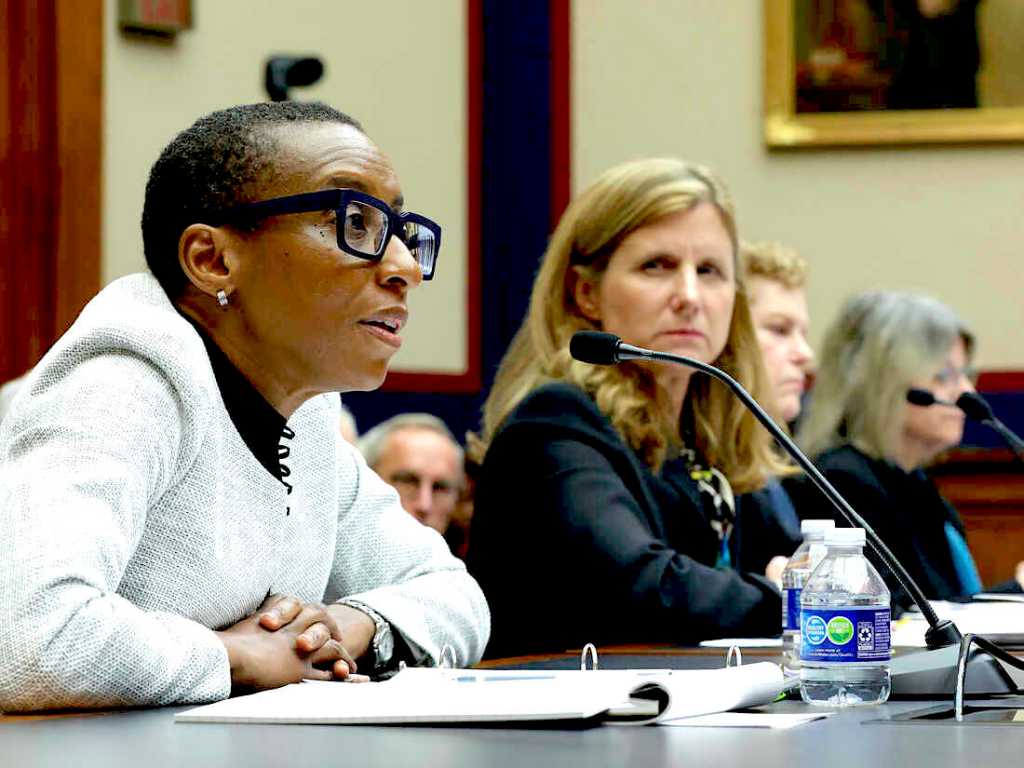
Photo Claudine Gay, president of Harvard, Liz Magill president of Penn, Pamela Nadell (professor of history and Jewish studies at American University), and Sally Kornbluth, president of MIT, testifying before the House Education and Workforce Committee, December 5, 2023.

Credit: Kevin Dietsch/Getty Images

Credit Where It’s Due: The Power of the Press

Last week in this blog I wrote—yet again—about the responsibility of the press to call out the threat that the Trumpist GOP poses to American democracy, instead of engaging in the outdated, pre-2016 faux objectivity and maddening bothsidesism that has helped bring us to this pretty pass in the first place. 

It’s a safe bet I’ll harp on that topic again before November 2024. (Mark your calendars.)

But in the interest of being fair and balanced (cough cough), I’d be remiss if I didn’t note some recent examples of the press doing exactly what I asked. 

In fact, the week that followed saw a veritable flood of articles on that very topic. “Après moi, le déluge” indeed, motherfuckers.  

I’m not saying my essay moved the national conversation, post hoc ergo propter hoc. (French and Latin in the same essay? Gott im Himmel!) I’m just saying that clearly I have my grubby little index finger on the pulse of the nation. Which is good, because I am saving the finger next to it for messaging members of MAGA Nation when they scream by me on the New Jersey Turnpike in their black pickup trucks, flying “Let’s Go Brandon” flags and blasting Lee Greenwood

In The New York Times, David Leonhardt had an excellent piece on the imminent threat of Trump 2.0, while The Bulwark’s Charlie Sykes published a column called “You Are Really Not Sufficiently Alarmed.” The Atlantic devoted an entire issue to the topic, featuring an all-star cast including Applebaum, Serwer, Foer, Packer, Gellman, Frum, Coppins, Dickerson, and more. 

Most widely commented upon of all, Robert Kagan had a long and terrifying piece in The Washington Post titled “A Trump Dictatorship Is Increasingly Inevitable. We Should Stop Pretending” that was so grim that it left numerous friends of mine in the fetal position all week. As a wakeup call—its obvious intent—it was powerful, to be sure, but for my money almost too defeatist and depressing, running the risk of making progressives throw up their hands in surrender. 

Kagan’s fellow WaPo columnist Greg Sargent certainly saw it that way, responding with a piece of his own titled “Enough With All the Fatalism About a Trump Dictatorship”: 

The impulse to sound alarms—to break voters out of their “it can’t happen here” doldrums—is understandable. But it’s also possible to take this too far, and here it’s worth registering an irony: Ruth Ben-Ghiat, a scholar of strongman rule, has noted that a time-tested tactic of authoritarian leaders is to disarm the electorate by suggesting their glorious triumph is inevitable.

“Authoritarians create a climate where they seem unstoppable,” Ben-Ghiat told me. “Creating an aura of destiny around the leader galvanizes his supporters by making his movement seem much stronger than it actually is. The manipulation of perception is everything.”

But we need not take sides in the Kagan vs. Sargent cage match: both have the same Paul Revere-like aim, differing only in how they think we best organize ourselves to forestall Trump’s return. (Sykes, too, subsequently tempered his position, with a follow-up called “The Case Against Despair,” writing that, “Alarm is justified. But fatalism is deadly.”)

So by all means, let’s wake up to the very real danger that Trump poses, and do something about it. But let’s not psych ourselves out and create a self-fulfilling prophecy that hands him power—again—by virtue of our own anxiety and paralysis. 

The good news is that the MSM are sounding the alarm at all. In fact, the sudden ubiquity of reportage on the topic was so striking that it became a story in itself, as reported by MSNBC’s Hayes Brown, who wrote that “Trump’s second term threats are the story of 2024.”

Will these pieces have any impact beyond the left-leaning chattering classes who were already scared shitless over the prospect of a second Trump administration?

I don’t know. But they’re a start.

A LOVE SUPREME

I hasten to note another recent example of how the American press did an outstanding job, if not exactly on the topic of the MAGA menace, then at the very least related to it, and that is ProPublica’s reportage on corruption in the Supreme Court. 

Strike that—I don’t want to tar the whole Mudville Nine. PP’s reporting concerned howling breaches of ethics by the two most right wing justices on the Court, Samuel “Abortion Ain’t in the Constitution” Alito and Clarence “Coke Can” Thomas. Those breaches including flying on private jets and going on all-expenses-paid fishing vacations on the dime of billionaire Republican donors who had business before the Court (Alito), and accepting gifts including luxury vacationsprivate school tuition for a grand nephew, and the purchase of his mother’s home by a different Republican billionaire donor (Thomas). Neither justice recused himself from the relevant cases involving those donors or their associates, nor even disclosed those gifts. And that’s not even getting into the activities of Mrs. Thomas, a prominent player in the attempt to steal the 2020 election. 

It goes without saying that if a liberal justice had done such things, Fox Nation would be howling for impeachment, if not the guillotine. (As it is, the best they can do is try to gin up a false equivalence, without a millimeter of traction.)

But Pro Publica’s work on these stories shows how journalism can actually have a concrete impact on our democracy.

As a result of that outstanding reporting, Congress got up in arms—because much of the American public got up in arms, at least the part that is not comatose, or in a pact with Satan—and began putting pressure on the Court to clean up its act. Congress even summoned John Roberts to testify, or should I say, politely asked, and John imperiously declined because, absent a subpoena, Supreme Court justices have that kind of privilege. But Roberts clearly felt the heat, because not long afterward he announced that the Court was instituting a written, binding code of ethics for its justices, something that had never been necessary in the previous 234 years of existence, when that quaint little thing called “shame” was still operative. 

I have little doubt that Alito and Thomas (and perhaps other justices as well) will continue to try to get around the system and allow money and influence to poison their duties: we are in scorpion-and-frog territory here. But all politics is about measures and countermeasures. This was a significant win, and it is already bearing fruit.

I hear your muttering.

Is this just a small thing, you ask, getting the Supreme Court to do the bare minimum, ethics-wise, that is required of almost every other federal employee? Au contraire. It’s a BFD, as Joe Biden would say…..and that dramatic, overdue, and fairly humiliating concession by Roberts and the Court is 100% due to the dogged reporting of the outstanding journalists at Pro Publica. 

In fact, let’s call them by their names: Joshua KaplanJustin Elliott and Alex Mierjeski. Well done, fellas. More, please. 

I note this example very deliberately, because far from rebutting my previous point about the shortcomings of the American press when it comes to the current democratic emergency, it is a demonstration of the vast good that the press can—and must—do.  

A TISKET, A TASKET

The press still has some sins to repent for, of course. Mehdi Hasan’s show was just canceled by MSNBC, robbing us of one of the sharpest progressive voices on American airwaves—hardly the act of a network that its right wing critics would have us believe is the left’s version of Fox. (NB—and more Latin: it ain’t, by a mile.)

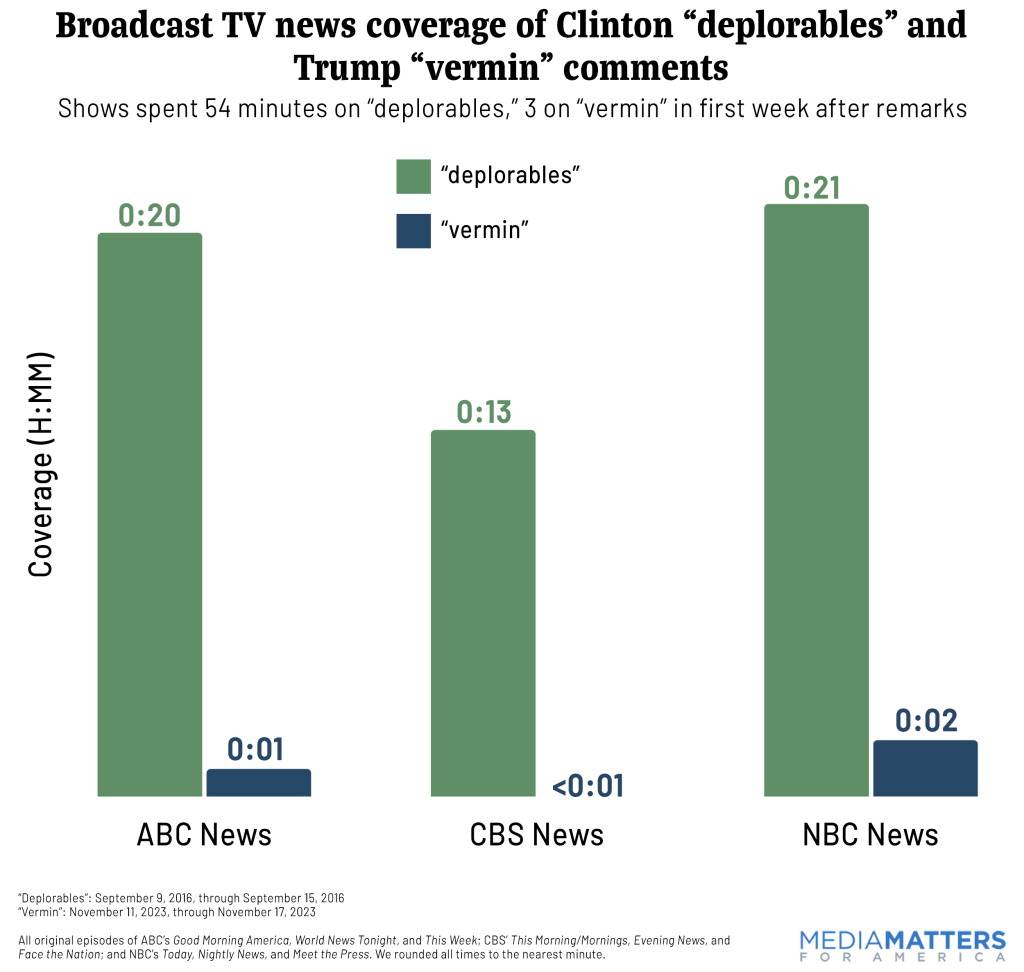
Meanwhile, Media Matters’ Matt Gertz compared the relatively little attention the mainstream US media paid to Trump’s recent comment calling his political opponents “vermin,” as opposed to the vast coverage of Hillary Clinton’s widely misunderstood “basket of deplorables” comment in 2016. 

The contrast is eye-popping—and outrageous. Media Matters found that the major US broadcast news programs “aired 54 minutes of coverage of Clinton’s ‘deplorables’ comment but just 3 minutes regarding Trump’s ‘vermin’ remark.” (See below.)

For what it’s worth, to my ears, Clinton was—correctly—applying the term “deplorable” to Trump’s neo-fascist, white nationalist supporters, not to conservative white people in general, even though the latter is how it was invariably reported. I longed for Hillary or her surrogates to point that out and own the remark, but they never really did. Trump, by contrast, was undeniably talking about anyone who dares oppose him, and in terminology that very specifically and deliberately recalled the Nazis’ characterization of their domestic enemies.

Kinda seems like the sort of thing that should be called to the attention of the American people, n’est-ce pas? 

We learned way back in 1990, via Trump’s ex-wife Ivana, that Donald had kept a book of speeches by his bedside—uh, another worrying tell. He now seems very clearly to be following the Mein Kampf model in telling us exactly what he will do if he regains power. 

If only there were a public institution devoted to spreading the word about such things.

KILLING CASSANDRA

I am not hard on the press for the fun of it, and certainly not—like the right wing—in an effort to destroy its credibility and the obstacle it presents to the autocratic project. On the contrary: I am hard on the press precisely BECAUSE I know the obstacle it presents to the autocratic project, and the good it can do in stopping that project in its tracks. We saw it with ProPublica and the Supreme Court. 

When it comes to the broader future of democracy at large, if we are to keep Robert Kagan’s dire prediction from coming true, we’re going to need a lot more of that over the next eleven months.  

Res ipsa loquitur.

***********

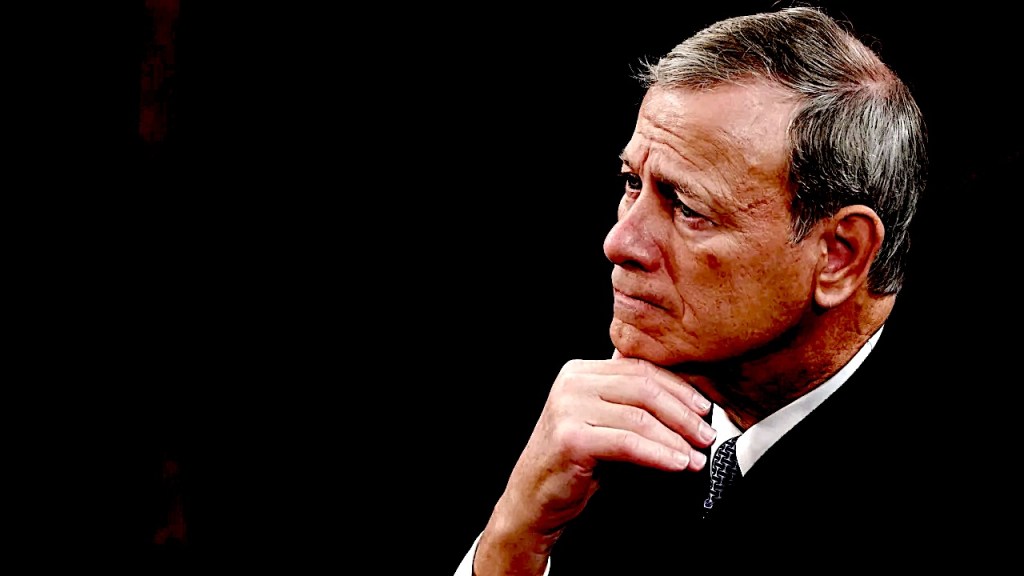
Photo: Chief Justice John Roberts. Credit: Sarah Silbiger/Bloomberg/Getty Images.

Thanks to Genie Smith for pointing me to the Media Matters reportage on Trump’s “vermin” speech contrasted with Clinton’s “deplorables” comment.

Copy editing courtesy of the intrepid Gina Patacca. 

Biden Shames the Press 

Among Americans who pay attention to politics, there is currently a palpable panic in Democratic circles that Joe Biden could well lose the 2024 presidential election. The opponent we fear can beat him is currently facing 91 separate felony charges in four different criminal cases at both the state and federal levels—not to mention additional civil suits—among them some of the most serious offenses imaginable for a public servant. And the evidence against him is close to overwhelming. 

Yet the race is terrifyingly close. Such is the desiccated and diseased state of contemporary US politics, a state for which that aforementioned defendant bears a great deal of responsibility. 

Luckily, Joe Biden has recently signaled that he intends to enlist a new and unlikely ally in his cause—an ally that can be found under the heading “Wretches, Ink-Stained” and their brethren in the electronic realm. That is a bold gambit, as thus far those folks have figured heavily in fomenting the very danger in which Joe finds himself in the first place. 

STOP THE PRESSES

Biden, corny ol’ fella that he is, has long been fond of telling voters, “Don’t compare me to the Almighty. Compare me to the alternative.” It’s become a hoary line by now…..but that doesn’t mean it’s wrong. 

The Atlantic’s Ronald Brownstein reports that last week the Biden campaign issued a press release that “urged the political press corps ‘to meet the moment and responsibly inform the electorate of what their lives might look like if the leading GOP candidate for president is allowed back in the White House.’” 

(T)hough neither the media nor the electorate is yet paying full attention, Trump in his 2024 campaign is regularly unveiling deeply divisive policy positions (such as mass deportation and internment camps for undocumented immigrants) and employing extremist and openly racist language (echoing fascist dictators such as Adolf Hitler and Benito Mussolini in describing his political opponents as “vermin”). Eventually, Trump’s excesses could shape the 2024 election as much as Biden’s record will.

With his callout of the press, Joe is challenging the media to highlight that stark choice for the American people. 

That exhortation speaks to a crucial truth: That the press must abandon the pre-2016 mentality that insists on reporting a presidential contest in “horserace” terms when one party is openly proposing the installation of an autocracy; that it must cease engaging in wildly inappropriate and dangerous bothsidesism when the very fate of democracy is on the ballot; that it has a responsibility to alter its antiquated obeisance to the great god Objectivity when one candidate and his enablers have ruthlessly exploited that ethos and inverted it into a weapon against Truth itself.

One would have thought the press would have learned from these mistakes in 2016, and to a lesser extent in 2020. But clearly it has not.  

The press is both under-covering Biden’s accomplishments and failing to highlight Trump’s monstrosity. To cite but one example, it is hammering Joe on favorite Republican talking points like his age, doing the GOP’s work for them, while failing to offer comparable coverage of Trump that presents a fair picture to the American people. 

(In Republican media, Biden is simultaneously derided as an “imbecile”—that is the precise word they use—and a criminal mastermind pulling all the strings in a vast conspiracy to undermine ‘Merica. A huge advantage of being in the right wing is the absence of any need to hew to logic.)

Biden is regularly the butt of jokes about his age and his alleged mental decline, but Trump is barely any younger, and his mental state is far more degraded and alarming. It’s a dynamic reminiscent of the press’s fixation on Hillary’s emails in 2016, while devoting a relatively paltry number of column inches to Trump’s own long history of outrageous corruption and malfeasance, a howling disservice to the voting public that distorted the entire campaign. 

In part, this disconnect is a function of the press’s natural inclination to go for the more sensational story in all cases, even at the expense of substantive and accurate reportage. The notion—relentlessly promoted by the GOP—that the press is left-leaning is demonstrably false. (If anything, the MSM tilts center-right.) But even more than allegiance to any given political ideology, the press’s prime directive is to seek out that which is juiciest and most attention-grabbing. 

As Molly Jong-Fast recently wrote in Vanity Fair:

Not only is the media more interested in covering Trumpworld than Bidenworld, but it seems like journalists are somewhat resentful toward the current administration for its disinterest in playing ball these past few years. Remember, Trumpworld was filled with blockbuster leaks and White House feuds, leading to increased subscriptions and sky-high ratings—the “Trump bump,” as it was called. “The media became addicted to the constant excitement and danger of Trump,” Guardian media columnist Margaret Sullivan wrote in an email. “Biden offers something apparently far less compelling: decency, sanity, and a sense of reasonable calm.”

If it bleeds it leads, right? 

Sadly, if we let Trump back into office, it will be democracy that is laid down on the blacktop and bleeding out, with no ambulances on the way.

WTF, AMERICA?

In throwing down this gauntlet to the press, is Biden trying to outsource his campaign’s job, asking the media to make an argument that is really the task of his own team? No, he’s just asking the press to do their own job as it is meant to be done.

Similarly, are we ascribing too much power to the press? Setting aside those mouthbreathers who thrilled to it, the ghastliness of the Trump presidency ought to be self-evident to any sentient American. If it is not, do we really believe that the mainstream media can change the country’s collective mind? 

Maybe not. But it doesn’t help when it aids the other side. 

We have all seen—and many of us shivered to our bones over—polls showing Trump beating Biden in a head-to-head rematch, including in the crucial swing states. Whether or not those polls are accurate, the fact that Biden is not beating Trump by high double digits is worrying all by itself. The idea that significant numbers of Americans trust Trump more on the economy, foreign policy, and immigration—three areas where, ironically, he is especially horrific—can only be ascribed to some combination of mass amnesia, ignorance, and willful self-delusion. Indeed, the idea that anyone would trust Trump on anything, but on those matters in particular, is hard to comprehend, as is the idea that anyone would want to return to the hellscape that were the years 2017-2020. 

The Bulwark’s Mona Charen writes:

While a second term of Trump will destroy democracy and potentially destabilize the entire world, these Americans either don’t know that, don’t believe it, or don’t care. Trump’s calls for internment camps, his interest in invoking the Insurrection Act on day one, promises of prosecution for political enemies, the probability he will pardon his own crimes (and the certainty that he will shut down federal investigations into them), and an overhauled government filled with cronies who will do Trump’s authoritarian bidding are not registering as a danger in these polls.

You would think that trying to overturn an election and leading a coup, encouraging the murder of your own vice president, stealing government secrets and recklessly waving them around at your golf club, kidnapping and caging children as a matter of national policy, licking Vladimir Putin’s boots, wantonly exploiting the office of the presidency for personal financial gain, being twice impeached for high crimes and misdemeanors, and demonstrating the depraved indifference to human life that led to hundreds of thousands of deaths during a global pandemic would, collectively, make a person un-electable.

But apparently not, in the good ol’ USA.

We know that despite Biden’s many impressive accomplishments, the broader American public consistently fails to give him credit. Just to review, those accomplishments include pulling the country out of a historic pandemic; deftly managing two complex foreign wars involving key US allies; overseeing an economic recovery at a speed few experts thought possible; restoring America’s badly injured global reputation and undoing the damage done by his predecessor; and passing landmark legislation in areas as diverse as semiconductor production; lowering prescription drug prices; addressing the climate emergency; promoting clean energy; and instituting the most comprehensive gun control measures in decades. And he has done all that in the face of an obstructionist—indeed openly seditionist—opposition party that refuses even to acknowledge that he is the legitimately elected president. 

That stinginess with credit is especially nutso when it comes to the state of the economy, which is actually doing quite well, even as a slim majority of the public actively believes exactly the opposite. Heidi Shierholz, president of the Economic Policy Institute, told The New York Times, that she had “never seen this big of a disconnect between how the economy is actually doing and key polling results about what people think is going on.” 

We also know that working against Biden in the 2024 presidential campaign is what the researcher David Atkins calls “thermostatics”: the American electorate’s reliable impulse to “throw the bums out” no matter who’s in power, a kind of built-in disadvantage to incumbency that serves as a counterbalance to its much-documented advantages. 

But there is some good news. In contrast to years past, negative views of the challenger look to figure more heavily in the 2024 race than the usual referendum on the incumbent, a phenomenon that the veteran GOP pollster Bill McInturff called unprecedented. In a recent poll by McInturff’s firm in cooperation with a Democratic partner and NBC, nearly three out of five voters said that their view of Trump would be their most important consideration in a Trump-Biden rematch. “I have never seen a number like this NBC result between an incumbent and ‘challenger,’” McInturff reported. “If 2024 is a Biden versus Trump campaign, we are in uncharted waters.”

A recent New York Times/Siena College poll also showed that swing state voters who currently favor Trump would flip to Biden if Trump is convicted of some of the 91 criminal charges he currently faces. I guess there’s more respect for law and order and the criminal justice system than previously thought. 

It is also worth noting that this is the first time since 1892 that both the (presumptive) nominees of the two parties have occupied the highest office in the land. (Brownie points for anyone who can name the two men in that contest, and no Googling. Answer below.) In other words, as former Obama campaign manager Jim Messina says, 2024 is a matchup of two incumbents. The electorate doesn’t have to imagine what a Trump presidency would look like: we’ve already seen it. That denies Donald the advantage of hypotheticality and the tabula rasa onto which dreamy voters can project their fantasies, an advantage from which most presidential challengers benefit, thermostatics wise.  

Let’s just hope enough voters remember the nightmare that was the first Trump administration, and make it the only such one. 

THE HORROR

In the first years after Biden took office, while COVID-19 was still raging, there was a fella who lived near my father’s house in Bucks County, PA who had a homemade sign by his mailbox that read FAKE PANDEMIC, REAL TYRRANY. 

The precious bodily fluids mentality that held that COVID was a hoax was mind-boggling enough, but that was to be expected. It was the attendant claim that Joe Biden—perhaps the most avuncular American politician since Hubert Humphrey—was somehow a dictator that really blew my mind. 

This is a man who kept in place the US Attorney that his predecessor appointed to investigate his own son, and didn’t lift a finger even when his own Attorney General gave that same man special prosecutor status; a man who studiously avoided any involvement in righteous investigations into the manifest criminality of that presidential predecessor; a man who labored mightily to provide federal funds and to pass legislation to help states that fiercely opposed his presidency, and that continue to demonize him.

If Biden is a tyrant, he must have finished at the bottom of his class in Dictator School. 

And yet, in MAGA World, Dark Brandon—per above, simultaneously a borderline vegetable and an all-powerful master puppeteer—remains the antichrist. Could there be a more perfect example of the polarization of contemporary America? 

As Mona Charen notes, it’s hard to fathom those who are unbothered by the prospect of a second Trump administration, let alone those actively excited by the idea. But Trump’s red-hatted true believers I can at least understand, even though I disagree with them with every fiber of my being. I even understand the motivations of loathsome and cynical Trump supporters like Lindsey Graham, despicable though they are. What I don’t understand, and what drives me crazy, are those low-information apathetic folks who shrug at the prospect of Trump 2.0, along with the too-cool-for-school crowd who claim it doesn’t matter who’s in the White House, and repeat the lazy canard that “both candidates are bad,” or whinge that they’re tired of politics and polarization and all this drama. (NB: That’s exactly what the GOP wants you to feel. Cui bono?) 

When I watch SNL make smug, halfwitted jokes denigrating Biden, I always think the same thing: Keep it up, bozos—you’ll get Trump again.

Is it unsporting to ask comedians not to go after obvious comedic material, low-hanging or otherwise? Maybe. But like shoddy journalism, cheap jokes, hidden beneath the disingenuous cloak of being an “equal opportunity offender,” are impossible to justify when they contribute to fascism on the rise that threatens to devour us all. By all means, let’s use satire for its intended purpose, but contextualized in truth-telling, something that more ambitious comedians often lay claim to, court jester-like. Biden can take a joke; a second Trump administration would see James Austin Johnson and his dead-on impression of The Once and Possibly Future Despot clapped in irons.

You think I’m kidding? Wait and see.

In a recent piece for Slate with the unimprovable title “The Horror of Who Is Still Listening to Trump,” Dahlia Lithwick describes the Trump of 2016 as a thought experiment. (“What if we allowed a guy who talks like this to run for and secure the US presidency?”) The Trump of 2023, she writes, is much, much scarier: “How many people who once struggled to condone and parse and rationalize the opaque notions floated by a mediocre demagogue can now do so knowing his full intentions and ability to achieve them, without breaking a sweat?

Turns out—a lot.

Lithwick looks back on Trump’s outrageous statements of the past, going back to 2015, writing of the bitter irony that now the “violence is both more overt and insane, and it also goes down even smoother in 2023, despite being more recognizable as a real threat.”

What Donald Trump is now expressly promising is perfectly clear—just look to his Veterans Day “vermin” speech; in an earlier statement that immigrants “come from mental institutions and insane asylums.…It’s poisoning the blood of our country”; and in promises to “aggressively deport resident aliens with jihadist sympathies.” Gone are the gauzy illusions that he just wants to make America safe. Gone are the double and triple meanings that we in the press used to parse for days. Donald Trump used to be described as inadvertently saying the quiet parts out loud, but now he is quite purposefully saying the fascism on the stump. Now he’s openly calling for mass deportations and the murder of his opponents and martial law.

Rank senility notwithstanding, Trump’s word choice and manner haven’t changed appreciably in the years since he took office. What has changed—what has morphed unrecognizably—is how it’s being received. Which is why we should stop asking why the message is still allowed to happen and start asking when it became distilled down to constitutional elevator music.

DEEP DARK TRUTHFUL MIRROR

I would caution here that we should not let bad numbers cause us to throw up our hands. A sober recognition of the challenges of Biden winning re-election are in order, but defeatism is of no use, and in fact, counter-productive to say the least. 

If the American people return Trump to office next November, even by means of a deeply flawed, antiquated, anti-democratic system that favors the minoritarian party, we will have no one to blame but ourselves. Even given the inherent inequities of that system—the Electoral College, extreme partisan gerrymandering, the poisonous infusion of dark money, voter suppression, and outright electoral subversion—if we cannot get ourselves together sufficiently to muster our collective outrage, get out the vote, and keep this fascist out of the White House for a return engagement, we will deserve what we get.    

The media’s role in facilitating that catastrophe cannot be ignored. 

As the political scientist Brian Klaas recently wrote in The Atlantic (after Trump called for General Mark Milley, Chairman of the Joint Chiefs, to be executed for criticizing him), “The man who, as president, incited a violent attack on the US Capitol in order to overturn an election is again openly fomenting political violence while explicitly endorsing authoritarian strategies should he return to power. That is the story of the 2024 election. Everything else is just window dressing.”

Good on Joe Biden for calling the press out on that point. Spread the word. 

************

Photo: Pablo Martinez Monsivais / Associated Press

The last time two US Presidents faced off in an election was 1892, when Grover Cleveland, a Democrat who had been the 22nd president, defeated incumbent Republican Benjamin Harrison in a rematch of their 1888 contest.

“War Crime” Is a Redundancy (Almost)

Keeping up with the news coming out of Gaza is daunting, so I can’t remember where I read it, but I recently saw someone reject the use of the term “war crime” because, as they put it, “all war is a crime.” 

That would put the phrase in a club along with hot water heater, tuna fish, Lake Tahoe, and ATM machine. 

I don’t entirely agree, but points for a thought-provoking way of putting it. 

I am not a pacifist, but I do believe that most people—and certainly the majority of political leaders—misunderstand the limitations of violence as a tool of policy, and are far too eager to turn to it. (Go read Clausewitz’s On War, in the original tongue if possible. I’ll wait here for three years while you learn German.) 

Those limitations are purely practical in nature and require no appeal to altruism or morality. That ought to be enough. But even in war there are moral boundaries. The war in Gaza offers a perfect, if horrifying, demonstration. 

AUTEUR THEORY

Though it may come as a surprise to some, there is a thing called the law of war. Is it naïve to believe in its efficacy and importance? On the contrary. It is naïve to believe we can wage war without it.

It’s true that non-state actors—guerrillas and insurgents—often disregard it, as those laws are written by the powers-that-be and favor the advantages that they possess. But as the thinker Michael Walzer recently wrote in a cogent essay for the Atlantic, “even the oppressed have obligations,” chief among them, obeying proscriptions against forms of violence that we as a species deem too barbaric even for war.

Then again, those powers-that-be often disregard those proscriptions themselves. 

There are simply things that human beings generally consider beyond the pale, even in combat. Deliberately targeting civilians. Killing prisoners. Taking hostages. The use of land mines or chemical weapons. Rape. Torture. Many combatants break those rules: some aberrantly, in the rogue actions of the proverbial “bad apples”; others regularly, as a matter of deliberate policy. Revolutionary movements blow up train stations and kill all comers. Uniformed air forces bomb cities without regard to civilian casualties. Intelligence officers in the service of various causes engage in “enhanced interrogation techniques.” (Even the term “beyond the pale” itself is freighted, deriving from the 12th century Norman conquest of Ireland, wherein the occupiers differentiated between the “civilized” territory that they controlled, demarcated by a palisade, and the barbaric region beyond it, not to mention the allegedly barbaric people who populated it.)

The atomic bombings of two Japanese cities were acts of monstrous barbarity that, whatever their strategic purpose, can’t plausibly be said to have been aimed at military targets, except in the broadest Napoleonic “total war” definition of the term. That fiction is widely accepted in the US; in Japan, not so much. Even before Hiroshima, during the firebombing of Japan that preceded it, US Army Air Force General Curtis LeMay told his deputy LTC Robert McNamara that if the Allies were to lose the war, he was certain they would all be tried and hanged as war criminals. 

Was that LeMay—the famously cigar-chomping bomber general who was the inspiration for not just one but twocharacters in Dr. Strangelove—acknowledging the savagery of what he and his comrades were doing? Or simply acknowledging that history is written by the winners?

(Fun fact: two decades later, McNamara went on to play a prominent role in another aerial campaign in Asia, one in which the by-then-retired LeMay suggested that we bomb the enemy “back into the Stone Age.”)

The murderousness of the Japanese Empire is often cited as justification for Hiroshima and Nagasaki, as is the calculus of the invasion-that-never-was. We’ve waded into that debate previously in this blog. But neither rationale erases the fact of some 100,000 civilian non-combatants—men, women, and children—annihilated in a matter of collective seconds. Even more horrific, the Final Solution was the most large scale mass murder in human history, unless you want to make a case for Stalin’s pogroms, or the Cultural Revolution. Its perpetrators certainly believed that they too were justified, even if no sane human agrees, nor the verdict of history. 

But I refer you again to who writes it.

No nation that suffered an attack like that of October 7 could reasonably be expected not to launch a military response. Recall, if you will, the American mood on 9/11. Then note that this attack on Israel was far worse, relatively and strategically speaking. But the nature and form of that military response comprises a vast spectrum. Recall also the self-inflicted disaster into which that American response of 22 years ago eventually descended.

The underlying complexity of the Middle East dilemma remains unaddressed (as usual, Adam Serwer is very cogent on the topic), but the horrific acts committed by Hamas cannot be justified as legitimate warfare, no matter the injustice of Israel’s treatment of the Palestinian people. Likewise, the Israeli government’s massacre of innocent civilians in retaliation via indiscriminate bombing, the cutting off of food, fuel, water, and electricity even to hospitals, and the slaughter of Palestinian noncombatants including thousands of children cannot be justified in response. And a chicken-or-the-egg argument about who started the bloodshed, decades, or centuries, or even millennia ago, gets us nowhere. 

None of this is acceptable. 

LINGER ON, YOUR PALE

If keeping up with the news coming out of Israel and Gaza is daunting, being there in the middle of it is infinitely worse. Even from the safety of this side of the Atlantic, it is harrowing to worry about family or friends on the ground there and caught up in this horror, or even just strangers, not to mention the general state of humanity.

The Palestinian journalist Mohammed R. Mhawish writes of this, the fifth war in his lifetime, which he assumes will not be the last. “We Palestinians have been asked to honor the humanity of the civilians killed by Hamas in Israel. I can do that, without hesitation. No civilian deserves to lose their life, and I have all too much experience of the suffering that war inflicts. But I cannot accept that it is right for the humanity of only one side of this conflict to be acknowledged. Three thousand children have died all around me in the past 20 days. Are their lives not worth mourning? Do they deserve to only be remembered as statistics?”

Keeping up with the news coming out of Israel and Gaza is also fraught because it is rife with misinformation and disinformation, both deliberate and accidental (that’s what those terms mean, by the by) and because coverage in the American media is particularly weak, and public dialogue is frequently woefully uninformed. The idiocy of callow college students who think it’s fashionable to chant “from the river to the sea”, and believe that Israel deserves anything it gets, is matched only by the ghastliness of American right wingers far from the fight who think Gaza should be bombed into oblivion, irrespective of civilian casualties. 

Meanwhile, outrage over Israel’s military offensive has been taken as a greenlight by cretinous, old school anti-Semites—who care not a whit about Palestine or the Palestinian people—to do things like spray paint swastikas on the LA apartment building that is home to Renee Firestone, the 99-year-old Auschwitz survivor who is the star of my wife’s 2015 documentary The Last Laugh, a hate crime that happened last week. Amid all the saber-rattling by the GOP, let’s not forget that a party that claims to be staunchly pro-Israel and not anti-Semitic (“We’re not, we’re not, we’re not!”) somehow remains allied with alt-right neo-Nazis and the tiki torch-toting white nationalists of Charlottesville. To be fair, I don’t know whether those particular assholes who vandalized Renee’s home are far left or far right (it could be either), but I do know that the right manages to hate Jews and Muslims in equal measure. Anti-Arab hate is being openly fueled by morons like Fox News’s Jesse Watters, even as a six-year-old Palestinian boy was stabbed to death in Illinois by his own landlord (who also tried to kill his mother). 

Still, there are voices of sanity out there, even in America. Retired Navy chief petty officer, terrorism expert, and erstwhile MSNBC commentator Malcolm Nance, currently serving in the International Legion of the Ukrainian army, had a superb post last week on Twitter—sorry, X—with the lede, “ProTips for newly minted Palestine ‘allies’.” Even more prominently, a BBC interview with the former Israeli peace negotiator Daniel Levy went viral recently, including this exchange:

BBC PRESENTER: The Israelis would say, well look, we are defending ourselves, we are targeting Hamas targets in Gaza. We are trying to put an end to what we believe is a terrorist organization once and for all.

LEVY: Do you really keep a straight face when you say that? These kinds of lies can’t be allowed to pass. 

Do you think terrorist organizations embedded in populations who are denied their most basic rights are ended once and for all in a military campaign? Does that happen in history? Can someone credibly tell me that when the leadership of a country says we are cutting off food, electricity, water, all supplies to an entire civilian population that they’re targeting militants? I’m sorry, these kinds of lies can’t be allowed to pass. And when you tell yourself the lie, it leads to the wrong policy. 

Renegade Democratic presidential candidate Dean Philips got a similar lesson in geopolitics last week when a citizen at a town hall in New Hampshire got him to agree that the KKK are terrorists, then asked why we don’t bomb Alabama.

Levy went on, to the BBC:

If anyone told me that what the militants did on the weekend was a legitimate response to years and years of occupation. I would say no, you’re wrong-headed. You’ve lost sight of humanity and reality. And if anyone tells me that what Israel is doing in Gaza today is a legitimate response to what happened on the weekend, it’s exactly the same. And yet they are saying it, and yet the international community is, and people need to challenge them on it because it’s a lie and we’re war-mongering if we allow them to get away with it.

Levy also published an op-ed in the Irish Times recently, co-authored with the Palestinian human rights attorney Zaha Hassan, begging the “outside world” to “walk Israel back from the abyss” and not “be part of the choir of incitement.” They write: 

We both unequivocally condemn the targeting of civilians, no matter who they are, as a violation of the laws of war. Full stop. International law defines the conduct of war and the parameters for what constitutes legitimate self-defence. It does not say “anything goes” or that one war crime justifies another. It is also clear that occupied people have the right to resist structural violence associated with military occupation – again, within the confines of legal prohibitions.

Here’s what Levy told Mother Jones a week and a half ago:

I’ve simply tried to point out something that should be very simple: One war crime is not met by another. That’s the path to hell, which is precisely the path we’re on now.

Especially at a moment like this, where emotions are so raw, and understandably so, where the temptation is to lash out in all directions, and throw every rulebook and every restriction out the window, doing so is not only going to cause a devastating impact on civilian lives on the Palestinian side—after the already devastating impact on Israeli civilian lives—but it can also take you down such a dangerous, unpredictable, and escalatory path. War is horrific. That’s why there are rules that govern the conduct of war. But even when you play within those rules it’s still horrific.

If you want to take seriously the idea that no one who is a civilian should be targeted without distinction, then you cannot be indifferent to something that is premeditated in targeting civilians in Gaza. There’s an argument that says: Hamas started this, Hamas embeds itself amongst the population, so anything that happens to the Palestinians of Gaza will be laid at Hamas’ door. You cannot cut off water, food, fuel, electricity, medical supplies, humanitarian systems, bomb pretty much indiscriminately, force the relocation of half the civilians in Gaza and say that’s OK. It’s patently not.

PEDICIDE IS NOT WAR

In a conflict like this, extremists on both sides—as the term “extremist” implies—will argue that the sins of the other side are so horrendous that they justify anything and everything in return, even the most horrific acts humanly imaginable. That is a recipe for apocalypse, and nihilism. It is also simply not so. 

So “war crime” is not quite a redundancy, and we would do well to remember why. So long as war remains an instrument of geopolitics, there will be boundaries in how it is conducted, the respect for which—or crossing thereof—demands our attention.  

In the present moment, modern telecommunications allow us to see the horrors of this contemporary war with our own eyes, from the GoPro footage of Hamas attackers to the daily images of the damage from Israeli air raids that have rubblized much of Gaza and killed thousands of civilians, operations that—as I’ve written previously—rob the Netanyahu government of its already suspect claim to any kind of moral credibility. Do we need more evidence of this catastrophe before we say it must stop, and the bellicose voices of war stilled, and efforts toward a workable, just, long-lasting political solution to the region’s deeper problems pursued?

As a number of sane voices have noted, we are beyond lucky that Trump is not President of the United States right now. Notwithstanding his initial praise of Hamas’s allies in Hezbollah and his attacks on Bibi—which, uncharacteristically, he was forced to walk back (that’s how bad they were)—were he in office he would surely be among the biggest hawks advocating the worst kind of criminal response, possibly even an atomic one, and goading Netanyahu toward a wider war in the region. (Not that it takes much goading.) 

But that danger has not passed, because, as we know all too well, Trump might be President yet again. Or as the New Republic put it, “Imagine Handing this F***d-Up World Back to Donald Trump.”

It’s fitting we end with the words of another President, from what seems like some long-lost era eons ago: Jimmy Carter, architect of the 1978 Camp David accords, from his 2002 Nobel Peace Prize acceptance speech

“We will not learn to live together in peace by killing each other’s children.”

**********

Photo: Senior members of the Nazi Party—including Goering, Hess, von Papen, Speer, Streicher, Jodl, von Ribbentrop, and Kaltenbrunner—on trial for war crimes in Nuremberg, 1945.

The Penalty Kick as Ontological Dilemma

During last winter’s World Cup (remember when they held the World Cup in the winter?), the Washington Post ran a piece prosaically titled “Soccer Players React In Milliseconds In Penalty Kicks. How Do They Do That?” 

The obvious answer was: Because there is no such thing as a continuous Self.

To say the least, I was very disappointed that the piece never did get around to noting that fact. 

Let’s redress that glaring omission now.

KICKING A BALL AND PRETENDING TO BE HURT

The Post piece, part of its Brain Matters strand, was by Richard Sima, a Hopkins- and Harvard-trained PhD in neuroscience who has also written very memorably about the neurological basis for the stickiness of fake news. Sima wrote that “penalty kicks at the professional level strain the limits of human reaction time,” describing the process in physiological terms:

(Goalkeepers) need to defend a goal that is 24 feet wide and 8 feet tall against a kick from just 12 yards away. That kick is also fast—traveling, on average, at 70 mph. From the time the kicker’s foot makes contact, the ball takes about 400 milliseconds to reach the goal—roughly the amount of time it takes to blink….

The human eye needs time to register visual information, which the brain’s visual areas then need to process. This visual information needs to be relayed to the brain’s motor cortex which then tells the muscles how to move. Adding up the time from each of these biological relays, humans have a visual reaction time of about 200 milliseconds.

Then—the dive. The movement itself can take 500 milliseconds if the goalkeeper wants to cover the post….

As a result, roughly 80 percent of penalty kicks score.

That percentage only makes sense, since a penalty kick is given when the defending team has committed a foul so egregious that, absent it, a goal would likely have resulted. “There’s no pressure on the goalkeeper,” Sima quotes Greg Wood, a sport and exercise psychologist at Manchester Metropolitan University Institute of Sport. “If they save one, they are ‘a hero,’ since they weren’t expected to save it.”

I was a goalkeeper myself in my schoolboy days, and I loved playing that position, though at 5’10” I didn’t have a long term future in the sport. But the theater of the penalty kick has stayed with me. (Bonus points for fans of Die Angst des Tormanns beim Elfmeter—“The Goalie’s Anxiety at the Penalty Kick”—the 1970 novella by Nobel Prize winner Peter Handke, and the film adaptation by Wim Wenders.) A regular one-off penalty is dramatic enough; a match that is level at the end of 120 minutes of play, including extra time, and has to be decided by penalty kicks is even more nailbiting.

And don’t even get me started on the Panenka.

But here’s where it starts to get really interesting (I promise).

Sima reports that professional goalkeepers typically dive before the ball is even struck—about 220 milliseconds before, according to one analysis of 330 PKs. They do so based on microscopic cues they pick up by watching the penalty taker as he or she prepares to shoot, as well as research done before the fact regarding the patterns of where a given player likes to put the ball. (Some keepers, like the perennially angry English international Jordan Pickford, who plays his club football for Everton in the Premier League, keep crib notes on the water bottle they are allowed to have in the goal. In a 2006 World Cup quarterfinal, Germany’s goalie, Jens Lehmann saved two penalties against Argentina after consulting notes he kept in his sock.)

But Sima’s recent piece focuses exclusively on physiology, which is indeed interesting. But as a neuroscientist, he surely knows that that is really just a sideshow.

EASY TO BE HARD

The point is that the goalkeeper’s decision is actually made so fast that it precedes any conscious knowledge of it, in the same way that you don’t “decide” to pull your hand off a hot stove, or to slam on the brakes when a deer runs in front of your car, or to move your head when a flying mallet is coming at it. (Happens to me all the time.) All that decision-making happens under the hood, and we are aware of those “decisions” only after the fact, with the illusion that we consciously made them.

Let’s take this further. It’s not just “hand on the hot stove” decisions that are made this way. All our decisions are. What shirt to wear today, where to go to college, who to vote for, who to marry, what to name our children, whether or not to trade the cow for that handful of magic beans. So to be precise, yes, a “decision” has been indeed made—it’s just that what we think of as our “self” did not make it. It was a subconscious response resulting from the activity among the 100 billion neurons in the human brain.

Here we go into the so-called “hard problem,” a term memorably coined by the Australian philosopher David Chalmers. The expression distinguishes the relatively “easy” problem of understanding the mechanics of how the brain works (yes, so easy!) from the harder, indeed almost unfathomable problem of understanding how a mass of gray tissue can make us feel jealousy, or love, or righteous anger, why we swell with pride at watching our kid in the school play, laugh at Richard Pryor’s 1982 concert film Live on the Sunset Strip, or cry when we hear “Let It Be,” or any other aspect of the human condition. And also, more broadly, how we come to carry around this conception of a unified, continuous persona that constitutes the being each of us thinks of as Me.

In other words, what is the nature of consciousness itself?  

Philosophers, neuroscientists, and Buddhist monks spend their entire lives trying to sort this topic out, and even as longwinded as this blog generally is, I can’t possibly summarize it all in just a few pages. So please excuse this cursory survey.   

Most people instinctively think of “themselves” as an immutable entity, often distinct from our physical selves. In religious terms, that continuous essence is often thought of as “the soul.” Even non-religious people very often have this idea of themselves as some sort of metaphysical being, even if they don’t use the spiritual term. We often hear people speak dismissively of the corporeal body as just “a suit of clothes” that this Self (or whatever you want to call it) walks around in. The place you most frequently hear that trope is at funerals, since a central part of that comforting delusion is the belief that this non-physical essence survives after death, be it through ascent to heaven, or reincarnation, or some other sort of afterlife. It’s also the source of a belief in ghosts.

In fact, it is so common to think of this “me” that directs the physical actions of the body that we usually don’t even question it. (The novelist Julian Barnes described it as the notion of “the submarine captain in his turret.”) But any such explanation inevitably leads us into the infinite regress of what that abstract entity is constructed from. Turtles all the way down and all that.

Counterintuitive though it may be, when you begin to tease it apart, this conventional idea of Self begins to crumble, especially if you’ve downed a couple of ayahuasca-and-Red-Bulls.

Don’t believe me? Famously, in 1983, the neuroscientist Benjamin Libet conducted experiments in what he called “readiness potential,” measured by the pressing of a buzzer, that proved that our sense of conscious decision-making actually comes milliseconds after a given physical movement has been initiated. In other words, our sense of a conscious, continuous Me is just an illusion floating on top of a subterranean, autopilot-like series of decisions made by this meatsack of flesh that comprises our body, the brain very much included.

Plenty of folks have come along since then to dispute the implications of Libet‘s findings, with varying degrees of credibility of their own. But his study remains a striking affront to the conventional concept of a conscious, decision-making Self.

In other words, the most famous maxim in all of philosophy, Descartes’ “Cogito ergo sum”—“I think, therefore I am”—is dead wrong. If I may offer a suggestion, it would be more accurate to say, “I think, therefore I think I am.”

FREE WILLY

Once the myth of the Cartesian theater is obliterated, on the other side you will find materialism, in the philosophical sense, which dispenses with all that mumbo jumbo and asserts that consciousness derives only from purely physiological phenomena.

Per Chalmers, we just can’t begin to explain how.  

But once you (“You”—ha!) accept materialism, it’s but a short hop to the realization that there’s no such thing as free will.

The New York Times recently published an interview with Robert Sapolsky, the esteemed Stanford biologist, neuroscientist, and Robert Plant doppelgänger, who is an adamant disbeliever in free will. (He’s also a MacArthur “Genius” Grant winner. But Plant can hit a C♯6 and looks fetching in a half shirt.) Sapolsky has a new book out on the topic called, Determined: A Science of Life Without Free Will, which I confess I have not yet read. (The neuroscientist Sam Harris explored this same issue in his own slim but fascinating 2012 book Free Will. I do recommend that.)

Speaking to the Times, Sapolsky called free will “a completely useless definition,” but acknowledged that rejecting it is a very hard thing for humans to do, as it “completely strikes at our sense of identity and autonomy and where we get meaning from.”

“Every living organism is just a biological machine,” he told the Times’ interviewer. “But we’re the only ones that know that we’re biological machines; we are trying to make sense of the fact that we feel as if our feelings are real.”

“If you have myths about free will,” Sapolsky quipped, “keep it to how you’re flossing your teeth.”

Don’t get me wrong: I’m not suggesting there is some sort of external determinism, driven by an almighty deity or anything else, and neither are Sapolsky or Harris. There is indeed an entity coming to such decisions independent of any kind of predestination, supernatural activity, or silliness such as fate. But that entity is a hive mind consisting of billions of neurons firing at a subconscious level, the result of an unknowable combination of genetics, of hormones, of environment, of conditioning—but most definitely not the thing that you generally think of as “You.” Even how those billions of neurons combine to create those decisions is a mystery—part of the “hard problem”—but the one thing we can say for certain is that there is no unifying consciousness at its core directing it. No beret-and-jodhpurs-clad director sitting in the theater issuing instructions to our fingers and toes and eyes and mouth. No submarine captain gazing through the periscope in the conning tower.

GHOST IN THE MACHINE

I know Woody Allen is canceled, but let me tell you an anecdote that Christopher Walken told me. (It’s in my forthcoming book, Groucho Marx and Other Namedroppers I’ve Discussed with Dick Cavett.) According to Walken, when they were making Annie Hall, he and Woody were riding in a car on the way to the set and Walken was carrying a paperback book that was on the bestseller lists at the time. Woody saw the book and asked what it was about. (Imagine Christopher Walken’s famous cadence, imitating Woody Allen’s famous one.) Walken answered, “Reincarnation,” and Woody replied, deadpan: “Yes, reincarnation would be good news for all of us.”

The desire to cheat death, to cling to a belief in an eternal life in one form or another, and an attachment to a sense of one’s being that will endure into that eternity, is at the heart of the delusion of Self. But another pathway into that immortality is to dispense altogether with the need to separate ourselves into discrete “things” engaged in a Darwinian, every-soul-for-itself existential struggle. One can go much further down this rabbit hole, into the question of where artificial boundaries between one human being and another—or among any physical objects—begin and end, and into quantum physics, where those boundaries start to disappear altogether. (Another round of ayahuasca Red Bulls, please.)

In addition to reincarnation, Walken apparently has an abiding interest in such matters. On a movie I made with him a few years ago, he ad-libbed a joke, which actually made it into the finished film. It goes like this:

“What did the Dalai Lama say to the hot dog vendor?”

“Make me one with everything.”

(Think about it.)

Accepting and embracing the reality of materialism, the finality of death, and a Buddhist-like rejection of the existence of the Self as it is usually understood is an incredibly liberating experience. The closest thing it can be compared to is the hackneyed but still profound feeling of staring up at the stars and understanding that each of us is so incredibly, infinitesimally small in the vastness of the universe. In fact, it’s even more powerful than that, as it involves not just a recognition of our smallness, but of our non-existence full stop.

If consciousness is merely an illusion, if there is no continuous Self but only an ever-changing dream of one, if there is no ego that requires ruthless defense and advancement, if the universe will eventually disappear up its own anus and there will be no trace of any of us left to be remembered by anyone or anything, what remains but the present moment and the experience of being here now, illusory though that is? Far from creating a moral anarchy where we can’t be held responsible for our actions, that is a world where there is only empathy and a sense of oneness and the imperative to live as justly and decently as humanly possible, not in futile pursuit of some eternal theological reward, but simply for its own sake.

In other words, the age-old puzzle of whether there is such a thing as free will is simply the wrong question. 

It’s not a matter of whether or not you have free will—it’s that there’s no such thing as “You” to have it in the first place.

And that’s how goalkeepers decide which way to dive.

**********

Photo: Brazilian goalkeeper Alisson Becker of Liverpool, making a crucial PK save against Chelsea’s Mason Mount in the 2022 FA Cup final. Which the Reds went on to win. #YNWA

Dick Cavett joke stolen from David Letterman and the NBC Bookmobile. But Chris Walken did tell me that anecdote. 

Beware the Backlash

Bottom line upfront, as they taught us bright-eyed young infantry officers in Building Four in what is now known as Ft. Moore, GA:

In asymmetrical warfare, where the two combatants have mismatched degrees of materiel might, it is standard for the insurgent force to carry out heinous acts of barbarism that provoke a draconian reaction from the more well-resourced side. 

The purpose of this approach is two-fold. 

The first is to attract the attention of the besieged party, and wider world, even if that reaction is horror and condemnation. 

The second is to bring on a backlash that ultimately benefits the original attacker. 

Hamas’s shocking attack on Israel of last Saturday, October 7, is a textbook example. The brutality of the attack—elderly Holocaust survivors in wheelchairs taken hostage, beheadings of children, bodies dragged through the streets, and more—has been widely reported. No matter what the political agenda, these are acts of pure evil: war crimes, irrespective of who committed them, or for what cause. It’s difficult to see how that helps Hamas, or its global approval rating. 

For the moment, therefore, Israel very much has the sympathy of the world. 

(Mostly. Hardcore anti-Semites will never take Israel’s side on anything, while hardline critics of the Israeli government will continue to insist that its sins outweigh anything that its enemies perpetrate against it. However, even they will likely admit that Hamas’s brutality has probably set the Palestinian cause back a hundred years.)

But once Israel begins what promises to be a ruthless counterattack—and it’s only barely begun—that sympathy will almost certainly begin to evaporate. That is an immutable law of warfare. 

After Israel has cut off the power and fuel and food and water in Gaza, and images of the resulting hunger and disease and medical calamity begin to appear on international television, after its fighter planes turn Gaza City to rubble, after IDF infantrymen and tanks begin killing people, and civilian casualties inevitably occur, that pro-Israel solidarity will quickly start to crack. The world will soon forget the horrors of October 7 and concern itself only with the horrors of Tel Aviv’s response. 

We saw this same dynamic after 9/11. On September 12th, the headline in the French newspaper Le Monde read, “Nous sommes tous américains”—“We’re all Americans.” (From the French!) But it was not long before the massive US military response—and specifically, the pointless, deceitful quagmire of Iraq—had the world back to hating us again.

Which was exactly as Bin Laden wanted it. Hamas too. That only makes its attack more appalling….but it will not protect Israel from condemnation.

VERY FINE PEOPLE ON BOTH SIDES REDUX

Hamas is a brutal, fascistic organization that oppresses even its own people, and is overtly dedicated not just to the obliteration of Israel as a state but to the explicit extermination of Jews as a people. Even in the Arab world it is widely reviled. Those Westerners who take its side in this crisis in any way are divorced from reality.

That is not to say that the Netanyahu government is saintly. It is a danger to Israel’s future as a democracy, as the widespread protests by hundreds of thousands of Israelis last year showed. Its treatment of the Palestinian people is indefensible and unsustainable, and an obstacle to a lasting political solution in the region that is just and acceptable to all sides. But there is no comparison between the two combatants in this new war.

In fact, Hamas’s attack has been a massive gift to Bibi, deflecting his other troubles and rallying the Israeli people around him. Only a few months ago, Israeli reservists were threatening not to show up for duty—an unimaginable protest in a country that valorizes military service even more than the US. (And in Israel that valorization is not just a matter of “thank you for service” yellow ribbons and F-16 flyovers at NFL games.) 

Now all those reservists have their boots on and the Galils in hand and are heading to the Gaza border, angrily. 

Indeed, Hamas’s fortunes and Bibi’s are intertwined. The last thing the former wants is peace, let alone the establishment of a Palestinian state. What Hamas benefits from is continued violence, chaos, strife, and division, and they’re doing everything they can to make sure matters stay that way, a pattern we’ve repeatedly seen in the region. (See: the assassination of Rabin.) Do you think they want Bibi out of power and replaced by a moderate democrat who doesn’t invite widespread outrage both domestically and internationally? Of course not. There is a strange symbiosis between Hamas and the Likud government, not unlike that of Al Qaeda and the American neo-cons at the turn of the millennium (as masterfully detailed in Adam Curtis’s 2004 BBC documentary The Power of Nightmares).

It is difficult to expect Israel to play by Marquess of Queensbury rules in fighting a foe that gleefully does not. But rightly or wrongly, the world will hold Israel to a higher standard. Yes, a sovereign state is expected to behave better than a criminal gang, but that ethos rarely survives the first angry shot….particularly when Israeli soldiers are so understandably driven for revenge, and will be operating in a densely packed urban area against an irregular opponent it’s hard to imagine that a counterattack ordered by Benjamin Netanyahu is going to be measured and careful, particularly when he would love to position himself to the right wing, both at home and abroad, as The Man Who Saved Israel. 

The conversation is further complicated by the mutual bad faith of anti-Semites who—in all situations, not just this one—dishonestly insist that their criticism of Israel is merely anti-Zionism and not racially motivated, and of others who just as dishonestly use the charge of anti-Semitism to protect various Israeli governments from legitimate critique when it is warranted. 

I am not calling for Israel to turn the other cheek. It cannot. But with Hamas cowardly hiding among the mass of the Palestinian people of Gaza, using its own brethren as human shields, it will be all but impossible for the IDF to conduct this war without inflicting massive bloodshed and suffering on the civilian population. “So be it,” say some: “Hamas does that to its enemies without so much as a batted eye.” But it is not a matter of being unwilling to descend to its level. Insurgents have fought this way since the Boer war, if not before, and the armies fighting them have faced these same dilemmas from Algeria to Northern Ireland to Iraq. The guerrilla behaves monstrously, is largely unaffected by condemnation, provokes brutality in response, then benefits from the opprobrium that rains down on its foe. 

I don’t have an answer for this riddle—I am only predicting the pattern that we are about to see repeated. 

FESTIVAL OF IGNORANCE

Israel’s intelligence failure in not anticipating this attack is a separate matter, though I suspect Bibi will dodge it just as deftly as Dubya did in 2001.

But as George Packer points out in The Atlantic, the 9/11 comparison goes only so far. Hamas is situated right on Israel’s border, and with the aid of Hezbollah, Iran, Syria, and others, poses an existential threat to the Jewish state that Al Qaeda never did to the United States. (The scale of casualties in the October 7 attack also dwarfs that of 9/11, per capita.) That means that Israel’s response to this latest crisis, unlike America’s in the so-called Global War on Terror, is far more urgent and dire.

The world would be far better off if Hamas ceased to exist, but it’s hard to see how that can be accomplished without untold death and destruction in Gaza and the attendant condemnation it will bring. The idea that Israel is going to be able to minimize civilian casualties during the coming air and ground war, even with a quasi-evacuation of the battlespace, strikes me as naïve. That fantasy—predicated largely on a misplaced faith in high tech—has plagued us ever since the Persian Gulf war, from which I returned to find that both the American people and the punditocracy had been deceived (or self-deceived) into believing that war had become a bloodless video game. That delusion has never entirely gone away, not even after it was thoroughly disproved in the bloody debacles of Afghanistan and the second Iraq invasion.

But we as a nation have never been especially sophisticated when it comes to understanding warfare, or political conflict of any kind. And in America, the subject of Israel in particular invites a lot of ignorant bloviating from all sides. 

As usual, Trump, with clockwork reliability, showed up on Fox to attack his friends (Netanyahu, in this case) and praise the bad guys (saying that Hezbollah “are very smart”). He also claimed if he were still POTUS the US intel community would have pre-empted the attack. It’s only a matter of time before he suggests that Israel should drop an atomic bomb on Gaza. 

Israel’s communications minister, Shlomo Karhi, succinctly called Trump’s remarks “shameful,” adding that, fortunately, “We don’t have to bother with him and the nonsense he spouts.” Would that the US could say the same. Asked by a reporter if Trump’s comments make it clear that he can’t be relied on, Karhi replied, “Obviously.” I hope American voters who think Trump is a friend to Israel will remember that thirteen months from now.

(Anyway, I thought Jared fixed the Middle East, didn’t he?)  

Meanwhile, the clown car of Republican dysfunction continues to careen across American politics, even during a crisis. The inability of House Republicans to hit the pause button on their general chaos even amid this catastrophe and get it together sufficiently to vote for aid to Israel is about as damning a demonstration of GOP unfitness to lead as you can possibly imagine. One hopes that, too, will be remembered at the polls come November 2024.

But I wouldn’t hold my breath. Some right wing talk radio that I dipped into recently was blaming the Hamas attack on—hold on to your hat—Biden, and also Obama, and not on even the flimsiest of grounds, but simply because (I kid you not) that they are both “communists.” I know radio is an old-fashioned medium, but I didn’t realize its radio waves were still reaching us from the 1950s. One jock complained that Biden had not even condemned the Hamas attack, even though he pointedly had, days before, and in terms so pro-Israel that a friend of mine on the left was already furiously accusing that same Joe Biden of being complicit in war crimes that Israel hadn’t even committed yet. (No mention of whether this was why his dog Commander was banished from the White House last week.) 

But complaining that right wing talk radio is ill-informed is like complaining that Limburger cheese smells bad.

For those looking for a sober, detailed, well-informed survey of the issues, I invite your attention to this interview in Politico with former special envoy Dennis Ross, one of the key US negotiators in the Oslo peace process, director of the State Department’s Policy Planning Staff under George H.W. Bush, special assistant to President Obama, and special advisor on Iran to Hillary Rodham Clinton when she was Secretary of State. (Thank you, Justin Schein, for posting it.) Among Ross’s insights is his confidence that Hezbollah and Iran were intimately involved in the planning of the attack, and the possibility of the former actively entering the fight in the north.

For further civilized and thorough responses by some of our countrymen, go here (thank you Ori Hanan Weisberg for writing it, and Aaron Naperstak for re-posting it) and here (thank you Sabrina Gordon). 

THE OCTOBER WAR + 50

I don’t want to dog pile on Francis Fukuyama and his 30 year-old theory (which he has clarified over the years anyway), but with two major, incredibly brutal land wars raging simultaneously in Ukraine and Gaza, it has never felt less like “the end of history.”

This isn’t Israel’s first “October war,” of course. A half-century ago, my dad was the senior aide-de-camp to the commanding general of the XVIIIth Airborne Corps when Egypt and Syria attacked Israel, almost 50 years to the day of the Hamas attack. I remember being ten years old and standing outside the kitchen of our quarters at Ft. Bragg, North Carolina, eavesdropping on my parents as they talked in hushed tones after Nixon had put the corps on alert for deployment to the Middle East, as well as sending warships to the Med, recalling nuclear-armed B-52s from Guam, and raising the Pentagon’s alert posture to DEFCON III. 

(Actually, it wasn’t Nixon’s doing, as he was drunk, and consumed with the ongoing fallout of the Saturday Night Massacre at the time; Kissinger, Haig, and Schlesinger were essentially running the country. And actually my parents were not talking in hushed tones: my mother was highly upset and my father was trying to downplay the danger.)

Israel won that war, and it may win this won too, but Hamas’s attack could still net gains. Israel’s counteroffensive may well destroy it, the same way that the Global War on Terror destroyed Al Qaeda, or the United States’ response to Tet 1968 destroyed the Viet Cong both on the battlefield and as a viable political entity going forward. But both of the movements represented by those “defeated” players still triumphed, in part because of their suicide bunts, with the organizations themselves merely replaced by like-minded successors that arose from their ashes, such as ISIS in the case of the GWOT, or allies, in the case of the VC.

As incredible as it may seem, and as evil as it is, Hamas may have scored a similar strategic (if pyrrhic) victory here. By no stretch of the imagination is Hamas a legitimate representative of the Palestinian people, and its obliteration will not solve the “Palestinian problem” or bring lasting peace to the region. As Dennis Ross notes, irrespective of October 7 and the counterattack that is only beginning, we will still have to engage in a substantive peace process in Israel and Palestine, working with players of good will on all sides. (That leaves Hamas out.) It would stretch the union rules of Pollyanna-ism to suggest that this crisis might have a silver lining in the end of that terrorist organization at the same time it injects new urgency into the global push for a lasting and fair two-state solution. It would be ironic if an organization that does nothing for the Palestinian cause accidentally advances it, at the cost of its own existence. But either way, Israel is going to have a very hard time coming out of this war without intense criticism for its response.

In the meantime, the people of Gaza—men, women, and children, young and old, the aged and infirm and able-bodied alike, mothers and fathers and infants and grandparents—are about to be flattened with the full force of a modern military engaged in a 21st century version of Napoleonic total war. The people of Israel—men, women, and children, young and old, the aged and infirm and able-bodied alike, mothers and fathers and infants and grandparents—have already been subjected to horrific violence that beggars the imagination. And all this, of course, is just another chapter in a bloody history of warfare in that region that has been raging for almost 80 years. 

I do not mean to engage in a specious bothsidesism. Hamas and Israel are in no way going to be equally to blame for the final outcome of this unfolding catastrophe. But the human suffering on all sides is going to be immense. And unfairly or not, over time, Israel, as a legitimate state, is going to receive more condemnation than the non-state murderers who started this thing.

All warfare is ultimately won in the information space, and Israel could easily wind up losing this one. As horrified as the world is right now by what Hamas did, don’t be surprised if, a year from now—if not sooner—opinion swings, unfairly or not, toward the nation that was the victim of that attack. 

That’s another thing they taught us in Building Four.

********

Photo: Aftermath of Israeli airstrike on Gaza City, October 9, 2023, in response to Hamas attack of two days before. Precious little respect for John Lennon’s birthday or his suggestion to give peace a chance. 

Credit: Mahmud Hams/AFP via Getty Images

Kafka Would Blush

Hey, hive mind: is there an app for keeping track of Trump’s various criminal and civil trials? (Ideally one that does not require me to update my operating system.) Between the Mar-a-Lago documents case in south Florida; the January 6thcase in Washington DC; the RICO case in Fulton Country, Georgia; the affair-with-the-porn star/hush money case in New York City; the Trump Organization tax fraud case also in New York; and the second E. Jean Carroll defamation and sexual assault case (in which a judge ruled against Trump for a second time just today), I’m having trouble keeping up. 

It’s on my mind, because this week the Washington Post’s Ruth Marcus reported on Trump’s latest legal maneuver in the most serious of those cases (though not necessarily the one that puts him in the most legal jeopardy), the January 6th prosecution brought by special counsel Jack Smith. She writes:

Any day now, Donald Trump’s lawyers are poised to unveil the former president’s shoot-the-moon defense against election-related charges: that Trump possesses absolute immunity from prosecution for what they claim are his official actions as president.

That, of course, has long been Trump’s first and last line of defense: “I am king.” But in order to present that argument to a judge in hopes of having her throw the January 6 case out, his lawyers have been compelled to dress it up in legal mumbo-jumbo. What kind of mumbo-jumbo you ask? Marcus explains:

Trump’s lawyers plan to argue that the actions cited by federal prosecutors as criminal violations were within the scope of Trump’s constitutional duty as chief executive to “take care that the laws be faithfully executed.” 

I’ll repeat that, since I’m sure some of you are slapping the sides of your heads to make sure you read right. 

Trump intends to claim that mounting a months-long disinformation campaign to undermine public confidence in the vote ahead of Election Day 2020, conspiring to overturn the results once he lost; using the power of the presidency to spread the lie that he was robbed; strong-arming state election officials to cheat on his behalf ex post facto, concocting a scheme to send false electors to the Electoral College; interfering with the actions of the US Congress in carrying out its duty to affirm the results; and finally, when all else failed, summoning an armed mob to attack the US Capitol to try to stop the certification of his opponent’s victory and murder his own vice president and other members of Congress in the process, somehow constitute his own presidential job requirement to “take care that the laws be faithfully executed.”

Wow. Every time I think Trump has hit rock bottom in the audacity trench, he picks up a shovel and begins to dig.

THE BOLD AND THE BEAUTIFUL

Marcus calls this legal gambit “bold,” which is generous in the extreme. Some alternative adjectives: brazen, shameless, arrogant, outrageous, infuriating, headspinning, bloodboiling, ridonkulous. Let’s try some nouns: the height of chutzpah, nerve, and gall; a waste of taxpayers’ time and money; reflective of a mind-blowing sense of entitlement; contemptuous of the legal process and democracy full stop; and an obvious and transparent procedural ploy that’s an insult to the court in which he will have to stand trial. 

Shall I go on?

This motherfucker has spent his whole life leveraging his obscene privilege and wealth to avoid repercussions, in the process making a mockery of the justice system over and over, and he’s trying to do it again. (Meanwhile, he sticks to his call for the death penalty for the young men now known as the Exonerated Five, even after they were proved innocent in the 1989 Central Park jogger case. Back then Trump took out full-page ads in four New York City newspapers, including the Gray Lady herself, calling for their execution. Apparently, like a lot of Republicans, he’s very selective about whom the criminal justice system should go after, irrespective of their guilt or innocence.)

In any event, given the amount of legal jeopardy Trump is in, and his self-evident panic at the prospect of going to prison, we should not be surprised that he and his attorneys are trying everything they possibly can to avoid that fate, no matter how batshit. Still, this ploy beggars belief. It’s Nixon’s already risible “when-the-president-does-it-it’s-not-illegal” defense taken to an extreme that even Tricky Dick would not have dared broach. 

And the particulars in no way make it less astonishing. 

With characteristic Trumpiness, The Former Guy’s lawyer John Lauro called Trump’s attempts to overturn the election “within the penumbra of executive action….of what President Trump under the constitution was required to do as president.” (Pause to take in jawdropping irony.) Lauro also declared that the special counsel’s case “essentially indicts President Trump for being President Trump and faithfully executing the laws and executing on his take care obligations.” (Pause again. Pour bucket of cold water over head.)

What could be Trumpier than claiming that he had an absolute right as president—nay, a duty—to overturn the election? (NOTE: Applies only to presidents named Donald Trump.) It’s a dip into the surreal, Bizarro World parallel universe of authoritarianism associated not only with Kafka, but also Lewis Carroll and George Orwell…..except in this case, it’s the defendant engaging in a theater of the absurd. And we are forced to indulge him, because that’s the way the justice system works, even when the defendant is a despicable cretin who has exploited and abused the goodwill of that system his entire life and gotten away with it.

So far. 

LEGALLY BLONDE ON BLONDE

The notion that trying to overturn a free and fair election and hang onto power in defiance of the will of the people—let alone through violence—is a normal function of the US presidency does not deserve to be dignified with serious consideration. So is it a waste of time to delve into whether there is even a scintilla of legal justification for this argument?

Marcus explains that in a 1982 case called Nixon v. Fitzgeraldfittinglythe Supreme Court ruled 5-4 that “presidents possess absolute immunity from civil suits for damages arising from their official actions, both while in office and after they leave.” The court also affirmed a wide berth for what constitutes “official actions.”

But not wide enough to include an autogolpe.

Trump’s previous lawyers (a big and not very exclusive club) have tried this defense before, and recently—specifically, to shield him from civil cases involving injuries suffered during the Insurrection. But in February 2022 US District Judge Amit Mehta ruled that the precedent set in Nixon v. Fitzgerald did not preclude such suits. Marcus: 

Mehta noted that Trump’s responsibility under the ‘take care’ clause did not extend to the certification of presidential electors, in which the president plays no assigned role. And, he said, while speech “is unquestionably a critical function of the presidency,” that does not insulate all presidential speech.

He cited the example of a president who touts his accomplishments at a campaign rally but also instructs the crowd to punch a protester in the face. “These are unofficial acts, so the separation-of-powers concerns that justify the President’s broad immunity are not present here”…. 

Trump, he said, was acting with “an electoral purpose, not speech in furtherance of any official duty.”

That decision is being appealed. 

But this case concerns completely different kinds of actions on Trump’s part, ones that put him in far hotter legal water.

(Those) lawsuits focus on the “bully pulpit” aspect of the presidency, in this case Trump’s tweets and his speech on the morning of Jan. 6 urging his supporters to go to the Capitol and “fight like hell.” But the Jan. 6 indictment doesn’t hinge on Trump’s remarks. Rather, it sweeps in efforts to organize fraudulent slates of electors and to pressure state officials not to certify the election results—acts that appear far afield of Trump’s presidential responsibilities.

Appear?

Let’s also note that the Nixon decision concerned only civil charges, not criminal ones.

(T)here has historically been little doubt that presidents could face criminal liability for their actions—only debate about whether that could take place while they were in office. Alexander Hamilton wrote in Federalist 65 that a president impeached and removed from office “will still be liable to prosecution and punishment in the ordinary course of law.”

Not clear why Hamilton’s remark didn’t rhyme. 

Trump recently made a similar “absolute unfettered power” argument apropos of a separate legal threat, the Mar-a-Lago documents case, telling the execrable WaPo columnist Hugh Hewitt: “I’m allowed to do whatever I want. I come under the Presidential Records Act….At trial, I’ll testify.”

I look forward to that. If his lawyers let him get on the stand (can they stop him?) and he says that, even before the super-friendly Judge Aileen Cannon, it’s hard to see how that doesn’t sink the SS Trump like the Titan submersible on its way to join the Titanic at the bottom of the North Atlantic. 

NUREMBERG MON AMOUR

While I have no doubt that Trump really does believe he’s above the law, and that he and his lawyers would love for the court to agree and toss the case, it’s unlikely those lawyers think this is going to work, even if their deranged client does. Their real goal, of course, is to delay the trial—currently set for this coming March—until after the election, and ideally, forever. Running out the clock is the standard, go-to trick Trump has used ad nauseam throughout his entire lawsuit-strewn life. And pretty successfully, I am disgusted to say.

Only slightly less brazen than Trump’s argument is Mark Meadows’ claim that he was “only following orders” (German accent optional), just doin’ his job, trying to overturn an election and that sort of thing—ya know, regular White House Chief of Staff stuff. Many of his co-defendants have made similar arguments, predicated on the idea that they were simply acting at the direction of the president and carrying out what they believed were legitimate job-related tasks. It’s a position that the legal system—like the law of war—has resoundingly slapped down time and time again over centuries of jurisprudence, and will presumably do so again in this case. Being an obedient foot soldier in the commission of crimes is no defense, nor is ignorance of the law (“I forgot armed robbery was illegal”), nor a genuine but mistaken belief in the rightness of what one is doing. 

More to the point, we know that many of these defendants are not genuine at all in making those claims, that they knew very well that what they were doing was illegal, since a large number of them are fucking lawyers.   

But Trump’s own lawyers are operating in a whole ‘nother realm of taurine manure in attempting to extend this same stance to the boss himself. And when I say “Trump’s lawyers,” I mean Trump himself, as it’s obvious that he insists on charting his own (frequently losing) legal strategies, and demands that his attorneys do as they are told if they want to keep their jobs. (Many—Bartleby-like—ultimately decide they’d prefer not to.) 

It also seems clear that he personally dictates the verbiage of some of the motions that his various attorneys have filed in various cases over the years, filled as they are with irrelevant ranting about his victimization du jour, rambling complaints about the “stolen” election and accusations about the villainy and/or mental illness of his opponents and even the judges to whom the motions were presented, not to mention braggadocio about his big, beautiful presidency and how his fingers aren’t really short, they’re not they’re not they’re not! 

(All the lawyers do is remove the CAPS LOCK.)

In this latest episode, Marcus reports that Lauro has said he will file “a very complex and sophisticated motion regarding whether or not this court would even have jurisdiction over this case.” (Italics mine.) 

That’s a nice one: insulting the court even as they brag about how smart their filing will be. (Spoiler alert: it won’t.) But that’s another standard part of the Trump M.O. After being hit with RICO charges in Georgia last month, a huffing and puffing Donald announced on Truth Social that: “A Large, Complex, Detailed but Irrefutable REPORT on the Presidential Election Fraud which took place in Georgia is almost complete & will be presented by me at a major News Conference at 11:00 A.M. on Monday of next week in Bedminster, New Jersey.” That report, he promised, would be so convincing that all charges would immediately be dropped. (Spoiler alert  #2, in case you DVR’d it to watch later: they weren’t, and not simply because he canceled the press conference and produced no such report.)

Trump’s empty bravado would be comic were we not so regularly tortured with it, and were it not so damaging to the rule of law.   

RED CARD FOR TIME-WASTING

The odds that the courts will side with Trump on this motion are low. But the fact that he intends to bring it at all, and that we will have to deal with it, is maddening. 

What other absurd claims will Trump make that we have to indulge? He could claim that he is the 172nd reincarnation of the Egyptian boy-king Hotepchednezzar, the eternal Sun God, with dominion over all the birds of the air and fish of the sea and all the creatures who walk upon the land on two legs or four, and therefore not subject to the laws of mere mortals. Would we have to humor that assertion, too, and let it wend its way through the courts before we proceed with grownup business here on Earth 1? 

As Marcus notes, even if this outrageous ploy is doomed to fail, its function as a stalling tactic is the bigger threat. “In the civil litigation over Trump’s immunity, Mehta ruled in February 2022, the appeal was argued in December, and there’s still no decision. If Trump’s goal is to delay, he might be able to win by filing this losing motion.”

It’s taken two years just to bring these various indictments against this man who has demonstrated a lifelong contempt for the rule of law and an imperial belief that he is above it, even as he has been the howlingly undeserving beneficiary of that very system over and over and over again. Now, when he is finally beginning to be held accountable for the first time in his miserable life, we should not let him game the system once more in a serpentine attempt to evade justice yet again. 

Judge Tanya Chutkan is clearly a no-nonsense jurist who has no time or patience for bullshit. That has been her record and her reputation and she is living up to it. Let’s hope that, seeing this motion for the shameless delaying tactic that it is, she makes short work of it, prevents the accused from engaging in further chicanery, and proceeds with the people’s business….which is to say, bringing this disgraceful excuse for a human being to justice and making him answer for his crimes. 

As the pharaohs like to say: so let it be written, so let it be done.

**********

Courtroom sketch by Jane Rosenberg