Things Trump Supporters Have Taught Me

MAC34_TRUMP_TOURISM_POST01

Having written this blog for several months now, I’ve had a lot of opportunities to interact with Trump supporters. Spoiler alert: They’re not fans. But I’ve learned a fair amount from those interactions. (I doubt they have. Their attitude is definitely not one of appreciation of an opposing viewpoint or enthusiasm for informed debate.) I’m sure many of you have had similar encounters and experiences.

Let’s take them by category….

THE SCREAMERS

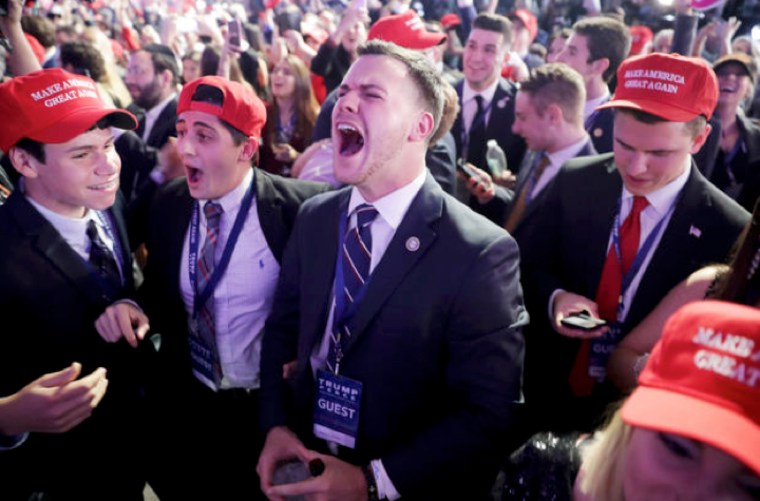
Most of the Trump supporters who write me are very brief, very angry, and very obscene. Their posts are usually on the order of: “You’re a moron.” (Also: jackass, asshole, clown, and many other non-complimentary epithets.) They seem to have a special fondness for the word “moron,” though, which Rex Tillerson evidently shares. And as with Rex, profanity accompanies their posts about half the time.

I’m not sure why they feel the need to make an ad hominem attack with no other substantive content. If I reached out to everyone I thought was an asshole just to let them know I felt that way, I wouldn’t have time to do anything else. The specific insult is also surprising to me, since going into this I thought I’d be much more frequently called a commie, un-American, or things of that sort. I do get called that stuff, but not as often as I am accused of being just plain dumb.

Naturally, we have to ask if this is just a matter of projection, given that one of the chief criticisms of Trump supporters is that they are stupid….a criticism we are often told is condescending, counter-productive, and ironic considering that they won the election and we lost.

It would not be surprising to me if Trump supporters were sensitive to that line of attack and therefore quick to lash back reflexively the same way their hero does. (“I’m not a puppet—you’re the puppet!”) Their insults do seem to carry a strong whiff of anti-intellectualism and an indictment of smartass book learnin’ at the expense of “common sense,” as right wingers define it.

Perhaps we could settle this if we all take IQ tests.

THE SCREAMERS PART DEUX

Admittedly, the people who reply to blogs are a self-selecting group skewing heavily toward bombthrowers, so I am not saying these correspondents are representative of all Trump supporters, or even a majority of them. But they are definitely reflective of a certain anger and animus out there in spades.

What’s especially interesting to me is that these people almost never try to make an argument for Trump or refute anything I’ve written about him, though I frequently invite them as politely as I can to do so and defend their position. I do this not because I’m a good person—I’m not— but in an attempt at rhetorical jiu-jitsu: to disarm them, to give them nothing to push back against, and to shame them by responding to their bile with kindness. I don’t want them to be able to say “See: liberals are just as nasty.” (When they go low, I go high…..but only so I can pour molten lava on their heads.)

Occasionally some do take me up on the offer. (If all they want to do is sling insults—which is much of the time—there’s no conversation to be had.) Sometimes they even calm down enough that we can have an actual civilized discussion of issues, although those discussions still remain pretty hostile and often circle back to name-calling (by them, that is; see above: I’m a moron). Sadly, I’ve never had anyone concede a point or even express appreciation for the vigorous debate. I usually try to sign off by noting that we’re all Americans who presumably only want the best for our country, even if we disagree on what that is and/or how to achieve it, and I wish them well.

Still waiting for any of the Screamers to return that sentiment.

THE SCREAMERS: PART TROIS

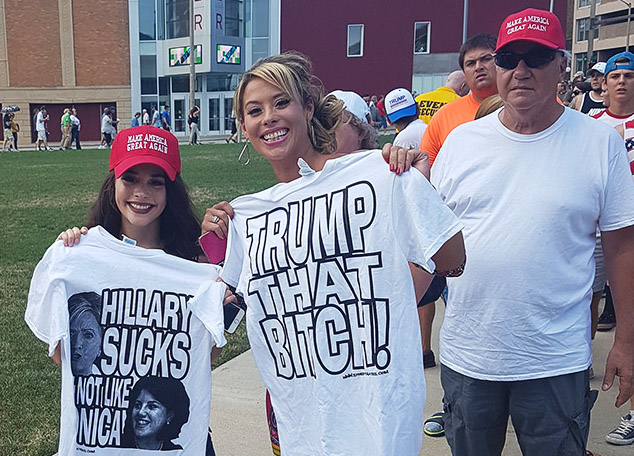
In terms of the Screamers’ actual beliefs, to the extent that they express them, it’s the usual menu of grievances against “socialism,” Islam, Obama and Obamacare and all things Obama, political correctness, Hollywood, gun control, taxes, intellectual and cultural “elites,” and liberals in general. No surprise there’s also a heavy dose of hollow patriotism and mindless jingoism as well. Thinly veiled racism is a given often as not (sometimes not so thinly veiled), especially if you pay a visit to their own social media accounts. Not every Trump supporter evinces it overtly, and in fact most of them get very irate at the suggestion that there is any racially-motivated component to this administration or their support of it. But to support Trump is by definition to be comfortable with a certain amount of racism, bigotry, and xenophobia. That is part and parcel of who is, and what he ran on, and what he has done since taking office. You can’t back this guy and not in the process condone that, if only unconsciously. The people who take umbrage and insist that that is not the case are living examples of the very phenomenon they angrily reject—a kind of Marianas Trench-deep denial.

But far and away the thing that animates these folks the most is their absolute, unequivocal, white-hot hatred of Hillary Clinton. It comes up over and over, even now, long after the election is behind us and we ought to have moved on. She is a bête noire to whom they cling with almost suspicious fervor.

The issues they have with Hillary are not even in the realm of arguable criticisms about which rational people can disagree or debate. Largely they are based on utter lies, representing the bitter fruit of decades of aggressive demonization, misogyny, and character assassination. It is depressing to see how well that campaign against her worked, which suggests that we will see it deployed again against other politicians in the future. And of course, it is depressing to see such behavior rewarded with the Presidency.

The other thing worth noting is that none of these people believe there is a whit of truth to the allegations that Russia interfered with the election.

Let me be clear about that. Not only don’t they believe that Trump or his associates colluded with Russia, they don’t even believe that the Russians on their own tried to influence the election. And let us remember that in order to maintain that position, they have to wantonly disregard the conclusion of all 17 US intelligence agencies, preferring instead the word of Vladimir Putin.

Their staunch resistance to even the possibility of Russian meddling is something we can chalk up to extreme tribalism. Needless to say—as I regularly point out to them—if Hillary had won the presidency and there was even a fraction as much evidence of Russian involvement—even unilaterally, let alone the proven hanky panky between her team and the Kremlin that we’ve seen from Team Trump—she would already be in shackles on her way up the steps to the guillotine.

More alarming, more than a few of these folks have said to me that even if there was proof that Russia meddled with the election, they wouldn’t care. “If that’s what it took to keep Hillary out of the White House, that’s fine with me.”

This of course is a jawdropping admission—not only as evidence of the depths of their pathological hatred of Hillary, but as a proclamation that flies in the face of the traditional right wing claim that theirs is the party of patriotism, strong defense, and rock-ribbed national security. These people have irrevocably forfeited the high ground on that count—not that that claim was ever legitimate, but they have voluntarily exposed it for the cruel charade that it is.

I always point this hypocrisy out to them. They never ever address it.

THE AGONIZED

Beyond the Screamers, I occasionally encounter a Trump supporter who seems to be in genuine pain, born of real unease with the man (which they will sometimes cop to, sometimes not), but not enough to turn their back on him, at least not yet. When pressed, this category of Trump supporters will invariably say that whatever Donald’s flaws, they simply could not vote for Hillary, usually accompanied by a bunch of urban myths about her being disbarred, or running a child porn ring out of a pizza parlor, or absconding with all the White House furniture in early 2001. Thus they too are motivated largely by their loathing for her.

Need I mention the irony that these fake stories are themselves very possibly the products of the selfsame Russian disinformation campaign (or at least fanned by it) that Trump Nation steadfastly refuses to believe exists?

On one occasion, an unusually overwrought Trump supporter repeated to me a long-discredited lie about Hillary. When I presented her with a Snopes article debunking it, she responded that she now no longer trusted Snopes. When I asked why she would ignore the findings of a non-partisan fact-checking organization whose credibility was so solid, she replied that she preferred to come to her own conclusions. Which is exactly the problem.

Wild falsehoods about Benghazi are a particular sticking point for a lot of Trumpkins, proving that the multimillion dollar, taxpayer-funded witchhunt that the GOP pursued for years purely in order to damage her (as committee chairman Rep. Kevin McCarthy R-CA kindly admitted) did in fact work. The loss of life and martial circumstances of that incident make it the perfect vehicle for flag-waving right-wing sanctimony and weaponized outrage, the facts be damned. In another bitter irony, just this past week four US Army Green Berets were killed in an ambush in Niger that is shrouded in mystery similar to that of Libya in 2012. I eagerly await the grueling taxpayer-funded Congressional investigations, non-stop drumbeating by Fox News, and bloodcurdling howls for accountability from outraged conservatives over that incident.

Many of the people among the Agonized are religious, and inexplicably see Trump as some sort of defender of their Christian faith against the cause of secularism—or Islam— that they believe the Democratic Party represents. This absurd position makes no sense by any interpretation of Christianity, neither the charitable one in which humility, forgiveness, and service to the poor are paramount, nor the Bible-thumping version in which opposition to vices like sex, gambling, divorce, and usury are the rule. How the most amoral libertine greedhead imaginable became the standard-bearer of evangelical Christianity is beyond me, but the statistics bear it out. (White evangelicals went for Trump by 64 points, more even than they went for Romney or McCain or Bush, again attesting to the sinister subtext of race.)

Then again, old-time religion has always highly susceptible to con men and hucksters, from Elmer Gantry to Jimmy Swaggart to Jim Bakker. But those charlatans at least had the common decency to pretend to be pious and hide their hypocrisy. If you set out to make a human being who best embodied the exact opposite of everything Jesus Christ is supposed to stand for, you’d probably come up with somebody a lot like Donald Trump, and the fact that evangelicals overlook that is more an indictment of them than of him.

For my money, this is the final nail in the coffin of Christian credibility in American politics. I don’t ever want to be lectured on morality by these folks ever again.

Notwithstanding all hat, I do have some sympathy for the Agonized. Despite their incredible cognitive dissonance—indeed, because of it—they are genuinely in pain and confusion and searching for answers. I’m encouraged that they see at least some of the problems with Trump; maybe that displeasure will continue to build to a breaking point. But again I am deeply saddened at the level of irrational hatred toward Mrs. Clinton, which as with the Screamers, runs so deep that it can’t be dislodged by reason or logic or facts, alternative or otherwise, even if it is expressed with somber headshaking rather than the firehose-like use of the word “cunt.”

Let me point out here that I don’t have an inherent contempt for these people. Far from it. I hail from the same demographic as many of them: from a conservative background, in the South, out of churchgoing families, and the military. I don’t come at this with outsider animosity. But for that very reason, I don’t give these folks any slack either, none of that “salt of the earth” condescension you sometimes find among the chattering classes. I know where these folks come from and of what they are made. They ought to be better than this.

THE ONES WHO SHOULD KNOW BETTER

Beyond the Screamers and the Agonized, I also know a few Trump voters who defy the usual stereotypes of angry bigot, illiterate redneck, or Hillary-hating evangelical (nose-holding or otherwise). It’s not a big group, and some of them definitely surprised me with their votes. These are educated, informed people who are by no means lunatic fringe fantasists eager to see the US government burned to the ground, or nationalists driven by xenophobia, or class warfare, or unbridled racism. (Though per above, neither are they sufficiently bothered by any of that, so you do the math.) Some of these supporters, like the previous group, are tortured. Others proudly cling—at least publicly—to their support for Donny.

But here again, I regret to report that their feelings are motivated primarily by an extreme hostility to Hillary.

The OWSKBs’ innate dislike of her is better articulated and less neanderthal than the Screamers’, and her sins that they cite delineated with more sophistication, though usually rooted in the same fake news and ultimately still weak, especially if those sins are expected to justify a vote for Trump as the lesser of two evils. But it is at its core the exact same reflexive hostility toward the woman from Park Ridge.

Obviously, this group is among the most depressing, as they should—as their name implies—know better. In theory, education is a prophylactic against this sort of irrationalism and disregard for facts. But plainly even education has its limits. (See my recent interview with educator Matt Bardin on this site, “Literacy vs. Tyranny”)

Many of these OWSKBs are business people and longstanding mainstream Republicans whose primary concerns are economic. But I would not call them cynics—I’ll address that group in a moment. None of these people would say outright that they wanted Trump in office purely to benefit their own bottom line. That may be true, but they are not willing to say it. But they have convinced themselves that a) Hillary is an abomination that justifies voting for any other candidate, even one as—uh—“problematic” as Trump, or b) that Trump really isn’t that bad, or c) some combination of the two. Either way it is a rationalization that has the result of benefiting their pocketbook.

I know of at least one Trump voter—a wealthy New Yorker with a long personal connection to Donald, in fact—who openly admits that ”Trump is crazy,” but nevertheless supported him in the interest of “shaking things up.” With all due respect, that’s like remodeling your kitchen with a hand grenade, and standing by the refrigerator when you pull the pin. It also makes even less sense coming out of the mouth of a well-to-do member of the professional class who has benefited handsomely from the much-derided “System” than it does from a downtrodden member of the hoi polloi who at least has a legitimate grievance on that front. But again, reason clearly does not reign these days.

(Or maybe it does, in its cruel and dishonest way. It’s no coincidence that a person like this fellow benefits financially from a Trump presidency even as he play-acts at being part of the revolution. Res ipsa loquitur.)

THE QUISLINGS

Kissing cousins to The Ones Who Should Know Better is a far more despicable subset: the criminally cynical who do know better, who are well aware what a shitshow Trump is, that he has no business being on a guided tour of the White House let alone occupying it, yet support him anyway for their own partisan gain while spouting disingenuous banalities in his defense.

The leadership of the Republican Party falls overwhelmingly into this category. (Full disclosure: as you might have already guessed, Mitch McConnell and Paul Ryan are not people I have been in touch with as a result of this blog. I’m stretching out now to cover all the bases.)

Much has been written here and elsewhere about the GOP’s Faustian bargain, so there’s no need to rehash it. (Although Mephistopheles doesn’t really seem to be holding up his end.) However, the recent ugly public feud between Trump and Sen. Bob Corker of Tennessee offers some fresh insights.

There are surely some Republican backbenchers who are in denial and fit into the previous category of tortured souls, or worse, among the Screamers. But the senior leadership of the GOP certainly knows that Donald Trump is unfit and a menace. Corker—one of the first senators to endorse Candidate Trump—recently said as much in so many words. This revelation is somewhat reassuring in the sense of affirming that we’re not living in a Bizarro World where once esteemed public figures truly think Donald Trump an acceptable commander-in-chief. But it also leaves us in the equally if not more disturbing scenario where those same public figures are willing to abet and protect someone they know to be patently unfit and indeed genocidally dangerous. That is a level of self-aggrandizement and cynicism that is almost unfathomable, even for professional politicians. Would you rather a GOP led by idiots or by monsters?

Lest we forget, Corker was instrumental in helping Trump get elected, so he has a lot to answer for. But at least he has stood up and spoken the truth now, which is more than the vast majority of his peers in the Vichy GOP have done, even if his courage is mitigated by the fact that he’s not running for re-election. Like many, Corker evidently believed Trump would “pivot” and become presidential once in office. But when he finally realized that Donald would never ever do so, Corker had the integrity to stand up and address the Emperor’s nudity. So mark him down as an OWSKB who wised up and demonstrated some balls, however belatedly.

Of course, if there’s one thing Trump can’t abide it’s anyone who has the temerity not to kiss his fat ass, be it a senator from his own party, the mayor of an American city surrounded by ”big water,” or a football player unaccountably familiar with the First Amendment. That Corker didn’t seem at all fazed by Trump’s tweetstorm against him, and indeed fired back just as hard (and with much more wit), only further enraged the Toddler-in-Chief, prompting laughable protests from such tender souls as Kellyanne Conway and Steve Bannon, both of whom railed against the disrespectfulness and lack of patriotism inherent in criticizing a sitting president of the United States!

Nice to see them coming to Obama’s defense. Better late than never.

In my view it’s generous even to describe the White House as an adult day care center. (A mental ward for the criminally insane would be more like it.) But the reliably straight-faced Kellyanne had the chutzpah to say of Corker’s stinging riposte that, “I find tweets like this to be incredibly irresponsible.”

These people are either the greatest ironists in human history, or the hugest hypocrites, or simply the biggest fucking morons.

As many Washington insiders have noted, in picking yet another petty, self-destructive feud with yet another GOP leader—as he did with McConnell, Ryan, McCain, Flake, and others, to say nothing of Sessions and Tillerson—Trump has likely kneecapped himself when it comes to any hoped-for legislative accomplishments. In any event, Corker’s bold break with the GOP seawall may mark a crucial turn in this presidency. At the very least it reveals just how dishonest and venal the Republican Party’s alliance with Trump has been all along.

STOP MAKING SENSE

So there you have a rough field classification of homo Trumpus. They come in different shapes and sizes, unified only by their hatred of Hillary, and the unhealthy buildup of wax within their ears.

I can hear the complaints now. How arrogant am I to sweepingly dismiss any of these people and sanctimoniously proclaim that they voted for the “wrong” candidate? Isn’t that precisely the sort of East Coast elitist high-handedness that cost Hillary the election?

Maybe. But an election victory is not evidence of rightness; only a popularity contest circumscribed by fleeting conditions within the long arc of history. Right now it may seem haughty to declare that Trump voters were categorically wrong in their choice of who was best fit to be President, but history will eventually render its own verdict. In the 1950s plenty of people thought segregationism was perfectly defensible and voted accordingly. Lots of them resented being told by their opponents—whom they often labeled “condescending”—that they were racists, or that supporting politicians like George Wallace was abhorrent and damaging to the country. Today, few people outside of Breitbart employees would say, “Gee, those segregationists had a point.” At the risk of being branded a snotty liberal, I suspect that having supported Trump will someday be viewed through a similar lens.

What I haven’t yet encountered is anyone who has made a convincing argument that Donald Trump isn’t a complete trainwreck.

No credible conservative pundit has yet made a cogent case for Trump. On the contrary: many of them—Jennifer Rubin, George Will, David Frum, and others—have admirably defied tribalism to call Trump out as the monstrous clown he is.

Think about it. Is there a legitimate right wing commentator who has adequately defended Trump? Jeffrey Lord? The unctuous Andre Bauer, formerly the lieutenant governor of South Carolina, who frequently pops up on CNN to make grinning, flimsy apologies for our fake president, made worse by his Southern drawl and all the baggage it carries? Steve Bannon, if you want to count Breitbart as part of the legitimate media and not simply the propaganda wing of a terrorist organization?

The best Trump has for talking heads to fight his corner are the likes of Kayleigh McEnany, Dinesh D’Souza, and of course the entire staff of Fox—foremost among them Donald’s favorite softball pitcher Sean Hannity—none of whom deserve the dignity of our consideration under the rubric of “journalism.”

No right wing policy maker, politician, or other public figure has offered a defense of Trump that goes beyond the opportunism of the Quislings or the denialism of the Screamers and the Agonized and the OWSKBs. In my eyes, the closest any reasonable person has comes to a justification—a rationalization, really—is the chance to put justices of their ideological preference on the Supreme Court. To progressives, of course, that is a specious argument, as the justices in question are meant to advance a thoroughly retrograde agenda. Even if that were not so, it requires the acceptance of an entire slate of atrocities in exchange, rendering that bargain pretty shitty by most standards.

Of course, the right wing felt so strongly about that SCOTUS seat that they were willing to steal it from Merrick Garland. So there’s that.

But as I say, all of that is in the eye of the beholder. I realize that people who are in favor of AK-47s in schoolrooms, gay conversion therapy, and the Protocols of the Elders of Zion think Trump is great. If you are on the side of Richard Spencer, David Duke, and Stephen Miller, then yes, Trump has been terrific for you. But I am not counting Satan’s spawn as credible advocates of how America is best made great again.

AND YOUR POINT IS?

So why does any of this matter?

Little of this is news. Trump supporters hate Hillary, forgive him everything, believe fake news, and sneer at liberals? Stop the presses. Still, it is sobering to experience it firsthand and instructive to consider how we can use this intelligence going forward.

For anyone recently emerging from a coma, it’s clear that there are lots of angry people in this country. Some of that anger has legitimate roots in the tragic transformation of the American Dream into a cruel con game, as evidenced by the meteoric rise in economic inequity over the last thirty years. Undoubtedly many of our countrymen have been failed on that count by our leadership, right left and center (though not necessarily in equal portions).

But the voting patterns of Trump supporters—which contrary to popular myth show waves of white allegiance regardless of class—prove beyond question that racism, sexism, xenophobia, class warfare, and fear of losing longheld status are also key factors, if not the key factors full stop. The confluence of economic resentment and identity politics makes for a lethal stew.

Listening to Trump supporters is a sobering lesson in the power of demagoguery, racism, misogyny, and wanton deceit. This is not breaking news about human nature either. But it is gutwrenching to see it play out so brazenly in our own country, right before our eyes.

The only saving grace and cause for optimism, as we have seen over the past nine months, is the simple fact that this neo-fascist regime and the movement it represents can’t adequately govern in any way, shape, or form. The strange bedfellows of the modern Grand Old Party—Rockefeller Republicans and Alex Jones birthers and truthers and Islamophobes and evangelicals and Klansmen—simply cannot get their shit together to pass even the most basic parts of their legislative agenda (such as it is). The Republican Party has long held goals that progressives take issue with, but it used to at least be a rational organization. But since the 1960s the scorched earth strategy it has adopted, the despicable alliances it has made with bigots and gun nuts and religious fanatics, and the dangerous attack on objective truth it has pursued, culminating in the nomination of Donald Trump as its standard bearer, have rendered it beyond the pale.

During the Clinton and Obama years the American Right excelled at spreading lies, jamming crowbars in the machinery of governance, whipping up hatred, and declaiming what they would do to “take our country back” and “make America great again.” Now that they fully control both the executive and legislative branches and have the judiciary in a headlock, they have proven unable to do jackshit. That is because their coalition is inherently unworkable, and their agenda inherently incoherent and impossible to implement. Nihilism is not a feasible philosophy by which human affairs can successfully be conducted. The current state of the Oval Office is proof positive of that.

It should come as no shock that the coalition founded on hate and divisiveness and deceit that constitutes our current rulers cannot govern. This level of dishonesty and dysfunction—not only from Trump but from the entire debased carcass of what was once the GOP—cannot last. If John Kelly, Jim Mattis, HR McMaster, and Joe Dunford (with on-again / off-again help from Rex Tillerson) manage to keep Donald Trump from destroying the whole world in a thermonuclear war, we will eventually fight our way out of this era of madness and back to sanity.

What the state of the country will be by that time remains to be seen.


Seven Trump Outrages This Week (But Who’s Counting?)

Twilight Zone

Every week brings an avalanche of horrific things from this White House, far more than one would see in an entire four-year term of an ordinary administration, contributing to the sense that time is being bent out of its normal Newtonian or even Einsteinian shape.

This week wasn’t even especially extreme in that regard; I would rate it a 6.5 out of 10. But it’s still worth examining a handful of extraordinary things our insane clown president did or said in the past seven days, in no particular order:

  1. Undercutting His Own Secretary of State
  2. Race-Baiting the NFL
  3. Proposing a Christmas Present for the 1%
  4. Attacking the Mayor of San Juan
  5. Pretending to Care About Gun Violence
  6. Lecturing Puerto Ricans on “A Real Catastrophe” (and Praising Himself)

and lastly,

  1. Keeping Bob Mueller Working Overtime

So with apologies to Matt Bardin, yes, this is an all-DTBM blog post. Let’s dive in…

  1. UNDERCUTTING HIS OWN SECRETARY OF STATE

This seven day period was bad, but actually came off one that was even worse for our Dear Leader, including the “Little Rocket Man” tweet; pointlessly disinviting Steph Curry and the Golden State Warriors to the White House after Curry said he wasn’t coming anyway; the third humiliating implosion of an attempt to replace Obamacare with Trumpcare; claims about an Iranian missile test that wasn’t; and last but not least, six top presidential aides (including Kushner, Ivanka, Priebus, Bannon, Gary Cohn, and Stephen Miller) exposed for using personal email accounts for official government business, accounts in some cases set up AFTER the election. (Lock them up.)

But it wasn’t all bad news. On Saturday September 30 Rex Tillerson made the welcome remark that the US was in direct talks with Pyongyang over the North Korean nuclear crisis—the first good news I’d yet heard on that front. So naturally Trump undermined his own Secretary of State the very next morning by tweeting that Rex was “wasting his time,” implying that military action by the US was a foregone conclusion. I suspect that the Right’s take was that this was a “good cop bad cop” routine, but it felt more like an ignorant, unhinged child humiliating his handlers and recklessly risking nuclear war just because someone told him he shouldn’t. It remains hard to imagine any previous POTUS behaving so petulantly, let alone with stakes that high.

Apparently Rex didn’t take it too well, as stories emerged by Wednesday that Tillerson had openly called the President a “moron” this past summer and more than once threatened to resign, including over this latest humiliation, only to be talked down by Pence and Kelly and counseled on how best to work “within Trump’s policy framework.” No word on whether Rex was stunned to learn that there was one.

Now that this story is out in the public, how long will the notoriously thin-skinned Donald Trump be able to countenance the presence of an openly insubordinate Cabinet member? On cue, no sooner did those stories appear than Tillerson went on TV to deny them, Khmer Rouge self-criticism-style, which was the ultimate indicator that they are true.

Look for him to be gone by Halloween.

  1. RACE-BAITING THE NFL

After once again sending millions of sphincters puckering over North Korea, Trump presumably settled in for some pro football that same Sunday, as he continued his racially-based attack on NFL players who dared exercise their First Amendment rights—a campaign he began the week before in (whaddaya know) Alabama.

Trump had traveled to that very friendly turf to hold a campaign rally—ostensibly for Sen. Luther Strange (not a Marvel Comics supervillain) but really for himself. (After all, it’s just 1123 short days till Election Day 2020.) Embarrassingly for Trump, his chosen candidate would later go down to defeat in the primary at the hands of a Republican politician even more gutwrenchingly awful than Trump himself—if that’s possible—former Judge Roy (the Alabama Ayatollah) Moore. That’s a topic worthy of its own blog post, but that wasn’t the most memorable part of the affair.

In front of an adoring crowd of rabid Southerners, Trump took aim at one of the easiest targets imaginable for someone trying to pander to his particular base: wealthy African-American professional athletes. As the crimson-necked crowd cheered, Trump cloaked himself in the flag as he attacked the patriotism of NFL players who had the temerity to protest the appalling number of African-American citizens murdered in cold blood by police officers. He sneered: “Wouldn’t you love to see one of these NFL owners, when somebody disrespects our flag, to say, “Get that son of a bitch off the field right now. Out. He’s fired. He’s fired!”

Much has already been written about this brouhaha as Trump rode it into the week in question, but allow me a personal note.

As both a veteran myself and someone who grew up in a military family, I am left cold by the unearned sanctimony of Trump and the others on this point. It ought to go without saying, but perhaps a remedial civics lesson is in order. The men and women who serve our country in uniform do so to DEFEND Constitutional rights like free expression, not to compel some forced display of loyalty. That is the province of police states, which some seem determined that we emulate. Kneeling in protest during the anthem no more disrespects those who served than—say—learning French disrespects your high school English teacher. If the US is indeed exceptional it is precisely because of things like peaceful dissent, and the people insisting otherwise mostly have no idea what they’re talking about. I resent them usurping my service and that of other American soldiers, sailors, airmen, and marines for their irrational,  jingoistic, and truly un-American agenda. And contrary to popular misconception, I’d wager a large segment of professional soldiers agree.

Patriotism is not only the last refuge of a scoundrel but often an arbitrary veneration of real estate above principles, and Trump’s shameless pandering betrays his moral bankruptcy. He never served his country in any way, or indeed anything other than himself; to hear him pontificate about patriotism and disrespecting the flag is the height of hypocrisy. The ways in which he personally disgraces our country are legion, from spewing racism and hate (as he did in that very speech), to denigrating a free press, to obstructing justice, to colluding with a foreign power. A man who pre-emptively pardons Joe Arpaio even before he is sentenced and calls him “a great American patriot” while labeling Colin Kaepernick a “son-of-a-bitch” is a man beneath contempt.

Colin Kaepernick, by the way, is currently unemployed precisely because his politics have made him radioactive to NFL owners, even though he remains undeniably better than many active QBs in the league (per Richard Sherman, who ought to know). His own former team—currently 0-4—has the hapless Brian Hoyer, discarded by the Cleveland Browns (!), starting at quarterback. What does that say?

Some have argued that picking a fight with black NFL players was a savvy move for Trump precisely because his base loved it so. Maybe, although I’m not sure I give our toddler-in-chief that much credit for strategic forethought. He seems to operate more on a knee-jerk basis like the deranged child he is, with a keen instinct for what will most please any given crowd in the moment, other considerations and consequences be damned.

Still, it may be true that his appalling behavior does delight his base (and the more appalling the better). The question is: how long will the United States allow itself to be held hostage by this minority of mouth-breathing neo-fascists and the fatuous bully they worship? It’s a question that only the GOP can answer.

Speaking of which….

  1. PROPOSING A CHRISTMAS PRESENT FOR THE 1%

Captain Renault, call your office:

On September 27 the GOP rolled out its long-awaited tax cut, the crown jewel in its whole agenda, which—brace yourself!—turned out to be a shameless early Christmas present to the 1%. (There: I said “Christmas.” Get off my back, Fox News.)

I am shocked, shocked!

Technically Trump did not take the lead on this—it was the doing of his despicable allies- cum-enablers Ryan and McConnell—but he had certainly campaigned on it and now endorsed it with his trademark gauzy promises (commonly known in the vernacular as “lies”), promises that were short on details and long on magic beans. Among his whoppers was his continued insistence that he and his family would not benefit from the new plan. (“Believe me.”)

Meanwhile, those bothersome experts who analyzed the plan—thin and vague as it was—concluded that it would actually result in higher taxes for some in the middle class, while the Family Trump stood to save approximately $1 billion from the repeal of the estate tax alone. Wow: that is a record-breaking piece of perfidy even by Trumpian standards, one that ought to test the credulousness of even the most ardent drinker of Trump brand Kool-Aid.™

We will delve into this tax cut in more detail in an upcoming post. To be continued.

  1. ATTACKING THE MAYOR OF SAN JUAN

Trump’s psychology promises to be a cottage industry for psychiatric experts long after he is dead and gone and rotting in hell, but this much is already clear: somewhere in his childhood he failed to learn that it is not always wise or advisable to viciously counterattack every single person who ever says anything even remotely negative about you.

Such was the case with the Mayor of San Juan Carmen Yulín Cruz, who had the gall to say publicly that the people of Puerto Rico were in a life-or-death crisis and desperately needed assistance. (Making matters worse: she had the bad judgment to be a woman and Latina.)

The President of the United States responded by attacking her on Twitter even as she was struggling to address this epic humanitarian crisis. Much like the North Korean tweet, it’s impossible to imagine any previous American president laying into the mayor of an American city during a crisis of this sort. Then again, it seemed clear that Trump either was not aware that Puerto Rico was part of America, or did not consider it to be. (Not really—I mean, come on.)

Perhaps he was taking his cue from Sondheim’s lyrics for “America,” from “West Side Story,” which also seems geographically challenged about PR’s status, but has the excuse of having been written in 1961:

Puerto Rico, my heart’s devotion

Let it slip back in the ocean

Always the hurricanes blowing

Always the population growing

And the money owing

Trump also issued a barely veiled racial dig by claiming that the leaders of Puerto Rico “want everything to be done for them.” He did this while playing golf at his posh country club in New Jersey.

No further comment necessary.

  1. PRETENDING TO CARE ABOUT GUN VIOLENCE

Trump was still dealing with the blowback from the Puerto Rico debacle when, on Monday October 2, the US suffered the worst mass murder by gunfire in its history, which is saying something.

There is far more to say about the horrific Las Vegas massacre and the issue of gun control than can be adequately addressed here, including the sinister fifty year transformation of the NRA from a sportsman’s group to an insane homicidal lobby for the Republican Party; in conjunction with that, the GOP’s criminally cynical embrace of guns as a wedge issue; how the rise of gun fanaticism in the US was accelerated by white panic at the emergence of the Black Panthers, again demonstrating the racial subtext to this entire debate; the miraculous ability of Australia (another once gun-besotted frontier culture) to do what it’s said is impossible in the US to do and disarm; the widespread belief among right wing Americans that they need to arm themselves in case they have to overthrow the government (proof positive of Richard Hofstadter’s “paranoid style”); and the inexplicable willingness of allegedly brilliant members of a conservative-dominated Supreme Court to interpret the words “well-regulated militia” to mean that private citizens have the right to own combat weaponry designed for the sole purpose of killing other human beings as fast as possible on the battlefield.

Feel free to check my bio on this website if you are tempted to dismiss me as a bleeding heart liberal with no firsthand knowledge of firearms.

At the risk of stating the blindingly obvious, what is wrong with our country that we—alone among Western democracies—keep letting this happen as if it is routine, acceptable, and unavoidable? Speaking of Australia, an op-ed in the Sydney Morning Herald rightly shamed us:

“It is incomprehensible to us, as Australians, that a country so proud and great can allow itself to be savaged again and again by its own citizens. We cannot understand how the long years of senseless murder, the Sandy Hooks and Orlandos and Columbines, have not proved to Americans that the gun is not a precious symbol of freedom, but a deadly cancer on their society. We point over and over to our own success with gun control in the wake of the Port Arthur massacre, that Australia has not seen a mass shooting since and that we are still a free and open society. We have not bought our security at the price of liberty; we have instead consented to a social contract that states lives are precious, and not to be casually ended by lone madmen. But it is a message that means nothing to those whose ideology is impervious to evidence.”

In the wake of Vegas, we have already heard again from the GOP and the NRA that the issue isn’t guns but mental health (or some such canard), even though just this past February Trump signed Republican legislation making it easier for mentally ill to obtain guns, including semiautomatic weapons. Part of the GOP/NRA mantra is the tedious refrain that even if all guns were illegal a deranged individual would still find a way to kill people with a knife or a boxcutter or a car. No doubt that is true to some extent. But a man with a knife cannot readily kill fifty Americans and wound hundreds of others from a rooftop for minutes on end with such horrific ease as Steven Paddock did.

By way of deflecting an urgent conversation about guns in America, the Right has assumed its usual sanctimonious stance that “we shouldn’t politicize this tragedy.” What utter dishonesty. That’s like saying, if you’re in a burning building you shouldn’t talk about fire. Whatever the shortcomings of how we deal with mental illness, we have this problem not because of that but because we let ordinary citizens have battlefield weapons, and there is a giant multi-billion dollar industry devoted to protecting that indefensible state of affairs, and a ruling political party that has seized on it for partisan gain. This blood is on their hands. And that is not “politicizing” anything; that is an objective fact.

But let’s just focus on the fake president’s role in all this.

In response to the Vegas atrocity, Trump managed to read from a teleprompter, robotically repeat the usual empty platitudes, and do the bare minimum we expect from a president without veering off into an attack on Jeff Sessions or bragging about the size of his Electoral College win. Two cheers.

But it’s worth noting that he was very quick to express sympathy for a largely white audience of country music fans—undeniably his demographic—when he has been disgracefully slow to express any kind of sympathy—or even acknowledge—the victims of violence when they are people of color or don’t otherwise neatly fit within his agenda. (On the contrary, in fact, when it comes to the epidemic of African-Americans murdered in the name of the law. See above.) He certainly took his sweet time before even trying to reach out to the family of Heather Heyer, murdered by a white supremacist, part of a group he instead defended as including “some very fine people.” In that sense, his reaction to Vegas mimics the racism of his non-reaction to Puerto Rico.

Trump supporters will say, “He can’t win with you libtards, can he? Even when he does the right thing you attack him.” But until he has consistently demonstrated empathy and equitable treatment for all Americans regardless of race, creed, or other distinctions, he has not yet earned that right and this critique will remain legitimate.

6. LECTURING PUERTO RICANS ON “A REAL CATASTROPHE”

On Tuesday October 3, with the country still numb from the shock of Vegas, Trump finally made his way to Puerto Rico, evidently a forbiddingly remote place where relief efforts had been hampered by the fact that it is “an island surrounded by water, big water, ocean water.”

Once on the ground, Trump clueslessly lectured the crowd (again) on Puerto Rico’s financial debts, and informed them that they were lucky they hadn’t been hit with a “real catastrophe” like Katrina. He also praised himself and his administration for its response to the crisis, saying they would get an A+, as they he claimed they had in Texas and Florida. (A heckuva job, Brownie.)

By this time it seemed plain that, compared to those Southern US states, Trump had paid little attention to the devastating effects of Hurricane Maria on Puerto Rico because—as we have already seen—it was full of brown people who did not fully meet his criteria of true Americans. To my knowledge, that conclusion has not been directly put to Sarah Huckabee Sanders Mellencamp Parker-Bowles, but one assumes that if it were it would be met with outraged denial at the very thought. But it’s hard to understand Trump’s actions (and inactions) in any other context.

George Bush may hate black people, as Kanye memorably said on national TV, but by comparison with Trump he’s Harriet Tubman.

7. AND LASTLY, KEEPING BOB MUELLER WORKING OVERTIME

Last but far from least, all this madness nearly obscured what should have been a front page story: yet another significant development in the ongoing Russiagate investigation in the form of two new previously undisclosed contacts between Trump associates and Russian interests during the presidential campaign. If not exactly a bombshell, it was at least another in the steady drip drip drip of damning revelations. (Note deft swapping of metaphors there.) From the WaPo:

Trump’s personal attorney and a business associate exchanged emails weeks before the Republican National Convention about the lawyer possibly traveling to an economic conference in Russia that would be attended by top Russian financial and government leaders, including President Vladi­mir Putin, according to people familiar with the correspondence.

In the other case, the same Trump attorney, Michael Cohen, received a proposal in late 2015 for a Moscow residential project from a company founded by a billionaire who once served in the upper house of the Russian parliament, these people said. The previously unreported inquiry marks the second proposal for a Trump-branded Moscow project that was delivered to the company during the presidential campaign and has since come to light.

How many more of these undisclosed contacts with the Russians are going to come out???? Gee, it’s almost like Trump’s people are deliberately hiding them.

Technically, per the title of this essay, this is not something Trump did this week….it’s more like something he did not do, which is be honest with the American people about what he and his employees were up to. But a sin of omission is a sin nevertheless.

Three things worth reiterating here:

Michael Cohen, who had these two heretofore undisclosed contacts with Russian officials, is Trump’s longtime personal attorney. The “business associate” in question is the shady Russian real estate developer and longtime Trump crony Felix Sater, who in 1998 pled guilty to a $40 million dollar stock fraud scheme involving the Russian mob. And documents detailing those contacts are now in the hands of the special counsel Robert Mueller and the other congressional committees investigating Russiagate.

There are already numerous documented instances of Trump associates actively seeking out, responding to, or coordinating with Russian efforts to help him win the White House, not to mention a byzantine web of Trump business dealings with Russian interests (many of inevitably connected to the Russian government itself, as well as organized crime, which are almost one in the same). As the Post article says, these include—astonishingly—an aggressive effort by the Trump organization to build a giant highrise hotel in downtown Moscow, an endeavor which required the endorsement of the Kremlin, during the heart of the US presidential election.

Needless to say, if Hillary Clinton had been involved in such a deal the American right wing would already be parading her severed head around Washington on a stick.

Please recall that throughout the campaign and even into his first weeks in office, Trump and his minions and apologists in the GOP and conservative media consistently denied any contacts with Russia, scornfully dismissing them with proclamations that left little room for misinterpretation, like this one from DT himself, in July 2016: “I have nothing to do with Russia. I don’t have any jobs in Russia. I’m all over the world but we’re not involved in Russia…..I have nothing to do with Russia whatsoever.”

Or this one, from February 2017: “I have nothing to do with Russia. To the best of my knowledge, no person that I deal with does.”

Or this one, in the infamous Lester Holt TV interview, where he also boasted that he fired Jim Comey over Russiagate: “I had the Miss Universe pageant—which I owned for quite a while—I had it in Moscow a long time ago. But other than that, I have nothing to do with Russia.”

And while he was saying those things, everyone around him was busily talking to the Russians, trying to negotiate enormous business deals with Russians, attempting to build skyscraper hotels in Russia, and eagerly looking to obtain Russian help on the campaign trail. So it’s hard now to see any of those quotes above as anything short of bald-faced lies—quelle horreur!—displaying stunning arrogance and contempt for the American people. Some might even say they contribute to a slate of impeachable offenses.

(See here for a detailed rundown of all the times Trump or his people have denied any contacts with Russia…..and this list is three months old)

Just limiting ourselves to what is public knowledge, let alone anything the special counsel knows and we yet don’t, it is already clear that the Trump Organization has long had massive, lengthy, and immensely complex business entanglements with many many Russians, to an almost comical degree. Don Jr—he of the infamous July 2016 meeting with Natalia Veselnitskaya, former Soviet counterintelligence officer Rinat Akhmetshin, along with Manafort, Kushner, et al—bragged about it as far back as 2008, telling attendees at a real estate conference: “Russians make up a pretty disproportionate cross-section of a lot of our assets. We see a lot of money pouring in from Russia.”

The Cohen revelations may prove to be dark horse winner as the most significant event of this past week, though the more baroque incidents will likely stand out in our collective memory. In toto, when future generations look back on this era, the events of the past week will be just another sad episode in the headshaking saga of our 45th (cough cough) president.

So let him rant and rave and disgrace himself and the country and gin up his neanderthal base all he wants. A reckoning is coming for Donald Trump, and an end to what history will remember as a deep dark chapter in American history.


Rod Serling photo illustration: h/t Jay Rosenblatt


Literacy vs. Tyranny: A Conversation with Matt Bardin

Pink and Matt

A few weeks ago I had a conversation with my friend Matt Bardin, a veteran educator and the founder and CEO of Zinc Learning Labs. Matt had a number of very thought-provoking things to say about the role of education—specifically, reading—in our current political climate, and on the state of political discourse in America in general, some of which challenged my own preconceived notions. He graciously agreed to talk at more length for this blog.

Before founding Zinc, Matt taught high school and middle school in the New York City public school system, was a founding director of Teach For America, co-founder of the technology company High Five Labs, and founder of Veritas Tutors (now Zinc Educational Services). He is also the author of Zen and the Art of the SAT.

**********

THE KING’S NECKTIE: Matt, when we saw each other in August, you told me how tired you were of a certain kind of journalism that has become very commonplace since the election. As I thought about it afterward, I began to feel like this blog might fall into exactly that category. So can we start by talking about this concept of yours, “DTBM”?

MATT BARDIN: (laughs) Yeah, “Donald Trump Bad Man.” After the election, like everyone else I know, I was very upset, and reading lots of news and opinion in all the usual venues—the New York Times, the Washington Post, the New York Review of Books, the Atlantic, you name it—and after a while I just got so sick of being herded like cattle towards all this clickbait. It’s very sophisticated clickbait, but most of it boils down to nothing more than just “DTBM”: Donald Trump Bad Man. Donald Trump is not who I want representing my ideal of America, but the reality is, we elected him, even though there’s a lot of argument and debate about why. And most of those essays and opinion pieces don’t add anything. They’re not informing me, they’re not teaching me anything.

But I still read a lot of these pieces. I think the Ta-Nehisi Coates piece last week in The Atlantic (The First White President) was really impressive.

TKN: Right. I read it.

MB: I don’t agree with everything he said. I think there’s more to it than just plain racism, but that was a very powerful piece, and he’s a spectacular writer, and I think that’s actually resonating and making people come out and talk about racism more. I don’t know if it’ll help….I don’t know if it will make us less racist, but maybe, you know? Because it was really powerful.

TKN: It’s interesting you bring up that Coates piece because I think a lot of people had the same reaction that you and I had. It stood out in a sea of venting about Donald Trump…. 

MB: DTBM! 

TKN: Yeah. It stood out because it was saying something eloquent, but also different and powerful and not just the usual, “Ah God, this is horrible.” So I think maybe that’s the reason that it jumped out. It’s an issue of—if I’m hearing you correctly—of quality. After a while, the sheer quantity makes you numb until you see something really insightful.

MB: Right. It added to my understanding of our society and culture, and also he’s a beautiful writer, so all of that made it well worth reading. My “DTBM radar” is pretty good. Usually I can read the first paragraph and I can tell, “Oh, you got nothing. Just DTBM.” (laughs) Which wore out on me at least eight months ago. I mean, why should we be surprised about Donald Trump? “People are racist? Really? That’s amazing! Wow.” We had slavery in this country for 300 years. That happened just a few generations back. We’ve done horrible things to each other. Just a few generations ago my ancestors were starving in Eastern Europe, just barely surviving.

The thing that struck me in the Coates piece was the statistic that every white demographic voted for Trump, but the slimmest margin was among white college graduates. White college graduates voted for Trump by a margin of 3%—this is according to the Coates article, which presumably someone verified—but white non-college graduates voted for Trump by 37%. That was the widest margin of any group. So I thought that was pretty telling. I would argue that even being a college graduate doesn’t mean a person is particularly well-informed or well-educated, but that was what struck me. 

TKN: That’s exactly what I want to get into: your theory about the value of education or the role of education in all these issues.

MB: I’m on a mission, Bob. The sum total of my adult life in the world of education—from starting out as a public school teacher in New York City, and then being a tutor for many years—has taught me one basic truth. Most people can’t read. Now, when I say they can’t read, I don’t mean they can’t read a tweet or they can’t read the signs on a highway. I mean they can’t read Ta-Nehisi Coates’s article, and all these other articles too. They can’t read them.

The reality is that most people in this country can read on about a 4th grade level. There’s a very small minority reading on an adult level. The math numbers are even worse. But the reading numbers are like 37% at or above proficiency, which means roughly maybe an 8th grade level. So people reading on a college level are a tiny minority, and we’re the echo chamber that’s bouncing all the DTBM articles back and forth on Facebook and all.

Now why does this matter? It matters for many, many, many reasons. As a tutor, I’ve had to make people into readers because my value in the marketplace depends on making a big impact on somebody’s learning. The reason I’m convinced of the importance of reading—other than the obvious thing, that it makes people better informed, in theory—is that it affects how our brains develop.

There are a lot of mysteries around this stuff. Like, how can we even have written language? Language only evolved in the last 30,000 years. Writing is only about 5000 years old. So it doesn’t make sense that we can even do this, because evolutionarily, for our brains to develop the ability to turn these little symbols and marks on paper into sounds and meanings is very mysterious. It’s bizarre how we’ve done that. But what is so amazing about us as a species is brain plasticity and the fact that our brains are growing in our skulls until we’re 25 years old. Advanced literacy really matters because for people like you and me and everybody else who’s reading the Coates article, being able to read has rewired our brains at some point.

Think about it. An antelope is born on the savanna and two hours later it’s zig-zagging and outrunning a cheetah, right? For humans it’s an enormously long gestation period where our brains are growing, growing, growing. Every other species is born ready to do what that species does.

Now, at this point we’ve sort of maxed out our ability to function with the standard set, and the kind of advanced reading that I’m talking about not only makes you more informed but it affects your thinking power. There are very few things that can really have this kind of transformative impact on your functioning ability. There may be some others, like coding for instance, where it’s pretty wide open, where there are so many variables to contend with. But reading is the biggest one.

If you think about it, the whole cultural heritage of our species is written, but also, language is the operating system of the brain. What people can do in the written language is much more sophisticated than what we can do speaking. Speaking can get pretty elaborate, but the written language can go much deeper. So even language on that level is rewiring the brain.

TKN: So in light of that, can you talk a little bit about the role of education, or the failure of education, in allowing the rise of someone like Trump?

MB: That’s another side for a lot of people. I suspect a lot of people mistrusted Hillary because she is highly educated and they find that unappealing.

I think what happens in practical terms in school is, you have the kids who are the readers, which is about 10% of the population in every strata. I was a decent student, I did my work, but I was always amazed at kids who seemed to work much harder than I did and didn’t do that well. And you know what? They just weren’t taking the words off the page and processing them and getting it. And they were good kids. But what happens is, for many people, they just give up. It happens around middle school. And with that there’s a resentment that builds up: this kind of academic “meritocracy” that feels extremely unfair to someone who’s not succeeding at it. It feels extremely wrong, and so there is a distrust of “book learning,” and a real dislike for people who do well in the academic arena.

TKN: This issue of resentment of the educated seems to me undeniable. There’s no doubt that a lot of the resentment around Hillary—apart from sexism and misogyny and other things—was simply that she was smart. She was smart and well-read and some people don’t like that.

MB: It’s not just that. If you look at video of Hillary from the ‘90s, she was the kind of smart, Ivy League type that people really hate. Look, she was extremely popular as Secretary of State so I don’t know how that all gets translated, and I suspect a lot of it was just pure sexism—people not feeling comfortable with a woman—and racism, people feeling like she was representing Obama, and they didn’t like him. But they didn’t have the same problems with him.

TKN: To me, the connection with Obama is undeniable too. When Hillary was Secretary of State, as you were saying, she was very popular among conservatives and foreign policy hawks. Not just because she’s hawkish herself but because all their fury was focused on hating Obama. And I had this debate many many times with my conservative friends. They would praise her by way of attacking Obama, and I used to say to them, “I know that in eight years you guys are gonna turn on Hillary like she’s the Antichrist.” But at the time, they didn’t have any bandwidth for hating her because they were too busy hating him.

MB: Right. I think one of the real conundrums of our time is how do white people—especially straight white men like you and me, who come from this privileged class—how do we check our privilege? How do we become aware of what it actually means, and how do we understand the perspective of someone who doesn’t have that and respect it? And it’s very hard to do, and I don’t think that it’s going very well in the country.

TKN: (laughs) Clearly it’s not. But at the risk of giving Trump any credit at all, even inadvertently, I will say that one silver lining in this may be a rise in the awareness of that. Just speaking for myself, it has made me more aware of white privilege—which I should have been a lot more aware over 50 years. But when you see it so nakedly, it does make you—or should make you—sit up and take notice.

MB: I guess. I don’t know why you should have been aware. That’s one of the problems we’re discussing. The immediate reaction when you’re accused of all this stuff obviously is to be defensive….to be like, “Are you kidding me? You don’t have any clue, man. That’s not right, I’m not a racist. You’re a racist!” You know? And that’s kind of how the country has reacted to a lot of this stuff. If you talk to Trump supporters, they say things like, “Black lives matter? Oh, please. You live in America. People would kill to live in this country! You should put your hand on your heart and sing along to the National Anthem.” To them that makes perfect sense, doesn’t it?

TKN: In a reactionary way, yes. I think if you isolate it and say, “Should you be happy that you’re living in America?” Yeah, hell yes, of course. But that doesn’t mean that you can ignore all those other things. But in terms of defensiveness there is no worse insult in America today than to call somebody a racist. Even racists don’t like to be called racists. Very few do anyway, very few embrace that label. So it’s a super loaded term and we see the result of it.

MB: Right. But I think that was one of Coates’s strongest points. Even if Trump voters themselves were not racists, they were comfortable voting for a racist.

TKN: That’s been my point from the beginning. Conservatives that I talk to about this—back when we were still talking—would be so offended if I ever suggested that there was a racial component to any of this. This goes back to when Obama was President, and they would complain about everything, I would say, “Do you object to the policies or to the man?” And they would say, “Oh, the policies.” Except that the policies they were objecting to were Republican policies! Obamacare was a Republican-designed plan. But it was so offensive to them to be accused of being bigoted that they had to insist that their argument was policy-based and not personal, let alone racial. And it’s the same with Trump. You don’t have to be in a white hood to be a Trump supporter, but if you’re cool with everything he does, then by definition that means you’re cool with a certain amount of racism. Period dot.

MB: I think that’s what is very hard to understand and process. When I talk to people who are anti-Hillary or pro-Trump, or at least agnostic, it’s very striking to me to consider Coates’s argument. How threatened is this person by the idea of not having some kind of privilege? Just raw competition for everything in life. The idea that it’s truly a meritocracy, that I’m not gonna have some advantage over you because I have this and you don’t have it. It’s a kind of armor that I think subconsciously we all have, because we all feel scared. There’s a feeling of, “Oh my God, what if I have nothing to contribute and I’m gonna be on the street?” Hopefully at our age we understand that our intrinsic worth isn’t about all that. But if you’re a young person or in a very insecure position, I think it’s pretty hard not to feel a sense of, “This is unfair.“

TKN: Even members of the most privileged caste in America nonetheless see themselves as victims. That badge of victimization is a very powerful thing. Everybody’s a victim. It gives a certain amount of power.

MB: I think it’s a lot easier for you and me to be at least somewhat open-minded about this because we live in New York City, we’re interacting all the time with people who are not white, people from all kinds of backgrounds, and just our normal ability to function is predicated on curiosity—or not necessarily curiosity, but at least respect for difference. If you’re gonna walk down the street and be outraged by someone in a hijab, or if that makes you uncomfortable, you can’t live in this town. Any racism you might have has to be really in check because you’re constantly interacting with people who look different from you.

TKN: That’s an argument just for exposing yourself to other viewpoints and other ways of life, as you’re forced to do in the five boroughs. If you live in the middle of Nebraska, maybe you’ll never see anybody in a hijab, and so of course you’re gonna be much more skeptical or resistant or it’s easier to be that way. But if you have a family member who’s gay, suddenly your mind is opened up to that world. You could have been a homophobe before. Even Dick Cheney changed, because he has a gay daughter.

MB: It’s fascinating how quickly gay rights have moved forward. Not that there isn’t still a ton of homophobia, because there is, but the reason that it’s moved forward is that every family has someone who’s gay, even if they’re not out, and it forces you to deal with that fact. “Oh my God, Bob—you’re gay? Oh, OK, I don’t judge you. Hey, we’re cool, you’re my cousin, you’re my son, you’re my brother. That’s fine. I’m gonna be open-minded,” quote unquote. I’m not gonna see you at Thanksgiving and say, “Oh yeah, I’m against your rights.” Whereas for racism or sexism, that doesn’t seem to go away. Would all these so-called racists have voted for Trump if Obama were running against him? That cool guy you want to go have a beer with, who’s actually charming and funny?

TKN: Because there is that small slice of the Venn diagram that were Obama voters and became Trump voters, right? I’m not saying that there were Klansmen who did that, but there was some weird crossover of people who just wanted something different and weren’t too picky about how different it was. 

MB: We think of ourselves as being rational. That is wrong! It’s scientifically proven to be wrong. Every impulse you have to do anything originates in your brain 300 milliseconds before you’re aware of it. 

TKN: The Libet test, right? The Libet effect.

MB: That’s it. Right. And that’s why if we want to function as a species, we’ve got to fix this reading thing. Because people can learn to do it. And there’s this institution called “school” where that’s meant to happen, and I think it’s very, very hard for teachers to succeed the way the whole thing is set up, but technology provides the opportunity. And so that gives me enormous hope because there is so much more that can happen. And it’s not to say that if I succeed and everybody becomes a strong reader, that means nobody will vote for Donald Trump. But I gotta believe that if we have ten million more readers in this country, then a guy like Donald Trump doesn’t get elected.

TKN: Well, I would like to believe that too. But let me be the devil’s advocate for a minute.

MB: Please.

TKN: Isn’t what you’re saying just another form of an educated person’s condescension toward the uneducated? Because in a way you’re saying, if people were better readers and more educated, they wouldn’t support a demagogue like Trump. Is that fair to say? 

MB: Yeah, absolutely, absolutely. There was a famous 20th Century leader who said that if you want to reach the masses the message has to be as crude and simple and as strongly appealing to emotion as possible. Any kind of complexity at all destroys your message. That was Adolf Hitler, and he was a lot more popular than Donald Trump. And he was right. That kind of demagoguery worked for Hitler because people were starving, and he also ran a successful campaign of terror, just having his minions out in the field rounding people up and killing them. And I don’t mean to say that that couldn’t happen again.

Again I have to emphasize, I don’t mean to say that if everybody becomes a reader there won’t be arguments about things that you and I find distasteful, and I’m not saying that those arguments won’t be much more sophisticated and possibly persuasive. If you really listen to Fox News and to the National Review and Commentary, those people aren’t stupid. They’re not uneducated, they read, and they have an articulate point of view. 

TKN: It does sound like you’re saying that if there were more readers and better readers that our level of critical thinking as a society would be better.

MB: Exactly. That’s exactly what reading is. Advanced reading is critical thinking. It’s the same thing! You cannot read a text like the Coates essay without doing a lot of processing and a lot of critical thinking. You can’t read that and not be A) surprised by some of the information, but B) also critical of some of it.

TKN: Any final words you want to say? 

MB: Yeah. Information inequality. We are living in possibly the first moment in history when new technology has simultaneously made information widely more available and people less likely to access it. Digital technology gives anyone with a device access to pretty much everything, but at the same time diminishes our abilities by systematically finding and exploiting immediate gratification. Images make fewer cognitive demands than text, so we get sucked down the Instagram rabbit hole. But the game’s not over. Technology can also teach. It can create the conditions for many, many more people to develop the reading and thinking skills to take advantage of all that’s out there. Zinc is building the tools to support people—mostly teachers—who will lead the reading revolution and end information and education inequality .

TKN: Thank you, Matt.

MB: Thank you.

Transcription: Sherry Alwell / type916@gmail.com

Photo from “Pink Floyd: The Wall”

 Knowledge is good.

—Emil Faber


Who Says the Next Election Will Be OK?

Not bold Kremlin WH

Ever since November 8th, 2016, those sentient Americans who are appalled by the presidency of Donald Trump—myself very much included—have clung to a number of hopes to keep us off the ledges of nearby buildings. These include (but are not limited to) impeachment, resignation, the invocation of the 25th Amendment, and the arrival of Rod Serling to tell us this has all been just a bad dream.

But backstopping all these hopes is one final fail-safe: that at the very worst, we will have the chance to vote this deranged clown-monster out of office in 2020.

But will we?

I’m not talking about the possibility that Trump will find a way to declare martial law and suspend the 2020 election, although I’m not ruling that out either. (Especially since a majority of Republicans reportedly would be cool with that. I suspect the White House took notice of that poll, and probably included it in one of Donny’s twice-daily ego-soothing packets of positive press coverage. Wheels are turning in the West Wing, I am sure.)

No, what I am more concerned with is the possibility that Russian interference with the 2016 election—which we have recently learned was much more extensive and aggressive than previously thought—was far from an isolated effort but remains ongoing, and in shockingly insidious ways. This risk is heightened by the fact that the GOP, which controls both the executive and legislative branches (and by extension has the judiciary by the short hairs as well), has shown absolutely no interest in investigating and redressing it. Gee, I wonder why.

In other words, what makes us think the 2020 election will be any more legitimate and free of Russian skullduggery than the highway robbery that was 2016?

THIEVERY CORPORATION

Even as Russiagate has unfolded over the past nine months and questions of collusion with Moscow by Trump and/or his associates have been raised, the one thing that almost everyone has been quick to concede—even the most hardcore elements of the anti-Trump brigade—is that no one thinks the Russians actively monkeyed with the actual vote count. That they employed a highly sophisticated, aggressive, diabolical disinformation campaign was sufficiently horrifying. But actually tampering with the tabulation of the results? Nah….

But should we be so quick to rule that out?

I realize that just raising this question risks a fitting for a tinfoil beanie, or charges of extremely sour grapes, or both. Fair enough, especially after the mainstream media and much of the electorate ridiculed Trump’s campaign trail claims that the election was “rigged.” The difference is, Trump was plainly just pre-emptively setting up his post-November excuse for an election he figured to lose. More to the point, he had absolutely zero evidence to support his spurious claim. As it later turned out, with bitter bitter irony, the election was being rigged….but in his favor. And we now have a lot of evidence that Russian assets—whether private or government-directed or both—were aggressively trying to influence and interfere with that election, and on Trump’s behalf, and possibly with his assistance.

Just this week the Department of Homeland Security notified 21 states that that had been the targets of Russian attempts to hack into their election systems during the 2016 campaign. Shockingly, the DHS had been in possession of this information since June, and even released the figure, but until now—inexplicably—had not informed the states in question. Now that the states have finally been informed, only one—Wisconsin—has made it public. All the efforts were reported to have been unsuccessful. But do we know that for sure?

So how do you steal an election anyway?

Step 1: Convince everyone—especially your target—that it’s impossible to do, and that they don’t need to worry.

Step 2: Even after you’ve stolen it, keep saying that.

Step 3: Since everyone believes it didn’t really happen, make sure no one thinks they need to worry about happening again.

The rest is easy.

A recent article in the New York Times reported widespread irregularities in voting that have drawn remarkably little attention. Republicans, as noted above, are actively incentivized to behave like ostriches on this matter; Democrats seem psychologically unwilling to face the possibility, either for fear of being branded sore losers or out of sheer exhaustion, much as they declined to fight Bush v. Gore in 2000. No one asked me, but their deference to good sportsmanship seems wildly out of place. The Times:

Government officials said that they intentionally did not address the security of the back-end election systems, whose disruption could prevent voters from even casting ballots. That’s partly because states control elections; they have fewer resources than the federal government but have long been loath to allow even cursory federal intrusions into the voting process. That, along with legal constraints on intelligence agencies’ involvement in domestic issues, has hobbled any broad examination of Russian efforts to compromise American election systems. Those attempts include combing through voter databases, scanning for vulnerabilities or seeking to alter data, which have been identified in multiple states. Current congressional inquiries and the special counsel’s Russia investigation have not focused on the matter.

“We don’t know if any of the problems were an accident, or the random problems you get with computer systems, or whether it was a local hacker, or actual malfeasance by a sovereign nation-state,” said Michael Daniel, who served as the cybersecurity coordinator in the Obama White House. “If you really want to know what happened, you’d have to do a lot of forensics, a lot of research and investigation, and you may not find out even then.”

In interviews, academic and private election security experts acknowledged the challenges of such diagnostics but argued that the effort is necessary. They warned about what could come, perhaps as soon as next year’s midterm elections, if the existing mix of outdated voting equipment, haphazard election-verification procedures and array of outside vendors is not improved to build an effective defense against Russian or other hackers.

When Trump was making noise about a rigged election, experts scoffed about the impossibility of such an effort in a system so decentralized and even chaotic as ours. True true. But given Trump’s narrow victory in the Electoral College, it would not have required a unified field theory to put him in office. He won (“won”) Wisconsin by a mere 23,000 votes; Michigan by less than 11,000; Pennsylvania by about 44,000—all minuscule margins. A very targeted effort by Russian hackers could well have been enough to make the difference….especially if knowledgeable Americans were helping guide them. (And that is only taking into account foreign influence. A new voter ID law in Wisconsin may have suppressed the vote there by as many as 200,000 ballots, according to a recent report…..all a topic for another day, along with Diebold, gerrymandering, and the evisceration of the Voting Rights Act of 1965.)

I know that the aforementioned sour grapes is certainly the sneering, go-to retort with which Trump’s supporters (and—significantly—their Kremlin allies) dismiss these questions. But it’s hard to imagine the “Trump won, just deal with it” crowd being similarly sanguine if the roles were reversed and there was this much evidence of Russian interference to help Hillary Clinton get elected. (And they damn sure didn’t “just deal with” when Obama won, twice.) So, uh, it’s less like sour grapes than being robbed at gunpoint, and then having the robber call you whiny for objecting.

Is it conclusive at this point that there was tampering with the actual vote count? Certainly not. But it definitely bears investigating—at least as much as Benghazi, on which millions of taxpayer dollars and Congressional man-hours were expended before Rep. Kevin McCarthy (R-CA) bluntly admitted that it was all a partisan witchhunt, or Whitewater, or Travelgate, or any number of other politically motivated investigations of Democrats, especially those named Clinton. After all, it’s only the integrity of our electoral system at stake.

RUMORS OF WAR

So let us leave that question aside for now. One hopes it will be actively investigated and a definitive answer arrived at so we can either put it to bed, or recognize that Russiagate was even more egregious than we feared. Either way, given that Russia undeniably tried to mess with the vote count, it’s only sensible that we take vigorous action to prevent such tampering in the future. Though admittedly, common sense is not exactly the dominant ethos at the moment.

As many have noted, there is a certain amount of irony in the United States having a foreign power screw with our electoral system, given our own long and shameful history of interfering in the free elections of other sovereign states, from Chile to Iran to Congo to Guatemala, the Philippines, Lebanon, and beyond. In that regard, I am not at all surprised by what Russia did, and I don’t even blame them for it. It is the nature of geopolitics.

The great 19th century Prussian strategist Carl von Clausewitz laid down the fundamental truth of all warfare when he wrote that “war is the continuation of politics by other means.” In military circles, that is a truth so obvious it’s like saying “The sun is hot.” But as basic as it is, it is deceptively easy to forget, and its implications are vast and profound.

Nations resort to war, typically, when less violent and expensive means of trying to achieve their strategic objectives have failed—e.g., diplomacy, economic measures, and other levers. The purpose of war then is not wanton destruction for its own sake but to compel a recalcitrant opponent to bow to one’s wishes. That is why it is very possible, even commonplace, to “win” a war militarily on the battlefield and lose it politically. (See Vietnam.)

The converse of Clausewitz’s famous dictum is also true: there are activities short of violence that are nonetheless war-like attempts to force one’s will upon a foe.

In the late ’80s and early ‘90s, the US Army formulated a concept it called LIC—Low Intensity Conflict, a state of war characterized by low level guerrilla/counterguerrilla warfare, propaganda, political agitation, and other actions beyond what the Pentagon called “the normal competition between nations,” but short of high intensity combat between conventional armies. LIC was really just a fancy re-branding of an old idea, but it was a concise description of the kind of warfare that had predominated during the Cold War. (These days, LIC has been subsumed by what the Army now calls COIN—counterinsurgency—with which it has lots of experience after more than a decade of fighting in Iraq.) Technically, LIC does involve the use of force. But a huge component of it are the non-lethal activities associated with an insurgent campaign, and by extension a counter-insurgency.

What Russia did during the 2016 presidential election, and clearly is continuing to do, is wage a kind of low intensity war against the United States.

DEGREES OF INTERFERENCE

A long piece in the New York Times Magazine on Russia’s propaganda and disinformation machine—chiefly, its slick, Western-oriented, state-run TV network Russia Today—included this shocking assessment:

In early January, two weeks before Donald J. Trump took office, American intelligence officials released a declassified version of a report—prepared jointly by the Central Intelligence Agency, Federal Bureau of Investigation and National Security Agency—titled “Assessing Russian Activities and Intentions in Recent U.S. Elections.” It detailed what an Obama-era Pentagon intelligence official, Michael Vickers, described in an interview in June with NBC News as “the political equivalent of 9/11.”

“Russian President Vladimir Putin ordered an influence campaign in 2016 aimed at the U.S. presidential election,” the authors wrote. “Russia’s goals were to undermine public faith in the U.S. democratic process, denigrate Secretary Clinton and harm her electability and potential presidency.” According to the report, “Putin and the Russian government developed a clear preference for President-elect Trump.”

One would think that “the political equivalent of 9/11” might get people’s attention. (Per Clausewitz, of course, there is no such distinction. 9/11 itself was political to the core.) Yet in the face of such an attack, the Republican Party has been despicably inert and disinterested, even actively obstructionist in trying to block any inquiry. This party, with its long tradition of chauvinism, nationalism, and jingoism—a party that has always positioned itself as a pillar of strength on national defense, as opposed to the weak-kneed namby pamby “Kum-ba-ya”-singing Democrats—will not of its own free will lift a finger even to investigate Russian meddling in the election. It has been forced to do so only under duress. Many of its members continue to reject the consensus of the entire US intelligence community that Russia aggressively interfered…chief among them, their putative leader, the President of the United States, who takes the word of his friend and patron Vladimir Putin over that of his own intelligence agencies.

It goes without saying that the GOP’s shameful position on Russiagate makes a joke of its claim to be the great defender of American security. That they would accept the help of a hostile foreign power in order to win an election, even passively—let alone actively solicit it—makes a mockery of all they claim to stand for. Hawks who buy into Republican dismissal of Russian interference are guzzling Kool-Aid from a firehose and engaging in malignant tribalism and epic self-denial. More damning still, consider the fact that the Kremlin plainly believes that having Republicans in power hurts the United States and helps Russia. (In that regard they are more clear-eyed than about 49% of the American electorate.) What does that say about today’s GOP?

According to that piece in the Times Magazine, Valery Gerasimov, a top Russian general, published an article in a Russian military journal called VPK regarding the role of Twitter and other social media in the Arab Spring:

There were new means through which to wage war that were “political, economic, informational,” and they could be applied “with the involvement of the protest potential of the population.” Russia’s military doctrine changed its definition of modern military conflict: “a complex use of military force, political, economic, informational and other means of nonmilitary character, applied with a large use of the population’s protest potential.”

Military officials in America and Europe have come to refer to this idea alternatively as the “Gerasimov doctrine” and “hybrid war,” which they accuse Russia of engaging in now. When I asked Peskov about those charges, he shrugged. Everyone was doing it, he said. “If you call what’s going on now a hybrid war, let it be hybrid war,” he said. “It doesn’t matter: It’s war.”

Surely both General Gerasimov and the aforementioned military officials in the US and Europe knew all this very well long before the Arab Spring. But in laying it out, Gerasimov has helpfully re-stated Clausewitz for a new generation. We would do well to heed him.

PSYCH OUT

Given that Russia is undeniably waging an information war on the United States, how then should we respond?

First we must recognize that it is happening at all and call it what it is: a form of war. It isn’t the sort of thing a friendly nation does to its allies. (Notwithstanding the sort of surprisingly dark things we do to our allies, and they do to us, that are rarely spoken of.) But we should hardly be shocked that a hostile power like Russia is engaged in such a campaign. The only thing that is surprising, to the uninitiated, is the scope, sophistication, and aggressiveness of that campaign.

The first recourse would be simply to tell the Kremlin to cut that shit out. President Obama did exactly that in September 2016, not long after US intelligence first uncovered evidence of Russian meddling, telling Vladimir Putin to his face at a G-20 meeting in Hanghzhou, China that we were aware of such activity and wanted it stopped. To the extent that they took note at all, the Right ridiculed Obama as weak for “merely” objecting, but what does it say that the Right is now not willing to do even that? Instead the Republican Party has enthusiastically rolled over onto its back and obsequiously submitted to Russian interference, denying that it even exists, and even encouraged and possibly abetted it.

Since Moscow plainly has no intention of halting its campaign to undermine the integrity of our elections, we are forced to fight back. That response should include both defensive measures—that is, a concerted effort to root out Russian meddling and prevent it—and offensive ones, in the form of a similar campaign to undermine Russia’s political system from within. Of course, with a fake democracy like Russia’s, the notion of rigging the vote against an autocrat like Putin is not in play. But there are numerous other nefarious things the US can do to undermine and embarrass him, foment unrest, and aid his opponents. I would be shocked if such efforts were not already well underway. That, after all, is an enormous part of the CIA’s raison d’etre. Whatever one thinks of the dirty tricks element of intelligence, let us at least use it on the side of the angels to protect ourselves and undermine a monster like Vlad.

Is it possible that such Russian activity could cross into open hostilities requiring a military response? In theory, yes. Again, we are drawing a bright line here between Russian interference that is limited to propagandizing, however nefarious, and actual vote tampering. (The involvement of American citizens in either effort is an entirely different matter.) The former still requires US citizens to act of their own free will and cast a voluntary vote, even if they have been taken in by shameless lies. The latter is a different kettle of stinking fish altogether, and arguably an act of old-fashioned, no-bones-about-it war. Most countries will tolerate its foes blasting propaganda (see, for example, the competing Cold War broadcasts of Voice of America and Radio Moscow), and even masking such efforts as homegrown. Few, however, would allow an enemy to mess with its vote count. The line may be fuzzy, but it’s pretty clear when it’s been broached.

But in keeping with Clausewitz and the spectrum of war, we have at our disposal an escalating range of flexible response (to use the Cold War jargon of nuclear utilization theory). I know Donald Trump is eager to drop hydrogen bombs on Pyongyang; for Moscow, he sends only flowers.

Psychological operations are as old as warfare and human history itself, and in the modern day increasingly sophisticated, powerful, and impactful as a force multiplier. Technological advances, particularly the advent of the Internet, the ubiquity of smartphones in even the most remote parts of the Third and Fourth Worlds, and other telecommunications breakthroughs have had an exponential effect on the impact of PSYOPS. I’ve had a few Army friends in PSYOPS, which for decades was a relatively small, obscure, and decidedly unglamorous niche of special operations. But today PSYOPS is arguably as central to American national security as the 1st Armored Division or the Seventh Fleet.

Concomitant with the propaganda effort is the rising importance of information technology in military affairs. Within the United States at least (less true globally), the US military was ahead of the curve in recognizing cyberspace as a new battlefront. The armed services have devoted significant energy and resources to building a capability to wage war online, to include everything from rigorous courses of study at West Point and Annapolis to actively recruiting blackhat hackers to assist in the cause —not typically a group of people known to crave military discipline. In essence, cyberwar units are becoming a fifth branch of the armed forces, subsuming a role that during the New Frontier era we imagined would belong to a Space Corps of astronaut-warriors. Instead of spacesuits and laser guns, the combatants of cyberwar are coders and hackers in Pixies t-shirts and jeans, sitting in dark rooms on terra firma. God bless them every one.

In short, if we are in a propaganda and technology war with Russia in which public opinion is the coin of the realm and cyberspace the battlefield, we are going to have to fight that war tooth and nail, both defensively and offensively, with every weapon at our disposal. On that topic, count me a hawk.

BACK IN THE USSR

Back in June I wrote a blog post that laid the blame for Trump’s victory squarely at the feet of we the people (Who’s to Blame for Donald Trump?). I didn’t do so because I think Russiagate is all smoke and no fire—far from it. But even accounting for Russian interference, I think it is crucial that we as Americans take a long hard look in the mirror and accept responsibility for this self-inflicted wound.

Disinformation campaign or no, sixty-some million Americans voted for Donald Trump. That’s a shit-ton, to use the technical term. Even if the Russians actively monkeyed with the vote count, the most reliable expert estimates still put the numbers at only a few thousand ballots. In other words, tens of millions of Americans still inexplicably thought a lowlife con man like the purveyor of Trump Steaks, Vodka, and University was preferable to Hillary Rodham Clinton as the 45th President of the United States. Until we take responsibility for that shocking fact, and begin to understand how it came to be, we will not be able to fix what ails this republic.

That said, in tandem with this self-examination we must uncover and understand the extent and specifics of the Russian attack in order to prevent it from happening again. That ought to go without saying, but there is so little enthusiasm for such an effort within the GOP that I am forced to say it. Left to our own devices we might well elect another cretin like Trump, but there is no reason we should let Moscow or any other foreign power abet that kind of self-destructive stupidity.

It’s no doubt true that the Kremlin did not initially think its efforts would result in a Trump win, and aimed only to damage Hillary and shake confidence in the American electoral system and liberal democracy at large. But they did much better than expected, in part because of the US government’s blithe ignorance of what was going on. Talk about knife to a gunfight: in the 2016 election the United States didn’t even realize it was in a fight, with guns or otherwise, which explains why we showed up not only unarmed, but continued to be oblivious about it even after we’d been shot in the chest.

A better metaphor than gunplay might be that old Russian specialty, poisoning. It is now very clear that Moscow surreptitiously introduced a number of toxins into the bloodstream of the American electoral system, toxins which helped pollute discourse and reason and aid the election of a man previously dismissed far and wide as an utter bozo. Perhaps even more worrying, those actions may have irreparably damaged that system for the foreseeable future.

So now, twenty-six years after the fact, we are forced to reconsider who really won the Cold War. The answer that appeared obvious in 1991 now seems questionable. When one sovereign state is able to install a candidate of its choosing in another ostensibly sovereign state, is there any other way to describe that chain of events than as “conquest”?

Again, back to Clausewitz. If the purpose of war is to force one’s will upon an opponent, it doesn’t matter if that objective is accomplished by bayonet, nuclear missile, or Facebook post. Any way you slice it, with Trump’s ascension to the Oval Office, Russia seems to have achieved a bloodless victory over the United States.

WANTED: TIME MACHINE

If it were to come out that Russia actually did tamper with the vote, and/or that members of the Trump team (possibly including Donald Trump himself) had enlisted Russian assistance in their campaign—which I hesitate to remind our Republican friends is illegal, and if part of a quid pro quo, potentially treasonous as well—what would be the implications be?

There is no mechanism in the US Constitution or elsewhere in US law for how to deal with a compromised presidential election. Simply removing the illegitimate presidential pretender would be insufficient. How do we unwind his various policy pronouncements and other executive actions? Does Neil Gorsuch get to stay on the Supreme Court? What about the down-ticket candidates who rode into office on his coattails, and all their actions over the past nine months? The questions are endless.

I don’t fantasize that somehow Hillary Clinton is going to get a mulligan. But we are certainly in a fine and unique mess, and it’s hard to imagine how justice can be done and the damage undone. At the very least, however, we ought to be able to safeguard the system going forward. Needless to say, we must have an electoral system that is free from even the whiff of impropriety, be it initiated by foreign actors or domestic ones. If, temporarily, we have to go back to paper ballots and hand counting so be it.

Since the Republican Party is clearly willing to let Moscow monkeywrench our elections to their mutual benefit—and to stymie efforts to investigate that interference, and to pretend it isn’t even happening—we have a serious problem. Let us not forget that as the ruling party the GOP is also charged with controlling the census and re-drawing Congressional districts for the next ten years even as they are engaged in brazen efforts to disenfranchise young voters, people of color and anyone else who might pull the Democratic lever, while spreading the myth of “voter fraud” as cover for such efforts. That is a lethal stew.

The nightmare scenario is that Trump manages to cling to power by his fingernails, dodging Bob Mueller and three Congressional inquiries, and—despite abysmal, record-low approval ratings—succeeds in “winning” re-election in 2020 thanks to a compromised vote…..compromised in part because he and his compatriots helped compromise it, and prevented all efforts to uncover and cut out the cancer. It could happen.

It is incumbent on all truly patriotic Americans, regardless of party or ideological affiliation, to demand a true accounting of Russian interference in the 2016 election and beyond, wherever that accounting may lead; to insist upon a robust defense against it going forward; and to push back against equally insidious domestic efforts to undermine the fairness and integrity of our elections. It should be apparent to all that without a reliable vote, the very basis of what we like think of as our “democracy” is impossible and becomes a cruel hoax.

The chilling thing is, they are some among us who are perfectly fine with that.

Illustration: Time Magazine


The Nature of the Person….and the Nature of the Threat

Pinocchio Donald-Trump-Lies-blog-post-sociallyurban-nose-long-e1463212580423

In a post back in June (Who’s Really to Blame for Donald Trump), I quoted the eloquent Reverend William Barber II, of Greenleaf Christian Church in North Carolina and the NAACP, who despite being a consistently trenchant critic of the cretin currently occupying the Oval Office, nevertheless had this very wise and philosophical thing to say:

This is not the worst thing we’ve ever faced. People made it through slavery; people made it through the denial of women’s rights; people made it through the Depression in this country; people made it through apartheid and Jim Crow. It‘s our time to stand up and be the moral dissenters, the moral defibrillators, and the moral dreamers and to make it through this moment and use it to change the course of history, to change America, and—in some ways, if we work together—to change the world.

He is quite right, of course. The real challenge of our current situation is to avoid falling into depression, discouragement, or nihilism and instead use it as motivation and inspiration for creating lasting, positive change. (Rev. Barber recently stressed that point again in the wake of Charlottesville.)

That said, there is no real way to compare the apples of those past crises and the rotten oranges of the present. By way of achieving the long-lasting changes of which Rev. Barber spoke, we would do well to recognize that Donald Trump, while not the worst or most terrifying monster ever to menace humankind (though he’s in the running), does represent a unique and very worrying threat to the American experiment. And that nature of that threat is very much connected to what James Comey memorably called “the nature of the person.”

BAREFOOT IN THE PARK

Needless to say, Trump has already wantonly ignored any number of political norms, from refusing to release his tax returns, to declining to address an avalanche of conflicts of interest, to blithely violating the emoluments clause, to installing laughably unqualified family members in positions critical to national security, to demurring on extending the customary denunciation of fucking Nazis. Whether those self-declared exemptions are unique to him or will become a permanent change to the rules for all future American politicians remains to be seen. (See another previous blog post, Beware a Better Demagogue, Parts 1 and 2.)

But the transgression that concerns me most is the one at the root of all the others, and that is Trump’s stunning contempt for the simple concept of “truth.” This contempt has been much remarked upon but it bears repeating, for a growing numbness to it is part and parcel of the insidious threat it poses.

Trump’s contempt for the truth not only goes above and beyond the garden variety dishonesty of ordinary politicians and their courtiers, but even beyond the deceitfulness of grand champions like Nixon, Lee Atwater, and (Lyin’) Ted Cruz. To call it mere “dishonesty” feels inadequate. It’s more like a wanton destruction of objective reality as a universally accepted metric.

Everyone from Swift to Twain has been credited with saying, “A lie goes round the world while the truth is still putting its boots on.” But Trump never even bothers with any boots. He’s the anti-Imelda Marcos, a man who doesn’t even seem to own any footwear. Call him Shoeless Don. With Trump, it saves time just to assume everything he says is bullshit, and adjust for the occasional accidental truth as necessary after the fact. To steal another well-known phrase (this one definitively Mary McCarthy’s), every word out of his mouth is a lie, including “and” and “the.”

This then is the ur-travesty of the Man from Queens. towering over (and encompassing) his many other horrors: defending Nazis and Klansmen, playing nuclear chicken with North Korea, attacking the press, using the Oval Office as his own personal ATM, pulling out of the Paris agreement, ending DACA, banning Muslim immigrants and refugees, winking at police brutality and the wholesale violation of civil rights with his pardon of the leprous Joe Arpaio, and of course, keeping Vladimir Putin’s boots spic and span. (I could go on.) It is the toxic well from which all these other tributaries spring.

As many have noted, Trump doesn’t even lie for practical gain, which is the usual motive among human beings. Trump lies about things great and small. He lies about things he doesn’t need to lie about, about things that gain him nothing, and about things that are easily—easily—disproven, which is a kind of suicidal recklessness in a politician. But for Trump, of course, none of this has been suicidal at all. On the contrary: he has gotten away with it, even thrived because of it.

And that is fucking worrying.

THE PO-MO PRESIDENCY

The supremacy of falsehood in the Trump regime began with the very first press conference of his administration, when someone doing a convincing impression of Melissa McCarthy stood at a podium and—reading a statement later revealed to have been dictated by Trump himself—angrily insisted that the crowd in Washington DC on January 20, 2017 “was the largest audience to ever witness an inauguration—period—both in person and around the globe.” The assembled press corps openly laughed, as photographic evidence baldly contradicted this absurd, petty claim. Nevertheless, the next day Kellyanne Conway rose from her coffin to double down on Shouty Spice’s laughable declaration, gifting us the unimprovable phrase “alternative facts.” Also known as “lies.”

(In defense of KAC, maybe she was just sloppy and imprecise. Maybe she was trying with that ridiculous phrase to suggest the existence of genuine facts that supported an alternative interpretation of events. But that VERY generous parsing of her intent would hinge on the “facts” in question being true…..in other words, on being “facts.” Which in this case, they plainly were not. Saying a million people were on the lawn for the inauguration is not a fact, alternative or otherwise. What it was, was our first taste of Team Trump’s strange form of fake empiricism.)

This opening salvo signaled open warfare between the White House and the Fourth Estate. And the attacks on the press came not only from paid mouthpieces like Spicer and Conway, or blowhard advisors like Bannon—who channeled his inner Stalin by melodramatically labeling the press an “enemy of the people”—but from the putative president himself. (For a self-styled tough guy, Trump sure does sound like a petulant toddler a lot of the time, habitually whimpering that all his foes are being “unfair” to him.)

Demonizing the press, of course, is page one of the fascist playbook. As Greg Sargent wrote in the Washington Post just days after the inauguration:

All White Houses spin and try to pressure the media into reporting stories their preferred way. But this looks like something considerably more: A concerted effort to erode the core idea that the news media is legitimately playing its role in informing the citizenry. If the media challenges or factually debunks the fabricated, Trump-aggrandizing narrative that is coming out of the Trump White House, it will respond by simply repeating relentlessly that the fabricated story-line is the truth. Needless to say, there cannot be any shared agreement on facts or reality, exception the ones that the Trump White House has validated.

This is why the most important thing about Spicer’s statement is the word “period.” When the Trump White House declares what the truth is, the discussion is over.

Less than nine months later, Sean Spicer is gone from the White House and the nauseating rehabilitation of his public image has already begun, as the Emmys and a fellowship at Harvard attest. But his starring role in this march of lies should never be forgotten.

DONALD TRUMP, BIZARRO WORLD BUDDHA

This president’s pathological dishonesty is so extreme it seems to exist in a realm of its own beyond ordinary deceit. In the Bush years, Karl Rove famously scorned the “reality-based community.” But that was child’s play compared to what we are facing now.

(Pausing now for a deep, cleansing breath as I contemplate the fact that, not ten years after leaving public life, Karl Rove has already been made to seem not that bad.)

The truly shocking thing is that Trump doesn’t even seem to grasp that he is lying. He seems to sincerely think that whatever he says at any given moment is correct and true simply because he is saying it. That is the mark of a psychopath. And then, in the blink of an eye, he will wheel about and contradict himself, swearing to the veracity of a diametrical opposed “truth” with equal certainty.

Trump seems to live in an eternal present, and I don’t mean in an admirable Zen-like way. He is transactional in the extreme, making ad hoc choices improvised on the spot regardless of any history, context, or consequences. No rational person could say one thing, often on camera, then turn around—sometimes in the same interview—and with a straight face deny he said any such thing, and say the exact opposite. The same goes for his reversals on policy, like the Wall that Mexico was absolutely going to pay for (until they weren’t), or the war in Iraq that he was for before he was against it, or even something as petty as blasting Obama for playing too much golf and then playing exponentially more himself.

If Trump were a venal, mustache-twirling villain who had the common decency to recognize the con job he is perpetrating on the American people, it would at least be understandable. But he genuinely does not ever seem to register that he is doing anything hypocritical. (His diehard dead-enders have this same affliction.) It’s a kind of malignant solipsism that is almost beyond human comprehension. Whether that absolves him of moral responsibility is a question for the philosophers and Almighty God, if one is inclined to believe in His existence. (After November 8th, I am not.)

There is no need for us—shrinks and laymen alike—to defy the embattled Goldwater Rule and speculate about Trump’s mental health and whether this phenomenon constitutes clinical derangement. Ultimately it’s moot. If he is indeed psychologically unfit for office, that diagnosis doesn’t really help us unless the 25th Amendment is invoked and he is slapped into a straitjacket and carted off on a handtruck like Hannibal Lecter. But even without resort to the DSM-V, or years of med school, it is quite evident that he is a sociopath who never sees himself as being in the wrong. Even by the standards of US Presidents—not known to be a group of shrinking violets—that is a jawdropping level of narcissism.

But while Trump’s relationship with the truth is sui generis, it’s no accident that he rode it to victory while running as a Republican. The GOP cooked up the primordial ooze out of which Trump slithered….

THE SEWER IN WHICH HE SWIMS

During the Obama era, the American Right waged a relentless war on the press—and by extension, on facts themselves—in its scorched earth campaign to destroy the United States’ first African-American president at any cost. Whether that campaign was driven by genuine racism or merely exploited the electorate’s racism for plutocratic reasons is a worthy question, but like Trump’s mental health, ultimately irrelevant. (Would you prefer a GOP led by shameless bigots or by amoral scumbags?)

In either event, that Republican effort aimed to obliterate the credibility of the free press in order to undermine criticism of the right wing agenda: on tax policy, on climate change, on foreign adventurism, and more. It succeeded all too well. By 2016, a large chunk of the American public was accustomed to dismissing any inconvenient facts that did not jibe with its pre-existing worldview. And the more august the journalistic source—the New York Times, Washington Post, CNN—the more readily the reports were disregarded as part of the alleged “liberal” bias in the “elitist” media. (That all those organizations are owned by giant for-profit corporations was somehow overlooked.) The balkanization of journalism that accompanied the rise of the Internet, and the concomitant capacity to spread stories virally regardless of whether they are true or false, also contributed to this development. Confirmation bias became the guiding principle of news consumption.

And let us not dither with any false equivalence: contempt for the press has always been traditionally highest on the right, and the further right one goes on the spectrum the more batshit the instinct becomes, living proof of Hofstadter’s famous “paranoid style. “ Notwithstanding the adamant insistence of reactionaries, there is simply no equivalent “shadow media” on the left that is analogous to the propaganda machine that exists on the right.

Donald Trump was the perfect candidate to waltz into this Deriddan world where there is no objective reality, a place where he could weave his web of lies and build an infinitely malleable constructed reality bespoke to his political needs at any given moment. In retrospect, it is now agonizingly clear that the mainstream media was completely unprepared to hold him accountable. (To be fair, many people realized as much at the time.) The press were like medieval lancers confronted with an enemy armed with machine guns, simply incapable of comprehending how to counter this new weapon. Instead, they blithely dealt with Trump with the same decorum that they extended to conventional politicians, tragically unaware that Donald intended to run roughshod over every rule, protocol, and nicety. He was a media terrorist who made a laughingstock of the norms intended to contain him, and indeed turned those very constraints into weapons that further devalued the stock of real journalism and fed his monstrous campaign. It is a bitter irony that Trump, with his schoolyard bully’s instinct for the jugular, was even able to co-opt the term “fake news”—which correctly described a Russian-made disinformation campaign that only a sophisticated intelligence service could mount— and now wields it like a Louisville Slugger against the legitimate press.

But it must also be acknowledged that for some in the press, especially broadcast news, Trump was anything but a menace to be resisted; on the contrary, he was manna from heaven, an unstoppable ratings bonanza that they embraced with both arms. (Jeff Zucker and Les Moonves: your floor seats in the ninth circle of hell await.) The only other occupation that benefited so handsomely was professional comedians, followed closely by oil company executives, and the manufacturers of swastika flags.

THE LEADER AND THE DAMAGE DONE

All that said, it’s one thing for Trump to be out of his tree. It’s quite another for that disease to spread to the body politic at large. This is the even greater danger of Trumpism: not only that he’s a lying sack of feces himself, but that he will do irreparable damage to the common standard of demonstrable reality to which we all theoretically subscribe. Trump may have already permanently poisoned American politics. Assuming we don’t all die in a fiery apocalypse triggered by a petulant Twitter feud with North Korea, it is hard to know what our politics will look like after he is gone.

The Times recently ran a long piece taking stock of the unprecedented nature of Trump’s fraudulence, with comments from famed presidential historian Doris Kearns Goodwin:

The glaring difference between Mr. Trump and his predecessors is the sheer magnitude of falsehoods and exaggerations … That leaves scholars like Ms. Goodwin to wonder whether Mr. Trump … has forever changed what Americans are willing to tolerate from their leaders. “What’s different today and what’s scarier today is these lies are pointed out, and there’s evidence that they’re wrong,” she said. “And yet because of the attacks on the media, there are a percentage of people in the country who are willing to say, ‘Maybe he is telling the truth.’ ”

Back to Greg Sargent, who has written extensively on this topic, describing the potential dangers of the post-Trump world:

Of course Trump will use the presidency to enrich himself and his family members. Of course he’ll hire people whose government “service” is for the sole purpose of enriching the industries from which they hail. Of course those who work for him will see public resources as theirs to do with what they will. That’s just how things work now. Which raises a disturbing question: When Trump leaves the White House, will he have so degraded every ethical rule and norm that future administrations will feel no need to exceed his debauched standards?

During the campaign, my conservative friends scoffed at my fears of how much damage Trump could do, confidently insisting that American democracy had survived much worse and was far stronger than I was giving it credit for. (Perhaps the first and only time they ever concurred with Rev. Barber, albeit dismissively.) I don’t know how they feel now because we don’t talk any more, at least not about politics.

If we are lucky, they will be turn out to be right. It’s very possible that this phenomenon will prove to be a product of Trump’s particularly toxic mix of wealth, household name recognition, and tabloid celebrity pre-dating his political ambitions, and not transferrable to the next ordinary politician. The experience of having lived through Trump (if we do live through it) might even inoculate the American people and system against similar dishonesty in the future. But that is a very optimistic prognosis.

It is equally likely that Trump is merely the wave of the future…..or more correctly, of the dark and not-too-distant past. Sargent again:

As I’ve repeated endlessly, Trump is trying to obliterate the very possibility of agreement on the free press’ legitimate institutional role in our democracy — indeed, he’s trying to obliterate the possibility of shared agreement on reality itself. This has worried some conservatives, too. As Bret Stephens recently put it, Trump is “denying the claim that facts are supposed to have on an argument,” and his overall message is that facts “needn’t have any purchase against a man who is either sufficiently powerful to ignore them or sufficiently shameless to deny them—or, in his case, both.” In other words, the entire point is the assertion and demonstration of the power to say what reality is in contradiction of what is empirically, demonstrably true….

It’s hard to say whether this is rooted in showman’s instinct, or in childlike rage at something he can’t control, or in true authoritarian tendencies, and, related to them, in a long term plan to weaken the press as an institutional check on his power later….what Trump and his advisers are doing is explicitly stating their contempt for the press’ institutional role as a credo, as an actionable doctrine that will govern not just how they treat the press, but how they treat factual reality itself.

 That is the very crux of authoritarianism: the replacement of objective truth with a reality of the despot’s own making. Call it liberal hysteria and unwarranted alarmism if you will (if the alarmism is warranted, is that still “alarmism”?), but it damn sure looks like that’s the path we are on.

GEORGE ORWELL, WHITE COURTESY PHONE

Continuing with Sargent, presciently writing immediately after the inauguration:

For many months during the campaign, Trump not only told lies to a degree that was unprecedented in volume and egregiousness; his staff also mostly refused to engage fact checkers at all when they questioned his claims, showing he felt no obligation whatsoever to back them up. And then, even when they were widely debunked, he simply kept on repeating them. Then, and now, this was, and is, an assertion of the power to declare what the truth is regardless of what is empirically, demonstrably true.

Anyone who is not considering the possibility that this may be an outgrowth of Trump’s well-established authoritarian streak is missing what may be happening here. As libertarian writer Jacob Levy has written, Trump may be experimenting with a time-tested tactic, in which a leader “with authoritarian tendencies” will regularly lie in order to get others to internalize his lies, as “a way to demonstrate and strengthen his power over them.”

It is hard to say how deep Trump’s authoritarianism runs and how it will impact his presidency. But this is something worth being prepared for. What’s more, all of this cannot be disentangled from Trump’s unprecedented conflicts of interest and lack of transparency about them. The press is going to dig up all manner of conflicts and potentially corruption, and the White House’s gaslighting now lays the groundwork to discredit any such efforts later.

Behold Trump last month in Phoenix, where he told his rabid crowd of mouthbreathers to their faces that the press were so afraid of him, and so unwilling to report the truths he was telling, that that they were turning off their cameras inside the arena. As the New Yorker reported: “This was a lie; the rally was still being broadcast. Indeed, it was such a blatant lie that Trump seemed to be using it to demand, from his supporters, something more than trust: they had to be willing to deny what they could see was true, and do it happily.”

Per above, this is the fascist loyalty test in its crudest form, straight out of Orwell. “When I tell you 2 + 2 = 5, will you agree?” For Trump’s supporters, the answer is an unequivocal yes. (And why not? After all, in Trumpworld, when you add up the popular vote, the guy who gets fewer votes wins.)

The question for America is, after Trump, will we ever return to communal agreement on basic arithmetic, that the sky is blue, or that it’s unacceptable to collude with a hostile foreign power? Or will every politician and demagogue going forward be entitled to their own facts?

Stay tuned.


An End to Nuclear Fairytales

Oppie

For the past five presidential administrations, the United States has been wrestling with the growing threat of North Korea’s rapidly expanding nuclear weapons capability. The issue has lately gained urgency due to two factors. One is the unexpectedly rapid leap forward in those capabilities (to include viable nuclear warheads and missiles capable of delivering them within range of US allies and perhaps even the United States itself). The other is the reckless incoherence of the current US president in responding to those developments.

For many many Americans, the notion of a maliciously ignorant, shockingly unqualified bozo (I’m using the technical term here) like Donald Trump in possession of the nuclear codes and responsible for managing a crisis like this was the fundamental terror surrounding his run for the White House. Now that he is inexplicably in power, it was all but inevitable that a nuclear showdown with the DPRK would emerge and test him on that front. And so it has.

Is anyone surprised that Trump’s approach to North Korea is like his approach to everything else—which is to say, ad hoc, impulsive, and transactional, heavily reliant on bluster and bullying and woefully short on reason, forethought, and attention to expert advice? Hawks may cheer his allegedly “tough” talk toward Pyongyang; more sentient beings have expressed a little more concern. But Trump’s nutjob loose cannonism is only a crasser expression of the fundamental fallacies at the heart of the United States’ historic approach to nuclear proliferation full stop.

FANTASY ISLAND, 1945 VERSION

From the very dawn of the Atomic Age, American chauvinists—giddy at the idea of our possession of an all-powerful “Doomsday Weapon”—fantasized that somehow the US could maintain its nuclear monopoly forever. Drunk on the notion of this god-like power, they imagined that the Bomb was, in the scathing critique of Dr. Robert Oppenheimer, like a pistol the United States could wave at the rest of the world and get whatever we wanted. The absurd conviction that no other nation had any right to such a weapon was twinned with the delusion that the United States could somehow prevent other nations from acquiring it. The appeal of this ”‘Doomsday Weapon” was so alluring that it overwhelmed reason.

For his temerity in stating otherwise, Oppenheimer himself—the reluctant father of that very weapon—would be hounded, defamed, and ultimately destroyed in a McCarthyite auto-da-fé. Very specifically, it was Oppenheimer’s refusal to endorse the development of the hydrogen bomb that led to his Shakespearean downfall (his own character flaws notwithstanding). For the definitive account, see Martin Sherwin and Kai Bird’s Pulitzer Prize-winning book American-Prometheus.

It was Oppenheimer’s contention that the sheer destructive power of the Super—as the H-bomb was known among nuclear scientists of that time—made an utter fiction of the idea that it could be used on purely military targets, rendering it by definition a “genocidal” weapon, both strategically unnecessary and morally indefensible. But in the broader sense, Oppenheimer was persecuted for the greater, unforgivable sin of simply opposing the bellicose orthodoxy of American exceptionalism. Yet his excommunication from the nuclear priesthood and public life did not change the inconvenient but undeniable facts that he had been so ungracious as to point out.

Even today it is an irrational article of faith in much of America—to say nothing of both ends of Pennsylvania Avenue—that no other country has any right to nuclear weapons except those that already have it. Setting aside the issue of “rights,” this attitude is sometimes cogently framed as a moral or practical point about the dangers of nuclear proliferation. But more often it is presented in Biblical tones of outrage and sanctimony, flowing from the belief that Almighty God entrusted America and America alone with the stewardship of this terrifying weapon. (Exceptions are made for our British, French, and Israeli allies; Russian and Chinese possession of the Bomb is still viewed as a travesty we are forced to live with, while the Indian and Pakistani arsenals are treated as a regional problem at best.) Countries with nuclear ambitions are branded “rogue states” simply by virtue of those ambitions, raising the question: rogue by whose measure? To the citizens of Iran or North Korea, or Brazil or Costa Rica for that matter, why shouldn’t they too have the Bomb? For ambitious tyrants like Saddam Hussein or Kim Jong-un, the strategic value of a nuclear arsenal is self-evident, both for regional leverage against their enemies and for self-preservation against Western intervention. Indeed, it would almost be foolish not to seek it.

The present rending of garments and gnashing of teeth that the DPRK and Iran must never be allowed to obtain nuclear weapons echoes the same panicky cries that were leveled at the USSR and People’s Republic of China in the late 1940s. Yet for all our outrage, we could not stop the Soviets or Chinese from acquiring nuclear technology, and we cannot stop the Koreans or the Iranians either, at least not by sheer apoplexy. The notion of nuclear capability in the hands of Moscow or Beijing was once unthinkable, but we eventually learned to live with it, however uneasily, because we had no choice. And we will be forced to do the same with Pyongyang and possibly Tehran.

This is not defeatism. It is a simple acknowledgment of reality and a refusal to pursue pointless and even counter-productive policies out of magical thinking and self-delusion.

I am not arguing that it is desirable or wise for more nations to acquire the Bomb, let alone those two. Very much the contrary. The DPRK is particularly terrifying, for obvious reasons. But the self-righteous claim that no developing country has any “right” to the Bomb is patently irrational and hypocritical, and the fantasy that the US can permanently prevent such efforts by force is precisely that.

THE DAY AFTER TRINITY

As early as July 1945, with the successful test of the world’s first atomic bomb at the Trinity test site in New Mexico, Robert Oppenheimer knew that there was no keeping the nuclear genie in its bottle. Having led the Manhattan Project, he understood better than anyone that any industrialized nation willing to devote the necessary time, energy, and resources could eventually get the Bomb. Much as it galls American exceptionaliststs and other xenophobes, that was indisputable in 1945 and it is even more indisputable today. The success of India and Pakistan on that front attests to the truth of Oppenheimer’s claim, proving that even impoverished countries could join the nuclear club so long as they were willing to sacrifice other urgent national priorities—like feeding their people—in order to do so. (See Jon Else’s Oscar nominated 1980 documentary, The Day After Trinity.)

Sometimes the ambitions of an aspiring nuclear power can be delayed or disrupted by the use of enough sticks, and sometimes they can be deterred by the deployment of enough carrots. But in the end, if a state is sufficiently determined and tenacious, it simply can not be denied—and certainly not by force. Despite the fervent wishes of flag-waving jingoists, military power may be able to prevent or set back a rival’s nuclear ambitions temporarily, but not always and not forever. Israel’s surgical airstrike on Iraq’s Osirak nuclear reactor in 1981 comes to mind, though it only delayed the Iraqi effort and drove it underground. (According to defectors from Saddam’s nuclear weapons program, by the time Iraq invaded Kuwait in August 1990 it was within two months of enriching uranium to weapons grade.)

Indeed, military action sometimes has the opposite effect on proliferation. It hardly bears repeating that the 2003 invasion of Iraq was justified in large part on the specious grounds of preventing Saddam from obtaining nuclear weapons, when in reality his nuclear program had been defunct since 1991. Ironically, the invasion forced many of Iraq’s nuclear scientists to flee and/or seek employment elsewhere. Is it a coincidence that the uranium enrichment technology they pioneered is now the very same technology Tehran is using? In short, the Bush administration’s war in Iraq may well have hastened exactly what it had been sold to as a cure for: it spread WMD throughout the Middle East.

Similarly, the resort to force in order to stop foreign powers from getting nuclear weapons has itself created an undeniable rationale for those powers to obtain them. Saddam Hussein had no Bomb and got invaded; Kim Jong Il and his descendants managed to get one and are still in power—and indeed get cut a tremendous amount of slack by the West as a result. For an aspiring potentate, the lesson is clear. Until we shift to a strategy that recognizes that dynamic, we will continue to be on a hamster wheel where the threat of military force brings about the precise outcome it is intended to forestall.

HOW I LEARNED TO STOP WORRYING

The only way to prevent a sovereign state from getting nuclear weapons is by creating conditions—via economic and diplomatic means, backed up by (but not solely reliant upon) military might—that convince, cajole, or otherwise incentivize that state to abandon those ambitions. That can mean leveraging them as part of the community of nations, or conversely, ostracizing and isolating them from that same community and starving them into compliance. In other words, measures precisely like the diplomatic deal to curb Iran’s nuclear program which remains so hysterically opposed by the hawkish right in the United States. True, a loaded gun is rather handy in the negotiators’ toolkit, but it is not sufficient on its own, despite the macho fantasies that are rife in the GOP primaries, for example.

In the shameless traveling snake oil road show that passed for his presidential campaign, Donald Trump predictably parroted the sneering contempt of the American right for the Iran deal. Atop the usual Neanderthal belief that we can somehow bully Tehran into abandoning its atomic ambitions, our con artist-in-chief added his own special dusting of bullshit, suggesting that he and he alone somehow had the “dealmaking” skills to negotiate a better arrangement. (He has subsequently shown that he can’t even broker a deal for his own party to repeal Obamacare.)

But even if we were inclined to pursue one, the feasibility of a military solution to the Iranian Bomb is highly questionable. With its uranium enrichment program and missile silos literally underground, buried in hardened sites and built into caves, Iran’s nuclear effort is largely impervious to airstrikes. So let’s rule out that otherwise alluring magic bullet. No one has consulted me, but I am not aware of a sufficiently robust clandestine program to overthrow the Iranian regime and replace it with a Jeffersonian democracy either. Which leaves conventional war, the least desirable military option. Does the US have the stomach for yet another invasion of a Muslim-majority Middle Eastern country and a brutal ground war in which the best case scenario is generations of painful occupation and counter-insurgency with no promise of success? Put in those terms, a diplomatic solution starts to sound more and more appealing, to say nothing of more likely to succeed.

North Korea is an even more difficult problem, as it already has the Bomb. The United States can no longer eliminate Pyongyang’s nuclear capability militarily—if indeed we ever could have—unless we are willing to trigger the deaths of upwards of 35 million people and turn the entire Korean peninsula and beyond into an sheet of radioactive glass. If that is your definition of victory, it’s all yours. Even if the US had pursued a military option earlier, before North Korea’s quest was complete, it likely would not have succeeded.

As with preventing nuclear proliferation, the only workable means of coping with it once it has happened is diplomatic. Only a handful of nations have ever willingly given up their nuclear arsenals, principally South Africa and various former Soviet satellites. All of them did so for reasons of pragmatic self-interest. None did so at gunpoint.

THE PATH NOT TAKEN

We as a species have become so accustomed to the nuclear balance of terror that we have come to treat it like an immutable law of nature. But it is not. Once upon a time there were other options available to us…..and there may yet be again, if we wise up. (A big if, to be fair.) But it’s worth looking back at the foolhardy stubbornness and near-suicidal myopia that got us into this mess in the first place.

Seventy years after the fact, it is hard to believe that in 1945, at the dawn of the Atomic Age, a consensus of US national security experts concurred that the best path forward for lasting global peace was for the United States to share its atomic secrets with the Soviet Union and put all nuclear technology under international control. That consensus included the greatly esteemed Secretary of War Henry Stimson and all of the four-star generals of the Joint Chiefs of Staff—not a group known for being dovish or stupid or wantonly giving away the store to our enemies.

I can already hear the nativists and America Firsters and anti-globalists howling with fury. (They did in 1945 and they would do so again today.) Give the Bomb to a genocidal monster like Joe Stalin? Willingly sacrifice America’s nuclear monopoly and surrender the most powerful weapon in human history and the unprecedented strategic advantage that went with it? A weapon that, after all, had been developed by American scientists in American laboratories with American know-how, determination, and taxpayer dollars? (A lot of those American scientists were immigrants and refugees, by the by, but whatever.)

Admittedly, it does give one pause. But consider the alternative, which of course is what happened instead.

Stalin got the Bomb anyway, as Oppenheimer and every other nuclear scientist and even the Pentagon knew he would. The War Department’s estimate was that it would take the Soviets somewhere between ten and thirty years to do so. They got the Bomb in four. (This tradition of overly rosy predictions continues today, as our habitual underestimation of the North Korean nuclear program shows.) In part Moscow was able to do so through espionage, which Oppenheimer and others also knew was inevitable, and therefore yet another reason that international control was desirable.

Even after the USSR got the Bomb in 1949, the hawks insisted that theirs had been the right course, since we still had a massive “headstart.” Their rationale immediately switched from the claim that the Soviets could be prevented from acquiring the Bomb to the delusion that we could always stay a step ahead. And from there we quickly descend into Strangelovian territory. The result was the arms race—the very crux of the Cold War—which for almost fifty years perched the world on the brink of Armageddon.

International control of nuclear weapons would not have cost the United States any strategic advantage at all, and would have saved humanity from the madness of that arms race. It also would have prevented any other nations from obtaining the Bomb, significantly reducing the risk of apocalypse both by accident and design. (It might not have worked, of course. Stalin might have balked at the inspection regimen required for such an arrangement. But we could have tried. The US had a lot more leverage in dictating terms in 1945 than it did in 1949. Instead the US pursued the disingenuous Baruch Plan, a ruse designed to sabotage the very notion of international atomic control and blame its failure on Moscow.) But that wise and thoughtful approach did not come to pass, because the American nuclear monopolists and their ignorant, demagogic argument prevailed. Once again, American indignation at the idea of anyone else getting the Bomb resulted in precisely that outcome.

HOW WE WON THE WAR

The fact of the matter is, the entire history of nuclear warfare is riddled with lies and willful self-deception, from the myth of a sustainable monopoly on nuclear weapons, to the idea that there could ever be any winners in a thermonuclear war, to the notion that the Bomb won the Second World War in the first place.

In the United States, it has always been an almost-universally accepted fiction that the dropping of the atomic bombs precluded the need for a bloody Allied invasion of the Japanese home islands, thus saving the lives of hundreds of thousands of US servicemen (and, incidentally, lots of Japanese as well). But subsequent scholarship and the emergence of declassified documents—including diplomatic cables from the Imperial Japanese government intercepted by the US—revealed that Tokyo had been willing to surrender before Hiroshima on one condition: that the Allies allowed Emperor Hirohito to remain on the Chrysanthemum Throne. Belying the myth that the Bomb won the war, Japan remained unwilling to waive that demand even after having not just one but two atomic bombs dropped on it.

Whether they would have eventually thrown in the towel if atomic bombs continued to rain we will never know. At the time, the United States did not even have a third A-bomb to drop, let alone an entire arsenal of them, nor was there reason to believe such action would have changed the tune of a Japanese government that had made suicidal fanaticism a national fetish. As it was, Tokyo submitted only when the United States agreed to let the Emperor remain nominally in power, if only as a figurehead. In other words, the United States got the same terms of surrender from Japan after Hiroshima and Nagasaki that it had been offered before. The falsehood of V-J Day as an “unconditional surrender” is blatant: the surrender was not unconditional at all. Contrary to the dogma that had been so relentlessly drummed into the American psyche, even two atomic bombs had not been not enough to force Japan to surrender.

But from the very moment that Hiroshima was vaporized, the narrative that the Bomb saved untold lives and won the war has been an article of faith so ingrained in us as Americans that it is rarely challenged or even discussed, not even in the most left-leaning or progressive circles. That was, of course, the version of events that Washington knew it had to sell in order to justify the instant incineration of hundreds of thousands of Japanese civilians (on the heels of the months-long Allied firebombing of other Japanese cities). It simply must be so in order for the United States to maintain its image of itself as moral and good. Which is why even to this day, to question the idea that the Bomb “won” the war remains not only blasphemy, but almost never even raised.

But it simply isn’t true.

It hardly bears mentioning the auxiliary reasons that the Bomb was dropped. American possession of this Doomsday Weapon—and more importantly, our willingness to use it—had to be demonstrated to the Soviets ahead of the looming Cold War; more prosaically, the vast expense of building the Bomb had to be justified to American taxpayers; and last but by no means least, the sheer inertia of an endeavor like the Manhattan Project made it all but inevitable that the resulting weapon would be dropped on someone. The United States would hardly have invested such time, money, resources, and grim determination in creating this device and then not use it. The most compelling imperative of all might have been the simplest, the one most deeply embedded in our collective reptile brain: the urge to exact revenge for Pearl Harbor and the entire, terrible Pacific War. (For more, see James Carroll’s seminal history of the Cold War and the arms race, House of War.)


Would we have as readily dropped it on the already defeated white people of Germany as we did on the similarly defeated yellow people of Japan? That remains an open question.

In any event, the United States remains the only country to have ever actually used nuclear weapons on human beings.

THE MINESHAFT GAP

So what does this history bode for our nuclear future regarding the DPRK, Iran, and others?

We have no choice but to come to terms with North Korea as a nuclear power. No amount of chest-thumping or wishful thinking will change that. That is the nature of the world that mankind’s shortsighted and arrogant decisions, beginning in 1945 and even earlier, created. Likewise, if we are able to deter Iran from fulfilling its nuclear ambitions, it will be through diplomacy, not force. The sooner we grow up and face these facts the better decisions we will be able to make in this realm.

For seventy-two years the world has avoided a nuclear war. But given the number of close calls, it would behoove us to see that pax atomica as extremely good fortune rather than destiny or the natural state of affairs. Let us hope that with the DPRK and other such crises, cooler heads prevail and a diplomatic approach takes precedence, as it did in October 1962 (as Martin Sherwin, co-author of American Prometheus, recently wrote). But in case you’re in danger of getting a good night’s sleep per Rex Tillerson, consider Evan Osnos’s words in the New Yorker, detailing his recent trip to Pyongyang:

The prospect of a nuclear confrontation between the United States and the most hermetic power on the globe had entered a realm of psychological calculation reminiscent of the Cold War, and the two men making the existential strategic decisions were not John F. Kennedy and Nikita Khrushchev but a senescent real-estate mogul and reality-television star and a young third-generation dictator who has never met another head of state. Between them, they had less than seven years of experience in political leadership.

I can’t believe I’m writing this, but as numerous observers have noted, of the two heads of state in this current nuclear showdown, Kim Jong-un is actually the more rational and predictable. That is not to say that he isn’t a monstrous mass murderer and horrific tyrant. He most certainly is. (And there are good reasons to worry about his motivation to launch a first strike.) But he is at least driven by logical, recognizable goals. It’s hard to say the same of Trump, unless you count pure sociopathic narcissism as a goal.

It is beyond comprehension that the world is dependent on Kim’s relatively level head (operative word: relatively) to restrain the deranged toddler who is President of the United States from plunging the globe into nuclear holocaust.

But her emails…..

Photo: Robert Oppenheimer by Alfred Eisenstadt for Life magazine


The Voice of the Prophet

Screen Shot 2017-09-06 at 12.25.35 PM

In November 1965, after what had thus far largely been a counterinsurgency against the guerrillas of the Viet Cong, US troops met North Vietnamese regulars in combat for the first time, amid the scrubby pines near a river in the Central Highlands of Pleiku Province. That place was the Ia Drang valley. In search of the enemy, an infantry battalion of the 1st Cavalry Division (Airmobile) helicoptered into what turned out to be the basecamp of several regiments of the People’s Army of Vietnam, setting off a three day battle in which more than two hundred Americans and well over a thousand Vietnamese lost their lives. The high commands of both sides took away from this fight crucial lessons that guided their respective strategies for the remainder of the war. Sadly for the United States, Washington took away precisely the wrong lesson: that we could win a war of attrition. Ironically, Hanoi agreed and avoided exactly that kind of fight; recognizing that it could not go toe to toe with conventional US forces, for the remainder of the war they almost never did. Yet in April 1975 the North Vietnamese conquered Saigon.

None of which detracted from the bravery of the American soldiers who fought that battle (nor that of their PAVN foe, for that matter), as the valor of a fighting man is wholly distinct from the agenda of the politicians he serves.

WE WERE SOLDIERS

Twenty-seven years after the battle, Lieutenant General (Ret.) Harold Moore—who as a lieutenant colonel had been the American commander in the Ia Drang—and Joseph Galloway—who had been the only journalist present, celebrating his 24th birthday while on the battlefield—published We Were Soldiers Once…and Young, their meticulously researched, decades-in-the-making account of the fight. The book was released to great acclaim, including plaudits from the likes of David Halberstam, Neil Sheehan, David Hackworth, and Norman Schwarzkopf, and became an instant classic of American military history. The mesmerizing photo on the book jacket was of a rifle platoon leader taken on the second morning of the battle, leading his men through the ghostly trees of the river valley. This being so early in the war—1965—he looked more like a GI from World War II than what we would come to picture as Vietnam. Unshaven, haggard from combat, chinstrap dangling, bearing a rifle with bayonet affixed—he could easily have been a statue at front gates of Ft. Bragg, NC—Iron Mike—or the Infantry School at Ft. Benning, GA, embodying its motto, “Follow Me.”

That platoon leader was Lieutenant Rick Rescorla.

In 1998 I filmed interviews with Joe Galloway and Rick Rescorla for a documentary my collaborator Richard Berge and I intended to make about the battle. A true Renaissance man, Rick was a soldier, a lawyer, a security expert, a poet, playwright, wit, raconteur, and bon vivant. Born and raised in Cornwall, England, where he had been outstanding schoolboy rugby player, he joined the British Parachute Regiment at the age of 17 and soon found himself in Cyprus, fighting the separatist insurgency there. He eventually made his way into the colonial police in what was then Northern Rhodesia, then returned to Britain and joined Scotland Yard’s famed Flying Squad of detectives. Upon emigrating to the United States he enlisted in the US Army, where he was quickly chosen for Officer Candidate School at Ft. Benning. After earning his commission he was deployed to Vietnam in 1965 as an infantry platoon leader in B Company, 2nd Battalion 7th Cavalry, which was attached to Hal Moore’s 1/7th Cav for the insertion into Landing Zone X-Ray during the Ia Drang operation. He was not yet a US citizen.

In the Ia Drang Rick’s rifle company bore the brunt of the enemy attack on the second night of the battle, turning the tide for the Americans. It was here that he demonstrated the courage and bravado that were to make him a battlefield legend, belting out Cornish songs in the midst of combat to keep up the morale of his men, and rallying them against odds that rightly terrified lesser mortals. General Moore subsequently called Rick the finest platoon leader he ever saw.

After leaving active duty in 1968 Rick continued to serve in the Army Reserve, eventually retiring as a full colonel. In his civilian life he earned a master’s degree in literature, a law degree, and became a professor of criminal justice at the University of South Carolina. He authored a textbook on criminal justice as well as screenplays on subjects ranging from colonial warfare in Africa to the life of Audie Murphy. He later began working as a security expert, eventually signing on with Morgan Stanley Dean Witter as vice president for corporate security.

Some time in the early ‘90s I had heard Rescorla speak at a reunion of Ia Drang vets. (My father had been the commander of C Company, 1st Battalion 7th Cavalry during the fight.) Big and beefy now in contrast to the wiry lieutenant of 1965, he had the booming voice and charismatic manner of a natural orator and a warrior poet. It was easy to see why he had been such a well-respected troop leader. Contemplating a documentary about the battle, I mentally filed him away as a must-have interview subject. Around 1997 I contacted him and he agreed to be filmed. We arranged to shoot his interview in the MSDW offices in the World Trade Center.

THE LOOMING TOWER

Early on the morning of July 28, 1998, my team of Ferne Pearlstein, Justin Schein, and I pulled up to the WTC in a rented white van full of 16mm motion picture equipment. I was startled at how perfunctory the security was. In the underground garage beneath the towers, we were made to get out of the van and have our photographs taken for visitors’ badges, but that was about it. No one inspected our vehicle, which was packed to the gills with hard shipping crates. Those crates were full of camera gear, but might very well have been full of C4. If there were dogs or chemical sensors to detect explosives, I saw no evidence of them. Not five years before, the very building we were standing beneath had been bombed by terrorists. Yes, there was such a thing as closing the barn door after the cow had escaped….and then there was not even bothering to close the door at all.

We unloaded the van and hauled our gear up to the 44th floor of the South Tower, where Rick’s office was.

I knew that Rick would be a great interview and he did not disappoint. He discussed his background, his role in the Ia Drang, and his views on the nature of warfare in general. Speaking with the impeccable credentials of a bemedaled warrior whose patriotism was beyond reproach, he derided the 1991 Gulf war as an anomaly and a poor model for future conflicts, given the months we had to put forces in place, not to mention terrain tailor-made for big tank battles that played to American strengths. Turning to the broader geopolitical picture, he criticized the American reliance on high technology at the expense of old-fashioned infantry operations, and suggested that US foreign policy had been hampered by ill-considered actions by politicians with little understanding of military affairs or the limits of force as a tool of national interests. He also displayed a searing insight into how anti-American hatred incubates, and how the United States—with the chance to serve as a beacon of liberty and democracy for the rest of the world, or to squander the same—could pre-empt such opposition in the future. Of Vietnam, he said:

I don’t think we should have been deployed there. I don’t agree with the reason we were there, and if we went in, we probably should have gone in on Giap’s side. That’s the way I feel. That nation had no hope of being united under anybody but Vo Nguyen Giap. He was the man who lead the triumph over the French, he was the most honored man, and by us opposing him and thinking we could take puppet generals and back them up with our own American force was the utmost conceit, and it failed miserably. Although we won on the battlefield, (it) was not about the battlefield. It was about the national will. And Giap knew his national will, he was fighting for his homeland. We didn’t know our national will, and quite rightly, the American people—when they got to see for a long period of time that we weren’t going to win the war—said, “Get out.”

It was a remarkably critical, clear-eyed monologue bereft of even a trace of flag-waving. At the end of the interview Rick gave Ferne, our cinematographer, a framed black-and-white photo of the Twin Towers and autographed it on the back.

We packed up and I flew back home to California that same day. The night before, Ferne and I had had our first impromptu “date” and soon began a cross-country romance. A few months later I moved to New York and turned my attention to other projects. The Ia Drang documentary was never finished, as other outlets (including ABC’s “Day One” news magazine) told the story and beat me to the punch. The footage of Rick’s interview went on the shelf where it stayed for the next three years.

FALL IN NEW YORK

Ferne and I moved in together and got engaged, with the wedding set for the end of September 2001. Halfway across the world—in Hamburg and Riyadh—other people had other ideas.

On the morning of September 11th, Ferne and I sat in our Chinatown apartment, reeling at the collapse of the Twin Towers less than a mile away. Thinking of who we knew who might have been caught inside, our minds went to Rick. Over the next several days we learned what had happened, a tale which remains one of the most poignant stories in a day filled with them.

Morgan Stanley was the largest single tenant of the World Trade Center, with over 2700 employees on thirty floors of the South Tower and another thousand in an adjacent building across the plaza. Rick had been its head of security when Islamic militants bombed the WTC in 1993, and was credited with saving the lives of hundreds of employees that day by calmly leading them to safety. (Displaying the same unflappable cool as in Vietnam, he reportedly got the attention of the panicked crowd by jumping up on a desk and threatening to drop his pants.) Characteristically, he was the last man out of the building.

Afterward, he told his bosses that there would be similar attacks in the future, and insisted that the company institute an emergency plan. His superiors had reason to believe him: even before the 1993 bombing Rick had told them—and the Port Authority—that the Twin Towers were woefully lax in security and a ripe target for terrorist attack. He had even identified a truck bombing of the underground garage as the primary threat. So, with the blessing of the Morgan Stanley brass, for the next eight years Rick forced his co-workers to carry out regular evacuation drills. He even wrote to friends that he suspected that the next attack would be by air, probably a cargo plane loaded with chemical or biological weapons. Predictably, the brokers grumbled about their work being interrupted, about the money-making minutes lost, and about the indignity of being treated like schoolchildren. But on the morning of September 11th those drills arguably saved their lives.

Rick Rescorla was not even supposed to be at work that morning, but he had delayed a vacation in order to accommodate one of his deputies. That afternoon, in fact, he was scheduled to testify in a lawsuit that Morgan Stanley had filed against the Port Authority over inadequate security measures surrounding the ‘93 bombing. The following day he was supposed to fly to Italy for his stepdaughter’s wedding.

When the first plane hit the North Tower next door, Rick immediately began evacuating his company’s employees, exactly as they had practiced. He led by example, just as he had done in ’93, and in the Ia Drang valley before that, inspiring confidence with his booming voice and magnetic personality, singing Cornish folk songs to keep spirits up and distract his co-workers from the dangers at hand. When an announcement was made that their building was not at risk and that everyone should return to their offices, Rick prudently ignored the directive and insisted that they continue the evacuation. He then made his way as high as the 72nd floor, accosting dallying workers and other stragglers and hustling them out.

When the second plane hit the South Tower at approximately 9:07 am, most of Morgan Stanley’s employees were already on their way to safety thanks to Rick. He could easily have joined them, as his superiors at corporate headquarters pleaded. Instead he headed back into the building, believing that his job demanded that he continue to help rescue others. Realizing that this decision would likely cost him his life, he phoned his wife Susan to tell her that he loved her. He was last seen in a 10th floor stairwell, calmly but firmly directing the evacuation of those who remained. A photograph snapped by someone on the way out shows Rick wielding a bullhorn, exhorting the employees to keep moving toward the exits, assuring them that “Today is a day to be proud to be an American,” and “Tomorrow the whole world will be talking about you!” That photograph was the last picture of him ever taken, a bookend to the iconic photo of him in the Ia Drang.

It is impossible to know just how many survivors of the September 11th tragedy owe their survival to Rick’s selflessness, foresight, and leadership, but a simple statistic suffices. Of some 3700 Morgan Stanley employees who worked in the World Trade Center complex, all but six escaped the collapse of the buildings. Rick was one of those six. He and two of his deputies were still inside the building looking for stragglers when the tower collapsed. No remains of any of the three were ever located in the massive pulverization of casualties and debris that resulted.

CASSANDRA IN A BUSINESS SUIT

When we interviewed him three years earlier, we did not know that Rick had been diagnosed with prostate cancer, which had gone into remission following treatment. Indeed, he was due to retire just three months after September 11, and planned to devote himself to writing full time. But believing that he might not be long for this earth, he had begun making preparations for his death, a mindset that served him well on that terrible morning. It was a bitter irony that a man who had survived three wars, cancer, and the 1993 bombing should meet his end in this way, but no one who knew Rick was surprised by the heroic actions of the last hours of his life.

When we learned about Rick’s death, I dug out the 16mm rushes of his interview and watched them again. I was astonished. He is dressed in a business suit and sits in someone’s borrowed office on the 44th floor of the South Tower, the better to give us a good background for the shot, facing uptown. Through the large plate glass window behind him we can see the Manhattan skyline, and prominent within it, the city’s second tallest skyscraper, the Empire State Building. He speaks into the camera with confidence and passion. While the first part of the interview covered his personal history and his experience in Vietnam, I had largely forgotten his comments in the second half, which concerned the future of warfare. They now sounded eerily prescient:

When you’re talking about the future wars, we’re talking about engaging in Los Angeles. We’re talking about terrorist actions. Combat in cities, hunting down terrorists—this will be the nature of war in the future, not great battlefields, not great tanks rolling.

Now, they may well be Americans, as we saw in the Oklahoma City bombing. We’re talking about no specific groups, no specific religions. For example, people have blamed the Muslims. The Muslims are honorable people. It’s just small segments of fanatics and terrorists….They can hit us at our weakest point because they choose the time and the place. Terrorist forces can tie up conventional forces; they can bring them to their knees. A good example was in Beirut, the Beirut bombing, and the more recent Saudi bombings. One individual, one fanatic, one man willing to give his life for what he believes….

Watching this interview in mid September 2001, with the smoking hole of Ground Zero still spewing noxious ash into the air of my neighborhood, a chill ran down my spine. Rick even mentioned the possibility of anthrax attacks.

He went on to describe the context in which such terrorism would arise, recalling Eisenhower’s indictment of the military-industrial complex and criticizing American foreign policy for being more about economic self-interest than the values of freedom, democracy, and self-determination to which the United States was supposed to be devoted. Again he indicted the Gulf war for being all about oil, and condemned US involvement in Nicaragua and other places where we were “backing the wrong people” and propping up dictators for the benefit of corporate interests. He further argued that if the US did live up to its professed values, the rest of the world would applaud and follow suit, eliminating much of the anti-Americanism that motivated problematic US military interventions overseas in the first place—a perfect (and perfectly elegant) solution.

For a man with Rick’s history, from Cyprus to Rhodesia to Vietnam to Morgan Stanley, it was a remarkably left-of-center declaration, as well as a prophetic one.

He concluded with these words:

Finally I would say that the residue of hatred this is creating in these foreign countries where we’re doing these things and we don’t think there are any repercussions, those people should think about the World Trade Center bombing and things of this nature. Things will come home to roost—and they may be twenty years later—of cavalier actions that we’re taking now out there. And who is directing these cavalier actions? People in command and control who have never seen a shot fired in anger in their life.…

“THE REAL HEROES ARE DEAD”

As Rick’s story emerged over the days and weeks that followed, it became one of the most repeated tales of that tragic day. (Sometimes it was confused with the similar story of FBI agent John O’Neill, who also predicted a terrorist attack.) Pulitzer Prize-winning author James Stewart published a long profile of Rick in The New Yorker titled “The Real Heroes Are Dead,” taking its name from a remark Rick modestly made about his service in Vietnam. Stewart later expanded the article into a well-received full-length biography called Heart of a Soldier, which itself inspired an opera by the same name—a fittingly dramatic medium for a man whose life and death were so epic in scope. (Another detailed account of Rick’s actions on September 11th is to be found in Out of the Blue by Richard Bernstein of the New York Times.) Further tributes and honors were to follow over the  years, including a scholarship in Rick’s honor sponsored by Morgan Stanley, tributes in his Cornish homeland, and a full-length documentary on British television.

Not long after 9/11, I went to hear General Hal Moore honor Rick at a ceremony at an outdoor amphitheater in northern New Jersey. His speech was majestic, recounting Rick’s life, career, and his heroism in Vietnam as well as on 9/11. “Statues have been erected to lesser men,” Moore marveled, thundering like an Old Testament prophet himself.

From his mouth to God’s ears. Someone noticed that the iconic photograph of Rick on the cover of We Were Soldiers Once….and Young truly did look like a statue waiting to happen, and one modeled upon it was duly commissioned, and installed in front of the Office Candidate School at Ft. Benning, of which Rick now ranked among the foremost graduates.

My 1998 interview with Rick also became part of his legacy. The footage was so jaw-dropping that shortly after 9/11 I cut together an eight-minute short consisting simply of Rick addressing the camera, in jump cuts, with no B-roll or other footage and no editorial comment except a couple of simple cards at the beginning and end. The film, which I called The Voice of the Prophet, quickly found an audience and began a wide run on the film festival circuit, starting with Sundance, Toronto, DoubleTake, Human Rights Watch, and many others. It was shown at the Smithsonian Institution/National Museum of American History and excerpted on CNN, NBC, CBS, and international television around the world. In November 2001 Ferne and I went down to Virginia to attend another reunion of Ia Drang veterans, and showed The Voice of the Prophet at their annual dinner. For his fellow Skytroopers, many of whom hadn’t seen him in years, Rick’s image and voice must have been like a visitation from beyond the grave, to say nothing of his widow Susan, who was also in attendance, and whom we would get to know in the coming years.

Rick’s remarks were met with wide acclaim, although the comment about “things coming home to roost” raised a few hackles at the time. Of course, Rick had made those remarks three years before the attack; he might well have avoided such a loaded phrase in the immediate aftermath. I can safely say that he never would have blamed the United States for 9/11, any more than one would blame the US for Pearl Harbor, or Israel for the 1972 Munich massacre, or loyalist Spain for Guernica. In any case, Rick Rescorla’s patriotism could never ever be in question.

But his point remains valid. Almost two decades later, the “roosting” remark seems less inflammatory than undeniable. It is hardly “blaming the victim” to understand and acknowledge that misbegotten US foreign policy contributed in part to the rise of the violent anti-Americanism from which the 9/11 attackers sprung. That understanding in no way excuses or forgives or justifies their actions, nor eliminates other contributing factors. But it does help us understand those actions, which is crucial if we hope to prevent such enmity and such attacks in the future. To do otherwise is willful ignorance: stubborn, arrogant, head-in-the-sand self-destructiveness that is almost juvenile in nature. Sadly, it is that mentality, rather than Rick’s wiser one born of hard-earned first-person experience, that is currently ascendant. To me, the short film is at once a memorial to the man, a record of his startling foresight, and an eerie call to his countrymen from the beyond the grave, demanding sober self-examination and even-tempered statesmanship in place of arrogant chauvinism.

For those who seek a true understanding of September 11th in hopes of preventing such horrors in the future, few speak with the moral weight of a man whose ashes now lay at Ground Zero. We throw the word “hero” around very loosely in our culture, but it does not rightly belong to professional athletes, entertainers, or hedge fund billionaires. It does belong to Rick Rescorla. Hal Moore was right—statues have been erected to far lesser men.

And Rick was right too. The real heroes are dead.

Photo credits: top left, Ferne Pearlstein; top right, Peter Arnett

The Voice of the Prophet on Vimeo

Rick Rescorla Memorial website: http://rickrescorla.com/


The Hubris of the Lemmings

Hubris

It ought to be clear to all by now that we have a deranged psychopath in the White House who is jawdroppingly unfit for the job and doing massive, possibly permanent damage to the United States of America. Right wingers (they have forfeited their claim to the term “conservatives”) may scoff and dismiss this assessment as partisan, or hysterical, but I suspect future historians will view it as objective reality, and those denying it now as either fools or accomplices or both.

Perhaps the most galling part of all this is the arrogance of those on the right who keep assuring us that they are clear-eyed and courageous enough to protect the country from the very leader they have foisted upon us. Acknowledging the dangers Trump poses with his hard-on for authoritarianism, contempt for the rule of law, and utter disregard for the truth, lots of Republicans have repeatedly said from the very earliest days of his rise: “If he goes too far, I’ll be the first to stand up and stop him.”

With all due respect: bull-shit.

SELF-FLATTERY: A PRIMER

Many of the Republicans who take this position aren’t all that crazy about Trump, but nonetheless condone him for various reasons. Those reasons don’t usually hold water when subjected to scrutiny, but that’s beside the point. They keep insisting that they will stand up if he crosses some imaginary line in the sand.

But if he hasn’t already done so, where could that line possibly be….and why should we believe them?

There’s no need to reiterate here the laundry list of horrors Donald Trump has perpetrated over the past seven months. (But if I were to do so, topping the list might be the day he eagerly presented top secret intel to the Russians on a silver platter. Or when he fired the FBI director in an effort to halt an inquiry that might implicate him, and then bragged to those same Russians about it. Or maybe when he defended the ”very fine people” in the neo-Nazi movement and suggested they were the victims in Charlottesville.) With each new outrage, the right’s self-flattery over their own patriotism and courage is further exposed for the charade it is. No tax cut, no Supreme Court justice, no repeal of healthcare (as if that’s an admirable aim) can justify Trump’s behavior. To say that it does beggars the argument. It is utilitarianism—or Machiavellianism—taken to its absurdist extreme: a willingness to tolerate every manner of horror for the sake of an ostensibly noble goal that in the end only renders the goal itself moot.

Even if one is an active supporter of Trumpian policies on immigration, global warming, foreign relations, trade, or other contentious issues, how can one overlook his troubling relationship with Russia except by utter ostrich-like denial, or in conjunction with that, his utterly un-American disregard for the rule of law when it comes to active obstruction of the investigation into that relationship?

Needless to say, if Hillary Clinton had done even a fraction of the things Trump has done—even a fraction!—Fox Nation would be out in the streets with torches and pitchforks howling for her guts on a stick. Hell, they were practically doing that over made-up shit like Benghazi, and the mere possibility of accidental compromise of classified information on an email server. It’s been said a lot, but please, just imagine if Hillary appointed wildly unqualified family members to top level advisory positions, refused to divest herself of businesses that were blatant conflicts of interest, shamelessly used the office of the presidency to enrich herself and her children, refused to release her tax returns, and then fired the FBI director to stop a criminal investigation of her actions. Which is only beginning to scratch the surface of the things Trump has done.

That Trump would recklessly flirt with nuclear war, for example, ought to give sober conservatives pause (ya think?), but I’ll leave that out of the discussion, given that many on the right actually like his insane saber-rattling over North Korea, as that sort of pseudo-tough guy act has a dick-hardening effect on certain Neanderthals among us. The same can be said of his policies on climate change, gun control, abortion, LGBTQ rights, crime, education, and on and on. But these are arguably partisan issues.

The simple rule of law is not.

I will even exempt Charlottesville, and Trump’s nodding and winking to neo-Nazis and Klansmen, allowing for some twisted rationalization of his shameless behavior there. But the obstruction of justice in which he has engaged is a fundamental subversion of our democracy, the kind of behavior that we all claim to abhor and that the GOP especially said it would never ever countenance. This is the very thing you said you would rise up and oppose, Republicans, should this tinhorn tyrant behave in that manner, as he gave every sign of doing throughout the campaign with his obvious predilection for despotism.

But you’re not doing that. What the hell will it take?

The only logical conclusions we can begin to draw are as follows:

a) You’re in deep, deep denial.

b) You are shameless hypocrites who either don’t recognize or won’t acknowledge Trump’s unconscionable behavior, even though you were on a hair trigger for anything even remotely resembling it from Obama or Hillary.

or lastly,

c) Like Trump, you were lying.

TWO LITTLE HITLERS

An extreme example of this phenomenon is cartoonist Scott Adams, creator of the comic strip “Dilbert,” who was one of the first to predict Trump’s victory—and very early in the campaign too, at a time when almost everyone else still thought it an impossible joke. (Ah, good times.) To his credit, Adams accurately understood and articulated the emotional appeal of Trump, although he presented it in creepily sexualized, stridently hyper-macho language that evoked the self-described “alt-right.” (I think at this point we can all agree to retire that bloodless and deceptive euphemism in favor calling them what they are: white supremacist neo-fascists.)

At first Adams offered this assessment dispassionately, or so he said, pointedly insisting it was not an endorsement but a prediction. Later he dropped the charade and endorsed Trump full stop—twice in fact, having first endorsed Clinton, on the bizarre grounds that it was a prophylactic against being assassinated by her followers, then switching to Trump, then Gary Johnson, then back to Trump again. (Adams is also a vocal adherent of icky self-help strategies that he claims helped him become a multi-millionaire.) Since the election, he has consistently blogged in support of Trump.

Confronted with the question of Trump’s authoritarian tendencies, Adams wrote this in October 2016:

If Trump gets elected, and he does anything that looks even slightly Hitler-ish in office, I will join the resistance movement and help kill him….That’s an easy promise to make, and I hope my fellow citizens would use their Second Amendment rights to rise up and help me kill any Hitler-type person who rose to the top job in this country, no matter who it is….If you are a Republican gun-owner, and you value the principles of the Constitution, I’m confident you would join me in the resistance movement and help kill any leader that exhibited genuine animosity toward people because of their genitalia, sexual preference, or skin pigmentation.

Thanks, Scott! Way to stump for an authoritarian would-be macho shithead, and then graciously offer an equally authoritarian would-be macho curative…..one that, PS, turned out to be all talk and no action. (Or maybe you don’t see defending Nazis as Hitler-ish.) Don’t make us send Garry Trudeau over to bitch-slap some sense into you.

TRIBALISM TRIUMPHANT

Is tribalism in America so extreme that Republicans are willing to tolerate all this behavior—and worse—from Donald J. Trump? Obviously, it is. Daily they somehow find a way to excuse each of his latest outrages. Even if one accepts those excuses, is not the cumulative effect deeply disturbing? If it is a mere smokescreen for the sake of cynical political opportunism we have hit a new low as a nation. (Not that that is working out very well for the right, legislatively speaking. The cowardice and ill-conceived opportunism of the GOP leadership is now looking more like a suicide pact.) If, conversely, they have truly come to believe their own bullshit, that is even scarier. Which is worse?

Trump’s willingness to obstruct justice and thwart the rule of law ought to outrage “small government” libertarian-leaning conservatives more than anyone. Yet it does not, at least not sufficiently for them to grow a spine and defy him. It is sickening that people who practically make a fetish of their devotion to the Constitution (as they interpret it) are so willing to condone—and even endorse—the most undemocratic, unconstitutional behavior imaginable. As reported in the Washington Post, a recent survey found that more than half of Republicans would support postponing the 2020 elections if Trump said so, presumably on the grounds of his cries of mythical voter fraud. (In this conspiracy theory, Hillary couldn’t scrape up 10,000 votes to win Michigan, but she could corral three million illegal aliens to cast ballots for her.)

Needless to say, this impulse for authoritarianism is precisely the kind of thing so-called “reasonable” Republicans assured us they would never let happen.

Of course, “reasonable Republican” is arguably an oxymoron at the moment, but there are plenty of rational conservatives who are appalled by Donald Trump as the standard bearer of their erstwhile party. In some ways, for obvious reasons, they are even more appalled than the left, and they should be. Many of these conservatives have stood up and announced their opposition. John Kasich, George Will, David Frum, Jennifer Rubin, Bill Kristol…these have been among the most powerful voices fighting back against Trump precisely because of their conservative perspective and credentials. God bless them. (Jennifer Rubin in particular is making my heart palpitate like it did for Stevie Nicks circa 1977, when I was 14.) If America survives this terrible age and passes into something approaching normalcy again, we may yet again be at odds. But for now we are all allied against the common enemy.

But these are the exceptions. The majority of Republicans continue to stand by Trump, despite it all. Yet these same lemmings continually declaim about their integrity and insist that they can be trusted to keep their monstrous champion within acceptable norms.

Even more disturbing than the WaPo poll about postponing the 2020 election, a recent Monmouth University poll found that 61% of those who currently approve of Trump’s performance in office said NOTHING would make them abandon him.

Let’s all take a moment and just let that sink in.

NOTHING he could do would make them turn on him. Wow.

That poll didn’t get into specifics, but presumably that would include jailing his political opponents, suspending the Constitution, or selling national security secrets to the Kremlin. Even if those respondents were thoughtlessly replying to a sloppily worded question, it is still astonishing.

If that is not blind allegiance, if that is not cult of personality-style fascism, if that is not Jonestown-grade Kool-Aid slurping, I don’t know what is.

EQUIVALENCE, TRUE AND FALSE

Some might object to the term “lemmings.” I keep hearing that the left needs to be more understanding of Trump supporters and sympathizers, that we should avoid being condescending or calling them names like ”stupid” and “racist,” that alienating those folks is part of what got Democrats in this mess in the first place and that we are all Americans and we have to reach across the aisle, etc etc. Fair enough. When Trump supporters cease being stupid and racist, I’ll stop calling them that. Until then, their willingness to swallow Donald J. Trump’s snake oil and support his unconscionable policies has earned them those titles.

But speaking of stupid, and in the interest of equal time, the left was stupid too, in not recognizing the threat Trump posed and in being cocky and over-confident. And I will concede that not all Trumpkins are stupid. Those who know what he’s peddling is snake oil and help him sell it—like Mitch McConnell and Paul Ryan—are not stupid but evil.

I suspect we’ve all seen the t-shirts and bumper stickers popular with Trump supporters, the ones that say: “Trump Won: Deal With It!” Rich advice from the same segment of the electorate that “dealt with it” so graciously when Barack Obama won (twice). From the moment Obama became the presumptive Democratic nominee they were in a frothing fury, lynching him in effigy, calling for his impeachment (or worse) and generally doing everything they could to try to convince themselves that he was not a legitimate president. The most twisted—but lasting—manifestation of that wish was birtherism: not coincidentally, the very wellspring of Trump’s presidential campaign eight years later.

(Anticipating the inevitable objection from Fox Nation: As I’ve written before, it’s a canard that Russiagate is the progressive analog to birtherism, a grasping-at-straws fantasy that a hated president from the opposing side is illegitimate. When I see evidence that Malia met with tribal elders in Kenya to cover up her father’s true birthplace, I’ll concede the equivalence.)

And why should we just “deal with it”? Regardless of political orientation, where does it say we ought to salute and submissively accept a leader we think is bad for the country, democratically elected or not? I’m not defending the irrational foaming-at-the-mouth bile directed at Obama, or at any politician. Far from it. But I certainly don’t buy the dopey argument that we should just shut up and roll over for whatever a president says or does. That’s an attitude so obtuse that it doesn’t deserve the dignity of a rebuttal. More to the point, the right certainly didn’t feel that way (or behave accordingly) when we had a president they didn’t like. So their outrage and sanctimony now rings rather hollow.

I didn’t begrudge the right its unhappiness with Obama, even though I didn’t share it in the slightest. I did begrudge them the racism that was its underlying cause, and the willingness of the GOP leadership— less racist but more cynical—to cultivate and exploit that bigotry for partisan gain. And I did begrudge them the despicable lengths to which they went to undermine and oppose and obstruct Obama, a strategy that eventually went full Victor Frankenstein on the Republican leadership, resulting in Trump. But peaceful opposition within the system is the very heart of a democracy.

So when faced with a unique threat to democracy like Donald Trump, now is not the time for specious obeisance to bipartisanship. That kind of false equivalence—“Both candidates are equally bad!”—as propagated by the GOP, which benefited from such widespread cynicism, is part of what got us into this mess on November 8th. And we see that faux evenhandedness continuing with Trump’s even more insidious “on many sides” response to Charlottesville.

Per above, the Tea Party didn’t exactly reach across the aisle during the Obama years, did it? I’m not advocating tit-for-tat out of sheer spite or payback. But you can’t win if you don’t understand the kind of battle you’re in, and submitting to some false sense of equanimity when dealing with fanatics is a recipe for continued defeat. It doesn’t pay to negotiate with terrorists.

By their nature liberals tend to want to make nice—one of the disadvantages the left has vis a vis conservatives, who are proudly antagonistic. The one complimentary thing I will say about right wingers is that they are tenacious and never shy to stand up for their beliefs, even when their beliefs are cuckoo for Cocoa Puffs. So it shouldn’t be surprising that they are in favor of us all holding hands and singing “Kum-ba-ya” when they’re out of power, and of everyone else shutting the fuck up when they’re in.

Sorry, but I won’t bring a hacky sack to a gunfight.

WHAT DID YOU DO IN THE CULTURE WAR, DADDY?

A friend of mine whom I’d characterize as centrist, and an opponent of Trump, nevertheless recently complained to me that CNN was not balanced enough, by which she meant that the right wing pundits CNN has on the air to defend Trump always “sound like idiots” when paired against Trump’s critics.

But that is anything but an indictment of CNN’s objectivity. It’s evidence that Trump cannot be rationally defended.

I do agree that this is the time for a serious re-assessment of who we are as a people, on several counts: chiefly, that we elected this ogre in the first place, and that we have become so polarized that we now cleave into two camps that see him so dramatically differently. But that does not mean that the two camps are equally in the right, or that an eventual rapprochement will arise out of some sort of meeting in the middle. There is something deeply wrong with the Republican Party and the conservative movement that I grew up in. Pretending otherwise will not fix the problem but only make it worse. Yes, the left needs to figure out why and how it lost its natural constituency. But the right needs to figure out why and how it became the party of pathological lies, demagoguery, and white power.

It would be one of the few positive outcomes of Trump’s presidency if we are able at last to break the grip of hyperpartisanship into which America has descended over the past decades and begin to have functional politics again in this country. But if so, it will not be out of some truce between rational politics on the one side and the madness that gave us Trumpism on the other.

As many have noted, Trump may be a sui generis monster, but he did not come out of nowhere. He is the logical extension of the morally and intellectually bankrupt direction in which the Republican Party has been willfully descending for many years. Trump is its apotheosis. For conservatives to accept and defend him as their leader, let alone the President of the United States, eagerly or grudgingly, represents not just a “Faustian bargain” in the words of Sen. Jeff Flake (R-AZ)—earning him a typically Trumpian temper tantrum on Twitter—but an unconditional surrender of their last shred of a claim on any integrity or principles whatsoever. Writing in the Washington Post, Paul Waldman summarized it nicely:

The devolution from that Republican Party to the one we see today took a couple of decades and had many sources, but its fullest expression was reached with the lifting up of Donald J. Trump to the presidency, this contemptible buffoon who may have been literally the single worst prominent American they could have chosen to be their standard-bearer. I mean that seriously. Can you think of a single person who might have run for president who is more ignorant, more impulsive, more vindictive and more generally dangerous than Donald Trump?

Notwithstanding Russian interference and the anti-democratic institution of the Electoral College, we as a people have to take responsibility for having put this abomination into the Oval Office. I have no doubt that history will look back on this period as one of terrifying mass psychosis among the American public, and on Trump as the worst US president ever. In the words of Dr. Allen Frances, a professor emeritus at the Duke University med school: “We need to be looking in the mirror to see what’s wrong with us that would allow someone who is so unsuitable for the Presidency to rise to the highest and most dangerous office in the world.”

Perhaps the difficulty of accepting that is part of what is preventing some of our countrymen from recognizing—or admitting—the awfulness that is Trump. Those who, even now, after seven months of this chaotic and deeply alarming reign stubbornly refuse to acknowledge how horrific and dangerous this President is will have to answer for their own culpability in this self-inflicted wound, and for having abetted and stood by its instigator.

Conservatives: You say you are patriots? May I respectfully suggest you open your eyes and your minds and prove it.

********

THE KING’S NECKTIE will be on hiatus next week, returning after Labor Day, unless some crazy shit happens that I can’t keep quiet about.

‘Round Midnight

Screen Shot 2017-08-13 at 12.51.52 PM

Remember when Gary Johnson didn’t know what Aleppo was and that was hilarious and disqualified him to be President?

Good times.

DONNY’S ALL-YOU-CAN-EAT KOREAN BARBECUE

Um, lots of interesting news this week. Where to begin? Oh—how about with Armageddon?

Speaking off the cuff, Donald Trump recklessly promised to start a nuclear war if the DPRK threatened us any further. Not attacked us, mind you, but merely threatened to attack us….a standard far lower than any previous US president had ever laid down (perhaps because they thought about what they were going to say before opening their traps).

Later that day, an unimpressed Pyongyang explicitly threatened to bomb the US territory of Guam. Trump did nothing in response, except presumably play more golf. This from a guy who loudly excoriated Obama over the red line in Syria. While I’m glad he didn’t follow through with his bluff of initiating a global apocalypse, he also proved himself—again—a blowhard whose boasts and threats (evidently, his only two modes of speech) can be disregarded by our friends and enemies alike.

So much for the world’s greatest negotiator and make-believe tough guy.

It was the most terrifying example yet of the dangers of having an ignorant loose cannon narcissist in possession of the nuclear codes, one that ought to have sent the Bulletin of the Atomic Scientists scrambling to move the hands of its clock.

(But her emails!)

Of course, some people have a high tolerance for ad hoc faux macho bullshit that could result in the deaths of millions of people. One of those, and among the very few public voices to support Trump on this, was a former CIA director of operations named Chad Sweet, who applauded the “madman” approach as the only thing the North Koreans would respect. Later, polls would reveal a significant amount of fist-pumping agreement with Sweet’s position in certain right-wing American quarters, the kind of quarters where you’re likely to hear Lee Greenwood’s “God Bless the USA” and jokes about date rape.

But that argument would be more convincing if there was even an iota of evidence that this was a coordinated strategy. But there isn’t, and it isn’t. It’s very clear Trump is winging it, without even the pretense of consultation with his military and diplomatic advisors. Instead, those advisors are repeatedly taken by surprise, whipsawed, and left to send out contradictory messages as they try to clean up the feces the President leaves behind him, like frantic shovel-wielding elephant tenders at the circus. That is not a strategy, and certainly not one that projects strength and respect as some would have us believe. Contrary to Mr. Sweet’s confident assertions, such recklessness and imprecision of speech undercuts the very bedrock of nuclear deterrence theory, and is as likely to trigger a North Korean nuclear launch as it is to impress them all the way to the bargaining table.

A perfect example was Trump’s warning to Pyongyang—via Twitter, of course—that the US military was “locked and loaded” when in fact no real measures had been taken in terms of positioning our forces for war. (Trump clearly doesn’t have any idea what “locked and loaded” means, having missed out on Vietnam—goshdarned bone spurs!) Such bellicose but empty rhetoric not only increases the risk of catastrophe, but undermines American credibility (not to mention Trump’s own) by announcing very clearly to our enemies that he is ignorant and not to be taken seriously.

Even Mr. Sweet himself admitted that tensions with North Korea are higher than he has ever seen, which is not good by any standard.

But again, some Americans loved hearing our insane clown president match Kim Jong-un tit for tat in florid verbal posturing. Most of these people also believe they need AK-47s to protect themselves from black helicopters (and black people). From a purely aesthetic point of view, Trump’s imagery falls short of anything as apocalyptically eloquent as Saddam Hussein’s promise of “the mother of all battles.” Saddam was at least a writer of poetry and romance novels. Donald’s literary career, on the other hand, has relied on ghostwriters for anything beyond 140 characters. Past that limit, Trump has a tendency to fall back on certain stock phrases, the likes of which the world has never seen, believe me.

But as Trump’s fans and other Neanderthals cheer his insanely reckless, improvised “tough talk” on the DPRK, consider that the other side thinks he is just as crazy as we think Kim is, and mirrors the notion that he will only respond to brute strength. “Sound dialogue is not possible with such a guy bereft of reason,” the head of North Korea’s strategic forces said in a statement. “Only absolute force can work on him.”

Nothing like a game of nuclear chicken with two madmen at the respective wheels.

But on the strength of Lee Greenwood’s America, Trump’s historically abysmal approval rating did go up slightly after the North Korea debacle, offering three clear takeaways:

  1. Many of our countrymen are fools easily taken in by dumbass posturing. (Did we need further evidence of that?)
  2. Our praise-craving fake president will now be encouraged to engage in even more ill-advised saber-rattling with the DPRK and others (hi there, Venezuela), and damn the consequences.
  3. We can expect more Gulf of Tonkin-style distractions as the Russiagate probes ratchets up, now that the White House has seen how well that works.

THE BABYSITTERS CLUB, MARINE CORPS EDITION

Amid all this legitimate criticism of Trump, the criminality and brutality of the DPRK regime should not be underestimated. One need only look as far back as this past June and the horrific murder of Otto Warmbier to see that. But Trump would have been on more solid ground threatening war over the treatment of Mr. Warmbier—civis americanus sum—than over a missile test that every East Asia specialist and nuclear proliferation expert knew was coming sooner or later, accompanied by the usual nutjob juche rhetoric.

But Kim, murderous megalomaniacal tyrant though he is, is at least a rational actor with understandable goals. (Having watched the downfall of despots like Saddam and Khaddafi who had no nuclear weapons, he clearly understands that it pays to have the Bomb if you want to keep the US Army out of your capital.) Trump, by contrast, is like a rabid badger that Animal Control cannot get a bead on with their dart guns.

The smart money continues to be on the intertwined notions that the US is going to have to accept a nuclear-capable North Korea, and that the North Koreans are not suicidal enough to use their new capabilities. But the potential for error or accident remains sky high….especially with an ignorant cretin like Donald J. Trump in control of the football.

Thus, as I wrote a few weeks ago, we are now in the reverse Strangelove position (check your Kama Sutra) of relying on a handful of level-headed generals to restrain a petulant, overgrown seventh-grader from blowing up the planet. To that end, it has been widely reported that Mattis and Kelly have a private agreement that one of them will always be in the US at all times to make sure Trump doesn’t kill us all…..another bit of news that ought to make us all soil our unmentionables. That’s right, folks: we now require a pair of retired Marine generals to babysit the President. Alternatively, we are counting on Kim Jong-un to be the calming, predictable influence in this episode of lethal brinksmanship. Think about that for a moment.

Meanwhile, I’m glad Trump was addressing the opiod crisis when he veered off and made his idle threat, because I’m gonna need enough oxy to sedate a horse in order to follow Rex Tillerson’s advice to “sleep soundly.”

TO AND FROM RUSSIA WITH LOVE

Speaking of John Kelly, he had a hell of a first week. So much for the notion that he could bring military discipline to a White House run by the toddler-in-chief. Trump gave two ad hoc press conferences where he sounded like an incoherent mental patient, further raising alarms about his manifest unfitness for office, and launched an inexplicably self-destructive Twitter attack on Mitch McConnell—the last person on earth he should alienate. Oh, and the laziest president ever also saw fit to take a 17-day golfing vacation just seven months into his administration, after relentlessly attacking his predecessor for his own far fewer vacation days. Somehow Trump’s base saw nothing amiss in this, which might suggest something about the differing feelings they have for white guys and black guys on the links.

John Daly yes, Tiger Woods no.

Russian Ambassador to the United States Donald J. Trump also thanked Vladimir Putin for expelling 755 US diplomatic personnel from Russia, further bootlicking behavior toward the Kremlin—and Putin personally—that fed deeply troubling questions about this American president’s bizarre fealty to Russia. (“Thank you, sir, may I have another?”) The natural assumption was that Trump’s nonsense about helping cut the State Department payroll (which the expulsions didn’t, of course) was tongue-in-cheek, and Trump later insisted it was, but it sure didn’t seem that way. Trump’s sense of humor, such as it is, is broad and bullying in tone, not at all dry, and he didn’t crack a smile when he made those jawdropping remarks. As David Graham wrote in The Atlantic, claiming sarcasm after the fact is a favorite Trump tactic when he’s under fire for having said something moronic. Even if it was a joke, it would have been an appallingly flip and inadequate response to such a hostile act by a foreign power.

But Trump never even goes that far when it comes to Putin. Remember during the debates when he said “everyone” knew he’d be much tougher on Russia than Hillary, who had historically been so tough on Russia that the Russians were desperate to keep her out of office? Trump’s obsequiousness and subservience to Moscow is so shameless that it’s almost hard to believe he’s in their pocket. (Almost.) No competent Russian agent or victim of their blackmail would be so blatant, or take so few pains to hide it….would they? But across the board Trump continues to do things that no rational human being would do, never mind the President. And that’s not a compliment.

At least he didn’t traumatize any more Boy Scouts this week.

In other domestic news, it was little noted but CNN reported that last summer the US intelligence community intercepted SIGINT communications among Russian intelligence operatives discussing efforts to help Trump defeat Hillary Clinton, prompted by his then-campaign manager Paul Manafort.

Say what????

CNN has learned that investigators became more suspicious when they turned up intercepted communications that U.S. intelligence agencies collected among suspected Russian operatives discussing their efforts to work with Manafort, who served as campaign chairman for three months, to coordinate information that could damage Hillary Clinton’s election prospects, the US officials say. The suspected operatives relayed what they claimed were conversations with Manafort, encouraging help from the Russians.

YIKES. Following news of Donald Jr.’s eagerness to meet with Russian officials offering dirt on Clinton last June, this is—if true—the second damning piece of evidence of actual collusion between the Trump campaign and the Kremlin. Drip drip drip.

Then, one day after Manafort met with Senate Intelligence Committee staffers, the FBI carried out a pre-dawn raid of his Virginia home like he was Ice Cube in Straight Outta Compton, presumably on the theory that he can’t be relied upon to turn over all the documents that Robert Mueller’s team have asked for. It also means that a federal judge was sufficiently convinced that there was enough evidence of a crime to issue a warrant for that search. YIKES again.

The smart money, according to the pundits, is that Mueller is building a case against Manafort surrounding his long history of shady financial dealings on behalf of various foreign despots (not necessarily related to Russiagate) as leverage to get him to flip on Donald. Of course, Trump could pre-emptively pardon Manafort, but that would only strip him of his Fifth Amendment option and in effect ensure that he would have to tell the truth under oath about Trump and any collusion, or face imprisonment for either perjury or contempt. Ironic, no?

Evidently Manafort did not leave Trumpworld on good terms, either. In his book Devil’s Bargain, author Joshua Green reports that Trump went ballistic on Manafort over reports that the campaign was reduced to communicating with its ADD-addled candidate by slipping information to TV news shows he was known to watch:

“You think you’ve gotta go on TV to talk to me? You treat me like a baby!” Trump said. “Am I like a baby to you? I sit there like a little baby and watch TV and you talk to me? Am I a fucking baby, Paul?”

Trump fired Manafort that same day.

Given that, if Mueller puts the screws to Manafort, is there any reason Paul should feel any loyalty to Trump and go to prison to protect him?

WHITE PUNKS ON DOPE

Has your brain not yet exploded out of your skull? OK, then it’s a good thing the week ended with a violent neo-Nazi / white supremacist rally at the University of Virginia, temple of Jeffersonian democracy, including an act of terrorism that killed one counter-demonstrator and injured numerous others. That death was a premeditated murder using an automobile as a weapon—the exact technique recently employed by Islamists in Europe, where it drew immediate (even premature) designation by Trump as “terrorism,” and with it, the attendant wrathful condemnation. For that matter, it’s merely a Westernized version of vehicular suicide attacks that have long been a terrorist/insurgent tactic in the Middle East. But when employed by a white supremacist here in the USA, it drew crickets from the White House for the better part of Saturday.

J.K. Rowling nailed it on Twitter. “Hell of a day for the Hell of a day for the President to forget how to tweet.” I’m being to think she has a future as a writer.

It was unsurprising that Trump’s eventual, overdue response on Saturday not only failed to call out white supremacists by name, but went even further in the other direction by pointedly including the disgusting false equivalence that this sort of hatred and violence happens “on many sides.”

Incredible. Even when it’s blatantly white supremacist violence, our pretender president wants to blame the left, Muslims, and brown people, at least in part. That phrasing had exactly the intended result, as the white right openly—gleefully—celebrated what they correctly saw as a nod and wink from the Oval Office, absolving them of blame and by extension tacitly endorsing their efforts.

Trump repeated that phrase “ on many sides” just to make sure no one missed the point. Well, the white power movement damn sure didn’t. The Daily Stormer wrote: “He didn’t attack us. (He) implied that there was hate … on both sides. So he implied the antifa are haters. There was virtually no counter-signaling of us all.”

At the risk of employing a tired (but useful) trope, imagine if a deranged black power activist had deliberately driven into a crowd and killed a white counter-protestor at a Nation of Islam rally, and Obama’s response had been to say “there’s violence on all sides.” I’ll leave you to ponder how Trump and Fox News would have reacted, let alone Breitbart.

But of course, Barack Obama would never have said that, because he is a decent human being and was a proper President.

Finally, on Monday, two days after the incident and following a firestorm of criticism—some of it from his own party—Trump belatedly issued something like the kind of statement we expect from our presidents.

Well, two cheers. Looking like he was making a hostage video, Trump read a carefully worded statement from a teleprompter—a dead giveaway of his insincerity. (When he really wants to tell you what he thinks, he does it on Twitter, usually from the toilet, or in the kind of shoot-from-the-hip improv that gave us “fire and fury.”) And he began, bizarrely, by bragging about the economy, credit which rightly belongs for the most part to—gasp—Obama, and to natural economic cycles, and not in a statement condemning neo-Nazi violence at all. In contrast to that wan statement that practically had to pulled out of him like an impacted molar, earlier that morning he had wasted no time lashing out with classic Trumpian viciousness at Kenneth Frazier, the African-American CEO of Merck, for withdrawing from Trump’s economic advisory council in protest over his appalling response to Charlottesville. That is the real Trump, responding immediately, from his heart (such as it is) and showing his true nature and true instincts. The rest is kabuki.

Paul Krugman wrote:

(Trump is) so deeply alienated from the American idea that he can’t even bring himself to fake it. We all know that Trump feels comfortable with white supremacists, but it’s amazing that he won’t even give them a light tap on the wrist. We all know that Putin is Trump’s kind of guy, but it’s remarkable that Trump won’t even pretend to be outraged at Putin’s meddling with our election.

WHAT’D I MISS?

So is a belated statement made under duress better or worse than nothing?

Arguably it’s worse in that it’s so transparently insincere, grudging, and self-serving, motivated only by a desire to stanch a self-inflicted wound, not to mention the hypocrisy of it all. Trump and his team want it both ways: the seal of approval from sane America, but without sacrificing his white nationalist shock troops, who comprise a large part of the “base” that the GOP mainstream fears so much and give Trump his leverage. If he had simply stuck by the first statement issued on Saturday, it would have at least been an honest reflection of his feelings. Instead we got a scolded schoolboy writing on the blackboard a hundred times, “I will not be a racist asshole.”

This the part of our program where we are told, “You lefties never give Trump a break, even when he does what you ask!” Yes, I’m glad he did the right thing for the country—finally—and at least tried to be presidential, for once. But the fact that it had to be dragged out of him rendered it hollow at best. As David Graham wrote in The Atlantic: “Seldom has any officeholder received such breathless news coverage for having the bravery to declare that ‘racism is evil.’”

If it is shocking that such a rally could take place in the United States in 2017—and not in Bumfuck, Alabama either, but in an esteemed college town—it is no more shocking than the election of a overt racist like Donald Trump to the presidency, and of course connected to it. The irony that this happened in the shadow of a university founded by Thomas Jefferson, genius Founding Father and one of the architects of American democracy, is equaled only by the irony that Jefferson was himself a slaveholder.

Is it fair to blame this tragedy in part on Donald Trump? Hell yes it’s fair. This vomit-inducing fascist/racist strain has always been present in American life, but until recently it was forced to hide its head in shame, a pariah subculture that knew it would face near-universal condemnation should it air its hateful views in public. No more. Trump lifted the lid off the sewer and empowered these swine to come forth. They now feel—justifiably—that they have a champion in the White House who is sympathetic to their hateful ideology. And why shouldn’t they, having watched him install Bannon, Gorka, and the skin-crawling Stephen Miller in his innermost circle? Why shouldn’t they, after seeing him run a campaign founded on racism and xenophobia, from the birtherism that launched his political career, to his attacks on Judge Curiel, to his Islamophobia, to the mythical wave of Mexican rapists and the magical wall that’s going to keep them out. Trump didn’t bother to dogwhistle, like Republican nominees in the past; he used a bullhorn.

Do you doubt it? These punk-ass thugs openly admire him, chant “Heil Trump!,” even dress in honor of him, bearing citronella tiki torches from Lowe’s, a perfect embodiment of their suburban American pretenderism to a Triumph of the Will fantasy life. A survey of white power propaganda (I won’t use the bloodless euphemism “alt-right”), like the one at the International Center of Photography in New York last year, reveals how much they revere Trump as their “God-Emperor.” It says a lot about the gullibility and low intelligence of the neo-Nazi movement that they find a shamelessly obvious con man, of all people, a credible leader. They don’t even have the brains to hitch their swastika to a proper tyrant.

The ultimate proof is that David Duke, a former Grand Wizard of the Ku Klux Klan, now feels free to issue orders to the President. In response to Trump’s belated and bland ‘can’t we all just get along’ tweet, the Klansman (who was present at Charlottesville) tweeted back:

So, after decades of White Americans being targeted for discriminated & anti-White hatred, we come together as a people, and you attack us?’I would recommend you take a good look in the mirror & remember it was White Americans who put you in the presidency, not radical leftists.

I can’t believe I’m writing this, but for once I (almost) agree with David Duke: it is these white supremacists who are Trump’s base, and to whom the mainstream GOP now openly kowtows. And Charlottesville is the result.

And we’re told not to call Trump supporters racists?

As John Oliver noted:“Nazis are a lot like cats: If they like you, it’s probably because you’re feeding them.”

Recall that Trump infamously had to be pressured to disavow Duke—grudgingly—during the presidential campaign. Recall also that during the campaign he actively encouraged his supporters to beat up anti-Trump protesters—another way in which Charlottesville is the harvest of the seeds he sowed—and was lightning quick to condemn any sort of violence when it was aimed toward his own fans. Not so much when the shoes changed feet.

But Charlottesville may open up a schism among Trump supporters, many of whom are older white people born in the shadow of World War II whose fathers fought the Nazis. Even if some of them carry traces of the endemic bigotry and anti-Semitism of that earlier time, how does the Second Greatest Generation feel about seeing young white Americans waving swastika flags and giving the Nazi salute?

Because our fake president’s response was so despicably tepid and equivocal, the more standard condemnations of other Republicans—and even their rebukes of Trump over the matter—have looked heroic by comparison. But let us not give them too much credit. No one ought to be surprised by what happened in Charlottesville. It is undeniably the fruit of the Trump campaign and presidency, and we all should have seen it coming. (Many did.) And that certainly includes the mainstream GOP and all its officials who saw Trump for who he was but made their Faustian bargain with him anyway. This is, after all, the party of the Southern Strategy, one that has courted bigots and racists for five decades (at least) in the interest of partisan gain.

Trump and the neo-Nazis and Klansmen of Charlottesville are not an aberration or a new phenomenon: they are the natural result of the deliberate choices of the Grand Old Party. So perhaps the GOP might now begin to take an active interest in fixing this problem.

UPDATE:

This afternoon, Tuesday August 15, while taking questions from reporters, Trump reversed himself and went back to his original statement blaming “both sides.” He defended the white power marchers’ (ostensible) goal of protesting the removal of a statue of Robert E. Lee, and blamed “very, very violent” “alt-left” counter-protestors for at least some of the debacle. He also denied the very fact that this was a white supremacist rally.

You could just see him seething at having been compelled to make the teleprompter statement on Monday, and chomping at the bit to insist he was never wrong. Never ever ever.

David Duke subsequently tweeted his thanks to Trump for his support.

Enough said.


The Helicopter Parent from Hell

Helo parent with caption

Somehow I doubt Donald Trump spent a lot of time helping his kids with their homework when they were growing up. But he sure went full blown helicopter parent in ghostwriting Donny Jr.’s specious explanation of why he eagerly met with Russian agents offering allegedly compromising info on Hillary Clinton. (And by “specious explanation” I mean “bald-faced lie.”)

Since the first allegations of collusion with the Kremlin arose, the Trump camp has howled in sanctimonious outrage at the very thought. How dare anyone suggest such a thing! Yet every time we turn around there are new meetings and new phone calls and other contacts between Trump’s minions and Mother Russia that the Trumpkins mysteriously “forgot” until some intrepid journalist found proof and cornered them. Flynn, Page, Sessions, Kushner, Junior: all of them have been forced to confess to meetings with the Russians—multiple meetings, in some cases—that somehow slipped their minds.

The Trump Tower meeting was the most damning evidence yet of real skullduggery, and the first in which the Trump campaign’s eagerness to work with the Russian government to defeat Clinton has come out. It’s hard to imagine it will be the last. Time and time again on the subject of Russia, our so-called president and his administration have hidden the truth, dissembled, spread disinformation and distractions, and just flat out lied, doing everything they possibly can to stop any honest inquiry into their activities. At the risk of stating the blindingly obvious, if there is nothing to hide, why do they keep lying?????? What are they covering up????

Bob Mueller will damn sure ask that.

RUSSIAN ROULETTE WITH SIX BULLETS IN THE CYLINDER

This particular meeting, on June 9th of last year, infamously took place on the 25th floor of Trump Tower in Manhattan, one floor below where Donald Sr. has his offices (where by some accounts he was at the very moment the fateful tete a tete was happening). But the Trumps would have us believe he neither knew about the meeting beforehand nor was informed of it afterward. Needless to say, that contention beggars belief. They would also have us believe that the meeting was a random one-off that had no relevant preamble, went nowhere, and entailed no followup. Also a Pinocchio-worthy claim.

Little Donny’s explanation of the circumstances of the meeting shifted moment by moment as more and more of the truth emerged, forcing him to do an unconvincing impression of Savion Glover. First he didn’t know the meeting was with anyone connected to the Russian government; then he didn’t know it was about providing dirt on Hillary; then there was only one Russian present until there were two and then three and eventually eight. (The number of Russians in attendance now seems enough to populate a Tolstoy novel.) All Junior’s denials were quickly proved to be utter bullshit. The subject line in the incriminating email was “Russia – Clinton – private and confidential”; Junior’s reply to the offer of info damaging to Hillary was “if it’s what you say I love it, especially later in the summer.”

Various former US intelligence officials described the meeting as classic KGB-style tradecraft to test a potential target for recruitment and/or exploitation. The Trump campaign’s reaction—not only did the candidate’s eldest son attend, but so did his highly influential son-in-law and the goddam campaign manager—must have had the SVR doing cartwheels. Speaking of which, the principal person he was meeting, Russian lawyer Natalia Veselnitskaya, turned out to be a prime mover in trying to overturn the sanctions against Russia that resulted from the Magnitsky Act, which meant that she was actively working in conjunction with the Kremlin (surprise surprise). Not only that, but it soon emerged that one of the other approximately 4,000 Russians around the table at Trump Tower was a former Soviet counterintelligence officer.

No word on whether they tried the taco bowl from the Trump Grill.

So despite repeated attempts to dodge and lie, Don Jr. was forced to admit that he was enthusiastic about obtaining help from the Russian government in defeating Hillary Clinton. If that ain’t collusion, please explain to me what is.

Maybe the capper to this whole sordid affair was Junior’s moronically self-destructive assertion that he cut the meeting short when it turned out the Russians didn’t have dirt to offer on Hillary after all. Uh, did he think that explanation would help his case? The Trump family seems pathological in its compulsion to blithely blurt out its true intentions, even when those intentions are blatantly self-incriminating. Ask Lester Holt.

First of all, the Russians did have some kind of information to offer. By some accounts, Veselnitskaya actually left a dossier behind with Little Donny. Secondly, Don Jr.’s apparent belief that “adoptions” was a benign topic betrays his stunning ignorance. “Adoptions” in this context is Russian for “sanctions,” referring to Putin’s ban on American citizens adopting Russian children in retaliation for the passage of the Magnitsky Act, which in turn was retaliation for the Kremlin-ordered murder of Sergei Magnitsky, a Russian attorney who worked for the American hedge fund manager William Browder, and who was brutally beaten to death in prison by officers of the FSB. (For the full story, see Browder’s book Red Notice.) The Magnitsky Act prevents numerous Russian officials involved in that crime (and related others) from doing business anywhere in the US and EU, which severely limits their ability to run their kleptocratic gangster enterprises. Whenever Russian emissaries bring up “adoptions,” what they mean is they’re trying to get the Magnitsky sanctions lifted so Putin and his cronies can continue to enrich themselves to an obscene degree on the backs of the Russian people and anyone else in their path.

FATHER KNOWS BEST

With typical pomposity, Trump himself dismissed the gravity of what his first-born offspring had done (“I think many people would have held that meeting”), once again demonstrating his blithe and appalling ignorance of the most basic principles of American democracy. I invite you to ponder what the Republicans would have said if Chelsea Clinton had taken such a meeting with the Russians to obtain kompromat on Donald Trump.

Then Sarah Huckleberry Hound of the Baskervilles goes on TV and says all Trump did was what any father would do. To which the best response was from Steve Kandell of Esquire.com, who wrote: ““I miss my dad and the way he used to sit me down and help me with my treason.”

Screen Shot 2017-08-01 at 4.55.20 PM

Now comes the revelation that Trump personally intervened to dictate his son’s lie in an attempt to cover it all up.

When news of that meeting was uncovered by the New York Times, it implicated not only Donald Jr. but also his brother-in-law Jared Kushner, who was in attendance as well. Unlike Junior, Kushner’s advisory role to the White House is—outrageously—official, exposing him to much more legal jeopardy. Kushner’s lawyers knew the only sane approach for their client was to be transparent (while spinning the situation as benignly as credulity allowed, of course). That was the plan. It was Trump himself who personally intervened and said “No, we’re gonna lie.” And he personally dictated that lie, right there on Air Force One as they flew back from his already-horrifying performance at the G-20 summit. If that is not the President of the United States personally inserting himself into a coverup, what is it?

Once again, we see a continuing pattern of obfuscation that directly contradicts the White House’s earlier claims, both about the specific incident in question, and about its broader relationship with Russia at large. With a lifetime of entitlement and a history of getting away with everything under the sun by lying, buying, bullying, and suing, Trump clearly thinks he can spin and lie his way out of this, too. But it could be that, at long last, Trump’s privileged life of criminal impunity will be coming to an end…..in part specifically because of his reckless sense of invincibility. As Peter Zeidenberg, the deputy special prosecutor in the Valerie Plame case, told the WaPo, Trump: simply does not realize the legal and criminality reality of the situation he is in:

The thing that really strikes me about this is the stupidity of involving the president. They are still treating this like a family-run business and they have a PR problem….What they don’t seem to understand is this is a criminal investigation involving all of them.

Of course, Zeidenberg is speaking in a tactical sense—the “stupidity of involving the president”—to say nothing of the morality. Moreover, it was Trump’s own stupidity, his insistence on lying, even against the best legal advice. No one forced him to lie; it’s simply his go-to strategy for everything. As Jim Comey bluntly told the Senate, it’s the nature of the person.

HE’S EVERYWHERE, HE’S EVERYWHERE

The big question, of course is: What did the President know and when did he know it? (As they used to say on Chickenman: “Where have we heard that before?”)

Plain and simple: the fact that Trump personally overruled his son-in-law’s lawyers and dictated a deliberate lie to the American public implicates him in the coverup. How much deeper his involvement goes remains to be revealed, but there’s little reason to think that it is limited to just this one incident. More likely, this is only the tip of the proverbial iceberg,….the one into which the SS Trump just sailed.

Consider this:

The email arranging the meeting arrived in Junior’s inbox on June 3rd. Four days later his father clinched the Republican nomination, and in his victory speech cryptically promised to reveal explosive news about Hillary—much like what the Russians (via their shady English go-between Rob Goldstone) had implied in his email that they had to offer. Hmmm.

“I am going to give a major speech on probably Monday of next week and we’re going to be discussing all of the things that have taken place with the Clintons,” Trump told the crowd. “I think you’re going to find it very informative and very, very interesting.” Trump never made any such revelation in that Monday speech, but two days later Russian hackers released files stolen from the DNC, a prelude to even bigger hacks to come via WikiLeaks.

Moreover, Trump’s flamboyant advisor, the inveterate Nixon idolizer and self-proclaimed “dirty trickster” Roger Stone, later bragged of his direct communications both with those hackers and with WikiLeaks and Julian Assange. (He later denied the same, but the proof is in black and white. On the Internet, everything lives forever.) He also correctly hinted about the second big DNC dump, including John Podesta’s personal emails, before they happened.

Republicans and others on the right continue to dismiss growing evidence of possible collusion with Russia as “a fairytale” and “wishful thinking” by liberals. I hate to inform you guys, but the only wishful thinking here is on your part. Hell, the right wanted to lynch Hillary Clinton for possible crimes not even a fraction as serious as these, while deeming Trump’s behavior unworthy even of investigating. That is tribalism run amok, to the point that it has eaten both the Republicans’ brains and their integrity.

The issue of “collusion” (a political term, we are told, not a legal one—same as “insanity”) is a subject for another day. But in brief, Team Trump need not have met with Kremlin emissaries in a dark alley and made a blood pact to sabotage Hillary for them to be guilty of an alliance with a foreign power. Trump’s personal financial entanglement with the octopus of Russian organized crime and the Kremlin (really, one in the same), his fiscal indebtedness to Moscow, and his willingness—unwitting or otherwise—to abet the cause of Russian propaganda and disinformation in the campaign was sufficient. Even if it Trump’s motive now is merely (merely!) that he doesn’t want anyone to discover the extent of those business entanglements, that is damning enough. And that is the most generous of all these scenarios.

Even if one believes that there was no collusion, there is the issue of obstruction of justice, which has been hamhanded and suspicious in the extreme. Per above, if there is nothing nefarious to hide, why are Trump and his people covering up like a panicked murderer in an Edgar Allen Poe story?

The litany of Trump’s efforts to undermine and halt the Russiagate probe is mind-numbing. He fired Jim Comey, bragged—astonishingly—on national television that he did it specifically to squash the Russia investigation, did the same to the Russian Foreign Minister and Ambassador (in the same meeting where he handed over to them top secret intel); tried to strongarm the Director of National Intelligence and Director of the NSA to publicly exonerate him of any conspiring with Moscow; relentlessly attacked his own Attorney General—probably the oldest and staunchest supporter not named Trump that he has within the administration—over refusing to break the law and hinder that inquiry; shamelessly attacked the unimpeachable credibility of the special counsel Robert Mueller, or at least tried to, and openly speculated about firing him (which would surely trigger a Saturday Night Massacre-like shitstorm); and last but far from least, brazenly floated the idea of pre-emptively pardoning everyone in his circle, to include himself.

Let’s stop and think about that a moment. We are only six months into this administration and we are talking seriously about the possibility of impeachment, and of the president pardoning himself. Wow.

More generally, Trump has attacked the American judicial system, Congress, the press, and even his own party, not to mention his political opponents (who, in Trump’s mind, are guilty of not setting fire to their entire party en route to helping him pass the GOP’s legislative agenda).

The only people he never attacks are the Russians.

THE WYNETTE DOCTRINE

As many have noted, one of the few positive consequences of the Trump presidency—unintended to be sure—is a reinvigoration of the Fourth Estate. Like many things in the bizarro monde du Trump, his cries about “the failing New York Times” (like his more general screeching about “fake news”) are completely ass-backwards. Never in our lifetime has the press been more in the role of truth-teller, holding the powerful to account and serving as an unofficial player in the systems of checks and balances (a role the Founding Fathers well understood and intended for the free press). In investigating the truth about Trump, the Times and the Post are in a thrilling neck and neck race to outdo each other, re-living the glory days of Watergate and the Pentagon Papers. Each time one comes out with a scoop it seems to spur the other to do likewise, and the republic is all the better for it.

When I heard the Post report that Trump had dictated his son’s reply, I actually thought, “Jesus, this might be it. This might be the beginning of the end.” At the very least I expected it to be a major story that would be covered everywhere and go on and on for days. The Post story did get a fair amount of play, in its pages above all. It seems to have been recognized as an important piece of the puzzle by most of the keenest observers of this shit show. But I thought it would be much bigger bombshell still, one that would on everyone’s lips for days to follow, and I was disappointed that it was not. No matter. I am quite certain that Bob Mueller’s intrepid team of investigators and prosecutors took note. But have we become so inured to Trump’s lies that even one of this colossal magnitude didn’t cut through the cultural clutter enough to get our collective attention? When we learn, just over three weeks after the initial brouhaha over Junior’s meeting, that not only was his statement total bullshit but that the President himself authored that bullshit, we shrug and move on, just another inevitable revelation that Trump was lying to us. I know that lying to the press and even the public is not necessarily a crime, but it is certainly part of a chronic pattern intended to impede both criminal and counter-intelligence investigations at the highest possible level. Which one would think would raise hackles.

But this story is just the latest in a seemingly endless string of outrages emanating from this White House—outrages that ought to horrify Republicans and other conservatives more than anyone else, given that they are being carried out in their name. Yet Tammy Wynette-like, the American right by and large continue to stand by their man.

Not to put too fine a point on it, but what the fuck? What will it take for these alleged patriots to live up to the name?