
God, Guns, and Gold 

In the immediate wake of the horrific events in Texas eleven days ago, a friend said to me, “I take it you’re going to write about Uvalde this week.” I said, “Why don’t I just re-run my essay from the last mass shooting?” (There are several.) After all, it’s not even two weeks old.

Because, you may have noticed, this kind of gut-wrenching, mind-numbing, wholly avoidable tragedy happens with tedious frequency in our country. No one said it better than The Onion: “‘No Way To Prevent This,’ Says Only Nation Where This Regularly Happens.” Proving once again that jesters are the best truthtellers.

When Uvalde happened we had not even yet processed the white supremacist mass murder in Buffalo of ten days before, also carried out by a disturbed teenaged gunman with an AR-15 variant and high capacity magazines. In the less than two weeks since then, there have been twenty more mass shootings in the US, including an especially horrific one in a Tulsa hospital

The cyclic rate of this blog is not as high as that of an Armalite. 

POST-MORTEM, AGAIN

I can’t add much to the points that have already been widely made across the mediascape in the aftermath of these two tragedies in quick succession—and just as readily ignored by the gun-fetishizing American right wing, which includes the mainstream Republican Party. But I feel compelled to hit a few lowlights:

Can we now bury forever the canard of “the good guy with a gun”? (First articulated, fittingly, by the odious Wayne LaPierre following the Sandy Hook school massacre ten years ago.) The shocking and unconscionable inaction of law enforcement officers on the scene in Uvalde speaks for itself, and it’s in a vomit of obscenities: violating two decades of SOP on how to handle an active shooter; cravenly refusing to confront a lone gunman for fear of their own lives; pepper spraying and arresting parents pleading with them to do something; ignoring the pleas of terrified 4th graders inside the building as they made desperate cellphone calls begging for help. 

Some—but not very much—attention has been paid to the fact that Uvalde is a poor community comprised largely of people of color. It’s hard to imagine a wealthy white suburb where the police response to an active shooter in an elementary school would be so lethargic. 

Absolutely vile, too, was the Orwellianism of Texas Gov. Greg Abbott and his ilk, who subsequently praised law enforcement on the scene, saying those police officers kept the slaughter at Robb Elementary from being worse. “Be thankful, peons!” was the subtext. (Of course, the blood on the hands of Abbott & Co. goes far beyond that when it comes to culpability for these and many other gunshot deaths.) 

But as The Atlantic’s David Graham points out, a focus on the shocking malpractice of law enforcement in Uvalde—legitimate as that criticism is—misses the point. “Only a broken society would focus on the police failures,” as the headline of Graham’s piece succinctly puts it. Indeed, we should not be surprised that the gun-worshipping cult that is America’s right wing has already twisted that failure inside out, arguing that the cowardice of Uvalde’s police department is the very reason why private citizens need to be armed to the teeth. 

This utterly infantile myth about so-called “rugged individualism” and self-reliance is at the core of American gun culture. Texas is one of the most heavily armed states in the country per capita, and that didn’t deter the Uvalde shooter one bit, nor provide any recourse as events unfolded. Yet predictably, there were immediate calls on the political right for teachers to be armed. (One of the first calls to that end came from Texas’s Attorney General Ken Paxton—the same Ken Paxton who is under indictment for securities fraud, who filed a lawsuit on behalf of Trump to try to overturn the 2020 election, and who spoke at the Trump rally before the Capitol insurrection on January 6.) 

But the broader point is that the whole idea is asinine. In 2013, battle-hardened Navy SEAL sniper Chris Kyle was killed on a civilian shooting range (in Texas, natch) by a gun-wielding attacker, so—as some wag pointed out at the time—I guess all we need to do is to give our teachers just a little bit more extensive training in firearms than Chris Kyle had. 

The reality is quite the opposite, in terms of an armed citizenry. The New Yorker’s Jelani Cobb reports that a recent study by criminologists at Florida State University, published in the journal Justice Quarterly, found that gun homicide rates were 11% higher in states with more permissive carry policies than in those with stricter laws, while “the probability of mass shootings increased by roughly 53% in states with more gun ownership.”

Twinned with the “arm the educators” movement is the idiotic argument of Ted Cruz, Texas lieutenant governor Dan Patrick, and others calling for “hardening” schools. Because we’d all relish living in an armed camp where our schools are built like prisons and everyone is strapped 24/7, right? Even if that idea was workable (good luck with the “one door” theory when the gunman takes control of that one door) are we also gonna harden our playgrounds, our parks, our supermarkets, our churches, our buses, our laundromats? So we’ll also need to put our doctors, and janitors, and playground supervisors, and grocery store clerks, and baseball umpires, and manicurists, and clergymen through Basic UDT/SEAL training at Coronado.

Wishful bullshit though it is, this harebrained idea would at least have more cred if the people crying for it were also in favor of taking action at the most obvious chokepoint in the crisis, which is the availability of guns in the first place. As the meme says, when my kid hits another kid with a stick, I don’t blame the stick. But I still take it away.  

Similarly, the right wing blather about mental health being the real issue is beneath contempt. It would have more bite if those folks did not also favor gutting social services and public health resources that would address mental health care in America. 

So what is the solution to this epidemic of gun violence? Maybe to change the laws so it’s not easier to get an AR-15 than it is to adopt a rescue dog, or buy a beer, or get into a nightclub? (Almost all mass shooters obtain their guns legally.)

Nah. Our solution is to train our children how to hunker down under their desks and try to keep quiet so a gunman stalking the halls of their elementary school doesn’t murder them with a legally-purchased, unregulated semiautomatic weapon designed for combat infantrymen. Good luck, kids!

A MODEST PROPOSAL

As of 2020, firearms are the leading cause of death for American children, according to the New England Journal of Medicine. 

Let that sink in. 

What makes this already somber fact even more appalling is that, unlike cancer, say, or even motor vehicle collisions, this plague is eminently preventable, and the cure well within our control, if only we had the courage to take action. 

For once we venture beyond the self-serving bullshit of the contemptible Ted Cruzes and Ken Paxtons of the world, there is a readily available menu of concrete solutions that would stop this wave of deaths by cutting off the easy availability of guns in the first place, the one distinguishing factor that separates the United States from every other advanced society when it comes to the prevalence of mass shootings. Simple as that.   

Why won’t we do that?

On the BBC Newshour, Art Acevedo, the highly regarded former police chief of Austin, Houston, and Miami, asked “How many more have to die before the Senate in this country does something and changes the law?” Good question, Chief. He went on to say that it is high time for the American people “to make gun safety reform a litmus test for every person running for office and demand that they do something or get ’em out of office.” 

Then he directly addressed the shamelessness of Cruz & Co:

One of the things I’m tired of is guys like Ted Cruz and Mitch McConnell. Time and again, they show up at the scene of these massacres—I remember seeing him in Santa Fe high school—and they offer their thoughts and prayers and nothing else. At the end of the day, if, if all you want to do is thoughts and prayers, maybe you should resign and join the clergy, because you are there to lead, and to pass laws that make sense and are pragmatic. It is reachable and it’s time for the American people to demand the same.

Fuckin’ A. Because what we expect of our elected officials isn’t homilies, particularly not wantonly hypocritical ones, but robust and targeted legislative action to protect our citizenry, defenseless children above all. Call me a starry-eyed idealist.

But thus far we as a nation have consistently refused to implement that kind of action, and the reasons why speak to an even deeper sickness that threatens the entire well-being of the republic. 

HOSTAGE CRISIS

Recent polling by the Pew Research Center found that a jawdropping 81 percent of American support background checks, 64 percent support a ban on high-capacity magazines, 63 percent support a ban on assault weapons, and a majority opposes permitless concealed carry. These are numbers that a typical president gazing longingly at his sub-50% approval rating could only dream of. Even a majority of gun-owning Republicans support background checks and oppose permitless concealed carry (which is on the rise in GOP-controlled states).

While this is reassuring proof that we are not, as a nation, as batshit crazy as it seems when it comes to guns, it is also alarming evidence that we are trapped in a dysfunctional political system where we cannot pass common sense gun laws even when they are supported by huge majorities like these

That is because, like abortion, gun control is an area where a small minority of fanatics have been able to foist their radical views on the rest of the country in defiance of the fundamental principles of representative democracy. In that regard, Buffalo and Uvalde are inextricably connected to the shock of the leaked Alito draft overturning Roe.

It is no coincidence that those fanatics are often religious in nature, with their “faith” offering both a cult-like, all-purpose self-justification for their crusade, and a blind, Reason-defying commitment to it. It is also no coincidence that the two demographics largely overlap, in a Venn diagram that approaches a perfect circle. 

The same people who would force a teenage victim of incest (which is to say, rape) to bear her attacker’s baby magically lose that concern for human life once said child leaves the womb. Access to medical care, maternal leave, childcare for working families, good nutrition, public education, even security from deranged killers toting battlefield weaponry as they hunt defenseless victims in the halls of our elementary schools—sorry, kid, you’re on your own. 

We are in this position because, beginning in the 1980s with Ronald Reagan, one of our two major parties—the one that has historically been sympathetic to that John Birch-y mentality in the first place—made a conscious decision to cultivate an alliance with extremist elements to help promote its longstanding plutocratic agenda. The GOP was happy to bed down with gun nuts, and precious-bodily-fluid obsessive anti-fluoridation freaks, and snake-handling tongue-speaking religious fanatics, so long as it brought tax cuts for the rich and helped reverse the trajectory that American governance had been on since the New Deal, and the advances in prosperity, justice, and equality that progressivism had brought. 

It worked brilliantly. Over the past four decades America has lurched rightward politically, even as sociological trends are pulling it in the other direction, as the Republican Party has gotten the tax cuts and Darwinian economic policies it craves. And all it had to do was sign on for a little gun-totin’, woman-hatin’ theocracy. 

But now the monster has Dr. Frankenstein waiting on it hand and foot. 

A CULTURE WAR, WITH REAL GUNS

In a recent column, the historian and Boston University professor Heather Cox Richardson ably tracked the Republican exploitation of the “cowboy myth,” dating back at least to the 1950s—that of the self-reliant rugged individualist who didn’t need no stinkin’ government—as a means to mobilize white male grievance against the civil rights movement, feminism, and the New Deal in general. (Even as the New Deal vastly benefitted that very demographic….precisely why the GOP needed to undermine it.) 

Behold some of the poisoned fruits of that effort:

In 2004, a ten-year federal ban on assault weapons expired, and since then. mass shootings have tripled….

(T)here were about 400,000 AR-15 style rifles in America before the assault weapons ban went into effect in 1994. Today, there are 20 million.

For years now, Republicans have stood firmly against measures to guard Americans against gun violence, even as a majority of Americans support common sense measures like background checks. Notably, after the Sandy Hook Elementary School massacre in 2012, when a gunman murdered 20 six- and seven-year-old students and 6 staff members, Republicans in the Senate filibustered a bipartisan bill sponsored by Joe Manchin (D-WV) and Pat Toomey (R-PA) that would have expanded background checks, killing it despite the 55 votes in favor of it.

There is a reason that “God, guns, and gold” go together as the holy trinity of marauders, from the conquistadors, to religious zealots who first settled the Plymouth colony, to the pioneers who murdered the native peoples and took their land as the US expanded westward. America is hardly the only country ever to have suffered under the pernicious influence of greed and a suffocating religious oppression. But the addition of widespread availability of lethal firearms is like gasoline poured on a greasefire. 

Once again we see the enduring accuracy of Barack Obama’s widely criticized—but 100% correct—comments from 2008 about bitter Americans left behind by the global economy who, not surprisingly, “cling to guns or religion or antipathy toward people who aren’t like them or anti-immigrant sentiment or anti-trade sentiment as a way to explain their frustrations.”

Yeah, it was an impolitic thing to say for a man on the campaign trail, but he was quite right, and refreshing in his candor, especially for a man on the campaign trail). Above all, Cassandra-like, he perfectly predicted the trajectory of the next 14 years of American politics, and counting, with no end in sight. 

Like abortion, the debate over guns has ceased even to be about guns, and is now simply a tribal signifier, a wedge issue where Big Lie Republicans compete to prove their far right bonafides and “own the libs.” Witness the deluge of GOP campaign ads (and family Christmas cards) featuring candidates displaying—and firing—combat-grade weaponry that would be the envy of Rambo.  

Even Scalia, in his disastrous DC v. Heller decision of 2008, reinterpreting the Second Amendment as guaranteeing a private individual’s right to own firearms outside of a well-regulated militia, made a point of saying that the government still had the right to regulate those firearms. And that is as it should be: we rightly regulate almost everything in our culture, from aspirin to yogurt to motor scooters to Pilates instructors. But not access to state-of-the-art killing machines specifically designed to slaughter human beings as rapidly as possible on the military battlefield? Today, the Republican Party treats the very idea of any restrictions on firearms as what Ronald Brownstein, writing in  The Atlantic, calls “a sign of disrespect to the values of red America.” In other words: sheer self-serving political theater, paid for with the blood of our children.

Republican politicians and pundits blamed Uvalde on everything from trans rights to critical race theory to the COVID lockdown—everything but the ready availability of combat weaponry.   

Meanwhile Tucker Carlson has overtly told his millions of viewers that Joe Biden’s true intent in pushing for gun control in the wake of this tragedy is that he knows he is an illegitimate president and fears an armed uprising by the people. That is despicable on so many levels I can’t count, but more than that, it is incredibly, incredibly dangerous. Yet night after night we let this sort of incitement go on and we act like everything’s going to be OK.

ANOTHER BRICK IN THE WALL

It is in that regard that the gun crisis is really a crisis of governance, or what Brownstein calls the “growing crisis of majority rule in American politics.”

A “commanding majority” of Americans supports universal background checks and an assault-weapons ban. But “gun control is one of many issues in which majority opinion in the nation runs into the brick wall of a Senate rule—the filibuster—that provides a veto over national policy to a minority of the states, most of them small, largely rural, preponderantly white, and dominated by Republicans.” Brownstein believes that only reform or elimination of the filibuster can solve this problem…..which goes for abortion, for voting rights, for action on the climate emergency, and for protection of a fair presidential election as well, to name just a few.

Otherwise, the basic rules of American politics will continue to allow Republicans to impose their priorities even when a clear majority of Americans disagree. The hard truth is that there’s no way to confront America’s accelerating epidemic of gun violence without first addressing its systemic erosion of majority rule.

Brownstein notes that “Democrats have won the popular vote in seven of the past eight presidential elections, something no party had done since the formation of the modern party system in 1828. Yet Republicans have controlled the White House after three of those elections instead of one, twice winning the Electoral College while losing the popular vote.” Matters are even worse in the Senate, where “Republicans have represented a majority of the US population for only two years since 1980….But largely because of its commanding hold on smaller states, the GOP has controlled the Senate majority for 22 of those 42 years.”

A 2020 Rand Corporation study found that the 20 states with the highest rates of gun ownership had elected almost two-thirds of the Senate’s Republican lawmakers (32 of 50) and comprised about two-thirds of the states that President Donald Trump carried in the 2020 election (17 of 25). In an almost mirror image, the 20 states with the lowest rates of gun ownership had elected almost two-thirds of the Senate’s Democratic lawmakers (also 32 of 50) and comprised about two-thirds of the states Biden won (16 of 25). 

Those 20 states represent more than two and half times as many residents (about 192 million) as the states with the highest gun-ownership rates (about 69 million), but carry equal weight in the Senate.

And this imbalance reflects only the inherent, built-in disparity of our Senatorial and Electoral College system. It will get even worse as the GOP continues to carry out its ongoing campaign to gain an irreversible countermajoritiarian chokehold on American politics

Brownstein again:

As with gun control, polls consistently show that a majority of Americans support acting on climate changeoppose overturning Roe v. Wade, and back comprehensive immigration reform, including offering legal status to undocumented immigrants (especially young people brought into the country by their parents). The House has passed legislation reflecting each of those perspectives. The Senate’s inaction on these issues again reflects the outsize influence of those states with the highest gun-ownership rates—which also tend to be those enmeshed in the fossil-fuel economy, with high shares of culturally conservative white Christians and low shares of immigrants.

God, guns, and gold indeed.

THE CHOICE IS OURS

The famous maxim about American fascism arriving wrapped in the flag and carrying a cross—, erroneously attributed to Sinclair Lewis, and worn out by now, given its regular, and apropos deployment since 2016—ought to be modified to include “and wielding an AR-15.”

Even as I write this, news comes that a retired Wisconsin judge was taken prisoner and executed—by firearm—in his own home on Friday by a disgruntled constituent found to have a “hit list” that also included Governor Tony Evers of that state and Gretchen Whitmer of neighboring Michigan, both Democrats, and Sen. Mitch McConnell (R-Ky.). (Not the first time Ms. Whitmer has been targeted, by the by.) 

Get ready for more of that, as Tucker Carlson, Donald Trump, Steve Bannon, and the rest of the malevolent clown car of Seditionist Republicans continue to scream incitement. 

Nobody has said it better than Jessica Winter in The New Yorker:

Republicans, as we know, get what they want. It is their best feature. They have vacuumed up the state legislatures, gerrymandered much of the country, stacked the Supreme Court and the federal judgeships, turned back the clock on LGBTQ rights, paralyzed entire school districts with engineered panics over critical race theory and “grooming,” ended (or so it seems) reproductive rights as a constitutionally guaranteed freedom, and blocked all attempts at gun-control legislation. 

If the leaders of this political movement, which in Texas managed to ban most abortions and criminalize health care for trans kids in the space of a school year, took real offense to murdered children, they would never simply accept their deaths as the unfortunate cost of honoring the Founding Fathers’ right to take up muskets against hypothetical government tyranny. They would act. 

If America were not afraid to know itself, we could more readily accept that gun-rights advocates are enthralled with violent sorrow. This is the America they envisaged. It is what they worked so hard for. Their thoughts and prayers have been answered.

So while it is true that we the majority have repeatedly been stymied in our attempts to institute common sense firearms regulations, our culpability remains. When the GOP filibusters the next attempt at even modest gun control, are we going to shrug and say, “Oh well, we tried”? The same goes for voting rights, for abortion access, for reform of the Electoral Count Act of 1887, for accountability for the January 6th coup attempt, and for other seminal issues. Or will we insist on reforms—major and tectonic though they may be—to redress these wrongs and create a functioning democracy that is equitable, safe, and secure for all?

We are indeed at the mercy of fanatics, but only as long as we let ourselves be. If we submit, then we have no reason to complain, and history’s withering judgment will be rightly upon us as a country that loved its guns more than it loved its children. It will duly record the sickening indifference that we have shown over the routine mass murder of our countrymen as one of the most damning examples of our cowardice and barbarity in what will surely be the twilight of the American experiment.

To that end, we are also, it seems, in danger of going down in history as a country too effete, or too self-destructive, to save its embattled democracy, even when it is drenched in that blood. 

Here’s an alternative idea, if you’ll indulge me:

We can stand up and say “No more.”

**********

Illustration: Being Jesus, he can get by with just a shotgun. 

I found it on the web, and I dunno if it’s ironic or not. What’s worrying is that both possibilities are equally likely.
They Don’t Want It to Stop

Where would you like to begin with the horrific events in Buffalo last week?

Let’s start with the most obvious and urgent aspect.

There is an epidemic of right wing domestic terrorism in the United States—especially against people of color—one with no analog anywhere else on our political spectrum, and it is being eagerly fomented and fanned by right wing politicians and media figures. 

You can tell how true that statement is by how ferociously those politicians and media figures are trying to deny it.

Last week, The New York Times’s David Leonhardt wrote an extremely coherent, non-hyperventilating piece that laid out the facts very clearly:

Over the past decade, the Anti-Defamation League has counted about 450 US murders committed by political extremists. Of these 450 killings, right-wing extremists committed about 75 percent. Islamic extremists were responsible for about 20 percent, and left-wing extremists were responsible for 4 percent.

Nearly half of the murders were specifically tied to white supremacists.

Leonhardt duly notes that “not all extremist violence comes from the right—and that the precise explanation for any one attack can be murky, involving a mixture of ideology, mental illness, gun access and more…..But it is also incorrect to pretend that right-wing violence and left-wing violence are equivalent problems.” 

The right, of course, would like us to believe otherwise, but the facts are the facts. It is not antifa going around killing people in cold blood time and time again, not BLM, not queer activists, not migrants from Latin America, not Bernie Sanders supporters or MSNBC devotees, not even—by the numbers—Islamist terrorists. It’s white neo-fascists, enflamed by the rhetoric of what has become the mainstream Republican leadership, both elected and not.

In this week’s entry in his excellent blog The Back Row Manifesto, my friend Tom Hall offers an excruciating litany of this terrible history over the past thirty years. It is a nightmare that includes both state-sponsored violence against people of color and unilateral acts by hate-filled individuals, twin horrors that go hand in hand.  

But as Tom notes, this nightmare is not new. Variations of it go back all the way to before the founding of this country, in the genocide of the native peoples of the Americas by European invaders, who also brought slavery to these shores, continuing through Reconstruction, the rise of the Klan (both in the 19th century and again in the 1920s), Jim Crow, and the violent response to the civil rights movement. We see it even now in the disproportionate violence toward people of color carried out by law enforcement and the criminal justice and prison systems. 

It is bitterly ironic that the same American conservatives who are apoplectic at the idea that we might (correctly) teach our children that there is a history of systemic racism in the United States are also unwilling to acknowledge that there is even a problem…..not even when, yet again, a murderer spouting vile white supremacist rhetoric guns down a slew of Black or Brown people in a bloody rampage, an occurrence which, you may have noticed, happens with tedious regularity in America.

Very on brand, as the saying goes.

That ought to be enough of a crime against humanity, doncha think? But added to it is the uniquely American plague of guns in millions of hands, such that a racist madman isn’t just confined to venting online, as he might be in other developed countries, or even attacking a few people with a knife before he is subdued, but can go into a supermarket and execute nearly a dozen people while kitted out in body armor and packing a veritable arsenal fit for a combat infantryman. 

Inevitably we are greeted with the Republican talking point that guns don’t kill people, mental illness does, which of course conveniently elides the fact that they don’t wanna do anything about mental health care in America either, any more than they want to support common sense firearms restrictions. (Despite his history of mental illness, the Buffalo gunman was legally able to buy an assault-style weapon, just as most mass shooters bought their guns legally.)

In short, I don’t know which is more despicable: the right wing’s responsibility on multiple fronts for what happened at the Tops supermarket in Buffalo, or its shameless denial of that responsibility.

But on that point, let’s spend a moment on one of the chief shitbags engaged in this evasion.

FÜR ELISE

Rep. Elise Stefanik, the third ranking Republican in the House, having replaced the excommunicated Liz Cheney, represents New York’s 21st congressional district, upstate, not too far from Buffalo, in the 26th. Once a mainstream-ish conservative who even railed against Trump’s unfitness to lead the party, she is now among that majority bloc of craven Republicans who came to realize that kissing Trump’s fat ass and embracing the Big Lie and going full MAGA is the only path to success in the contemporary GOP. And that is precisely what she has done. 

After overtly touting “replacement theory” on her website and campaign ads—literally the thing that inspired this mass murderer—as well as slinging the newly fashionable innuendo that all Democrats are pedophiles, she now has the gall to issue a statement in the wake of the Buffalo murders saying, “It is not the time to politicize this tragedy. We mourn together as a nation.” 

(Excuse me a moment—I’ll be back right after I clean up my vomit.)

This has become the standard, loathsome Republican dodge in the wake of mass shootings, especially when members of the GOP bear a strong measure of blame for what happened: 

“Let’s not talk about the blood on my hands, and how I helped spew the poison into the national consciousness that led to this latest atrocity.” 

To suggest that holding to account those whose words and actions contributed to a tragedy is somehow “politicizing” it is beneath contempt. So let’s be clear: It is the Elise Stefaniks, the Tucker Carlsons, the Steve Bannons, and the Stephen Millers of the world who created the conditions for the massacre in Buffalo in the first place, a massacre which by its very nature is political in every way.

MOTHERTUCKER

In the wake of Buffalo, we’ve gotten a lot of “explainers” breaking down exactly was the “great replacement theory” is, but at the end of the day it’s just another incarnation of racism itself, the idea that dirty, diseased outsiders in various shades of not-white are coming to take your jobs, deflower your daughters, and generally ruin America. (I know, I know, there are “nuances” involving global elites, the Protocols of the Elders of Zion, and the Christian baby content of matzoh, but we can leave that shite aside.) 

In other words, it is standard issue racism, nativism, and reactionary politics, with a baroque dash of Weimar-style anti-Semitism. 

We keep hearing that “replacement theory” is now a mainstay of the Republican mainstream, which is true, but what it represents is the age-old hatred and fear at the very heart of American right wingism.

With impeccable timing, The New York Times’s Nick Confessore recently published an epic three-part series on Tucker Swanson McNear Carlson (read it herehere and here), and how he has created what Confessore says “may be the most racist show in the history of cable news— and also, by some measures, the most successful.” 

Those two achievements are not coincidental; they are inextricably linked.

To channel their fear into ratings, Mr. Carlson has adopted the rhetorical tropes and exotic fixations of white nationalists, who have watched gleefully from the fringes of public life as he popularizes their ideas. 

Almost from the beginning, “Tucker Carlson Tonight” has presented a dominant narrative, recasting American racism to present white Americans as an oppressed caste. The ruling class uses fentanyl and other opioids to addict and kill legacy Americans, anti-white racism to cast them as bigots, feminism to degrade their self-esteem, immigration to erode their political power.

Among the most frequent recurring characters on “Tucker Carlson Tonight” are Black politicians like the Democratic congresswomen Maxine Waters and Ilhan Omar and Vice President Kamala Harris, whom Mr. Carlson has portrayed, against the available evidence, as a kind of shadow president. 

He regularly disparages Black women as stupid or undeserving of their positions…..When President Biden nominated Judge Ketanji Brown Jackson to the Supreme Court, Mr. Carlson demanded that the White House release her law school admissions test scores to prove she was qualified.

Seemingly every social ill is laid at the feet of immigrants and refugees—not just working-class unemployment, but rising home prices, out-of-wedlock births among native-born Americans, even the supposedly sorry state of his favorite Beltway fishing spots. 

Mr. Carlson, I feel compelled to point out, is the stepson of an heiress to the Swanson TV dinner fortune. My own assessment of him, which I have offered before, but of which I am so enamored that I will say it again, is that his family made its money feeding Americans garbage in front of their TVs and he is continuing the tradition.

Confessore tracks Carlson’s rise from troubled teenage ne’er-do-well to bowtied talking head dipshit to modern day Father Coughlin. The takeaway is that Carlson saw what resonated with his audience of aging, racially panicked white people and methodically honed his snake oil act accordingly. (This pattern is not new either. Read Volker Ullrich’s Ascent.) Whether he has come to believe his own bullshit or not is ultimately irrelevant. The toxic end result is the same.

Carlson and his producers continue to craft their message through a mechanism they call “minute by minutes,” a measurement of audience engagement in almost real time, as opposed to more conventional evaluation of ratings in 15-minute blocks. Three former Fox employees told Confessore that “Carlson was among the network’s most avid consumers of minute-by-minutes,” as he was “(d)etermined to avoid his fate at CNN and MSNBC,” where his shows failed due to low ratings.

And what did those “minute by minutes” prompt Carlson & Co. to do?

“Tucker Carlson Tonight” began devoting more and more airtime to immigration and to what its host depicted as the looming catastrophe of demographic change. “He is going to double down on the white nationalism because the minute-by-minutes show that the audience eats it up,” said another former Fox employee, who worked frequently with Mr. Carlson.

It is also no coincidence that Carlson’s wanton racism and championing of “replacement theory” is twinned with his support for the Big Lie, and attempt to portray January 6th as a false flag operation by the FBI, and the insurrectionists who stormed the Capitol as victims and martyrs. That is significant because the Republican Party’s virulent racism is of a piece with its campaign to gain a chokehold on the American political process, and elections specifically.

WHO BENEFITS?

The GOP very much wants America to view the Buffalo mass murders as the random and senseless act of a mentally ill individual, having nothing to do with politics, nothing to do with the ready availability—and legality—of firearms intended for the battlefield, and certainly nothing to do with the shameful, hateful propaganda it daily spouts, even though this shooter specifically cited it. 

Its reasons for this stance are as clear as the reasons a hijacker doesn’t like metal detectors.

But if a killer gunned down ten people while spouting almost verbatim rhetoric taken from Rachel Maddow and Nancy Pelosi, I think Republicans would be a lot more eager to connect the dots. Of course, Maddow and Pelosi don’t go around spewing lies and ginning up irrational hatred and encouraging people to violent criminal acts, do they?

As Republicans continually stand in the way of meaningful reform to stop this wave of unconscionable violence, the rest of us are left sputtering with rage, asking, “Why??” and “How many more must die before we do something stop it???” But the answer is so painfully obvious, it’s a wonder we so rarely see or hear it plainly spoken:

The don’t want it to stop.

After all, what is the purpose of political violence? I’ll tell you. It is twofold. First, and most bluntly, it is to take what you want by force, whether it’s land, money, resources, or the acquiescence of the victims in question. But secondly, it is to intimidate others, to cow them into submission, and to deter them from putting up any similar resistance going forward. That is the whole point, from Brownshirts to Klansmen dressed as ghosts to open warfare itself: to intimidate one’s enemies into bowing to your will in fear for their lives. That’s why it’s called “terrorism.”

And it’s not just ordinary Black people that the modern Republican Party wants cowed. It’s opposition politicians, and even their own members. 

David Leonhardt again:

If you talk to members of Congress and their aides these days—especially off the record—you will often hear them mention their fears of violencebeing committed against them.

Some Republican members of Congress have said that they were reluctant to vote for Trump’s impeachment or conviction partly because of the threats against other members who had already denounced him. House Republicans who voted for President Biden’s infrastructure bill also received threats. Democrats say their offices receive a spike in phone calls and online messages threatening violence after they are criticized on conservative social media or cable television shows.

The same threat is intimidating election officials, one in six of whom “have exper­i­enced threats because of their job,” according to the Brennan Center. These attacks range from death threats that name offi­cials’ young chil­dren to racist and misogynistic harass­ment, forcing “elec­tion offi­cials across the coun­try to take steps like hiring personal secur­ity, flee­ing their homes, and putting their chil­dren into coun­sel­ing.”

When it comes to this sort of thing, ask yourself, cui bono? (Not the illegitimate offspring of Sonny and Cher.) Who benefits from that kind of intimidation? The people who want to continue to oppress people of color, and keep them from voting, and get a chokehold on the American electoral process full stop, that’s who. 

I am not suggesting the GOP leadership, or even individual Republicans, endorse murders like the ones we just saw in Buffalo. (Or in Pittsburgh. Or in Charleston. Or in Charlottesville. Or in El Paso. I could go on.) 

Sometimes they do, of course, as in Kenosha. But there is no doubt that a climate of simmering political violence is serving Republican ends. You can tell, because they continue to stir it up.

Likewise, I’m not saying that this monstrous killer—I won’t say his name—had the specific agenda of aiding Republican electoral aims. He just wanted to murder Black people. But his actions sure do serve the goals of a white supremacist, Christian dominionist political movement, which is what the contemporary GOP has proudly become. (My friend Roz Weinman advocates dropping all this verbiage in favor of calling them something simpler and catchier for the sake of the American public, like neo-Nazis.)

We all know that Trump himself has frequently encouraged his supporters to commit acts of violence on his behalf, and well before January 6, 2021. The Republican leadership never denounced it, and has not started now. That cowardice, of course, only emboldens the would-be thugs. Because the threat of violence underpins and supports the rest of the reactionary campaign to gain a chokehold on the governance of this nation.

It is much like the oft-asked question of why Republican leaders don’t break with Trump when given the chance, as in his second impeachment. The obvious answer, as I’ve written ad nauseam in these pages over those past five years, is because they don’t want to break with him. And why should they? He serves their purposes beautifully! (Oh, I guess there is that pesky issue of common human decency and any shred of morality. But let’s not split hairs.)

Similarly, we should not be surprised that Republicans have not taken meaningful steps to stop this lethal plague of racist violence, that they have blocked attempts to do so by the Democratic Party, and indeed are pushing for an even freer hand in the wild west of public discourse where these poisonous ideas fester.

Because it’s good for them.

I am sure that, in the unlikely event that any right wingers (don’t call them “conservatives”) were to read this essay, they would be deeply, deeply offended by this allegation, and I understand why. But I invite them to do something to prove the case to the contrary. Because right now, I don’t see any evidence to support their claims. 

Steven Levitsky, a political scientist at Harvard, told The New York Times, “In a stable democracy, politicians unambiguously reject violence and unambiguously expel from their ranks antidemocratic forces.” The GOP is not doing that. Until it does, we will have no choice but to presume that it is perfectly happy with the murderous way things are. 

And we all know why.

*******

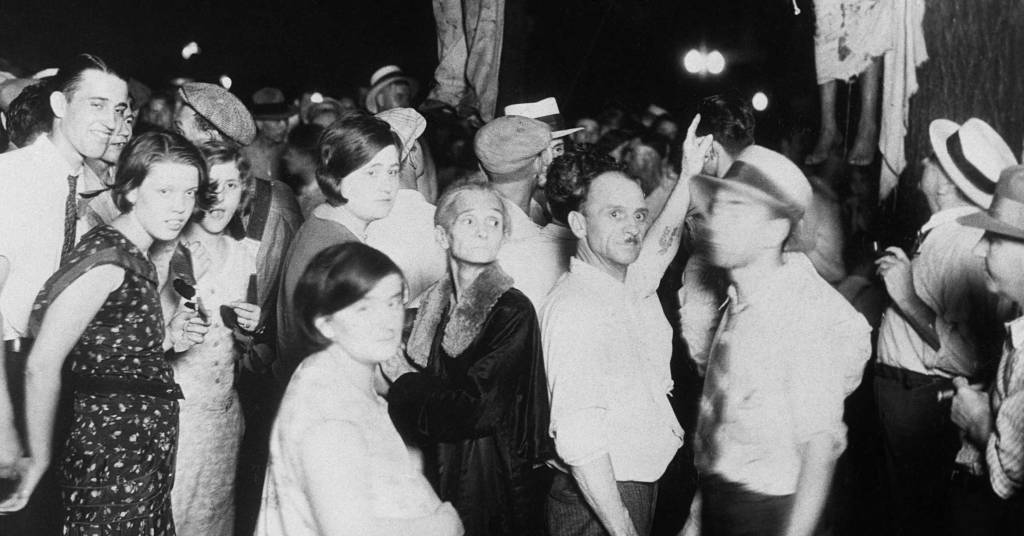
Photo: Lawrence Beitler’s iconic photograph of the lynching of two Black men, Thomas Shipp and Abram Smith, in Marion, Indiana in 1930. Credit: Bettmann/Corbis.

Zebras Not Horses: The New American Normal

Funny story. Early one morning last week, the wife and I were awakened around 6am by what sounded like an enormous explosion, followed by a burst of light. It speaks to the collective jumpiness of the current American moment that as New Yorkers, immediately flashing back to 9/11, the first thought for both of us was that a bomb had gone off. 

We leapt out of bed and went to the window—not having paid attention during those duck-and-cover drills in the ‘50s, before we were born—and soon heard more explosions and additional flashes. 

Pretty soon we realized it was nothing but an especially intense bout of thunder and lightning. But it took us a while. 

As I went about my business on the day that followed, I mentioned the experience to several friends, all of whom told me they had the same exact experience. All of them. 

When it comes to diagnosis, medical students are taught to live by Occam’s razor: that the simplest explanation is usually correct. As the maxim goes, when you hear hoofbeats, your first thought should be horses, not zebras. So what does it say when your first instinct upon hearing a loud boom is “bomb,” not “thunder”?

It says you’re living in fraught and anxious-making times.

A BOX OF GRID SQUARES

At the military installations that I grew up on and around, the sound of live artillery, in gunnery training, was pretty commonplace. You got used to it. 

(My dad—an old infantryman who had a pokerface that made Buster Keaton look like Jim Carrey—once told me that the cannonshot that accompanied the playing of “Retreat,” and the lowering of the flag in front of the post headquarters at 5pm everyday, was a live round that flew overhead and landed in an impact area on the far side of post. “That’s why helicopters fly with their doors open,” he added, “so the shell will pass right through.”)

Even in Iraq in the Gulf war, there was plenty of boom boom, mostly from the skies, but apart from the occasional Scud, it was mostly the other guys on the receiving end of it. (I’m told that American vets who have gone to Ukraine to fight with the International Legion have had to adjust to being on the side with less firepower, even as Kyiv’s forces have proved adept at asymmetrical warfare.)

But I’m not used to hearing bombs go off in NYC. Even the sound of the first 767 to hit the World Trade Center—an improvised missile—did not immediately register to me as what it was, on the day. (I thought it was demolition associated with construction or something, albeit an unusually very loud one.) 

Exhausted from the pandemic and from Trump, New York is a tense place at the moment, and I suspect that is probably true all across the country. The city feels jumpy right now, with a larger-than-usual number of openly unwell people on the streets, shouting profanities at imaginary demons and threatening violence to passersby. The shooting on the N train in Sunset Park last month, two stops from where my wife and daughter and I live, has people rattled and wary on the subway especially. (The shooter fled the scene calmly, debarking in our neighborhood before moving on to the Lower East Side, where he called the cops from a McDonald’s in order to surrender.) 

Old New Yorkers never cease bemoaning how the city ain’t what it used to be. I’ve lived here for 23 years, and still get lectured on the glories of pre-Applebee’s Times Square. File that under “careful what you wish for.”

Sad to say, then, but the notion that there could be a nuclear blast in New York City—or anywhere in the US, but NYC especially—feels like a reasonable fear. It’s something that has haunted America since 1945, and developed a renewed urgency in the wake of the attacks on the World Trade Center in 2001. Obviously, I didn’t think Vladimir Putin had attacked us the other morning; that, I presume, would have been a much bigger bang. But I did think it could be terrorism related to the war in Ukraine, or part of the not-quite-finished “Global War on Terror,” which is to say, the “clash of civilizations” between the radical Islamist extremism and the West.

We used to say that Americans were spoiled and soft and disconnected from the harsh reality in which the rest of the world lives. That is still so, compared to, say, life in Ukraine, or Yemen, or Myanmar, to pull just three names out of the hat. But after 9/11, an economic collapse, a certain tangerine-tinted tinhorn Mussolini, the pandemic, Derek Chauvin and Kyle Rittenhouse, and now the spectacle of the resurgence of brutal land war in Europe, we may have turned a corner, mentality wise.  

ACCEPT IT THAT SOON YOU’LL BE DRENCHED TO THE BONE

Obviously, I am generalizing, badly. There are plenty of individual Americans who are not at all benighted—who, either through personal hardship or experience of the wider world or both, are plenty clear-eyed about the harshness of the aforementioned reality. There are whole communities, and whole demographics, whose daily life in this country does not resemble a picnic, and never has. 

But as a nation, it’s hard to dispute that we have long been a rather naïve and privileged people, insulated by oceans and good fortune and military might. 

And there were certainly rough times in the past, to be sure. We are regularly, numbingly reminded of how the Greatest Generation endured and prevailed during the Depression and the Second World War. During the Fifties, even as America supposedly experienced a “Happy Days”-style period of postwar prosperity presided over by an avuncular war hero-turned President, it also lived through the plague of McCarthyism and under the cloud of looming nuclear armageddon that might descend at any moment. The Sixties too certainly had its share of horrors, from Dealey Plaza to Memphis, Chicago, My Lai, and Kent State and beyond. 

But the Seventies, Eighties, and Nineties—my own formative years—were relatively serene, assuming you were white, male, and middle class. The Wall came down, Francis Fukuyama sold books, there was peace and prosperity—an economic boom, in fact—and a smooth and fantastic hillbilly in the White House who played sax on “Arsenio Hall.” 

Even after September 11th broke the spell, it was another 15 years before the chickens really came home to roost, on a dark day in November 2016 that marked the beginning of the grim period in which we still wallow. The wars in Iraq and Afghanistan, which unfolded in that interval, really had little impact on domestic American life for most of our countrymen, which was actually a huge part of the problem. After Vietnam, our leaders figured out how to prosecute our foreign military misadventures without need for a draft, outsourcing our warfighting—or should I say, insourcing it—to a tiny sliver of the population that was returned to combat again and again while the rest of us had the luxury of not worrying about it. Needless to say, that is a toxic arrangement for democracy. The feeling within the ranks was succinctly captured in a photo snapped at a US Marine base in Ramadi, Iraq and widely circulated on the Internet, showing a whiteboard inscribed with the words, “America is not at war. The Marine Corps is at war. America is at the mall.” 

But that era seems very much at an end. The pandemic brought home the point of “It’s a Small World After All” with even more force than that insidious earwig of a melody. First, America—almost unique in the developed world—was humiliated by its inability to cope with the coronavirus, thanks to a widespread Know Nothing anti-intellectualism and predilection for the “paranoid style” that runs deep in our collective DNA, as strongly reflected by our government at the time. But then, just as quickly, we were at our best, the envy of the world as American scientific know-how—the very thing that COVID deniers and anti-vaxxers angrily rejected—delivered a medical remedy in record-breaking time. Even then, of course, that same John Birchist precious-bodily-fluids faction refused to take advantage of it, prolonging the death and suffering for everyone. 

But it was no coincidence that our haplessness in responding to the coronavirus coincided with the reign of a toxic political movement unprecedented in our history in terms of the threat it poses to the republic. We didn’t need a foreign crisis to teach us about the big bad world when a homegrown monstrosity had arisen to threaten everything this country was supposed to stand for. 

BLESSED BE THE FRUIT

While I’m writing about explosions, and the present dystopia, we might as well touch on the continuing fallout from last week’s Supreme Court bombshell (yswidt?). It feels like a prime example of the parade of hardships that lately seem to have befallen us.

After years of insisting the fight against abortion was all about returning power to the individual states, emboldened Republicans are already talking about a federal, nationwide ban on abortion—period, without exceptions even for rape, incest (which, btb, is a form of rape), or the life of the mother. That didn’t take long, did it? Giddy over Alito’s draft opinion, they aren’t even pretending to hide their hypocrisy. Should they retake the Senate, they are contemplating dispensing with the filibuster in order to do so, notwithstanding their recent gnashing of teeth and rending of garments over its sanctity—nearly as sacred as a newly fertilized ovum, protected by law with all the rights of a fully formed human voter even as the post-coital couple are still avoiding the wet spot. And despite Alito’s risible insistence that the Court isn’t setting a precedent regarding other unenumerated rights, those same Republicans are also talking about making IVF, the Plan B pill, and contraception illegal. Gay and interracial marriage, the rights of LGBTQ couples to adopt children, and even desegregation are all on deck

Hysteria? Perhaps Susan Collins can reassure us that the Court, and the Christian dominionists who spent decades working toward this moment, would never do such a thing. 

Let’s be clear. The plutocratic wing of the GOP, which ran the Republican show for many many decades, does not care about abortion one way or another. But beginning with Reagan, the GOP deliberately courted the so-called “religious right” to bring to the polls a bloc of religious fanatics who would turn out turn out turn out, ferociously, for years to come, in order to achieve their theocratic goals, enabling the mainstream Republican Party to achieve its own prime directive of cutting taxes for the rich. 

And it worked. 

The problem is, the creature has blithely knocked Dr. Frankenstein aside (that’s fronk-en-steen, to you) and is now fully in control of the GOP. And that’s why our country’s laws on abortion—and a whole raft of other issues soon to come—is being dictated by a small minority of medieval religious zealots. 

If we don’t like it, perhaps we can push back with some passion and ferocity of our own. Which may be why those same folks are not only very keen to suppress voting rights, but also to get a chokehold on how our elections are run full stop.

Leave it to Harvard’s Jill Lepore to hit the bullseye, in a piece for The New Yorker titled, “Of Course the Constitution Has Nothing to Say About Abortion,” which begins with the salient observation that “Supreme Court Justice Samuel Alito is surprised that there is so little written about abortion in a four-thousand-word document crafted by fifty-five men in 1787.”

As it happens, there is also nothing at all in that document, which sets out fundamental law, about pregnancy, uteruses, vaginas, fetuses, placentas, menstrual blood, breasts, or breast milk. There is nothing in that document about women at all. 

Most consequentially, there is nothing in that document—or in the circumstances under which it was written—that suggests its authors imagined women as part of the political community embraced by the phrase “We the People.” There were no women among the delegates to the Constitutional Convention. There were no women among the hundreds of people who participated in ratifying conventions in the states. There were no women judges. There were no women legislators. At the time, women could neither hold office nor run for office, and, except in New Jersey, and then only fleetingly, women could not vote. Legally, most women did not exist as persons.

Lepore writes that “Alito, shocked—shocked—to discover so little in the law books of the 1860s guaranteeing a right to abortion, has missed the point: hardly anything in the law books of the eighteen-sixties guaranteed women anything. Because, usually, they still weren’t persons. Nor, for that matter, were fetuses.”

(W)hen Samuel Alito says that people who believe abortion is a constitutional right “have no persuasive answer to this historical evidence,” he displays nothing so much as the limits of his own evidence. “

To use a history of discrimination to deny people their constitutional rights is a perversion of logic and a betrayal of justice. Would the Court decide civil-rights cases regarding race by looking exclusively to laws and statutes written before emancipation?

Lepore sagely points out that “Alito’s opinion rests almost exclusively on a bizarre and impoverished historical analysis,” one that argues that rights not explicitly stated in the Constitution, can be affirmed only if “deeply rooted in this Nation’s history and tradition”—a standard, she notes, that “disadvantages people who were not enfranchised at the time the Constitution was written, or who have been poorly enfranchised since then.”  

Women are indeed missing from the Constitution. That’s a problem to remedy, not a precedent to honor.

Mic drop.

HARBINGER FROM THE SOUTH PACIFIC

The other item in the news that struck me this past week was the presidential election in the Philippines, where the good people of that long suffering nation inexplicably returned to power a monstrous and corrupt family that not very long ago robbed that country blind and eviscerated its democracy before being ousted on a wave of massive public outrage.

(I invite your attention to John Oliver’s excellent pre-election piece on the topic.) 

This is a tragedy for the people of the Philippines. How and why would they do such a thing to themselves? I dunno, but I know it’s a bad omen for democracy across the globe, the USA very much included.

So what I want to know is: In 2024, or even just six months from now, with the midterms, will we look back and ask the same question of ourselves?

Among saddest aspects of the Philippine debacle is the fact that Bong Bong—like Duterte—legitimately has the support of massive numbers of his fellow citizens. We have a similar WTF problem here in the US, but not a majority, which is both good and bad, when one contemplates the looming autocracy they intend to impose. Is a dictatorship installed by a small cabal of venal assholes against the will of the people better or worse than one that seizes power with the enthusiastic support of tens of millions, as in the US, or more extreme still, a full-on majority of short-memoried supplicants anxious to be abused, as in the Philippines? 

It took the people of the Philippines 36 years to forget the sins of this particular criminal gang and return them to power. We the people of the United States of America might well do that in less than two. 

If the age of American privilege and naivete is ending, such that we—like many people around the world—have to worry about bombs going off, and killer viruses, and insurrectionists living next door—maybe that vigilance is not such a bad thing, even if it’s a nerve-wracking way to live. That clap of thunder that I and many others mistook for an explosion woke me up. Which is not a bad way to be.

The Very Worst Person We Should Have Let Decide Our Abortion Policy

The New York Times’s Peter Baker called this week’s leak of an Alito-penned draft decision overturning Roe v. Wade“one of the biggest earthquakes in American domestic politics in a generation.”  (Josh Gerstein and Alexander Ward of Politico broke the story.) No doubt about that.

It’s early days to say the least, but let’s dig into just a few aspects of this rapidly unfolding development, one that promises to consume and reshape US politics for months or years to come, and yet another major turn in what is very clearly right wing autocracy on the march. 

The bluntness of the Court’s decision. 

For years pundits, experts, and others in the SCOTUS peanut gallery predicted that the Court would subtly chip away at Roe rather than bluntly overturning it. The Court has long been signaling a gutting of Roe, a process we have watched slowly but inexorably unfold, with sickening milestones along the way, like Texas’s vigilante anti-choice law passed last September. All the experts thought that pattern of death by a thousand cuts would continue.

So Alito’s opinion in the case known as Dobbs v. Jackson Women’s Health Organization came as quite a shock: a full-throated, balls-to-the-wall extremist screed that could have been written by the most virulent anti-choice radical you can imagine. As the lawyer and writer Jill Filipovic wrote on Substack: “I thought this decision would have a lighter touch, that the Court would functionally overturn Roe without formally overturning Roe. I underestimated their radicalism.”

She wasn’t alone. In Slate, the veteran justice correspondent Dahlia Lithwick writes that if some version of this decision comes to pass, “years of conventional wisdom about the court and its concerns for its own legitimacy will be proved wrong.”

Every single court watcher who spoke in terms of baby steps, incrementalism, or “chipping away” at one of the most vitally important precedents in modern history will have been wrong. Those who suggested the court would never do something so huge and so polarizing just before the November midterms will have been wrong. And the people who assured us that Brett Kavanaugh and Amy Coney Barrett were moderate centrists who cared deeply about the appearance of a nonideological and thoughtful court—well, yeah. They will have been wrong too.

They said Roe would go out not with a bang but a whimper, but when are we going to stop underestimating the awfulness of the Republican Party? I guess around the time Charlie Brown finally succeeds in kicking that football.

The first chance Republicans got to overturn Roe they are doing exactly that, because they don’t care about the will of the majority, they don’t care about optics, they damn sure don’t care about women or basic human decency…..they don’t care about anything except their own power, and they will do whatever the fuck they want to maintain and extend it, and do it as bluntly and as loudly and as crassly as they wish, even if it means lying (to the Senate) or cheating (in an election) or stealing (a seat on the Supreme Court). And if you don’t like it, fuck you. 

And that despicable ruthlessness applies both to the Ginni Thomas-brand religious zealots for whom overturning Roe is the Holy Grail, and to the plutocrats who couldn’t care less about abortion, but who have pandered to these Christian dominionists for their own venal ends.

The extremity of Alito’s opinion. 

“Full-throated” and “evisceration” are two terms widely used to describe Alito’s opinion, which I think is too kind, and implies a cogent argument, which it is anything but. It is, however, certainly full of sneering contempt not only for Roebut for an entire school of Constitutional scholarship, the one that sees the Constitution as a living document and not something to be read like a biblical diktat from Heaven.

By contrast, Alito favors a specious originalism, arguing that “The Constitution makes no reference to abortion,” and that there is no tradition of a right to abortion in American history, but rather “an unbroken tradition of prohibiting abortion on pain of criminal punishment persisted from the earliest days of the common law until 1973.” 

So let’s bring back slavery, child labor, anti-miscegenation laws, and men-only voting too! (Don’t worry: someone at CPAC is working on all four.)

He certainly seems to have a badly impaired sense of irony, as when he writes: 

This Court cannot bring about the permanent resolution of a rancorous national controversy simply by dictating a settlement and telling the people to move on. Whatever influence the Court may have on public attitudes must stem from the strength of our opinions, not an attempt to exercise “raw judicial power.

That will be news to the roughly two-thirds of Americans who want Roe to stand, and to the conservatives who for years have been howling about “judicial activism” (by liberals).

Among the lowlights of this opinion, a possible cake-taker is Alito’s argument that “(Roe) imposed the same highly restrictive regime on the entire Nation, and it effectively struck down the abortion laws of every single State….and it sparked a national controversy that has embittered our political culture for a half-century.” 

George Orwell, call your office. So Roe—which gave American women control over their own bodies—was the “restrictive regime” that the government was forcing upon them, not this new reality the Court seeks to unilaterally install in which that control is arrogated by the state, such that it can compel a woman to carry her rapist’s child to term, even if that “woman” is a minor and her rapist is her father or stepfather? And Roe was the source of bitter national controversy, whereas this Molotov cocktail of a decision in Dobbs is going to usher in an era of comity and group hugs?

IMSIYAR. (It Makes Sense If You’re A Republican.) 

Incredibly, the right wing has managed to invert the whole concept of “religious liberty” such that the phrase now effectively means that the Religious Right can foist its faux morality on the rest of us, and force us to live by its medieval, mythological rules, but cannot be compelled to extend any such consideration to others’ beliefs or freedoms. 

We’ve seen that the justices, not surprisingly, live in a bit of a bubble—the older liberal ones, as well as the reactionaries. But Alito’s screeching diatribe betrays the ugly confluence of that isolation with immersion in the right wing echo chamber. 

In a piece for Slate titled “The Supreme Court’s Legitimacy Is Already Lost,” one of the country’s sharpest observers of that institution, Dahlia Lithwick, notes that in 1992, when O’Connor, Souter, and Kennedy affirmed the constitutional right to an abortion in their plurality opinion in Casey—all Republican appointees, by the by—they “knew very well what would happen to the court if it disregarded and disparaged the American public, the Constitution, and itself.” 

The Court’s current right wing supermajority either doesn’t know or has zero fucks to give. 

(I)n addition to Alito’s sneering references to “abortionists” and eugenics and his gleeful mockery of the authors of both Roe and Casey, anyone who believed the court would pretend to have any solicitude whatsoever—for women, for public opinion, for its own reputation as a moderate branch—was well and truly kidding themselves. This draft opinion, whatever may be done to it in the days to come, is Exhibit A for anyone who believed that time or history or respect for their colleagues or the justices who came before them would moderate the five justices in this current majority, a majority that ought to know it stole its way into a majority but again refuses to even feign self-moderation in the face of that fact. We knew this when Texas’ S.B. 8 law banning abortion after six weeks was decided on the shadow docket in September, and when the court let it stand again this winter. We knew it when we watched the Dobbs arguments last fall. Roe had already been effectively overturned then—we have just had trouble catching up.

+ States’ rights, shmates’ shmites. 

Alito writes: “The Constitution does not prohibit the citizens of each State from regulating or prohibiting abortion. Roe and Casey arrogated that authority. We now overrule those decisions and return that authority to the people and their elected representatives.”

“Leave it up to the states!” has been the Republican rallying on this matter since at least 1973. If Roe falls, it won’t affect abortion rights in Massachusetts or California or anywhere else the citizenry collectively wants it, we were assured by ostensibly moderate conservative pundits. There are serious problems with that theory, but never mind, because Republican adherence to it was always disingenuous. Even before the Dobbs decision becomes law, we are already seeing them beginning to push for federal legislation banning abortion nationwide. 

The morning before the leak broke, the Washington Post reported that “Leading anti-abortion groups and their allies in Congress have been meeting behind the scenes to plan a national strategy that would kick in if the Supreme Court rolls back abortion rights this summer, including a push for a strict nationwide ban on the procedure if Republicans retake power in Washington.”

It’s almost as if everything the GOP has said, going back decades, has been flat-out lies, isn’t it?

+ Damage to the court’s Image—boo hoo—and the deceit of Gorsuch, Kavanaugh, and ACB.

As Politico noted, “No draft decision in the modern history of the court has been disclosed publicly while a case was still pending.” Whoever leaked it (and the prevailing theory is that it was a right wing clerk, to pre-emptively lock the justices into the decision), it speaks to the firebreathing volatility of the present moment.

But it’s very telling that the leak is the thing that conservatives like David French, late of the National Review, are most upset about—and French counts as a relatively reasonable conservative, and anti-Trump—along with the damage to the Court it will cause. Indeed, clutching their pearls and howling about the leaker is a literal GOP talking point, according to an internal strategy memo obtained by Axios.

So let’s be clear. The damage to the Court was done by duplicitous right wing justices who did an Apache dance before the Senate over stare decisis during their confirmation hearings. That in turn has been part of a broader self-sabotage of the Court’s credibility by its conservative members and by the right wing movement in general, with Mitch McConnell in the role of mustache-twirling ringleader. 

Collins and Murkowski both issued statements saying that they are shocked (shocked!) that Gorsuch & Kavanaugh & Barrett blatantly lied to them. Wow. In other news, apparently you can be a US Senator and be as gullible as a newborn—or as dishonest as a fucking Republican politician.

So forget the leak. The real tragedy here, I humbly submit, has to do with a rather larger issue of human rights in America—again, eloquently stated by Dahlia Lithwick by way of demolishing the Frenchy position: 

The court’s staggering lack of regard for its own legitimacy is exceeded only by its vicious disregard for the real consequences for real pregnant people who are 14 times more likely to die in childbirth than from terminating a pregnancy. The Mississippi law—the law this opinion is upholding—has no exception for rape or incest. We will immediately see a raft of bans that give rights to fathers, including sexual assailants, and punish with evermore cruelty and violence women who miscarry or do harm to their fetuses. The days of pretending that women’s health and safety were of paramount concern are over.

PS Mr. French believes that the decision to overturn Roe would represent “a restoration, not a rupture of our constitutional fabric….Roe was the rupture, and our nation has been dealing with the legal and political consequences ever since.” He has also said he thinks dispensing with Roe will cool, rather than inflame, national tensions on the topic.

Good luck with that, Dave.

+ The towering significance of McConnell’s crime. 

Every day and in every way, the repercussions of Mitch McConnell wantonly, despicably, hypocritically violating the spirit of the US Constitution and blocking even a hearing for Merrick Garland continue to reverberate. Also: the disastrous decision of the Democratic Party not to raise holy hell about it at the time, born of overconfidence re an imminent Hillary victory.

Fool me once. 

+ Anything from the ivory tower? 

Eagerly awaiting Ross Douthat’s column telling American women why this is best for them.

+ Conservatives and radicals.

For the second time in a month (the previous one being on the subject of Ukraine), I am shocked to find myself agreeing with Bret Stephens, Douthat’s wiser fellow conservative on the Times’s opinion page, who notes that overturning Roe is a radical, not conservative move. Notably, Stephens disagreed with the reasoning behind Roe in ’73, but argues that almost fifty years later, reversing it will do more damage. While his argument is grounded mostly in the arcana of Constitutional law, rather than respect for a woman‘s reproductive rights, or human rights full stop, he’s still on the side of reason, decency, and common sense.  

Bret, forget what I said before: you are invited to the bat mitzvah again.

+ Only the beginning.

As I have written before, joining a loud chorus, this ain’t just about abortion: it’s about a wide-ranging rollback of civil rights and the ominous clatter of a right wing autocracy on the march. 

Heather Cox Richardson writes:

And so here we are. A minority, placed in control of the US Supreme Court by a president who received a minority of the popular vote and then, when he lost reelection, tried to overturn our democracy, is explicitly taking away a constitutional right that has been protected for fifty years. Its attack on federal protection of civil rights applies not just to abortion, but to all the protections put in place since World War II: the right to use birth control, marry whomever you wish, live in desegregated spaces, and so on.

Alito’s weak-kneed attempt to wall off this decision from other potential rollbacks of civil rights is a joke. (“We emphasize that our decision concerns the constitutional right to abortion and no other right. Nothing in this opinion should be understood to cast doubt on precedents that do not concern abortion.”) Emboldened by this long sought victory, the right wing is going to extend it to try to outlaw IUDs, IVF, the morning after pill, and if it can pull it off, contraception itself. (God willing they will stop short of masturbation.) And next they will come for all those other unenumerated rights: the ones laid down in Obergefell, Loving, even Brown v. Board of Education. 

Doubt it? Which of us, then, is the naïve one here?

It reminds me of Scalia’s opinion in DC v. Heller (2008) asserting an individual’s constitutional right to own a private firearm under the Second Amendment, incorrectly in my view, but still a decision that explicitly said the government can regulate those weapons. That last bit has been conveniently forgotten and trampled upon by America’s firearms fetishists, and the anti-choice cabal (overlapping a lot with those Yosemite Sam gun nuts) will do the same with Alito’s absurdly flimsy qualifier.

+ Careful what you wish for.

For Democrats and other progressives, the optimistic view is that this Supreme Court decision-to-be represents one of the few ways the GOP could blow the midterms, which all the smart money has it tipped to win in a historic red wave. It sure seems to be trying. 

Insert “dog that caught the car” analogy here. Let’s hope it backs over it. 

In a piece for The Bulwark, Charlie Sykes writes:

For years the GOP has campaigned against Roe, but without any realistic expectation that it would actually be overturned. Republicans are keenly aware that polls have consistently shown that while opinion on abortion itself is mixed, a strong majority of voters opposes overturning Roe. Just 30% of Americans say they’d like to see the Supreme Court completely overturn its Roe vs. Wade decision, with 69% opposed—a finding that’s largely consistent both with other recent polling and with historical trends. 

While abortion has been a highly useful wedge issue for the GOP, the passionate part of its base that is fired up by it is not representative of the larger population, the roughly 7-in-10 American majority that supports some sort of abortion rights, and might work against the GOP in a general election. 

Last December, Sykes wrote, “In a rational political world, legislators would craft compromises that would reflect the various shades of public opinion. But, as you may have noticed, we do not live in that world.”

In this environment, the extremes will define themselves by their hostility to compromises of any sort.

I imagine it playing out like this: J.D. Vance comes out for a ban after 6 weeks; Josh Mandel calls for a ban after 2 weeks; MTG declares that all true conservatives support a total ban; and Madison Cawthorn insists that the true pro-life position demands the death penalty for doctors who perform the procedure.

Sykes predicts—and I’m not betting against him—that every race at every level “now becomes a referendum on abortion,” from statehouses and governorships to Congress and the presidency. “In a sane world, this debate could actually be healthier than what we have now. But does anyone think that we live in a world that particularly values sanity?”

(Sykes also  believes that “the schism between red and blue America will become wider and starker. While red states impose criminal penalties, blue states will expand taxpayer funding. American women will be living in two very different countries.” Except they won’t, because Republicans are planning a nationwide ban on abortion, full stop.)

So will this decision really galvanize the left? Will American women—and men—rise up in outrage? Or are there too many self-loathing Phyllis Schlaflys and Anita Bryants and Marjorie Taylor Greenes out there? 

Regardless, the Democratic Party damn sure ought to make this the centerpiece of its campaign. If it can’t straighten out its traditionally piss-poor messaging and mobilize voters off this, maybe it deserves to lose. 

The leadership does seem to recognize that. In a joint statement released soon after the Politico story broke, Pelosi and Schumer wrote: “Every Republican Senator who supported Senator McConnell and voted for Trump Justices pretending that this day would never come will now have to explain themselves to the American people.”

Damn straight. Let’s not let them avoid it. 

+ And lastly—Trump. AYFKM???

At the end of the proverbial day, I keep coming back to the gobsmacking fact that somehow we let Donald Trump decide abortion policy for the United States. Donald Trump!

The abortion wars have been raging for decades. It is bitterly ironic that it was this grotesque cretin—himself a strong argument for abortion—who should be the one to deliver the final coup de grâce. But thanks to Mitch McConnell, Democratic meekness, Tony Kennedy looking out for his kid, and just plain dumb luck, Trump was allowed to put THREE justices on the Supreme Court, fully a third of that bench. Three!!!

The members of America’s religious right hitched their wagon to a thrice-married, serial adulterer and proud sexual predator, the least pious man imaginable, a walking affront to everything their faith claims to be about……and it paid off, both for them and for their plutocratic allies, who as we noted above, don’t really give a shit about abortions (except when their mistresses need them), but are eager to weaponize it as a wedge issue to energize the reactionary base.

As I have written before, how many abortions do you think Trump himself has paid for in his long, misbegotten, teenage beauty contestant-harassing, porn star-rawdogging life? (Or more likely, as Samantha Bee quipped, promised to pay for and welshed on?) I’ve always hoped one of those women would come forward, but at this point I think MAGA Nation would just shrug and rationalize it away like everything else. 

It is beyond irony that this is the man we have allowed to determine what reproductive rights American women would have. As a result, the US may soon have more restrictive laws on abortion than Catholic countries including ItalyIreland, and Mexico, where the systems are far from perfect, but still far more humane than what looms here.

Once again we are reminded that elections have consequences. Oh, do they ever. Even the ones we win in the popular vote, but lose in the electoral college (with a little help from the Republicans’ friends in Moscow).

But her emails, amirite? 

+ Bad moon rising.

In closing, everything about the Alito draft confirms what ought to be excruciatingly obvious by now: the American right is playing rollerball while the middle and left are playing Candyland. The right means to seize power in the United States and take us back to a pre-New Deal, pre-feminist, retrograde America where white Christians didn’t have to worry about offending anybody with the n-word, or uppity women who thought they should be paid the same as men, or having their political power challenged in any way. The government they mean to install will certainly not be one that cares about a woman’s right to control her own body or make her own health care decisions. And they are willing to do just about anything to achieve that control: get behind Donald Trump, ally with Vladimir Putin, overturn an election, or throw democracy out the window to make sure elections no longer matter. 

If the Alito draft is a slap in the face that wakes us up to that harsh reality, it will be for the best. Because the sooner we realize it, the better off we will be in trying to stop it, if it’s not already too late.

**********

Previous King’s Necktie posts on the Supreme Court and/or abortion:

The Unkillable Zombie of States’ Rights – December 9, 2021

Autocracy on the March – September 10, 2021

Smash the Patriarchy, 2020 Edition – March 7, 2020

The Ghost of Merrick Garland, Part II – October 10, 2018

“Blessed Be the Fruit”—Patriarchy, Tyranny, and the Supreme Court – August 13, 2018

Five Blind Mice – July 11, 2018

The Ghost of Merrick Garland – November 25, 2017

Violence and the Heroic Impulse 

When last we met, I was pondering whether Vladimir Putin was rational enough to recognize his losing situation in Ukraine, and—given his almost total control of the information available to the Russian public—simply declare victory and go home

The question was partly rhetorical. He has not done so, and unlikely to going forward. Stop the presses. 

Even so, Putin is proving to be somewhat rational.

The Washington Post’s Fareed Zakaria calls our attention to the military scholar Can Kasapoglu, writing for the Hudson Institute, who early on predicted that the invasion of Ukraine would really be two distinct wars, one in the south and east and another in the north and west. Having met unexpectedly stiff resistance in trying to subdue the whole of the country—a string of embarrassing defeats, really, including, most recently, the sinking of the battlecruiser Moskva, the flagship of Russia’s Black Sea fleet—Putin now seems to be recalibrating toward a less ambitious objective, one that merely carves off the oil-rich Donbas region and the southeastern portion of Ukraine, with its access to that sea. 

In that regard, he is, if not declaring victory, at least moving the proverbial goalposts—perhaps by design—back to where many experts had them from the start.

Whether this is a strategic retreat after a colossally ill-conceived overreach, or what the Kremlin planned all along (my money is on the former), repelling a Russian invasion and preventing the speedy conquest that most expected already represent a tremendous upset victory for underdog Ukraine, and a deep humiliation for Putin. But the danger is far from over, and the situation remains highly fraught….in part for that very reason. 

Russia’s less publicized gains in the east remain worrying, and Putin seems set on exploiting them. Zakaria:

Russia has been able to move forces and supplies out of its bases in Crimea and capture the cities of Melitopol and Kherson. Mariupol is now encircled and invaded by Russian troops, and Ukrainian forces trapped there cannot be resupplied. Ukraine’s access to the Sea of Azov has been blocked, and, Kasapoglu points out, Russian forces have a contiguous land corridor from Crimea deep into Donbas. 

The loss of Odessa, the country’s main port, would be especially devastating, as it would turn “Ukraine into an economically crippled rump state, landlocked and threatened on three sides by Russian military power, always vulnerable to another incursion from Moscow.” 

Zakaria also believes that this outcome would tempt Putin to invade neighboring Moldova, “which has its own breakaway region”—Transnistria—”filled with many Russian speakers.” Zelenskyy himself believes that if Putin succeeds in the south and east, he will return to try to capture Kyiv again, a view shared by the Ukrainians’ senior general in charge of the defense of Kyiv, Alexander Gruzevich. 

It is also clear that Putin intends to prosecute this new, more limited campaign with the same monstrousness he has shown thus far, including the wanton leveling of Ukrainian cities with artillery and airpower, the deliberate targeting of civilians, summary executions of prisoners, massacre of noncombatants, and widespread rape, torture, and other war crimes, all perpetrated by an undisciplined force that seems to have no adult supervision. (A longstanding and blood-drenched tradition within the culture of the Russian military, it must be said.)

Images of the Kyivan suburb of Bucha, site of some the worst atrocities thus far, prompted a number of observers to note that Ukraine is “not a battlefield—it’s a crime scene.” (The analogy was made by everyone from the Estonian prime minister Kaja Kallas to Vitali Klitschko, the former professional boxer whose brother Wladimir—also a former pro boxer—is now the mayor of Kyiv.) The recent arrival of a new field commander, General Alexander Dvornikov, nicknamed “the Butcher of Syria” for his performance in that theater, does not suggest that a reversal of that trend is in the works.  

For a time there was talk that Zelenskyy would negotiate an end to hostilities by ceding the Donbas to Moscow. That scenario now seems unthinkable. It may yet emerge—geopolitics is famously unpredictable, in case you missed it. But having badly bloodied the Russians’ collective nose, Kyiv now has the strategic initiative; Zelenskyy is not going to sacrifice the Donbas or any other part of his country, and he should not. 

His fighters certainly aren’t in the mood to wave the white flag, as witnessed by the defenders of Mariupol just this week giving the middle finger to a Russian demand that they surrender. It was reminiscent of a moment early in the war, when besieged Ukrainian soldiers on a place with the unimprovable name of Snake Island defiantly told the crew of a menacing Russian warship to “go fuck yourselves.”

And what was the name of the Russian warship? Oh, yeah: the Moskva. Which now sits at the bottom of the Black Sea. 

PRESCRIPTION FOR VICTORY

So how to proceed from here? As Putin readies this new offensive, how can the West capitalize on Kyiv’s success thus far to expel Russia entirely with Ukrainian sovereignty—and territorial integrity—intact? 

The primary answer is pretty simple: Arm and support Ukraine so that it can resoundingly defeat the Russians and win the war. 

That such a prospect is even on table is pleasantly astonishing to most people outside of the Kremlin and Mar-a-Lago, where the faithful pennant-waving for Team Putin continues, but there you have it. And it is within Kviv’s means to achieve it, and within ours to help.

Ukrainian triumphs on the battlefield mean that the West can now pursue a more aggressive strategy of pro-active military assistance without fear of Russian escalation, and we should do exactly that. Concerns about a wider war—even a nuclear one—remain, but success breeds success, and we are in a position to act more forcefully. 

Writing in The Atlantic, Eliot Cohen of the Johns Hopkins School of Advanced International Studies offers a savage critique:

The Russian military—revealed as inept at tactics, unimaginative in operational design, obtuse in strategy, and incompetent at basic logistics and maintenance—can do only two things well: vomit out massive amounts of firepower and brutalize civilians. It has been bloodied very badly indeed. If, as seems plausible, it has taken losses (killed, wounded, missing, and imprisoned) of a quarter or more of the forces it committed to this war, it may teeter on the verge of collapse. We can see the indicators in reports from the battlefield: equipment abandoned, officers killed by their own men, desperate attempts to dragoon young men into military service, and blocking units to shoot deserters. The Russian military has not established, let alone maintained, control of the air. Russia threw three-quarters of its ground-combat forces into Ukraine, where they were driven from one theater and severely handled in the others, and now has no real reserves on which to draw.

Cohen believes that both Putin and his top generals are woefully ill-informed about this true state of affairs—a true hazard of despotism. To that end, he thinks Putin is foolishly about to “order offensives that, if confronted by a well-resourced Ukrainian foe, can effectively destroy his own army. The challenge for the West is to ensure that this is its fate.”

From your lips to God’s ears, Eliot. 

Per Zakaria, retired flag officers like Lieutenant General Mark Hertling, former commander of US Army Europe, propose sending Ukraine the kind of equipment that will allow it to exploit the inherent weaknesses of Russia’s rigid and tactically inflexible military: helicopters, armored vehicles, drones, multiple launch rocket systems (MLRS), and good old fashioned artillery that will enable the Ukrainians to stand off and attack Russian forces from long range.

Admiral (Ret.) James Stavridis, former Supreme Allied Commander of NATO, has advocated giving Ukraine fighter planes (a contentious issue thus far), air defense systems, and more advanced anti-ship missiles like the homegrown R-360 Neptunes it used to sink the Moskva. I had previously been skeptical of the push to send old MiG fighter jets, but as Cohen points out, “the Ukrainians are now the world’s experts in fighting Russians—not us….So rather than questioning whether they need fixed-wing aircraft or can use Western military hardware, the US should err on the side of generosity.”

Zakaria also argues for a naval blockade in international waters similar to the one NATO imposed during the Balkan wars of the ‘90s, one that would keep Russian troops from making an amphibious assault and resupplying by sea. Intelligence support is also a force multiplier, and because it is by definition secret, with plausible deniability baked in, has the added advantage of not risking escalation the way, say, a USAF C-17 full of AT-4 anti-tank weapons landing at the Kyiv airport does. 

In some ways, however, the shopping list is an inside-baseball matter for the military cognoscenti. It’s the speed of delivery that matters most to Kyiv. 

In a recent interview with Anne Applebaum and Jeffrey Goldberg of The Atlantic, President Zelenskyy said, “When some (world) leaders ask me what weapons I need, I need a moment to calm myself, because I already told them the week before. It’s Groundhog Day. I feel like Bill Murray.”

(Cue “I Got You Babe.”)

Moscow, of course, is threatening Washington not to do any of these things, but that is the sound of a desperate man on his back foot. (White House reply to Kremlin: “You’re not the boss of me.”) Putin has little leverage with which to deter such stepped up Western aid, short of mutually assured destruction, and I am guardedly optimistic that he is not that crazy nor so out of it, despite reportedly not getting the straight skinny from his generals. (Understandably so, as few of them are keen to get fired, or worse.)

Zelenskyy also argues for the importance of information warfare in penetrating domestic Russian propaganda—not only at the state level, but also via non-state actors, like Anonymous and other hackers who can break through (or go around) Putin’s informational Maginot Line and eat away at public support for the war among ordinary Russians. Even steel-fisted dictators are vulnerable to the regiments of grieving mothers when the coffins start coming home, accompanied by questions.  

Economically, depriving Russia of the roughly $320 billion it derives annually in oil and gas sales to foreign buyers—Europe, principally—would help, though Zakaria believes sanctions and embargoes alone will not force Putin to end the war. “The only pressure that will force Russia to the negotiating table is military defeat—in the south. Putin’s Plan A failed, but we cannot let his Plan B succeed.”

CURB YOUR ENTHUSIASM

There is no doubt that the US can and should move faster and more aggressively to send aid to Ukraine. That said, some of Mr. Cohen’s suggestions go far beyond what I would say are advisable. 

These include the deployment of volunteer US combat pilots, organized along the lines of the First American Volunteer Group, better known as the Flying Tigers, that flew under the Chinese flag before the US entered World War II. A step beyond even that, he advocates the overt deployment of active duty American advisors to Ukraine itself, presumably from the 10th Special Forces Group, which is focused on Europe, and has a forward-deployed battalion permanently stationed in Germany. (“If the Soviet Union could deploy thousands of advisers to North Vietnam in the middle of the Vietnam War without triggering a nuclear conflict, the US can deploy advisers to western Ukraine, or at least to Poland, to train Ukrainian soldiers.”) 

Of course, the US already has some 8750 soldiers in Poland, including a brigade of the 82nd Airborne, not to mention whatever the 10th SFG is up to already, covertly. But to openly put American military personnel into Ukraine would be a very risky move, as history shows that “advisors” almost always wind up as active combatants. 

We ought not be surprised at Mr. Cohen’s hawkishness, though, as he is a card-carrying member of the neo-con brain trust that dragged us into the disastrous and dishonest second Iraq war. It’s ironic, since those neo-cons, you may recall, were gripped by the same blinkered expectation as Putin that the nation in question would greet its invaders with bouquets of flowers.  

Cohen also argues that any Russian use of chemical weapons ought to trigger consideration of a no-fly zone, which—he declines to note—is tantamount to jumping with both feet into a full-blown shooting war. Even the New York Times’s reliably conservative Bret Stephens won’t go that far, offering instead a far more measured menu of escalated response to that terrible scenario. I can’t believe I’m agreeing with Bret Stephens, but when the alternative is Eliot Cohen, it’s a sliding scale…and Stephens’ argument is sound and smart. 

Cohen’s recklessness marks the boundaries of how far we ought to go in pursuing the initiative in Ukraine—a reminder that hawks gonna hawk, and we need to rein them in, even when they’re on the side of good now and then. 

ALL NAZIS ARE NOT CREATED EQUAL

The war in Ukraine has had a galvanizing effect on the Western world, as we watch an embattled democracy resist a brutal invasion by a criminally aggressive, openly autocratic neighbor. Even some pacifists have noted that it’s impossible not to admire the bravery and valor of the Ukrainian people, and hard to argue that they should not fight back by force of arms. 

Not since the Second World War has there been a conflict that has generated such near-universal consensus over the righteousness of one side and the villainy of the other. Other combatants in other wars have certainly had their devoted supporters convinced of the justness of their cause, but they were usually opposed by an equally devoted cohort for the other side. By contrast, in Russian’s invasion of Ukraine, the whole world is on Team Blue & Gold, save for Vladimir Putin and Tucker Carlson and their respective, overlapping cults. On that count, Putin’s supporters at least have the excuse of being in an information chokehold without access to the actual facts. Tuck’s do not; their blinders are voluntary. 

To that point, Eliot Cohen represents the old school Republican attitude on foreign policy. But there is another longstanding strain on the right, and it is more Lindberghian. Indeed, this faction is eerily reminiscent of the previous one operating under the slogan of “America First!,” a group whose lobbying to keep the US out of a war in Europe was a similarly thin disguise for its flatout admiration for the aggressor in that war. 

The cult of Carlson and other faithful American consumers of Kremlin propaganda seem to have swallowed whole Mr. Putin’s risible claim that his invasion of that nation is about “de-Nazification.” To cite one anecdote, the WaPo recently detailed the angry, threatening messages the proprietor of a steakhouse in Bardstown, Kentucky received for flying a Ukrainian flag, including sneering references to the Ukrainians being “Nazis.”

Funny, MAGA Nation was a lot more sympathetic to Nazis when they were marching in Charlottesville and otherwise backing the Trumpist GOP

(But if they liked Tucker’s recent foray into homoerotic soft porn, they’re gonna love Leni Riefenstahl’s Olympia.)

The symbiosis between Putinist and Trumpist propaganda is no coincidence. Heather Cox Richardson reports:

Russia specialist Julia Ioffe told MSNBC, “Every time I’m asked by Americans do Russians really believe this stuff… as if we don’t have the same thing happening here. You have 40% of the American population that was convinced in just one year that Donald Trump actually won the 2020 election….”

And, indeed, Trump loyalists like Representative Marjorie Taylor Greene (R-GA) and Fox News personality Tucker Carlson continue to echo Russian talking points to undercut Ukraine’s war effort. Media scholar Eric Boehlert noted that “the anti-democratic, authoritarian bonds are becoming tighter as the Trump movement now turns to the Kremlin for its messaging cues. The overlap is undeniable, and the implications are grave.”

What is even more astonishing is that the American right is at once able to side with Vladimir Putin, while aping the martyrhood and idealism of the people he is fighting. 

LOOKING FOR A FIGHT

The chest-swelling inspiration that we draw from Ukraine’s pluck—and success—is instructive, whether it ignites “Kum-ba-ya” rhapsody for global democratic solidarity or Cohen’s innate itch for interventionism. It’s undeniable that there is frisson in observing a life-and-death drama on this scale. It makes many of us long to be part of a similarly righteous struggle for something much larger than ourselves, which is part of why so many Westerners have, admirably, if abstractly, adopted the Ukrainian cause as their own. (It’s a lot less romantic huddled in a makeshift bomb shelter in Kharkiv, or looking over gunsights in the frigid trenches outside Mariupol, or trying to flee to safety in Poland with your terrified children in tow.)

I get it. I felt it as a young man looking for adventure and for dragons to slay, or at least windmills to tilt at, and I feel it even now, as a not-so-young-man with a bad back. In some ways, those of us who have been infuriated by the rise of Trumpism and energized to push back against it have been steeped in a similar sort of passion for six or seven years now. (Not equating the gravity of the situations, nor Trump to Putin, but the sense of mission and of  camaraderie is similar.) 

But it’s also an impulse that can easily curdle and turn into something dangerous and toxic. I invite your attention to the fervor of the January 6th Insurrrectionists, who so passionately believed that they too were fighting the good fight. They believe it still. 

It must be noted that their beliefs—passionate though they are—are grounded in self-delusion, cuckoo-for-Cocoa Puffs conspiracy theory, Salem-like mass hysteria, and a willful refusal to consult the facts, all fueled by lies told by the fomenters of that despicable cause. 

So let me be clear that I am not saying, “Gee, the right wing rabble have a point,” or in any way justifying or excusing their batshit beliefs and indefensible actions, let alone comparing them to the righteousness and bravery of the Ukrainians. (I feel compelled to note again that January Sixthers and other Big Lie Republicans tend to identify and sympathize with Russia.) I am saying only that they see themselves as comparable, notwithstanding the epic delusion at the core of that belief and the falseness of the premise from which it springs. 

Thus we see the self-flattering feedback loop of all those who resort to violence. Sometimes they are right, as in Ukraine. Sometimes opinion is greatly divided, from the West Bank to Derry. Sometimes they are dead wrong, from the KKK to the SLA to the Islamic State. But ”our cause justifies killing people” is the argument of all who take up arms, from sovereign states, to legitimate freedom fighters, to terrorists who claim that mantle, to aggressors like Putin himself, to lone wolf lunatics who shoot up the N train in Sunset Park. Grievance justifies gunfire. That sometimes they are right and sometimes howlingly wrong is the complexity at the heart of the whole problem.

MAGA Nation takes inspiration from Ukraine’s fight too, even as it sides with the invaders. The idea of banding together under the patriotic banner to take up arms against “tyranny” is intoxicating, even if the casus belli isn’t foreign invasion but gender neutral bathrooms, Anthony Fauci’s belief in empiricism, and Colin Kaepernick. We rightly scorn these yahoos for their adolescent eagerness for revolution, and their t-shirts quoting Jefferson about the bloody plant food for the tree of liberty. But we ought to recognize the universal impulse from which it comes.

Their self-flattery falls apart, as does its ostensible function as a pretext for armed revolution, under even a cursory examination of their agenda. The regime that Trumpists want to install is one that would eviscerate our republic, put an end to the American experiment, and create a de facto one-party right wing state, one which promises to make the (gulp) first Trump administration look like an episode of “Teletubbies.” 

It is one that valorizes Putin and Putinism and as it seeks to emulate his autocracy here at home.

WANTED: FORTUNE TELLER

We cannot yet predict with any confidence how the war in Ukraine will end. Putin might well be forced to withdraw without achieving any of his objectives, but it’s not gonna come easy. While he could almost certainly sell that retreat to his domestic audience as a Potemkin victory, the international consequences of such a humiliation are very much another matter. More to the point, as we have discussed, any settlement that leaves Zelenskyy in power would also leave Vladimir’s chief strategic goal—the ruthless obliteration of an uppity pro-democracy movement on his border—unfulfilled. In fact, it would likely have the opposite effect, emboldening such democratic impulses and inspiring others that they too can defy Moscow’s desired “sphere of influence.” He is therefore unlikely to submit to such a result unless he has no other (realistic) choice. Which is to say, unless Ukraine, with our help, forces him out. 

It has become trite to say that Putin has already lost the war, given that he has turned Volodymyr Zelenskyy into a global icon, brought the admiration of the civilized world onto the Ukrainian people, prompted Germany to rearm, and made Finland and Sweden seek membership in NATO, to say nothing of the lasting damage he has done to his own country. (Own goal: V. Putin/ RUS, 2’) 

But Putin “losing” the war will still entail horrific suffering by the people of Ukraine along the way, and months or years of fighting, even if it is confined to the south and east. Russia may yet turn all of Ukraine into smoking rubble and massacre every last citizen with a Ukrainian passport before this is over. We can have a hand in preventing that, or at least minimizing it. Notwithstanding the recklessness of some of his more hawkish ideas, Cohen is quite correct when he writes that, “Decisive action is urgently required to tip the balance between a costly success and a calamity.”

And while we go about that effort, let us do so with a clear head and a gimlet eye, and the knowledge of how intoxicating righteous violence can be, and how readily turned to less admirable ends. 

Might Putin Just Declare Victory and Go Home?

When Vladimir Putin invaded Ukraine on February 24, 2022, most of the Western world assumed that his army would readily conquer the nation within a few weeks. I was among them, putting me in the company of almost all informed military strategists, foreign policy experts, and laymen alike, who expected a swift, if ugly, Russian victory. 

Putin clearly thought so too.

But we are now 33 days into the invasion and the Kremlin’s forces are bogged down in a grinding war of attrition. The Russian advance has been halted on all fronts; indeed, Ukrainian counterattacks have even pushed the Russians back in some areas. No major cities have yet fallen, despite relentless, cowardly hammering by far-off Russian artillery, much of it aimed at brutally flattening Ukraine’s cities and deliberately targeting civilians in order to inflict as much pain as humanly possible. 

Yet still the blue-and-yellow flag is flying.

The credit for this unlikely stalemate goes to the Ukrainian people, whose tenacity and determination in fighting foreign aggression by a monstrous autocrat are an inspiration to the world. Untrained Ukrainians of all ages have taken up arms and stymied the Russian invaders, a conscript army plagued by low morale and a general mystification of what the hell they are even doing there. Ukrainian fighter planes have been flying so low in attacking Russian forces that at least one UAF Su-27 returned to base with a street sign stuck to its jet intake after clipping it on a strafing run. That is really putting the “close” in “close air support.”

The Russian troops have been further bedeviled by logistical problems and long supply lines that have made it difficult for Vlad to keep them supplied with fuel, ammunition, spare parts, and even chow, proving the old saw that tactics is for amateurs while logistics is for pros. More prosaically, in the US Army we say, “If Joe don’t eat, Joe don’t fight.” Goes for Ivan too. 

At the national level, Volodymyr Zelenskyy, an actor and comedian who found himself the unlikely president of his country in its darkest hour since the 1940s, has established himself as a heroic figure, “the Jewish Churchill,” as some are calling him. (NB: Actually, some believe that Churchill is the Jewish Churchill, according to Mosaic law, given rumors that his mother Jennie was Jewish or partially so.) 

We have also witnessed excellent statecraft by the Western powers, led by the Biden administration, distinguished by impressive control of the narrative and dominance in the informational battlespace, at least outside of Russia’s own borders. More concretely, the West has executed a well-coordinated campaign of non-military resistance and targeted economic sanctions, even at the price of mild domestic sacrifice—not America’s strong suit in the past. Among other things, those sanctions last week caused Russia’s Uralvagonzavod tank factory in the town of Nizhni Tagil in the Ural mountains—the largest such facility in the world—to shut down, largely because it can no longer get the computer chips that are essential to its product. 

But silicon wafers are the least of it. On the ground in Ukraine, the Russian tank corps has been getting it even more viscerally, as the combination of man-portable light anti-tank weapons (like the Javelins Trump held hostage) and drones (particularly Turkish TB-2s) are wreaking havoc on it.  

Haters have been trying to write the obituary of armored warfare since the end of the Cold War, but somehow the main battle tank manages to hang on. (It is worth noting that the Russian invasion of Ukraine occurred on the 31stanniversary of the commencement of the ground phase of the 1991 Gulf War, the largest armored assault since World War II and itself a famous refutation of the premature epitaph for armored combat.) But in Ukraine we may indeed be witnessing a sea change in armored warfare, and—at long last—the end of the supremacy of the main battle tank. (Ladies and gentleman, as an old grunt, I submit to you that the once and forever champion in the category of the Ultimate Weapon remains the infantry soldier.)

None of this is to say that Russia is beaten. On the contrary: faced with these setbacks, Putin is even more dangerous, and apt to intensify his brutal tactics—war crimes, as even Joe Biden has rightly begun to call them. That choice, should he make it, may prove even more self-destructive than the original decision to invade, but it doesn’t mean he won’t do it. 

So as the operational situation evolves, a great many pundits are openly pondering how all this might end. Some of the scenarios are quite grim, and I am duly worried about them. But without speculating on the relative odds, we must acknowledge that another, more welcome possibility exists as well, largely as a result of those Ukrainian successes: That Vladimir Putin, realizing the epic error he has made, and the damage it is doing to Russia and to him personally, might simply declare victory and go home. 

Am I predicting that will happen? No. But it might….particularly if Ukraine and the West continue to rack up wins that incentivize him to do so.    

NOT-SO-BEST ACTOR

In just this first month of the war we have seen headlines that read “Putin has already won” and “Putin has already lost.”  So let me be clear about what I mean and what I don’t by the question I am posing. Latter part first, 

I don’t mean Putin has actually won the war. Very much the opposite. For Putin to declare victory would suggest that he is losing the war, and knows it, and needs to find a rapid, face-saving way out, one that simultaneously deflects recognition of that fact.

But given that he has near-total control of the Russian media, he is very much in a position to do so, simply by announcing to his people that Russia has achieved its objectives, Ukraine is “de-Nazified,” and he is bringing the boys home. 

Do we doubt his ability to pull off this Orwellian trick? He has been able to convince his citizenry that Ukraine started the war, that its Jewish president is a Nazi, that Hunter Biden is running US-funded bioweapons labs inside its borders, that the citizens of Mariupol are bombing themselves, and more. So it’s not a stretch to think that the charade of a glorious Russian victory will not be hard to sell at home. 

International opinion is a different matter, of course.

Even if he gaslights his own people, Putin won’t want to look weak or defeated on the global stage. Who does? The desire not to be humiliated is natural and universal, but it can’t always overcome reality, and the reality may well be that Russia cannot win in Ukraine. By that I mean not merely that it will ultimately be defeated in a long and grueling counterinsurgency—the long-term end state that I and many others have predicted—but that it cannot capture Kyiv, eject Zelenskyy from power (and likely from this mortal coil), and occupy the country at all. 

Given that he was foolish and arrogant enough to start this war in the first place, and not exactly surrounded by stalwart advisors who tell him the truth, Putin may be very far from coming to that recognition. But it may eventually be forced upon him whether he likes it or not.

As I wrote a few weeks ago, war is hard. Surprisingly so. 

A significant chunk of Russia’s armed forces is occupied in Ukraine, limiting its ability to project power elsewhere as needed or desired. That is tenable in the short term, but in the long run it will seriously constrain Moscow’s strategic flexibility, even more so than Washington’s lengthy quagmire in Southwest Asia did (or Southeast Asia before that). If Putin does come to realize that this campaign is doing him more harm than good, he may well decide to cut his losses while trying to put the happiest possible face on the withdrawal. Eventually even the great powers have to face reality, as both the USSR and US had to do in Afghanistan. Of course, in both those cases, it took ten to twenty years, respectively. Putin may traverse that arc faster, or he may not.

Or, at the other end of the spectrum, he may double down on his commitment to conquering Ukraine, even to the point of leveling its cites, starving its people, and perhaps even exercising his nuclear option, either at the tactical level, or the strategic one, or both, all of which would be a historic catastrophe. He might do so because he continues to think he can win, as numerous informed sources have reported. Or he might do so because, consumed with the sunk-cost fallacy, he calculates that the humiliation of losing is a price he cannot afford to pay. Or he might do so because he is living in the proverbial dictator’s bubble with no one but groveling sycophants and yes-men to give him advice. Or simply because he has lost his fucking mind. 

So does this all come down to whether or not Putin is a so-called “rational actor”? Maybe. And the answer to that question is not at all clear. 

Reporting from the critical port of Odessa, on the Black Sea, the former NPR correspondent Lawrence Sheets recently told Morning Edition’s Steve Inskeep that when Putin appears on Russian television these days, he seems unable to use his right arm properly, and walks with a limp on that side, suggesting that he may be suffering from a Parkinson’s-like neurological condition. Footage of him trembling and twitching has appeared in the Western TV as well.  There have also been rumors that he has cancer, and is suffering from ill effects of his treatment. Even his famous, laughable obsession with macho displays of his fitness—judo, hockey, horseback riding, scuba, etc—has been linked to a lifelong need to prove his good health, he doth-protest-too-much-wise. 

I don’t want to wish ill on another human being, but if Vladimir Putin dropped dead tomorrow, it wouldn’t cause me a moment’s hiccup in my daily Wordle. (Though that is squarely in careful-what-you-wish-for land. There isn’t exactly a long line of Jeffersonian democrats waiting in the Kremlin green room to succeed ol’ Vlad.) 

But short of that, what is plenty worrying is the idea of an unwell, unpredictable, unstable dictator with his finger on the not-at-all figurative nuclear button.  

NO SUBSTITUTE FOR VICTORY

Among respectable members of the American punditocracy, The Atlantic’s Anne Applebaum, an Eastern European expert, continues to be among the most hawkish voices on Ukraine, as she was on Afghanistan, rejecting the idea that a decade-long insurgency resulting in the ejection of the Russian invaders would be a practical goal for the West to pursue. 

Instead, in a piece titled “Ukraine Must Win,” she calls instead for outright Ukrainian victory right now, and describes its parameters:

It means that Ukraine remains a sovereign democracy, with the right to choose its own leaders and make its own treaties. There will be no pro-Russian puppet regime in Kyiv, no need for a prolonged Ukrainian resistance, no continued fighting. The Russian army retreats back over the borders. Maybe those borders could change, or maybe Ukraine could pledge neutrality, but that is for the Ukrainians to decide and not for outsiders to dictate. Maybe international peacekeepers are needed. Whatever happens, Ukraine must have strong reasons to believe that Russian troops will not quickly return.

That scenario may be achievable. It is certainly—surprisingly—much more within the realm of possibility than almost anyone thought three weeks ago. It is cheering to think that we are even discussing the possibility of Russia withdrawing with its collective tail between its figurative legs after just a month of fighting. (“Just a month”—if it’s a news story you’re reading in a café in Georgetown or Silverlake or Peoria, and not an in-your-face reality in a makeshift bomb shelter in Kharkiv.)

In any event, Ukrainian successes have undeniably strengthened Kyiv’s hand in potential peace talks. 

As canny as he is eloquent, Zelenskyy has expressed his willingness to negotiate with Putin. But so far all Zelenskyy has offered by way of concessions is an expression of “neutrality” and a commitment not to seek membership in NATO, which was never really going to happen anyway, and therefore not much of a trade. 

Moreover, as we have discussed, NATO expansion has never been anything but a fig leaf for Putin, so in that sense Zelenskyy is merely calling his bluff (or rubbing his nose in it). Putin’s real purpose in invading Ukraine, as Applebaum herself wrote pre-war, was to crush a powerful pro-democracy movement on his border and deter the same impulse across the Baltics—and more importantly, at home—something that the no-NATO promise does not achieve. 

But it could still offer him cover for a strategical reversal of an ill-conceived and disastrous decision. I am not advocating appeasement, but all negotiations require giving the other guy a way out. 

What Russia has offered thus far—the possibility of an end to hostilities if Ukraine surrenders the Donbass and recognizes its 2014 annexation of Crimea—has been bluntly rejected by Kyiv, and rightly so. What leader would sacrifice whole parts of his nation and its citizenry like that, rewarding aggression in the process? A pragmatic one, some might say. But the Russian-speaking Ukrainian populations in those regions, the very people whom Putin claimed would welcome his troops and take his side, have valiantly risen up and fought back against him, ferociously. They deserve far better than to be bargained away, even to save the sovereignty of the rest of the country.   

Of course, it’s easy for me to say that, channeling my inner Applebaum. But if anything, the Ukrainian people and their leaders are even more steadfast and unyielding on that point than me, or her. 

Another possibility is what the LA Times calls “a creative compromise: While (Ukraine’s leaders) won’t agree formally to Russia’s annexation of any part of their country, they will promise to pursue reunification only by peaceful means.” That means a kind of “don’t ask, don’t tell” in which Zelenskyy accepts the de facto conquest of Donetsk, Luhansk, and Crimea without saying that’s what he’s doing. 

Distasteful? Yeah. But politics is the art of the possible. Zelenskyy is trying to balance the need to resist aggression—which means deterring it in the future by not submitting—with keeping millions of his people alive and free. 

To that end, negotiations also benefit from pressure that brings the other side to the table under conditions favorable to ours. Zelenskyy has called for even more Western aid, which is his job, as it is the job of Biden and Johnson and Scholz and Macron to take other factors into account, like preventing a wider war while not signaling to Putin that, short of an attack on a NATO member, we are unwilling to confront him. 

Not that anyone asked, but I would offer a qualified endorsement of that call for more military aid from the West: it is not for Putin to tell us what lines we may cross, after he crossed an enormous one. None of us, of course, is privy to what Moscow has privately told Washington regarding its red line, or vice versa. But I don’t need to be told that a no-fly zone, inherently entailing US engagement with Russian forces, is an escalation no one should want, just as any ratcheting up of Russian atrocities in Ukraine makes it accordingly less possible for the Kremlin to complain about the increasing overtness of Western assistance. 

Putin’s battlefield failures therefore give the West the initiative, and a freer hand to act aggressively in aiding Ukraine. But they also push Putin into a corner, making him even more dangerous. We must capitalize on Kyiv’s surprising military success while still pursuing diplomatic solutions that have become more favorable, though still fraught, as a result. 

CLAPPING ON THE ONE

One thing we can be sure of is that Putin will not be getting any “tough love” advice from his own cowering advisors. 

In the Washington Post, Catherine Rampell recounts a surreal passage from Solzhenitsyn’s The Gulag Archipelago, about the Iannucciesque extremes to which the USSR’s cult of personality extended in Russia’s past. 

Solzhenitsyn describes a Fifties-era conference which ended with a call for a tribute to Comrade Stalin, leading to a rapturous standing ovation “for three minutes, four minutes, five minutes,” as “palms were getting sore and raised arms were already aching,” and “older people were panting from exhaustion.” 

However, who would dare be the first to stop?

The secretary of the District Party Committee could have done it. He was standing on the platform, and it was he who had just called for the ovation. But he was a newcomer. He had taken the place of a man who’d been arrested. He was afraid! After all, NKVD men were standing in the hall applauding and watching to see who quit first! 

….the applause went on–six, seven, eight minutes! They were done for! Their goose was cooked! They couldn’t stop now till they collapsed with heart attacks! 

The director of the local paper factory, an independent and strong-minded man, stood with the presidium. Aware of all the falsity and all the impossibility of the situation, he still kept on applauding! Nine minutes! Ten! In anguish he watched the secretary of the District Party Committee, but the latter dared not stop. Insanity! To the last man! With make-believe enthusiasm on their faces, looking at each other with faint hope, the district leaders were just going to go on and on applauding till they fell where they stood, till they were carried out of the hall on stretchers! And even then those who were left would not falter…

Finally, after eleven minutes of vigorous, non-stop applause, “the director of the paper factory assumed a businesslike expression and sat down in his seat,” with everyone else—consumed with relief—immediately following suit. 

Bad idea. 

That same night the factory director was arrested. They easily pasted ten years on him on the pretext of something quite different. But after he had signed Form 206, the final document of his interrogation, his interrogator reminded him: “Don’t ever be the first to stop applauding!”

We’ll leave Solzhenitsyn’s exploitation by the American right, as a precursor to the contemporary GOP’s Christian nationalist pro-Putin wing, for another day. But that tale is instructive as evidence of how diseased and irrational an authoritarian state can become, making it a dangerous and unpredictable opponent. 

So will Putin declare victory and go home? I doubt it. The recent intensification of Russian attacks suggests that he is in fact pursuing the opposite course, at least for now. I fear that he is indeed clinging to the disastrous belief that he can win, that in any event he can’t afford the damage to his authority that would accompany anything short of unqualified victory, and that no one around him is brave enough, or suicidal enough, to stop applauding and tell him otherwise. 

Even so, we can increase the chances that, against those long odds, the rational Putin will return. We want the mind of the cold-eyed career KGB officer to prevail, not that of the barechested, Idi Amin-ish dictator, and we can hasten that by delivering him setbacks and losses—militarily, economically, psychologically—and making it clear that victory is not within his grasp, no matter how loud the ongoing ovation from his terrified myrmidons. 

As I used to write at the end of all my undergraduate history papers, only time will tell. (Lazy all-nighter cliché or charming prose trademark? You be the judge.) We shall see if Putin will pursue a prudent course of cutting his losses, even if it is papered over with propaganda, or a scorched earth one that leaves Ukraine—and even broader Europe—in rubble and ruins. Opaque as the current Russian regime is, even the best neo-Kremlinologists can only guess.

We’ve all been wrong before. 

*******

Photo: Putin holds a trophy at a 2015 hockey game on the occasion of his 63rd birthday, in which he scored seven goals. Credit: Alexei Nikolsky/AP.

h/t Dixie Laite for rumors of Churchill’s Jewish ancestry.

The Ghost of Impeachments Past

As I wrote two weeks ago, it’s almost an obscenity—and the height of parochialism—to think about the war in Ukraine in terms of domestic US politics. 

But there is an aspect to that discussion that goes beyond tribalism. Because I hasten to remind you, dear reader, that until it recently became embarrassing to them, one of our two political parties was fully aligned with Vladimir Putin and a vocal supporter and ally of his regime. And its standard bearer continues to be his BFF

That is well worth keeping in mind as we watch wanton Republican gaslighting over Ukraine, and as we contemplate the GOP’s effort to regain power right here in the USA.

A GENTLE REMINDER

So much has happened in the last two years that it’s easy to forget what would otherwise have been earth-shaking events. One such event is Trump’s first impeachment which, you may recall, turned on him blackmailing the president of Ukraine, Volodymyr Zelenskyy—the same guy they are now calling the Jewish Churchill—to manufacture dirt on Joe Biden if he wanted to get American anti-tank weapons with which to defend his country against a Russian invasion. 

All but one of the 49 Senate Republicans—everyone but Romney—thought that was much ado about nothing, or at least pretended to. 

But that was the least of it.

For the past four or five years, Republicans were extraordinarily forgiving—and even openly supportive of—Vladimir Putin, following the example of their own Dear Leader, whose worshipful groveling before the Russian dictator was widely noted and commented upon. (After one particularly appalling episode, the 2018 Helsinki summit, Sen. John McCain called Trump’s kowtowing “one of the most disgraceful performances by an American president in memory.”) 

In thrall to Donald much as Donald was in thrall to Vlad, the GOP dutifully emulated his attitude toward the Russian police state. 

There have long been many things American reactionaries overtly admire about Putin: his racism, his distortion of Christianity, his homophobia, his total control of the press, his use of brute force to get what he wants—abroad, with invasions of uppity neighbors, and at home, with violent suppression of dissidents. Above all they admire his chokehold on the domestic electoral process, such that he never has to face a true challenge at the polls.


The ascent of Trump brought all that to the foreground, unabashedly.

But now that Putin has, in brutal fashion, reminded the world of his true colors (NB: it’s Tarantino-brand blood red, Pantone 032), Republicans are trying to walk a very fine line, hoping that we will forget about their pro-Putin past, even though it was only yesterday, while opportunistically trying to score points in a contest over who can bang the drums of war the loudest. 

By now we ought to be used to such gaslighting.

It’s true that, until Trump, Russophobia was also a staple of mainstream Republican politics, even among its isolationist wing, so one might say the GOP is just returning to its roots. But we ought not let them do so without accounting for their quisling behavior of the recent past. (The general knee jerk xenophobia and Red Scare-style paranoia of that Russophobia is yet another matter). 

A gentle reminder should suffice to put it all in perspective: The Kremlin worked its collective ass off to help put Donald Trump in office, Trump welcomed the assistance, and then returned the favor by doing Russia’s bidding throughout his administration. And that water-carrying continues to this day, no matter how much some Republicans would like us to forget it.

WAR BY OTHER MEANS

As we watch this horrific war unfold in Ukraine, we ought to remember that we were attacked by Putin too—far less brutally, but still in an outrageous “cyber Pearl Harbor” fashion. 

The always astute Rebecca Solnit, writing in The Guardian, quotes the  British journalist Carole Cadwalladr, who explicitly describes Russia’s actions during 2016 as “a military attack on the West.”

We called it “meddling.” We used words like “interference.” It wasn’t. It was warfare. We’ve been under military attack for eight years now. 

That attack included not only efforts on Trump’s behalf but also support of Brexit and groups like LePen’s racist neo-fascist National Front in France (lately rebranded as the National Rally).  This, as Clausewitz teaches us, is a form of war on the low end of the spectrum of conflict. Also known as politics.

Solnit lays it out quite clearly—in particular, the close coordination between the Kremlin and Team Trump, including what some might call (gulp) a quid pro quo: 

(T)he most striking role of the Russian government in the 2016 US election was its many, many ties with the Trump campaign, including with Trump himself, who spent the campaign and the four years of his presidency groveling before Putin, denying the reality of Russian interference, and changing first the Republican platform and then US policy to serve Putin’s agendas. 

This included cutting support for Ukraine against Russia out of the Republican platform when he won the primary, considerable animosity toward NATO, and ultimately trying to blackmail Ukrainian President Volodymyr Zelenskiy in 2019 by withholding military aid while demanding he offer confirmation of a Russian conspiracy theory blaming Ukraine rather than Russia for 2016 election interference.

When Solnit reminds us of the shoulder-shrugging of many on the left over Moscow’s actions in 2016 (looking at you, Glenn Greenwald)—“Hey, hasn’t the US interfered in lots of foreign elections?”—it is eerily reminiscent of what we are seeing and hearing from those quarters now, over Ukraine:

Stunningly, a number of left-wing news sources and pundits devoted themselves to denying the reality of the intervention and calling those who were hostile to the Putin regime cold-war red-scare right-wingers, as if contemporary Russia was a glorious socialist republic rather than a country ruled by a dictatorial ex-KGB agent with a record of murdering journalists, imprisoning dissenters, embezzling tens of billions and leading a global neofascist white supremacist revival. 

(Yes, I know the US has meddled in plenty of foreign elections. Doesn’t make it right when it is done to us….or when the senior members of one of our two political parties openly welcomes that interference and serves the ends of the foreign power that perpetrated it.)

Solnit details the “stunning number of Trump’s closest associates (who) had deep ties to the Russian government,” including his campaign  manager Paul Manafort, who spent a decade as a lobbyist for Putin’s toady Viktor Yanukovychwhen he was the howlingly  corrupt president of Ukraine, and also shared internal Trump campaign polling data with the Russian intelligence agent Konstantin Kilimnik before himself being convicted of bank fraud and other crimes (Trump, of course, pardoned him)…..former Sen. Jeff Sessions of Alabama, who shared information with the Russian ambassador to the US Sergey Kislyak before going on to be Trump’s first Attorney General…..LTG (Ret.) Mike Flynn, who was paid to speak at a dinner celebrating RT, Russia’s state-run propaganda channel, before serving as Trump’s first (of four) National Security Advisors, a post from which he was forced to resign and was subsequently convicted of lying to the FBI (Trump pardoned him too)…..and last but not least, Trump’s son-in-law and top advisor Jared Kushner who tried to set up a backchannel to communicate with Russia’s ambassador to Washington in order to hide their communications from the CIA.

Wow. Imagine if Hillary Clinton’s team had those Russian connections. Her corpse would still be dangling from a makeshift gallows in front of Fox News HQ in Midtown Manhattan.

But that is only the appetizer.

More broadly, Solnit indicts the “corruption and amorality inside the United States” that enabled Putin, from the likes of Trump and Manafort to “Silicon Valley’s mercenary amorality that created weapons and vulnerabilities (that) were exploited to destructive ends,” with the help of “international players such as WikiLeaks and Cambridge Analytica”; to “media outlets such as Fox News that continued—in Tucker Carlson’s case until last week’s invasion of Ukraine caught up with him— to defend Putin and spread disinformation.”

But it’s all good, because these people are all in prison now, rightly held accountable for their crimes. 

Wait, what? They’re not? They’re actively campaigning to run the country again? And the smart money says they’re going to succeed?

Oh. 

DOG WAGGING 101

On the right there is this narrative that Ukraine is a Wag the Dog situation, that even if Biden did not himself create the war a la Robert DeNiro and Dustin Hoffman—and there are those he would have us  believe that he did—he is at the very least using it to distract from his sagging poll numbers, from inflation, from lingering COVID (bad news, Republicans: it’s on the wane), and other right wing bugbears. 

But the fact is, it is the right that is using Ukraine in Wag the Dog mode, to try to distract us from the investigation of their attempted coup, and from their attempts to undermine and take control of the electoral process here at home, and to make us forget their support of Putin and other despots in the past. 

For all their infamous Barnum-like ability to control the narrative, “a lie goes round the world”-style, the GOP can sometimes be pretty clumsy with public relations. For example, why does Truth Social sound like the least popular sister-wife in a religious cult?

In The New York Times, Jonathan Weisman writes that “the bulk of the Republican Party (is trying) to get on the right side of history amid a brutal Russian invasion of Ukraine.” That will be a neat trick, considering their shameful history on that topic heretofore. Not surprisingly, their go-to move is to promote reckless military action by the US.

Republicans are among the most vociferous champions for the United States to amp up its military response, and are competing to issue the strongest expressions of solidarity with Ukraine’s leaders.

Senator Roger Wicker of Mississippi has taken up Mr. Zelensky’s call for a western-enforced no-fly zone. Senator Rick Scott of Florida said deploying US ground troops to Ukraine should not be “off the table.” Senator Lindsey Graham of South Carolina encouraged the assassination of President Vladimir V. Putin of Russia to save a nation that many in his party had previously portrayed as hardly worth saving.

As I wrote last week, the jingoism of this crew is matched only by its contempt for the intelligence of the American people. 

Even worse, of course, are the Republican voices still defending Putin. But as Weisman notes, “Now, even the far-right flank seems confused.” 

On Monday, (Marjorie Taylor) Greene used her Twitter account to both call one of the whistle-blowers in former President Trump’s first impeachment, retired Lt. Col. Alexander S. Vindman, a “clown” who was “clueless about Americans being fed up with sending our sons and daughters to die in foreign lands,” and advise, “While innocent people are being murdered in Putin’s war on Ukraine, the US response is critical.”

Maybe MTG is worried about the Gazpacho

Such great human beings as Tucker Carlson, and convicted felons Dinesh D’Souza and Steve Bannon (like Manafort and Flynn, both pardoned by Trump) would have us believe that Joe Biden and the Democratic Party are the greater threat to American democracy than Vladimir Putin, and that we should take Russia’s side over Ukraine’s. (Carlson’s words, as is frequently the case, are being widely broadcast on Russian state TV.)

Even Bill Barr, while hawking his new book in which he describes how Trump spread the Big Lie and tried to eviscerate American democracy, told NBC’s Savannah Guthrie that he will still vote for Trump in ‘24, if he is the Republican nominee. “Because I believe that the greatest threat to the country is the progressive agenda being pushed by the Democratic Party, it’s inconceivable to me that I wouldn’t vote for the Republican nominee.”

Hive mind: help me figure out what to file that under. Hypocrisy? Tribalism? Cowardice? Greed? Psychopathology?

I’ll wait.

MY CANDIDATE, RIGHT OR WRONG

There is simply no way to separate Trumpism from Putinism, or to honestly support the former while condemning the latter. But Republicans are damn sure trying, like the odious New York Congresswoman Elise Stefanik, the third ranking Republican in the House, a former moderate turned staunch Trump supporter, who is now releasing videos condemning Putin over Ukraine, even as she tries to blame it all on Biden.

An even better example is Nikki Haley, another Republican with presidential aspirations, who is supposed to represent the “still sane” wing of the party. Haley used to have little to say about Ukraine, except that Putin wasn’t going to invade it. Even as the crisis heated up, she spouted JD Vance-like talking points about how Biden ought to be less concerned with Eastern Europe and more with our southern border. Now she is a regular presence on Fox talking tough about Putin and accusing Biden of being soft.

I was born at night, Nikki, but it wasn’t last night. 

The Bulwark’s William Saletan writes:

(Haley) has no courage. It’s easy for American politicians to talk trash about Putin. What’s hard is to stand up for democracy and the rule of law when those principles are threatened by a man who can derail your career. In Haley’s case, that man is Trump, not Putin. And when Haley is asked about Trump’s sabotage of NATO, his praise for Putin, and his attempts to overturn the 2020 election, her response is thoroughly craven. “I’m not a fan of Republicans going against Republicans,” she pleads.

Even Trump’s own National Security Advisor (#3 of 4) John Bolton, asked about the war in Ukraine by Sirius XM’s Julie Mason, said: “I think one of the reasons that Putin did not move during Trump’s term in office was he saw the president’s hostility of NATO. To Putin’s mind it’s a binary proposition. A weaker NATO is a stronger Russia. So I think Putin saw Trump doing a lot of his work for him, and thought maybe in a second term Trump would make good on his promise to get out of NATO.”

On Twitter, Liz Cheney—along with Adam Kinzinger, the conscience of the Republican Party (NB: that’s why it disowned her)—recently referred to “the Putin wing of the GOP.” The specific thing that prompted her remark was retired US Army Colonel Doug MacGregor, once considered a deep thinker in the military, who now goes around saying that Russian forces have been “too gentle” and “I don’t see anything heroic” about Zelenskyy. Not surprisingly, he too is frequently seen on Fox—he’s a favorite of Tucker’s—and (you guessed it) RT. 

During his presidency Trump nominated MacGregor to be a senior advisor to the Secretary of Defense, where he was in charge of—you guessed it again!—the US withdrawal from Afghanistan. On Trump’s watch, that consisted of making a deal with the Taliban not to attack us until we slashed US troop strength so deeply that they no longer had to. So please spare me your cries that Biden fucked it up. 

Trump also tried to make MacGregor Ambassador to Germany, until the Senate refused, due to his statements about minorities, Islam, the “Israel lobby,” and Germany’s too-nice-to-the-Jews remembrance of the Holocaust. Appointed by Trump to serve on West Point’s advisory board, MacGregor distinguished himself by repeatedly spreading “a conspiracy that the Biden administration is bringing in non-White immigrants as part of a ‘grand plan’ to have them outnumber White Americans of European ancestry in the United States.”

The best people, amirite?

PUTINISM ON THE POTOMAC

Some will ask: why are you looking to the past? Shouldn’t we all band together as Americans and look forward? It’s a disingenuous question to say the least. I’m looking to the past because past is prologue. The Republicans have shown us who they are when it comes to Putin. They continue to show it still, as Carlson bleats pro-Putin propaganda to his millions of viewers every single night. If they take power again, they will continue to facilitate the Putinist agenda, and that’s not all. They will also undermine our democracy here at home, continue trying to establish an autocracy, and generally carry on the spirit of the January 6 insurrectionists. 

The Russian autocracy is precisely what Republicans aspire to in America, right down to the cult of personality around its leader. But right now they don’t want us to recognize that, as they try to piggyback off the general condemnation of his aggression in Ukraine. 

In the words of my man Flavor Flav: Don’t, don’t, don’t believe the hype. 

(#justforyouAriMelber)

Under its new, Republican-made voting laws, Texas just flagged over 27,000 mail-in ballots in its recent primary, a blunt demonstration of how the GOP intends to suppress and subvert the vote in the midterms and in 2024. Florida is banning the very use of the word “gay” in public schools, while the racist assault on so-called “critical race theory” and “wokeism,” in the Orwellian name of free speech, is giving us actual book burnings. The Big Lie that Trump won the election is now sacrosanct dogma for any Republican who hopes to run for office, and a chilling number of these candidates are openly campaigning on the promise that, should a similar constitutional crisis arrive again, they will deliver the victory to Trump or his surrogate. Failing that, real Americans are justified in taking up arms to overthrow the tyranny of Pelosi.  

The good news is that it’s startling to see how the Ukraine crisis has made Trump shrink on the American mental landscape. It’s not merely his continued cheerleading for Putin, even now. It is—what feels to me—like a late-dawning awareness of how fucking crazy this guy was, how inept and reckless and ignorant, and how lucky we are he’s not in the Oval Office in the midst of this epochal crisis. I think even many Republicans and other conservatives feel that way, at least the rational ones among them. (I know them both.)

It’s as if the Russian invasion of Ukraine has reminded us of how serious geopolitics really is.

Bear that in mind when you go to vote in November 2024. 

Very early days, of course, but we all know Trump cannot resist praising Putin, no matter what. So will that hurt him (as almost nothing else ever has) if and when he runs in 2024 and this war is still raging, or at the very least its repercussions are still being felt?

Maybe. Americans have very short memories, and, as we’ve seen, a shockingly high susceptibility to Trump’s carnival barker bullshit. Hell, the dude had been a step ahead of the law his whole rotten life, dodged two impeachments, COVID, and even an emergency landing in a private jet this week. Those pacts with Satan have some pretty good bennies, evidently.

So will Ukraine be the thing that finally dooms him? Not holding my breath. 

The last word—or at least the penultimate one—goes to Ms. Solnit:

The Republican party met its new leader by matching his corruption, and by covering up his crimes and protecting him from consequences, including two impeachments. The second impeachment was for a violent invasion of Congress, not by a foreign power, but by right-wingers inflamed by lies instigated by Trump and amplified by many in the party. They have become willing collaborators in an attempt to sabotage free and fair elections, the rule of law, and truth itself.

Well worth remembering as we watch the bloody events unfold in Ukraine, precipitated by a man whom a powerful wing of the GOP continues to lionize, and as we push back against their attempts to emulate his rule here in the US.

*********

Illustration: Tim O’Brien, TrumPutin.

A Guide to Recognizing Imperialism

Foreign policy debates are often framed as a fight between realists and idealists. The very terms are self-flattering; the former are more often cynics and the latter aspirationalists. 

In the American response to the war in Ukraine we are seeing the weaknesses of both, most glaringly in the ways that some practitioners of realpolitik slip into abdication, and thus provide cover for Putin, while some interventionists are proposing actions that would be reckless in the extreme, even if motivated by admirable humanitarian reasons.

How to thread the needle, while a war crime carries on?

KEEPIN’ IT REAL

I have already whinged in these pages about those who blame the US for the crisis in Ukraine. Generally speaking, the left especially is quick to recognize and call out American aggression when it happens, which is all well and good. But when it comes to the sins of our adversaries, such as the guys in the furry hats, they tend to shrug…..or worse, still find a way to blame the US (which only hurts those critics’ credibility in those cases when there are legitimate critiques to be made).

But when it comes to Ukraine, the “blame America” school also includes a number of self-styled “realists,” largely but not exclusively from the right, who define actions on the world stage only in terms of so-called “great-power politics,” divorced from moral considerations. 

Faced with Putin’s horrific, unprovoked attack on his weaker neighbor, their response is: 

“Whaddaya gonna do? Empires gonna empire. Politics is the art of the possible.” 

Again, the problem is that the allegedly clinical, cold-eyed objectivity on which these voices pride themselves is not applied equally across the Risk gameboard. Indeed, many of the “realist” critics go even further, taking an actively Putinist view, arguing that Russia has legitimate security concerns surrounding NATO and related matters. To the point of excusing an invasion. 

One does not have to be a mouthbreathing, gun-totin’, flag-waving American exceptionalist to be offended by that.

Before you freak, dear reader, rest assured that I am not going rah rah “America, fuck yeah!” on you. Virulent nationalism—masquerading as mere patriotism, shot through with racism, xenophobia, and jingoism—has always been a pox on this country, like most countries. The last four years under Trump saw that strain explode, even if it included an equally Neanderthal dose of isolationism, and it was revolting. (Ironically, the Trumpists were actively pro-Putin, in their white supremacist, bully-admiring, nihilistic way, and now find themselves in quite the pickle.)

But there are respectable people advancing the “great-power” view and it is worth considering. We can’t get into a McCarthyite mode of accusing anyone with insight into an adversary of being “a useful idiot,” a stooge, or an apologist. (And I know I used some of those terms recently, and I stand by them for the specific people I mentioned, the likes of Carlson, Pompeo, and Trump himself.)

For example, Jack F. Matlock, a vastly experienced career diplomat who was US Ambassador to the USSR under Bush 41, recently made a similar argument, blaming US policy, on the website of the lobby/think tank ACURA—the American Committee for US-Russia Accord—of which he is a member. (Conspiracy theorists take note: in 1962 Matlock was the young Moscow-based Foreign Service officer who interviewed Lee Harvey Oswald and authorized his return to the US from the USSR. No word on whether he knows Ted Cruz’s dad.)

It is admirable to be rigorously self-critical of one own’s motives, and advisable to consider what self-interests drive an adversary’s behavior, know your enemy-wise. It’s the sort of thing that strategic intelligence analysts do for a living all day long, in think tanks in Santa Monica and windowless rooms in Langley, Virginia. But it’s quite another to cross the line from predicting (or explaining) behavior to justifying that behavior.

Somehow these critics are never so forgiving or understanding of the US’s legitimate beefs or self-interest when we engage in aggression abroad.

These criticisms of the shortcomings of US policy therefore must be twinned with acknowledgment and condemnation of Putin’s actions, and his exploitation of them as excuses, or they do merely serve as cover for Russian aggression, inadvertently or otherwise. 

Pull the other one, as our British friends say.  

HIS STORY, AND HE’S STICKING TO IT

Right now, the “realist” argument on Ukraine is not looking very good. 

A leading voice in this group is the political scientist Prof. John Mearsheimer of the University of Chicago, who has merited mention in these pages three weeks running. The New Yorker’s Isaac Chotiner was quite hard on Mearsheimer in a recent interview, as you might guess from its title, “Why John Mearsheimer Blames the US for the Crisis in Ukraine.”

Chotiner explains that Mearsheimer hews to the precise school described above, one “that assumes that, in a self-interested attempt to preserve national security, states will preëmptively act in anticipation of adversaries.” All well and good as far as it goes. 

But Mearsheimer’s position excuses all of Russia’s behavior as part of “great-power politics,” a courtesy he does not extend to the US. 

For years, Mearsheimer has argued that the US, in pushing to expand NATO eastward and establishing friendly relations with Ukraine, has increased the likelihood of war between nuclear-armed powers and laid the groundwork for Vladimir Putin’s aggressive position toward Ukraine. Indeed, in 2014, after Russia annexed Crimea, Mearsheimer wrote that “the United States and its European allies share most of the responsibility for this crisis.”

Uh, does the US not have “great-power” interests of our own? Or is he simply saying that we pursued them in short-sighted fashion that is now backfiring on us? 

Chotiner pushes back, saying that American imperialism does not excuse Russian imperialism, and asking whether Ukraine does not have a right to self-determination. Mearsheimer’s answer is, “That’s not the way the world works.”

MEARSHEIMER: (W)hen push comes to shove, strategic considerations overwhelm moral considerations. In an ideal world, it would be wonderful if the Ukrainians were free to choose their own political system and to choose their own foreign policy. But in the real world, that is not feasible. The Ukrainians have a vested interest in paying serious attention to what the Russians want from them. They run a grave risk if they alienate the Russians in a fundamental way. 

Mearsheimer does acknowledge that there are moral considerations in foreign affairs. (Probably his most famous and controversial book, co-written with Stephen Walt, is about the pro-Israel lobby in US politics.) But in explaining Russia’s strategic thinking—which is to say, Putin’s strategic thinking, since nations are abstract concepts that tend not to have literal brains, and we’re talking about an authoritarian quasi-monarchy here—he skirts dangerously close to a simplistic advocacy of “might makes right,” or at least it damn sure feels like he does. 

If that’s not what he’s saying, he’s not doing a very good job of conveying the nuances or caveats. And once again, America doesn’t get the same consideration.

Mearsheimer repeats the claim that, “If there had been no decision to move NATO eastward to include Ukraine, Crimea and the Donbass would be part of Ukraine today, and there would be no war in Ukraine.” This flies in the face of arguments made by Anne Applebaum, former US Ambassador to Russia Michael McFaul, and many others that NATO expansion is a mere fig leaf, and that it is pro-democracy movements in Ukraine, other parts of the former USSR, and within Russia itself that are Putin’s chief fear. 

But perhaps Mearsheimer would say that excuses his behavior as well, if all we are concerned about is pragmatism. 

Going back in time, he stands by his longstanding claim that “the West, especially the United States, is principally responsible” for the disaster of Putin’s 2014 invasion of Crimea, which was part of Ukraine at the time, I hasten to note. (Mearsheimer believes China is our greatest threat and that we should ally with Moscow against Beijing—a position not unlike what one hears from many Fox News-y Republicans, where that argument tends to have racial underpinnings.)

MEARSHEIMER: My argument is that (Putin’s) not going to re-create the Soviet Union or try to build a greater Russia, that he’s not interested in conquering and integrating Ukraine into Russia. It’s very important to understand that we invented this story that Putin is highly aggressive and he’s principally responsible for this crisis in Ukraine. 

He pooh-poohs the idea that Putin has designs on other Baltic states, since he knows they’re members of NATO, while simultaneously saying it’s unwise that they are members. Chotiner points out the inconsistency, which baffles the professor, who replies: “(H)e’s never shown any evidence that he’s interested in conquering the Baltic states. Indeed, he’s never shown any evidence that he’s interested in conquering Ukraine.”

Perhaps the professor’s cable is out. 

He goes on to split hairs over whether Moscow installing a puppet government in Ukraine is fundamentally different than conquering and occupying it. (Please explain that to President Zelenskyy before he is shot.) Asked about Putin’s outrageous claim that Ukraine is a “made-up nation,” Mearsheimer seems unbothered, arguing that “all nations are made up.” which, again, I doubt is much comfort to the people in Mariupol currently being shelled by Russian artillery. 

It goes downhill from there.

MEARSHEIMER: It’s hard to say whether he’s going to go after the rest of Ukraine because—I don’t mean to nitpick here but—that implies that he wants to conquer all of Ukraine, and then he will turn to the Baltic states, and his aim is to create a greater Russia or the reincarnation of the Soviet Union. I don’t see evidence at this point that that is true.

It’s difficult to tell, looking at the maps of the ongoing conflict, exactly what he’s up to. It seems quite clear to me that he is going to take the Donbass and that the Donbass is going to be either two independent states or one big independent state, but beyond that it’s not clear what he’s going to do. I mean, it does seem apparent that he’s not touching western Ukraine.

CHOTINER: You don’t think he has designs on Kyiv?

MEARSHEIMER: No, I don’t think he has designs on Kyiv. I think he’s interested in taking at least the Donbass, and maybe some more territory and eastern Ukraine, and, number two, he wants to install in Kyiv a pro-Russian government, a government that is attuned to Moscow’s interests.

He also thinks Kyiv can come to terms with Moscow to end this invasion and establish a peaceful co-existence, concluding, “I think the Russians are too smart to get involved in an occupation of Ukraine,” and that Putin “understands that he cannot conquer Ukraine and integrate it into a greater Russia or into a reincarnation of the former Soviet Union….It would be a blunder of colossal proportions to try to do that.”

Right now, Prof. Mearsheimer is not looking like much of a seer. 

UNICORNS, RAINBOWS, AND SURGICAL STRIKES

So much for “realism.”

At the other end of the spectrum, idealism has led us into some dark places as well. (Sometimes because that idealism was mixed with—or a cover for—naked self-interest, and not idealism at all. Governments are not monoliths, and the factors playing into foreign policy decisions are almost always multi-pronged and even contradictory.) 

US involvement in Vietnam is often portrayed as an idealistic crusade gone wrong, though that itself is largely a fairy tale. It would be hard to argue that our nationbuilding efforts in Afghanistan, despite their noble origin, were an unmitigated success. (Though they may have been a partial one, more so than many recognize.) The deployment of British troops to Northern Ireland in 1969 was ostensibly meant to protect that country’s Catholics from attacks by the Protestant majority, and quickly turned into quite the opposite. 

So, yeah, we all know about the pavement on the road to hell.

I was born into and raised in a military family, where rational toughness on national security was in the DNA. (I say again: “rational.”) That worldview evolved during my own service as an infantry and intelligence officer in Germany at the end of the Cold War and in Iraq in the Gulf war, and was radically changed by the second Iraq war, eleven years removed from my last day in uniform, as I watched the Bush 43 administration lead us into a horrific and unnecessary war under false pretenses. Lies, as they are sometimes called.

One of my chief bugbears, then, is the uninformed naïveté of those—typically on the hamhanded and hawkish right, but sometimes also on the idealistic and interventionist left—who are keen to solve international problems with military force. Sometimes that impulse is idealistic, sometimes self-aggrandizing. Either way, it is an enduring delusion that we can pop into messy and complex foreign wars and change their course with a few airstrikes, but without, ya know, really getting our hands dirty. 

For very understandable reasons, the airwaves are filled with such cries now. 

Many people, including former NATO Supreme Allied Commander General Philip Breedlove, the Russian dissident Garry Kasparov, and even President Zelenskyy himself have called for NATO to establish a no-fly zone over Ukraine. There have been calls for other measures that are nearly as aggressive, including active intelligence and targeting assistance. 

I could not be more sympathetic to these pleas. Which is not to say that I endorse them, much as it pains me. 

For us to stand by and watch Putin wantonly brutalize Ukraine in an unprovoked, unjustifiable invasion, massacring civilians in the process, is gutting. The reptile brain impulse—and a noble one it is—is to ruck up and put American muscle into this fight. But almost without exception, our best military, security, and foreign policy minds all believe that would be not only suicidal, but possibly omnicidal for the human race. For us to intervene in that way not only risks a third world war, but almost guarantees it.  

It would hardly be the first regional conflict to spiral into a wider war. And where might that lead? An exchange of tactical nukes on the battlefield? A strategic nuclear war? 

The mind reels. 

THERE IS A TOWN IN NORTH ONTARIO

In 1992, in the debate over the war in Bosnia, Secretary of State Madeleine  Albright, frustrated with the post-Vietnam reluctance of the Pentagon to commit US forces to combat abroad, confronted General Colin Powell, Chairman of the Joint Chiefs of Staff, and memorably snapped (screamed, by some accounts): “What’s the point of having this superb military you’re always talking about if we can’t use it?” 

(“I thought I would have an aneurysm,” Powell recalled. “American GIs are not toy soldiers to be moved around on some global game board.”)

The answer is to Ms. Albright’s query is that no matter how big and how powerful and how good your military is, it’s not a magic bullet. There are constraints on how and when and where it can be used…..and we are seeing that now in Ukraine. 

I am a broken record on Clausewitz’s fundamental and most famous dictum, usually rendered as “War is the continuation of politics by other means,” the North Star of all discussions of the use of force as a tool of national interests. 

(For an arcane but instructive inside-baseball debate on the topic, I invite your attention to this dissection of the quote in the original 19th century German, by Naval War College professor James R. Holmes, including a heated debate over the significance of the prepositions “by” versus “with.”)

In other words, war is not some separate beast different and apart from politics, but only another tool that political actors—state and non-state—employ to achieve their desired goals. Combatants do not “cross a kind of event horizon, passing from routine peacetime politics into a dark realm ruled by violent interaction,“ such that “a discontinuity separates war from peace.” Conflict is a spectrum, only part of which involves physical violence. 

We are arguably at war with Russia right now, just not a shooting one. That is not metaphor. Our weapons in this war are economic, financial, informational, and the like—indeed, an unprecedented range and depth of non-military leverage we are bringing to bear. Putin himself has labeled them as such. (Ironically, the Russians used similar weapons on the low end of the spectrum of conflict in attacking the US electoral system in 2016….and deadly they turned out to be.) It will likely not be enough to save Ukraine. But for now this is the kind of war we must wage, given the geopolitical constraints of the situation. 

If that makes you feel helpless and frustrated, imagine how it makes the Ukrainians feel. But what we are seeing here is the limits of military power as a tool of national policy.

NOSTALGIA FOR THE NUCLEAR NIGHTMARE

President Zelenskyy and other prominent Ukrainian officials have repeatedly framed this invasion as a Sudetenland situation. Putin, they tell us—defying Mearsheimer—will not stop with Ukraine: his dream of a USSR 2.0 requires the gobbling up of most, if not all, of the former Soviet empire. Would he be so insane as to attack a country that is part of the NATO alliance and trigger the collective security provisions of Article 5, which is to say, to invite a full scale, planet-threatening world war with the United States? It’s hard to fathom he would be so crazy, but it was also hard to fathom that he would really invade Ukraine in the first place. 

In such a conflict, the specter of nuclear war is unavoidable. Not hands-of-the-Doomsday-Clock inevitable, but still a risk much greater than any of us should want to run.

As if to make the point, last week Putin raised the readiness level of Russia’s nuclear forces for the first time since the fall of the USSR 31 years ago. Is this saber-rattling mere gamesmanship, or something worse? I for one don’t want to  find out. Just his willingness to do that is a sign of his moral bankruptcy, and his unpredictability.

But that is Putin’s very ploy, to deter us from providing any further help to Kyiv. Here’s Clint Watts, the West Point-educated foreign policy specialist and former FBI counterterrorism expert, writing in the Washington Post:

When in trouble, Russia and its Soviet forerunners have always employed threats of nuclear war. This Sword of Damocles stokes fear at home and abroad, among officials and the public, and slows down the decision cycle of the United States and its allies. The knee-jerk reaction invokes the old Cold War paradigm: We should do nothing more to help the Ukrainians lest it trigger World War III.

Without giving in to that gambit, I think it would be a mistake to think it merely a bluff. Putin’s mental state is already in question. It is not beyond comprehension that if cornered, and losing the war in Ukraine, he could decide to go out in a blaze of glory and attack a NATO country, the consequences be damned. (Watts has suggested that precise thing.) 

In The Atlantic, Tom Nichols, also a professor at the Naval War College, writes that such concerns are ”perfectly understandable….now that a paranoid dictator has led Russia into a major war in the middle of Europe, attacking a country that shares a border with four of America’s NATO allies.” Reiterating that a “nuclear crisis is unlikely, but not impossible,” Nichols suggests that the most likely trigger would be not an intentional Russian attack on a NATO member but an accident. (Not super reassuring.) He also writes about the dangers of a tit-for-tat escalation of nuclear signaling, as happened during the 1973 October war between Israel and the Arab states. 

I was a boy at Ft. Bragg, NC in October 1973 when, in response to the Yom Kippur war, Kissinger (not Nixon, btw) brought the US military to DECON 3, its highest state of combat readiness short of active combat, prompting the Soviets to do the same and almost precipitating World War III. My father was aide-de-camp to the commanding general of the XVIIIth Airborne Corps at the time; I remember my parents speaking in hushed tones in the kitchen of our quarters, as my mother—who had already been through my dad’s two tours in Vietnam (PS so had my dad) was freaking out. They had both grown up in the “duck-and-cover” era of the Cold War and Red Scare, and been stationed in Germany in the early Sixties through both the Berlin and Cuban missile crises, and Kennedy’s assassination to boot. They could easily imagine the Cold War turning hot.   

It’s grim to think we are back to on the knife’s edge of a similar nuclear nightmare fifty years later, and once again right in the heart of Europe. 

FIN DE PARTIE

So what is the end game? No one knows, but the smart money is that it’s not good. 

By now it is apparent that the Russian invasion is what military people would call—to use the professional term of art—“a goatfuck.” But no matter how badly the war goes for Putin, it is unrealistic to think that he will accept a negotiated settlement that stops short of total conquest of Ukraine and the removal of the Zelenskyy government. Initial thoughts that he might be content with the Donbass—the sort of which Prof. Mearsheimer was so enamored—have quickly proved illusory, raising fears of just how unhinged and brutal the Russian dictator really is. As if, after twenty some years, we needed further proof.  

So if we are lucky (!), we will witness a grinding mechanized assault of some weeks’ duration, characterized by indiscriminate shelling of cities and slaughter of civilians, until Russian forces have rendered the Ukrainian military combat ineffective and taken control of the capital and other key objectives. That, as we are already seeing, will not be some lightning fast, brilliantly orchestrated demonstration of modern combined arms combat, but rather, a blunt old school assault, hey diddle diddle straight up the middle, fought by a recalcitrant conscript army reliant on an almost comically inept logistics chain, while it hammers the Ukrainian populace with artillery and levels towns and cities.  

That’s when it will get really ugly. The “victorious” Russians will then have to occupy and pacify a gigantic country that they just brutalized and whose citizens are prepared to fight a grinding, decades-long insurgency, if necessary. 

As criminal and unjustified as the 2003 US invasion of Iraq was, the initial march on Baghdad was masterful, operationally speaking. Our trouble there began after the capital fell, during the botched occupation, for which Cheney, Rumsfeld, and the rest of the neo-con brain trust had—incredibly—failed to do even the most rudimentary planning, arrogantly expecting our troops to be met with bouquets and kisses. That was a measure of their madness and self-delusion, which prefigured Putin’s. 

But Vlad’s situation is far worse. 

In Iraq we were at least removing a brutal and hated dictator, even if our reasons for so doing—9/11, WMD, blather about spreading democracy—were canards. Until we fucked it up, we had at least some segments of the Iraqi populace open to our presence. Notwithstanding Russian ethnic minorities in places like the Donbass, Putin is attempting to take out a wildly popular, democratically elected rock star president and force the people into a new Russian empire at gunpoint. Good luck with that. 

Russia faces a grueling guerrilla war, much of it to be fought in punishing urban terrain that heavily favors the incipient national liberation movement. Like almost all guerrilla wars, it is one that the occupier is all but doomed to lose, even though he may—temporarily—occupy Kyiv, Kharkiv, Dnipro, and the rest of the country. But in the end, Russian troops will be ousted. 

That will also be the phase of the war when the kind of military assistance the West can provide will be an exponential force multiplier. (In fact, it is not beyond comprehension that clandestine US assets are already operating in Ukraine, covertly by definition, and likely with plausible deniability of any official connection to Washington, should they be compromised.) 

The repercussions of that long war are equally hard to predict but may well include the beginning of the end of Putinist Russia. That would, of course, be the height of irony, given that Putin invaded Ukraine precisely because he feared that fate. It could happen abruptly, or—much more likely—painfully slowly. It might take a decade or two or three, until Putin dies, followed by a Khrushchev-like period of “de-Putinization.” But history will very possibly remember the Ukraine invasion as Putin’s Waterloo.

And as I say, that is the best case scenario. I might be wrong, but I don’t see one that includes Kyiv staying out of Russian hands. Nor is the notion of Putinism’s long term downfall a sure thing—it may hang on even after his death. The possibilities decline rapidly from there, if Putin precipitates an even wider conflict, or we make strategic errors that contribute to it. Then the “realists” who want to blame America will get their chance. 

Let’s not let them.  

FIRST PERSON PLURAL

A popular meme these days is to say, “We are all Ukrainians.” A great sentiment. Do we mean it?

If so, let us consider how “we” will beat Putin. We can’t do so in a toe to toe fight, not without risking World War III and Armageddon. But we can make a strategic withdrawal and prepare for the long, asymmetrical war ahead. Therefore, when we think about this fight in Ukraine, we have to think innovatively. 

For now, we must wage war on the lower end of Clausewitzean scale: with financial and economic levers, with materiel and intelligence assistance to the Zelenskyy government, with the written and spoken word, with things like the seizure of oligarchs’ yachtsan end to dependence on Russian oil and gas, and the isolation of Russian elitesincluding Putin himself from the global community in which they long to move.

Throughout, information warfare will be crucial. Watts again:

I do not believe the Russian people condone the violence inflicted on Ukraine, and as their sons vanish in combat, the antiwar protests in cities will grow. Information that specifically connects with the Russian people inside Russia offers an opportunity for the West to de-escalate the situation. The Kremlin has fed Russians a steady stream of disinformation to justify the invasion of Ukraine, but do the people believe Putin’s stories? Interviews inside Russia suggest they are increasingly disillusioned. The West should use every digital means available to send the truth about the needless violence Putin has waged.

Watts also proposes that, while not tripping into appeasement territory, we would be wise to offer Putin a face-saving way out of this, for everyone’s sake. That too is an arrow in our quiver. 

The West must help repel the Russian invasion of Ukraine, but that might mean providing an exit strategy for Putin that falls somewhere between exposing him to world humiliation and a coup inside Russia—both of which could bring about unprecedented scenarios involving nuclear strikes.

Let us hope it doesn’t come to that, or even a conventional fight between our forces and theirs. Avoiding it will require skillful statecraft, of the kind the Biden administration thus far has shown itself to be very capable, and its predecessor terrifying inept, if not openly complicit with the enemy. 

Still frustrating? Unsatisfactory? Insufficient? Yes, but that is the nature of warfare. It’s time we as a people grow up and face it. The Ukrainian people have had no choice.

********

Illustration: Edel Rodriguez

h/t Richard Berge for sending me Jack Matlock’s essay, Stephen Lee for the piece on the Russian air force, and Scott Matthews for the article on Turkish drones. 

Thank you as always to Gina Patacca for her stellar copy editing.

This Just In: War Is Hard

The Russian invasion of Ukraine is proving to be far harder than the Kremlin—and indeed, most outside observers—expected. This is above all a tribute to the grit and determination of the Ukrainian people, whom many expected, through no fault of their own, to be little more than speed bumps under the treads of Russian armor barreling toward Kyiv. 

They have been anything but.

It is also due in part to skillful diplomacy by the West, and—ironically—a revitalized and freshly unified Western alliance, with Vlad the unintentional agent of that revitalization.

But the mess Russia faces is also an immutable principle of armed conflict. 

“No plan survives first contact with the enemy,” as the old saying goes. (Attributed to the 19th century Prussian Field Marshal Helmuth Karl Bernhard Graf von Moltke, the elder, the literal quote is: “No plan of operations extends with any certainty beyond the first contact with the main enemy force,” or “Kein Operationsplan reicht mit einiger Sicherheit über das erste Zusammentreffen mit der feindlichen Hauptmacht hinaus,” if you want to be Teutonic about it.)

Or in the words of Mike Tyson: “Everyone has a plan until they get punched in the mouth.” 

Putin has taken several punches in the mouth over the last few days, both on the literal battlefield and the metaphorical one. 

To this old soldier, the first sign of trouble was the sight of Russian fighter planes being shot down. Moscow’s inability to achieve air supremacy is telling—and I do mean supremacy, and not mere “air superiority,” which is to say, total, uncontested control of the skies, as the US had in both its invasions of Iraq. Given the numerical and technological mismatch, the Russian military should have been able to effectively suppress Ukraine’s air defenses, and truly needed to do so as a prerequisite for the entirety of the operation to follow. That it has not been able to achieve that is an ominous sign. 

Meanwhile, on the ground, Ukrainian resistance, both from the military and from ordinary citizens, has been staunch. Russian armored columns are said to be stalled in their attempt at a blitzkrieg; no major Ukrainian cities have yet fallen; Russian supply lines are already stretched thin; and the expected cyberattacks have not yet emerged (though Anonymous took down a bunch of Russian government websites in a preemptive counterattack). 

The strategic weaknesses of an autocracy are showing. At home, many ordinary Russian citizens are said to be even more shocked than Westerners that this invasion would actually happen, and there is significant public protest. It’s even been reported—by LTC (Ret.) Alexander Vindman, among others—that some Russian soldiers didn’t know what country they were invading when they deployed to Ukraine, or indeed that this was a real world operation at all and not merely a training exercise. That is not a recipe for national resolve when the bodybags start coming home, or Western sanctions kick in. 

The Russians also seemed unprepared for the level of defiance from their Ukrainian foe. In a place with the unimprovable name of Snake Island, a small, besieged group of Ukrainian soldiers responded to a Russian warship’s demand that they surrender by radioing back: “Go fuck yourself.” 

And somewhere Tony McAuliffe is smiling.

WHEN INFOWARS AIN’T JUST A CUTE NAME

Russia is also losing the information war in a rout. 

There has been near universal global condemnation of the invasion, a kind of scrutiny and opprobrium Putin did not have to deal with when he leveled Grozny, for instance, in the early ‘00s. (We’ll get to his overconfidence in a moment.) 

Meanwhile, Ukrainian President Voldymyr Zelenskyy is demonstrating that he is both a bold and brave leader and a savvy communicator. Among his countrymen, his TV and Internet appearances from various wartorn locations are earning him a reputation as a flatout hero. His impassioned speech to the EU heads of state via video evidently convinced that otherwise jaded and recalcitrant bunch to enact historic, punishing sanctions on Moscow, including its eviction from the world’s financial network. His memorable and meme-ready way with words is turning him into a rock star in the West as well. (“I need ammunition, not a ride,” he apparently told the US when we offered to extract him, a quip since heard round the world.)

We ought not be surprised. Not widely remarked upon, but of special interest to comedy nerds, Zelenskyy is a lawyer by training, but also an actor and comedian who rose to fame playing a fictional President of Ukraine in a TV show called “Servant of the People,” before assuming that role for real, as the head of a political party bearing that same name. 

Someone please page Armando Iannucci.  

(Zelenskyy is also Jewish, making the score Ukraine 1, USA 0 when it comes to Semitic heads of state. That puts us in the same league as Saudi Arabia; Israel still has a commanding lead.)

The faceoff between Zelenskyy and Trump, star of “The Apprentice,” thus takes on the cast of the worst crossover episode ever. On the heels of that, and Sean Penn in Ukraine making a documentary, is it such outrageous satire to think Steven Segal—a naturalized Russian citizen—is fighting alongside Russian spetznaz

As long as it keeps him off the road with his band.

We’ve even seen statements by prominent Russian athletes who compete in the West, like the tennis pro Andrey Rublev, and to a lesser extent, a cautious statement by the NHL’s Alexander Ovechkin (of the Washington Capitals, for you fans of irony), heretofore a longtime pal and supporter of Putin. For many, however, Ovechkin didn’t go nearly far enough. Meanwhile, Formula 1 is canceling the Russian Grand Prix, and the Champions League is moving its final—a Super Bowl-level event, you maybe surprised to learn, my fellow Americans—from St. Petersburg to Paris. (So Liverpool supporters: change your tickets and get ready to watch Hendo & Co. hoist the trophy in the Stade de France.)  

In short, we shouldn’t be surprised that, for all his alleged cunning, a lifelong KGB officer pushing 70 and ensconced for the past two decades in the Kremlin bubble is proving inept at the complex game of modern marketing. The down side is that Putin might decide to say, “Fuck it” and just stick with the part of statecraft he’s good at, which is killing people.

AN ARMY OF ONE

By some accounts, Vladimir Putin is the most powerful human being who has ever lived in all of human history. (Sorry Madonna.)

He is the richest man on earth with an estimated wealth of $200 billion, having robbed the Russian nation blind on behalf of himself and his cronies. (Elon Musk is reported to be worth more, but Putin’s personal fortune is surely an underestimation, given that the entire treasury of the Russian state is pretty much his own personal ATM.) At the same time he commands a nuclear arsenal second in size and power only to that of the US, capable of eradicating all life on Earth at the touch of a button. The President of the United States is often described as the most powerful person on the planet. But he (or she—it’s possible, right?) is constrained by a wide range of democratic checks and balances, from Congress to the courts to the Constitution itself. Vladimir Putin is constrained by nothing but his own sense of decency. Which is to say: not at all. 

In military intelligence, we talk about the enemy not in the plural—“they”—but in the first person singular: “he.” He has such-and-such capability. We assess that he will do X, Y or Z. His forces are being attritted. He is vulnerable if we hit him here. (With apologies to Andrew Sarris, call it the military auteur theory.) 

This is largely just a matter of style and tradition. But with Vladimir Putin, it is pretty much an accurate statement of grammatical fact. 

Putin does not depend on the acquiescence of the Duma, nor the voters. He does not even really rely on the strategic advice of his top cabinet ministers or military professionals, whom he likes to keep at the far end of the longest table in all Moscow. He is a despot with virtually unlimited power who not only answers to no one but by all accounts does not even solicit anyone else’s advice. 

Much remarked upon before the invasion was his cocksure “overconfidence.” And why shouldn’t he be overconfident? He got away with annexing Crimea, with invading Georgia before that, and Chechnya before that; with poisoning KGB defector Alexander Litvinenko, a British citizen, on British soil; he even got away with ratfucking a US election and installing his own personal puppet as President of the United States. Looks pretty good on his Linked In profile. 

Domestically he’s gotten away with turning the Russian government into a cult of personality, with shutting down opposition parties and making a mockery of elections, with seizing de facto control of the media, with arresting and jailing his enemies on the flimsiest of provocations or no provocation at all. Litvinenko is the least of it, though still perhaps the most baroque, as Putin has gotten away with blithely imprisoning, murdering, or trying to murder uppity oligarchs, dissident journalists, and all manner of political opponents from Mikhail Khodorkovsky to Anna Politkovskaya to—most recently and dramatically—Alexei Navalny.

So yeah, he’s pretty cocky. And we thought he was gonna be reluctant to invade Ukraine?

Even so, there were so many good reasons to think that this invasion would be a colossal disaster for Russia that until it happened many informed observers found it hard to believe that he would go through with it, even as he made it abundantly clear that he intended to do so. To that end, there has been a lot of debate over whether he is a “rational actor” or not. 

In some ways it’s a matter of semantics, which is another way of saying that the answer is both yes and no. 

RISK/REWARD

Putin is a murderous despot, but he’s not stupid. He cannily played his hand against the Western powers and carefully prepared the battlefield for this operation with all the usual bullshit about a genocide of ethnic Russians within Ukraine, Orwellian talk of sending in “peacekeepers,” pearl-clutching about Russia as the real victim, etc etc etc. All that is supremely “rational”—if evil—in the extreme. 

Putin really made it hard to obey Godwin’s Law when he was covering all of Adolf’s greatest saber-rattling hits: the country I want to invade is historically part of my country, it’s not really a country at all, it’s the aggressor threatening me and my people, all I really want is a protective zone for my nation’s legitimate self-defense, and you know, maybe some room to grow—lebensraum, to coin a phrase. The parallels to 1938 were so blatant as to be ridiculous, right down to the not-coincidental choice of Munich for the last-minute security conference on the crisis. 

(The question of the Olympics, to which I alluded last week, is both absurd and emblematic. To think that a man who routinely kills his political opponents cares about the Olympic tradition of suspending hostilities every four years is laughable. Yet the timing of the invasion, on the day after the closing ceremonies, was likely not coincidental, as the Russia Federation, like its Soviet forebear, has aggressively weaponized the Olympic movement for its own ends, with China now following suit.)

But with Biden and the West having credibly informed Putin of the specific ways in which he was going to suffer if he went ahead with the invasion, surely he must be irrational to have still gone through with it. So what was he thinking? 

Well, I suspect he was thinking the same thing Saddam Hussein was thinking when staring down the barrel of a US invasion in the spring of 2003, his second in twelve years: that his grip on power was better served by defying the West, even with the lumps he would take, than by allowing threats to that power to continue to metastasize. And in Putin’s case, as we discussed last week, the chief threat to his power was and is the rise of democratic nation-states in what was once the Russian sphere of influence, including former parts of the USSR itself.

I do not believe it was a simple matter or having painted himself into a corner. An unchallenged supreme leader who has control of all significant media in his country could, if he wanted to, simply withdraw from his attack positions on three sides of Ukraine (four, if you count the ocean), declare victory, and tell the Russian people, “Mission accomplished!” 

But that would not relieve him of the central problem of a democracy next door that might give his own people worrying ideas.

In other words, pre-war debates over how Putin could extricate himself with face intact missed the point. He did not want to extricate himself. His only way out has always been through Kyiv.  

Now he must deal with the consequences of that calculation. 

NERO ON THE MOSKVA

As far as being a rational actor goes, even before the invasion kicked off, the image of Putin as icy grandmaster took a hit with his address of February 21 to the Russian people, and the world. Tom Nichols, a professor at the Naval War College, offered a tidy review of how unhinged that speech was: 

He had the presence not of a confident president, but of a surly adolescent caught in a misadventure, rolling his eyes at the stupid adults who do not understand how cruel the world has been to him. Teenagers, of course, do not have hundreds of thousands of troops and nuclear weapons.

But body language was the least of it. Putin’s words were a jaw-dropping greatest hits barrage of Soviet-style paranoia and lies. I thought he might take his shoe off and bang it on the table. The same was true for the televised charade of his meeting with his advisors, which had the feel of dystopian science fiction or a Python sketch, or both. 

Yet we keep hearing that it’s a mistake to think Putin is simply a madman. OK, point taken—I agree, and I would not underestimate him. (Not sure I would go to Mike Pompeo-level of fanboyism, though.) That said, Vlad continues to behave in ways that belie that presumption of rationality. Former US Ambassador to Russia Mike McFaul tweeted, “I’ve watched and listened to Putin for over thirty years. He has changed. He sounds completely disconnected from reality. He sounds unhinged.”

(For that matter, the same applies to Trump. Look at the old clips of him on Letterman in the ’80s. Always a racist megalomaniac and human skidmark, he could at least put together a coherent sentence back in the old days. No more.) 

Of course, is entirely possible to believe that Putin was once a ruthless, eminently rational, coldly calculating KGB officer, and at the same time believe that, over twenty years of dictatorial power, surrounded by groveling yes-men and sycophants fearing for their lives, he has, as the clinical term goes, lost his shit. 

Over the past ten years, Putin has definitely engaged in some Nero-like behavior. Check out his child’s piano recital version of “Blueberry Hill” from 2010, or the 2017 ice hockey game in which he scored six goals (somebody get me two octopi, Red Wings fans), while the professional players in the game somehow forgot how to play defense. (NPR’s Scott Simon: “Putin gets the puck. He’s blocked, but he sends his opponent to a labor camp. The goal is open. Putin scores. Putin with the puck again. He goes left. He goes right. But wait—the defender’s hit by a bathtub falling out of a window. Putin scores!”)

(For an instructive comparison, see this scene of President-for-Life Idi Amin in a swimming race, from Barbet Schroeder’s 1974 documentary, General Idi Amin Dada: A Self-Portrait.)

The less said about his scuba diving, horseback riding, and shirtless beefcake posing on the beaches of the Black Sea the better. 

Putin seems suffering from an ailment common to despots, which is the dangerous, mind-clouding isolation of authoritarian rule, with no one able or willing to give him good advice or tough love. Not to put it on a scale with Napoleon’s invasion of (yep) Russia, but Vladimir’s invasion of Ukraine may prove an own goal of such foreseeable stupidity that future historians will shake their heads in puzzlement at how such a savvy player could make such a big mistake. 

I would refer them to neuropsychologist Ian Robertson’s book The Winner Effect, about the physiological changes in brain chemistry produced by massive fame and power, for which evolutionary biology has not adequately prepared mere mortals.

INTO THE ARMS OF THE WEST

Perhaps the most ironic part of the backfiring of Russia’s invasion is the re-strengthening of NATO and the broader Western alliance, and the re-emergence of the US as a world leader. And all this just a few short years after Trump all but trashed eight decades of delicate and methodical postwar alliance-building. Whoda thunk it?

Surrealism abounds. Biden is hailed as a great statesman and America as the tip of the NATO spear. For the first time in almost 80 years, Germany is setting aside its well-founded fear of its own militarism and sending weaponry to aid a beleaguered foreign nation. (To say nothing of suspending Nord Stream 2.) Even famously neutral Switzerland has joined in global financial sanctions on Moscow. Hell, the last time the Swiss took sides, even covertly, it was to aid the Nazis.

In fact, forget NATO: Zelenskyy has applied for Ukrainian membership in the EU! While the former might have more practical military impact with the collective security implications of Article 5, the latter represents an even more stark break with Moscow and realignment with the West. Precisely the thing Putin feared and that he invaded Ukraine to stop. 

Writing in The Atlantic just before the war began, Tom McTague put the Ukraine crisis in the broader context of shifting (let’s not hastily say waning) American power, arguing that “Russia’s challenge to the West today….is predicated on its belief that American power is retreating, and with it the power of its example. Europe’s response, however, has been to reveal how powerful America remains. The truth is that it’s possible for both sentiments to be true at the same time.”

Warts and all, the Russian invasion demonstrates how the United States remains the indispensable nation to which the rest of the democratic world looks for leadership in a global crisis, whether it’s COVID or the climate emergency or Ukraine. We have not always lived up to those expectations, of course, but we saw what happens when the US abdicates that role, or proves unworthy of it, as under Orange Julius. Among many other reasons, that is also precisely why it was so wrenching to see Trump wantonly break the bones of our already imperfect democracy here at home. 

Here in the US, some 74% of Americans view the Ukrainian invasion as a travesty, a rare moment of near-unanimity in our polarized nation these days. Beyond that, however, the understanding of the nuances of the situation is not great. 

The self-righteousness on the center-left, bordering on jingoism in some cases, leaves me cold. (From the far left we continue to hear only about US imperialism.) All the rah-rah sanctimony about how we can’t let Ukraine fight alone is great, but ignores some practical realities. Yes, the US should provide as much support to the Zelenskyy regime as humanly possible: military materiel, technological assistance, intelligence sharing, economic and financial pressure, cyber operations, PSYOPS, some degree of clandestine and covert special operations, and yes, also moral support, which is more important than it sounds. 

(Gee, wouldn’t it have been great if we hadn’t blackmailed them and withheld Javelin anti-tank missiles back in 2019? What might have been.) 

But the deployment of conventional US military units in active combat—not even under discussion, except on Facebook—is not on the table and rightly not. It would be madness to risk letting a regional conflict, however noble, spiral into an omnicidal world war between the nuclear powers. 

If it is gutting to watch Ukraine fight for its life and not do truly everything we can to help, to include putting our own military might into the fray on Kyiv’s behalf, then we must reckon with the very nature of warfare itself, its meaning and purpose and implications. But the American public has never had a very keen grasp on the limits of military power as a tool of national—or international—political objectives. 

Meanwhile the actively pro-Russian propaganda from the US right is even more appalling, as I wrote last week. Silver lining, maybe: even if MAGA Nation is never moved by even the most blatant demonstration of their Dear Leader’s monstrousness, or that of his supplicant lieutenants from Hawley to Cruz to Cotton, for any sentient observer this crisis ought to expose the despicable nature of GOP’s ass-kissing of Vladimir Putin, and its blood-drenched results. 

As Amanda Carpenter writes in The Bulwark, “It’s worth remembering now, as so many Republicans pin ‘Stand with Ukraine’ images to their profiles, how little most of them cared when Donald Trump withheld critical military assistance from the country in 2019 as he pressured Ukrainian President Volodymyr Zelenskyy to do his political dirty work.”

Yet another figure from Impeachment 1.0, Dr. Fiona Hill, an expert on Russia and formerly an advisor on the National Security Council, writes in her recent memoir, There Is Nothing For You Here: “There’s no Team America for Trump. Not once did I see him do anything to put America first. Not once. Not for a single second.” Asked about the difference between Trump and Biden on national security, Dr. Hill said, “You couldn’t get a sharper contrast.”

Let’s go Brandon indeed. 

FIGHTING FAKE NEWS, AT HOME AND ABROAD

To speak of Ukraine as a chance for Biden to regain his foreign policy mojo after the fall of Afghanistan is a kind of uniquely American obscenity. For starters, it overstates this administration’s culpability for the ugly end of that forever war. But worse, it reduces this valiant fight by a brave people to mere partisan politics viewed through the most parochial of lenses. Still, there is no denying that Team Biden has handled this crisis well thus far. Thank God Joe and not Don is behind the Resolute Desk at this dark hour.

Russia still has terrifying assets at its disposal and may yet bring the hammer on Ukraine. One thing we know is that Putin is not about to be humiliated, or settle, even if he brought this mess upon himself, which means that things might get very nasty indeed before it’s all over. And when it’s over it still won’t be over, because he will face a grinding insurgency from a people who have already shown their toughness. Right now the US is on an admirable path to helping them. Let’s keep it up.

Before hostilities commenced, it was startling to hear Biden boldly predict that Putin would go into Ukraine instead of deploying the usual diplomatic front that “he may or may not, we dunno.” The reasons were likely two-fold. 

First, it served to announce to Vlad the efficacy of US intelligence collection and analysis, and perhaps put the fear of God into him over what else we might know, and how. In that sense, it flipped the usual intelligence paradigm. Normally the IC prefers not to let anyone know what it knows; ask the good people of Coventry. So this was a bold and clever inversion of that orthodoxy and impulse.

The second aim was to get ahead of Russian fake news, such as the possibility of a false flag pretext, or other fairy tales, which, sure enough, Putin predictably trotted out anyway. 

On the eve of the invasion, New Yorker writers Joshua Yaffa and Adam Entous explained this strategy, which also involved rapid sharing of intelligence with allies to create a united front and deny Putin the opportunity to exploit differences of opinion. “In some cases,” they write, the White House rapidly declassified intelligence “in order to expose Russian plots and complicate Putin’s apparent invasion plans.” As one senior US official said, “One of the big lessons learned….is that shining a light on Russia’s nefarious activities is the best kind of antidote to their plots.” (In that sense the US learned a lot from Russia’s 2014 invasion of Crimea.) 

Yaffa and Entous write that “The current US strategy to quickly declassify and publicly relay intelligence about Russian intentions and deployments may not prevent a war, but it has certainly complicated and raised the costs of one.” 

Of course, we may never know exactly how these revelations affected events. And none of these moves can forestall an invasion, if Putin has already made up his mind. Still, a shared, coherent, and factual understanding of the roots of any war is necessary to insure a unified response on sanctions and other measures.

At the very least, the US has shown a new willingness to try and outflank Putin’s attempts at disinformation. “For years, Russia looked to be one step ahead of everybody, able to create a certain reality and make others react,” Andriy Zagorodnyuk, Ukraine’s former defense minister, said. But now, at least in part, the roles are flipped: “Russia also has to react. And they look irritated, like they’re not used to it, having to explain themselves over and over.” Irritated and deterred are, of course, very different things. 

Yaffa and Entous go on to say: “The modern Russian information strategy is aimed not so much at making its narrative the dominant or convincing one but at creating such a cacophony that the very prospect of knowability comes into doubt.”  It is a model that Trump and American right wingers have studied and gleefully embraced. 

Here we must go to the Rosetta stone on that subject, Hannah Arendt, who in her 1951 book The Origins of Totalitarianism wrote of the dangers of “an ever-changing, incomprehensible world” in which people reach “the point where they would, at the same time, believe everything and nothing, think that everything was possible and nothing was true.”

The totalitarian mass leaders based their propaganda on the correct psychological assumption that, under such conditions, one could make people believe the most fantastic statements one day, and trust that if the next day they were given irrefutable proof of their falsehood, they would take refuge in cynicism; instead of deserting the leaders who had lied to them, they would protest that they had known all along that the statement was a lie and would admire the leaders for their superior tactical cleverness.

Perhaps there are some lessons here for fighting fake news at home. Preempting Putin’s lies didn’t stop him from invading Ukraine, any more than calling out Trump’s voluminous lies have shaken his millions of followers out of their 3.0 BAT-level Kool-Aid-drunkenness. But it’s still something, to plant the flag of truth amid a minefield of lies.

There’s a quote widely attributed to Alexander Solzhenitsyn—and he should know—but it turns out it is actually from the Russian émigré writer Elena Gorokhova (not to be confused with the late Russian painter of the same name), from her 2011 novel A Mountain of Crumbs. Whichever Russian said it, it’s never been more apropos, for their country and ours:

We know they are lying. They know they are lying. They know we know they are lying. We know they know we know they are lying. 

But they are still lying.

*******

Photo: Putin’s top military advisors explain that the Ukrainian situation is so dire they are forced to meet around a shuffleboard table.

h/t CDR (Ret.) Mason Weaver, USN for the Solzhenitsyn/Gorokhova quote.

The People Giving Putin a Pass

Well, at least he waited till the Olympics were over.

As we watch the early stages of the largest military invasion on the European continent since World War II, a wanton act of unprovoked aggression by a brutal dictator abrogating the sovereignty of a democratic neighbor, one of the most striking things to this observer is that the rhetoric from America’s hard left and hard right is almost identical.

And the gist of that rhetoric is: “Meh.”

I should qualify that. On the right there are many who are not just indifferent but active fans of Vladimir Putin, who admire him, who think that his invasion of Ukraine is great. This gang includes a former President of the United States and his Secretary of State, along with not a few Republican Senators, congressmen, newscasters, and pundits—not for nothing, influential people who openly aspire to lead this nation again. Just by the by.

But only a few of these, like the aforementioned Florida retiree, are so monstrous as to wear their admiration for the Russian despot on their silk sleeves. The majority of pro-Putin right wingers are savvy enough to keep it on the down-low, making them even more insidious, and therefore more dangerous. These right wing Putin “neutralists” operate under a dishonest veneer of alleged respectability and moderation—a veneer so Kleenex-thin that it would disintegrate in even a light breeze, but a veneer nonetheless—asking, with mock sensibleness, why we care about Ukraine, don’t we have other stuff to worry about, and anyway isn’t Russia entitled to its national security concerns in its backyard the same way the USA is?

As with most things that issue out of Republican pieholes, it’s hard to tell if this is genuine moral hideousness or simply sheer cynicism. Equally hard to tell? Which one is worse. 

Their far left wing brethren who are similarly unbothered by events in Ukraine come at the issue from a very different position—diametrically so, in fact—one that emphasizes American sins and blithely papers over Russian ones, if they merit mention at all. But the net effect is the same: to give cover to Vladimir Putin’s wholly indefensible invasion of Ukraine, and the global risks it foretells.

Who says America is riven in two and can’t agree on anything?

So let’s take this phenomenon apart in counter-clockwise fashion, beginning with the more conventional critique from the left, and work our way round to the ghoulish circus taking place on the right. 

MOSCOW MULES

Regular readers of this blog know that I have tremendous respect for Noam Chomsky, that great outsider of American political commentary, whose invisibility in the MSM is a telling measure of his acumen and the threat he poses to the status quo. His critique of domestic US politics of late has been especially acute, IMHO. 

But on Ukrainehis running conversation with the interviewer C.J. Polychroniou in the pages of Truthout has missed the mark. Both men acknowledge Putin’s awfulness, but only in passing, on their way to lengthy diatribes about what they see as the United States’s blame for this crisis. 

Their general argument is a familiar one in foreign policy circles, because it is Putin’s argument too: that the US is ignoring Russia’s legitimate security concerns, particularly with regards to the possibility of Ukraine joining NATO, and therefore is the party at fault for “creating” this crisis. Compounding the sin, in this view, is the fact that there is no real chance that Ukraine is going to become a member of NATO in the foreseeable future, making the US refusal to “meet Russia halfway” even more unjustified.

Pundits across the reasonable political spectrum from Mehdi Hasan to Chris Hayes to David von Drehle to Peter Beinart have endorsed or at least mused about something similar. It is a mantra often traced back to a 2014 article in Foreign Affairs by the University of Chicago’s John Mearsheimer, titled “Why the Ukraine Crisis Is the West’s Fault,” bearing the subtitle “The Liberal Delusions That Provoked Putin.” (Talk about blaming the victim. Was Ukraine wearing a short skirt or something?)

But the argument is unsound. 

While the US is open to Ukraine joining NATO—itself a relataively new development—our European allies, Germany above all, are dead set against it and have told Moscow as much in so many words. 

So if there is no chance of Ukraine joining NATO, how does that justify such “security concerns” on Putin’s part….. and not just any ol’ security concerns, but the kind that require a military invasion? 

The post-1991 expansion of NATO into former Soviet republics, during America’s hubristic, oat-feeling “hyperpower” period, may well have been ill-advised—not merely as part of the game of nations, but in hindering efforts for genuine democracy to rise within Russia. Thomas Friedman is among those making that case, quoting the great and wise George Kennan. 

Then again, one might well argue that Ukraine has very good reason to cozy up to the West, whose democracies (flawed though they are) it seeks to emulate. It has equally good reason to be hostile toward Moscow, which overtly denies that it is even a real country with a right to exist, and has long intervened in its affairs, including a previous military incursion into Crimea just eight years ago. Indeed, the expansion of NATO and the deterrent threat of Article 5 might be the only thing keeping Putin from gobbling up all of the former Soviet Union and its satellite states.

That can be filed under “Chicken or Egg? Discuss.” But to swallow whole Putin’s fish story about NATO and faux alarmist “security concerns” is to ignore the other plain-as-the-nose-on-your-face reasons why he wants the state of Ukraine wiped off the face of the Earth. Even Friedman acknowledges that Vlad is latching onto NATO merely as “low hanging fruit,” which is part of why it may have been foolish and self-damaging on the part of the US in the first place.

TWO WRONGS

The other aspect of the Ukraine crisis over which the far left has been hammering the US is that of simple hypocrisy. And to be fair, they have a point there. 

How, they ask, NATO or no NATO, would the United States respond to a foreign adversary pressing on our borders—that proverbial backyard—or indeed anywhere we deem of strategic concern, which is pretty much everywhere……how have we responded, in fact, from the Monroe Doctrine to the Cuban Missile Crisis to Operation Just Cause? 

Yes, we “secretly” invaded Cambodia in 1970 in violation of international law, a disaster that led to the rise of the Khmer Rouge. Yes, we dropped into Panama in 1989 and overthrew the government when Noriega became insufficiently cooperative, threatening US control of the canal. Yes, we nonsensically invaded Iraq in 2003, in irrational response to 9/11, to play out the Bush family’s Oedipal drama as far as I can tell. (But as Rumsfeld explained, Iraq had all the best targets!) Chomsky has long described even the US presence in South Vietnam as an invasion, and he’s not wrong.

And that is limiting the laundry list just to large scale military operations, leaving out covert skullduggery and proxy wars from the toppling of Mosaddegh in Iran to the Bay of Pigs to the murders of Allende, Lumumba, and more.

OK, so we’re no angels.  

But the fact that the United States has engaged in indefensible acts of international aggression does not make Russia’s latest demonstration of the same any more acceptable. Two wrongs, my friends, as any preschooler can tell you. 

More to the point, how is it that these critics are so unconcerned with Putin’s crimes, giving them only the scantest mention, while railing ferociously and at length about those of the US and the West? It is very reiminiscent of the 2016 election, when I often heard otherwise intelligent people continually say,”Yeah, Trump is awful, but….”, then spend hour upon hour and column inch upon column inch decrying everything that was allegedly wrong with Hillary. 

We saw where that got us. 

These critics cannot possibly believe the West is worse than the Russian autocracy; if so, their credibility is suspect from the jump. If it is only a matter of holding democracies to a higher standard, it still has the net effect of propagandizing for authoritarianism by dint of sheer journalistic real estate. Conversely, to argue that the West doesn’t deserve a higher standard—that is, that a Western democracy like the US, flawed though it is, is the moral equivalent of a jackbooted police state—is to parrot the exact argument Putin has been making for more than twenty years. 

In other words, a little perspective is in order here. Even if one accepts the Mearsheimer argument (which I do not), does that justify an invasion and the attendant slaughter of tens of thousands? Truthout & Co. have not been very forgiving of the US when it has done so, or as understanding of its reasons as they are of Putin’s.

So by all means, let’s call out the US’s failures and transgressions—it’s our moral duty to do so. But let’s not give Putin and other despots a pass in the process. 

PUTIN ON THE RITZ

If the left is bad on Ukraine, the right is infinitely worse. 

Show of hands: who’s shocked?

In right wing media, the narrative about Ukraine includes that same bullshit about NATO, but less elegantly framed, amid the usual head-in-the-sand “populist” isolationism:  

It’s none of our business! Why should we care about some obscure former Soviet republic halfway around the world? It’s in Moscow’s sphere anyway! It’s the Super Bowl halftime show that’s the real outrage!

Prominent in that choir, Tucker Carlson is a literal shill for the Kremlin, blasting out Putinist propaganda to his millions of mouthbreathing viewers every night. Not for nothing is he regularly featured in the Russian domestic media and on Russia Today, that country’s premier state-run TV network targeting the outside world. 

The Bulwark’s Charlie Sykes gives us a nice survey of Carlson’s service to the Kremlin:

“Vladimir Putin does not want Belgium,” explains Tucker. “He just wants to keep his western borders secure. That’s why he doesn’t want Ukraine to join NATO, and that makes sense.” As for Ukraine? “It’s run by a dictator who’s friends with everyone in Washington,” Carlson said. 

The Russian are, of course, thrilled.

A rogues’ gallery including the likes of Tulsi Gabbard, Maria Bartiromo, Paul Gosar, George Papadopolous, Candace Owens, and Laura Ingraham are also advancing the canards that “Zelenskyy is a dictator,” and that the White House is trying to distract us from its (supposed) failures on COVID and (zzzz) the border, and of course the latest on Hillary spying on Donald! Owens went so far as to suggest the US send troops into Canada to overthrow Justin Trudeau. (I’m not kidding.) The left and right meet in the person of Glenn Greenwald, the hard left contrarian who is now a regular presence on Fox News, including Carlson’s show, where he serves as resident progressive apostate and all-purpose housepet. 

Fiona Hill, formerly the senior director for Europe and Russia at the National Security Council, whom you may remember from Trump’s first impeachment, has called Carlson and his ilk “the ultimate stooges.” Arguably the central figure from that impeachment, LTC (Ret.) Alexander Vindman—himself a Ukrainian émigré, lest we forget, born in what was then the USSR—has said they have “blood on their hands.”

And it’s not just limited to the freak show of Fox. Presidential aspirant Mike Pompeo practically slobbered in describing Putin’s shrewdness and his own respect for him–he made me a better diplomat!!!!!—trying to walk the very thin line that will allow him to insist that he didn’t praise Putin per se, even though he knows that’s how it will read to MAGA Nation, and to Putin himself, which of course is how Mike wants it to read. (“Maybe Vlad will hack the DNC to help me,” is what’s in the thought bubble above Pompeo’s head.) 

Senatorial candidate J.D. Vance, locked in a race to the bottom with the other hopefuls in the Ohio GOP primary, took time out from taking obscene cheap shots at genuine American war heroes to suggest that migrants at our southern border are a greater national security concern than Putin. The Washington Post’s Greg Sargent took him apart like a wolverine who’d been thrown a pork chop, noting how repulsive it is to treat “immigration to the United States as a species of invasion on a par with what Russia is threatening.”

The best people, amirite?

In some ways, of course, the newfound GOP affection for Russia is astonishing, given that Russophobia has been at the very heart of the American conservative movement for almost eight decades as the organizing principle around which all right wing American foreign policy revolved.

But at the same time, head-in-the-sand isolationism is an equally old and venerable tradition among American reactionaries—America First, anyone?—creating a fundamental conflict with that jingoism. Postwar revisionism in the glow of victory has erased the memory of the vast number of right wing Americans who were perfectly fine with Nazi Germany—admiring of it, even—in the years before Pearl Harbor made that position untenable, from Lindbergh to the Silver Shirts to the German American Bund to many ordinary Hooverite conservatives. 

Which brings us to the truly appalling aspect of right wing apologism for Putin: It is not merely that many American conservatives are willing, for whatever reason, to overlook his ghastliness, as some on the far left are. They are kindred spirits who share his worldview.

The revanchist right views Putin as a great bulwark of white, putatively Christian supremacism in a world beset by the horrors of politically correct liberalism, the LGBQT movement, hip hop, and the tuck rule. (It is no coincidence that Putin and his cronies are fanatically homophobic, sometimes homicidally so.) 

That phenomenon reached its apotheosis with the ascendance of Donald Trump, whose bizarre, groveling subservience to Putin has been well-documented in this blog and innumerable other places. When the right looks at Putinist Russia, with its autocratic cult of personality, its governmental control of the media, its brutal suppression of dissent, and its retrograde anti-liberal agenda, they see not a nightmare but a dream to which they aspire.

GENIUS RECOGNIZES GENIUS

Even as Fox News makes the predictable Wag the Dog allegations, it may well be that we are past the era when the rally-round-the-flag effect of a foreign war helps a sitting American head of state, even as a distraction—not at a time when the leading members of the GOP are happy to openly root for our chief foreign adversary over our own President. Among Republicans, Putin’s “very unfavorable” rating is around 45%; Biden’s is 80%, and Pelosi’s and Harris’s are even higher than that. (#misogyny). 

But except among the already zombified, the expected cries from the right flank that Putin is going into Ukraine because “Sleepy Joe is weak” fall flat. It is certainly fair to say the Putin has been emboldened by American behavior in recent years, but a vast amount (and the worst examples) of that emboldening happened on the watch of Mr. Biden’s predecessor.

Contrary to his predictable claims, if The Former Guy were still in office, it’s safe to say that Putin would be waltzing into Ukraine with nary a peep of complaint from the White House, only the sound of Trump shaking his pom poms and jumping around in his pleated skirt, while hoping Vlad feels him up afterward at the big postgame homecoming dance. (“He’s so dreamy!!!”) 

During the Trump administration there was no need for a Russian invasion of Ukraine or anywhere else, because Putin had lackeys in the White House who would let him menace Kyiv without need for military force. As Damon Linkerwrites in The Week: “Putin didn’t play nice guy from 2017 to 2020 because he was afraid of Donald Trump. He did so because he knew he had nothing to fear from the fanboy in the Oval Office.” Forget Kremlin worries about NATO expansion: Trump was actively trying to pull the United States out of the alliance.  

Indeed, one could argue that Trump and the Republicans have been abetting the invasion of Ukraine for six years, stretching back to the change in the 2016 GOP platform on that issue. (After all, Manafort had been a lobbyist working on behalf of Yanukovich for more than a decade.)

Asked about the invasion this week, the first words out of Trump’s mouth were “Well, what went wrong was a rigged election.” Truly, the man is one note and one note only. But he soon got around to praising Putin as a “genius.” (Not a very stable one, though.)

The sight of prominent American politicians cheering for a brutal dictatorship over our own country’s leadership is nauseating to say the least. Reporting this in the wake of Russian troops rolling across the Ukrainian border, the Washington Post put it blandly, but accurately:

The comments reflect the novel phenomenon of a major political faction openly siding with the leader of a US adversary against the American president. They cite Putin’s shrewdness and strength, along with an unfettered willingness to use force to expand his country’s reach, suggesting that creates a flattering contrast with Biden, whom they portray as weak and feckless.

Yet Putin is an authoritarian leader who has jailed adversaries, shut down political opposition and moved to eliminate a free press and independent judiciary. He has dispatched his powerful military against an independent neighboring country.

That second graph is meant to be in contrast to the first, but for Trump Nation, they are one and the same. Putin’s brutal authoritarianism is a feature not a bug.

THE CASE FOR GIVING A FUCK

So what’s really behind the invasion of Ukraine, and why should we care? 

The latter ought to have been clear in 2019, when we impeached a US president over relations with that country……an impeachment, you may recall, that turned on Trump illegally withholding some $400 million in military aid to help Kyiv defend itself against Putin and Russia unless the Zelenskyy government manufactured a bullshit investigation of the man who is now President of the United States and leading the global effort against that very attack.

In a recent piece for The Journal of Democracy, the former US Ambassador to Russia, Michael McFaul, and Robert Person, director of the International Affairs curriculum at West Point, writes: “Forget his excuses. Russia’s autocrat doesn’t worry about NATO. What terrifies him is the prospect of a flourishing Ukrainian democracy.”

Putin would not stop seeking to undermine democracy and sovereignty in Ukraine, Georgia, or the region as whole if NATO stopped expanding. As long as citizens in free countries exercise their democratic rights to elect their own leaders and set their own course in domestic and foreign politics, Putin will keep them in his crosshairs.

In other words, it is not NATO expansion, but the homegrown pro-democracy movements of the so-called Color Revolutions in the former Soviet republics and satellite states that threatens Putinism. 

McFaul and Person note that “From the end of the Cold War until Putin’s invasion of Ukraine in 2014, NATO in Europe was drawing down resources and forces, not building up. Even while expanding membership, NATO’s military capacity in Europe was much greater in the 1990s than in the 2000s. During this same period, Putin was spending significant resources to modernize and expand Russia’s conventional forces deployed in Europe. The balance of power between NATO and Russia was shifting in favor of Moscow.” (Indeed, in 2000 Putin himself suggested that Russia itself might one day join NATO.)

Putin may dislike NATO expansion, but he is not genuinely frightened by it. Russia has the largest army in Europe, now much more capable after two decades of lavish spending. NATO is a defensive alliance. It has never attacked the Soviet Union or Russia, and it never will. Putin knows that. But Putin is threatened by a successful democracy in Ukraine. He cannot tolerate a successful, flourishing, and democratic Ukraine on his borders, especially if the Ukrainian people also begin to prosper economically. That undermines the Kremlin’s own regime stability and proposed rationale for autocratic state leadership. Just as Putin cannot allow the will of the Russian people to guide Russia’s future, he cannot allow the people of Ukraine, who have a shared culture and history, to choose the prosperous, independent, and free future that they have voted for and fought for.

Putin’s chief goal in his roughly 24 years in power has been to demonstrate to the world that Western democracy is a farce, no better than Russian-brand autocracy. Understandably, the rise of nascent democracies in the former Soviet sphere works mightily against that aim, and nowhere more so than in Ukraine. 

In The Atlantic, Franklin Foer seconds this argument:

Why did Putin cling to Ukraine? In 2014, his fear wasn’t Ukraine’s drift toward NATO. It was its drift toward the European Union, with its insistence on rule of law. To preserve his hold on Ukraine, Putin tried to instigate a counterrevolution in cities with large Russian-speaking populations. He invaded Crimea and the Donbas, threatening to carve the country into two. What he feared most was Ukrainian democracy, which would deprive him of influence over the colonial possession that he felt was his birthright.

Foer details the way Moscow kept Kyiv under its heel, and the West’s general indifference and willingness to let him do so:

Even if Russia nominally accepted the fact of Ukraine’s post-Soviet independence, the Kremlin treated it as a vassal state. Putin manipulated Ukrainian politics so that its corruption enriched his cronies and its leaders never deviated too far from his desired policies. The pipeline traversing Ukraine, which sends Russian gas to Western Europe, provided a massive pot of money that the Kremlin dispersed to serve its murky purposes. Meanwhile the Ukrainian state was deprived of cash that could have been spent on schools and roads.

Even now, as Russia threatens to invade Ukraine, it is talked about as an abstraction—a passive victim of great-power politics. Perhaps this explains why many foreign-policy realists and much of the American public are so willing to readily sacrifice the country to Russian President Vladimir Putin. They see Ukraine as part of a sphere of influence, not a collection of human beings.

One of the sharpest observers of contemporary Russia, the émigré Masha Gessen, writes in The New Yorker of how Russia and Ukraine were on parallel paths after 1991, contending with corruption, poverty, and uncertainty, not to mention leaders who tried to steal elections. But it was the Ukrainians who twice—in 2004 and again in 2013—rose up in revolt over those attempted coups, gathering in Kyiv’s Independence Square. 

They stayed there, day and night, through the dead of winter. They stayed when the government opened fire on them. More than a hundred people died before the corrupt President fled to Russia. A willingness to die for freedom is now a part of not only Ukrainians’ mythology but their lived history.

Many Russians—both the majority who accept and support Putin and the minority who oppose him—watched the Ukrainian revolutions as though looking in a mirror that could predict Russia’s own future. The Kremlin became even more terrified of protests and cracked down on its opponents even harder. Some in the opposition believed that if Ukrainians won their freedom, Russians would follow. There was more than a hint of an unexamined imperialist instinct in this attitude, but there was something else in it, too: hope. It felt something like this: our history doesn’t have to be our destiny. We may yet be brave enough and determined enough to win our freedom.

That is precisely what Putin is afraid of, and why he is so desperate to strangle Ukrainian democracy in the cradle. 

Of course Ukraine matters as a symbol of the lost Soviet empire. Ukraine was the second-most-populous and second-richest Soviet republic, and the one with the deepest cultural links to Russia. 

ANNE WITH AN “E”

Among the most eloquent and passionate writers on this topic is The Atlantic’s Anne Applebaum. She writes:

But modern, post-Soviet Ukraine also matters because it has tried—struggled, really—to join the world of prosperous Western democracies. Ukraine has staged not one but two prodemocracy, anti-oligarchy, anti-corruption revolutions in the past two decades. The most recent, in 2014, was particularly terrifying for the Kremlin. Young Ukrainians were chanting anti-corruption slogans, just like the Russian opposition does, and waving European Union flags. These protesters were inspired by the same ideals that Putin hates at home and seeks to overturn abroad. 

After Ukraine’s profoundly corrupt, pro-Russian president fled the country in February 2014, Ukrainian television began showing pictures of his palace, complete with gold taps, fountains, and statues in the yard—exactly the kind of palace Putin inhabits in Russia. Indeed, we know he inhabits such a palace because one of the videos produced by Navalny has already shown us pictures of it, along with its private ice-hockey rink and its hookah bar.

(Coming soon to hipster Brooklyn: ice rink and hookah-bar.) 

Putin’s subsequent invasion of Crimea punished Ukrainians for trying to escape from the kleptocratic system that he wanted them to live in—and it showed Putin’s own subjects that they too would pay a high cost for democratic revolution.

She goes on to write that Putin “wants his neighbors—in Belarus, Kazakhstan, even Poland and Hungary—to doubt whether democracy will ever be viable, in the longer term, in their countries too” Farther abroad, he wants “to undermine America, to shrink American influence, to remove the power of the democracy rhetoric that so many people in his part of the world still associate with America. He wants America itself to fail.”

Now, I should say that on many other foreign policy matters, Applebaum is too hawkish for me. Another of her recent articles for The Atlantic, “There Are No Chamberlains in This Story” (subhead: “But There Are No Churchills, Either. And Ukraine Will Fight Alone”) charts a course that would have the US get into a shooting war in Ukraine. (Last summer, on Afghanistan, she made a similar case for continuing that futile war.) But her expertise on Eastern Europe is indisputable, meaning she deserves to be taken very very seriously. Very. 

Of Putin himself, Applebaum writes: “Although he is sometimes incorrectly described as a Russian nationalist, he is in fact an imperial nostalgist.” The diagnosis speaks directly to his oft-quoted 2005 remark that the breakup of the USSR was “the greatest geopolitical tragedy of the 20th century.” More specifically, she identifies him as good old-fashioned power-mad despot­­–nothing mysterious about it. 

Yet, she writes that “Putin (is) simultaneously very strong and very weak.”

He is strong, of course, because he controls so many levers of Russia’s society and economy. Try to imagine an American president who controlled not only the executive branch—including the FBI, CIA, and NSA—but also Congress and the judiciary; The New York Times, The Wall Street Journal, The Dallas Morning News, and all of the other newspapers; and all major businesses, including Exxon, Apple, Google, and General Motors.

And yet at the same time, Putin’s position is extremely precarious. Despite all of that power and all of that money, despite total control over the information space and total domination of the political space, Putin must know, at some level, that he is an illegitimate leader. He has never won a fair election, and he has never campaigned in a contest that he could lose. 

He knows, in other words, that one day, pro-democracy activists of the kind he saw in Dresden might come for him too.

For such a man, rising democracy on his border is a greater threat than all the tanks and fighter planes NATO can muster. Which is a great lesson for us all, as we contemplate the looming threat of homegrown autocracy here in the US, and what we can do to fight back.

LINE IN THE SAND, 2022 EDITION

So let us not be taken in by Putinist propaganda, nor its American amplification either by the right or left. But where we go from here is unclear. 

In The New Yorker, Benjamin Wallace-Wells notes that Alexander Vindman sees the current crisis “as a way to signal to other democracies that the United States would support them if they were menaced by authoritarian regimes.” Vindman argues that “You can’t be progressive without believing, and buying into, the notion of supporting democracies.’”

100%.

But now we are into Applebaum territory, and the question of what that support looks like, short of risking the nuclear war that we managed to avoid for 77 years. 

If Putin rolls all the way into Kyiv, slaughtering tens of thousands along the way, rounding up his enemies list and putting them in concentration camps, and hanging Volodymyr Zelenskyy’s corpse upside down from the balcony of the presidential palace, it will make even our harshest sanctions and other non-military responses look feckless and weak. 

But it is equally likely that this invasion will backfire badly on Putin and prove a disaster for Russia, as so many have predicted. Putin may have just dragged his country into a grinding, decades-long insurgency reminiscent of the USSR’s catastrophic misadventure in Afghanistan (or the United States’ in Iraq). Already, even in these earliest days of the war, he has kicked off a wave of patriotic fervor and unity among Ukrainians. Fearful of NATO, he has—ironically—already strengthened it to a level of unity and cohesion not seen in decades. Seeing his willingness to massacre and occupy his neighbors, non-NATO members like Bosnia and Herzegovina, Georgia, and even Finland, once happy to stay neutral, may now clamber to join. He has already brought on non-military retribution in the form of sanctions and other economic pressure that will cripple the already precarious Russian economy, and hit even him and his cronies personally. Though he has long since co-opted most of the country’s oligarchs, those billionaire gangstercrats will not be happy to be squeezed out of the global financial playground. Threatened by pro-democracy movements in neighboring countries, the Ukraine invasion may well inspire the kind of homegrown resistance he has thus far been able to brutally suppress. Already there are anti-war protests in the streets of Moscow–not a typo, I don’t mean Kyiv, I mean Moscow—protests that are being violently put down by militarized Russian riot police. Imagine the courage it takes to get in the streets of Putin’s own capital, an infamously harsh police state, and protest the invasion of a foreign neighbor. And yet Russians are doing it. 

I guess Putin has good reason to be worried about pro-democracy movements. 

Even as he is openly trying to restore the Soviet empire and cement his place in history as a modern Peter the Great, Putin may wind up trashing that legacy—already dubious and blood-drenched—and be remembered instead as the overreaching fool who drove Russia even further down into the ranks of second-rate powers. But along the way, many many innocent people are going to die.

So I’m sorry to say that what’s going on in Ukraine right now is our business as Americans, because we are involved in humanity.

Here is the foreign policy thinker Max Boot, who like Vindman was born in the Soviet Union, writing in the Washington Post, echoing the French newspaper Le Monde in the wake of 9/11 (“Nous sommes tous américains”):

With his military superiority, Putin can invade Ukraine and maul its armed forces. He can even install a puppet regime in Kyiv. But he cannot make Ukrainians accept the Russian yoke. He cannot prevent Ukrainians from fighting back, whether with massive “people power” demonstrations (like the ones that toppled a previous pro-Russian ruler in 2014) or with guerrilla attacks (like the ones carried out by Ukrainian fighters against Soviet rule in the 1940s and 1950s).

The West must do whatever it can to support Ukrainian patriots. Ukraine’s fight is our fight, too. As Sen. John McCain said in 2014, during the last Russian invasion of Ukraine, “We are all Ukrainians.”

And the Americans who, either cynically or benightedly, want to downplay the brutality of this man and his actions are tiptoeing perilously close to playing for Putin the role described (apocryphally) by another famous Russian leader:

“Useful idiots.” 

*********

Russian tanks staged in Belarus earlier this month for the invasion of Ukraine, conducting joint exercises as part of the Response Force of the “Union State,” a military alliance between Moscow and Minsk. Credit: Russian Defense Ministry/AFP/Getty Images.