
If this was a test—and it was—we failed it. Bad.
The irony is, we were worried about Trump losing and trying to steal the election through various quasi-legal, parliamentary, and extrajudicial means including violence and the threat of violence. Instead, what happened was in its way far worse: A slim majority of the American people willingly handed him back the White House, in numbers that are resounding by contemporary standards.
Dobbs was supposed to galvanize American women into action, and yet it did not: Trump actually gained with white women. Insulting enormous swaths of the electorate didn’t matter either. (He also gained with Black voters, as he has done in each of his presidential runs, and with Hispanic voters especially, despite his regular racist invective and promise to deport some 11 million immigrants, which would devastate the entire country and that community especially.) Nor did staging a neo-Nazi rally, nor openly promising a dictatorship, nor being convicted of 34 felonies, nor trying to overthrow a free and fair election, nor being an adjudicated sex offender, nor behaving in the most rancid and vile way possible for any public figure let alone a candidate for president of the United States.
Once again, Adam Serwer’s observation from 2018 remains the lodestar of politics in the Trump era: all the things we think are horrible and disqualifying are, for many Americans, the very things they love. In other words, the cruelty is the point.
On Trump’s coattails, the GOP has also retaken the Senate and may yet get the House. As The Bulwark’s Bill Kristol wrote: “It’s hard to imagine a worse outcome.”
So this is who we are, and there can no longer be any denying it: a nation that flatters itself that it is an exemplar of freedom and democracy for the whole world has eagerly welcomed into power an openly fascist would-be despot, with mask off and teeth bared. All that remains is to ask whether we can survive and overcome that tragic mistake, and if so, how.
HOPE: A TRAGEDY (WITH APOLOGIES TO SHALOM AUSLANDER)
Walking around my neighborhood this morning, the feeling was somber and grim, but very different than it was on November 9, 2016, the day after Hillary lost, when people were visibly shocked, much as they were the day after 9/11. Now we are all like grizzled veterans who have already been through the wringer, even if we know it will be worse this time. But at least this time we know.
In a way, the Harris campaign inadvertently offered a kind of cruel, Lucy-and-the-football hope. After Biden’s disastrous debate performance in late June, there was a sort of garment-rending resignation in Blue America to the inevitability of a Trump victory. But Joe’s historic decision to step aside in favor of Kamala raised our hopes massively—and bitterly, as it turned out, setting us up for the brutal disappointment of last night, and all the PTSD and de ja vu all over again that came with it. It was a feeling a great many of us had dreaded re-living, but re-live it we did.
It is crushing to watch the bullies and bigots and assholes be rewarded for their hideous behavior and cackle at their triumph, but there is nothing we can do about that. (I remain convinced of the central role of misogyny, but ultimately that is just one tributary in a broader river of toxicity.)
For me, pettily, the worst part is the injustice that Kamala ran such an excellent campaign, under very difficult circumstances, and offered such brightness, hope, inclusion, and substance—in other words, she was the demonstrably better option by any reasonable metric. Meanwhile, Trump‘s campaign could hardly have been more incompetent, crude, vulgar, dishonest, demagogic, and just plain grotesque if its perpetrators had deliberately tried to make it so. (And they might have.)
Yet the American people decided they preferred that. And all of it on the heels of having seen Trump’s horrific performance in his first term, and all the criminality and scandals that have come out since then.
That, of course, is the most depressing and terrifying part of this whole debacle. As Esquire’s Charles Pierce—among others—noted, there’s no more pretending that we’re the victims of anachronistic, antiquated system that is foisting unpopular leaders on us, or of foreign interference (although that is now de rigueur in our politics), or of a “stolen election.” We choose Donald Trump of our own free will, and what that says about us as a people is damning.
Listening to pundits talk this morning, “inside baseball” style, about what this means for the midterms in 2026 or the next presidential election in 2028 is infuriating. Yeah, maybe all that stuff will be in play. But maybe we have just crossed a Rubicon, even if many of us—even (or especially) the political professional class—do not recognize it. American politics would never be the same after November 2016, and November 2024 may wind up marking an even steeper descent into the darkness.
BUCKLE UP
We are in for a painful ride ahead, and a lot of innocent people are going to suffer along the way. Casualty-wise, American democracy itself has already been dealt a grievous and possibly fatal blow. But we cannot give into despair. The Atlantic’s Tom Nichols writes:
Trump’s victory is a grim day for the United States and for democracies around the world. You have every right to be appalled, saddened, shocked, and frightened. Soon, however, you should dust yourself off, square your shoulders, and take a deep breath. Americans who care about democracy have work to do.
How long will that work take? Longer than we’d like, for sure. Bill Kristol writes that “there is no guarantee that the American people will turn against Trump and his agenda. They knew fully well who it was they were choosing this time. Their support may well be more stubborn than one would like. It certainly has been over the last four years.”
That is undeniably true. But given how fickle the American people are, it is also true that the public might very quickly get buyers’ remorse once it remembers what it’s like to be ruled by a deranged toddler-king. And we can hasten that process of memory-refreshing as Trumpnesia and fantastical campaign promises give way to the concrete reality of an American autocracy.
But we best be prepared for the long haul, my friends.
I will write more—much more…..probably more than you want—about all aspects of this crisis in the weeks and months ahead. But for now, the most important thing is to put a tourniquet on the hemorrhaging morale that threatens to bleed out and render us incapable of carrying on, at a moment when carrying on is all we can do.
After the 2020 election, but before the insurrection January 6, I posted a blog titled “America Is a Lot Sicker Than We Wanted to Believe.” The point there was that Biden’s win shouldn’t even have been as close as it was. (Good times.) The diagnosis has only gotten worse since then, but the prognosis is a different matter.
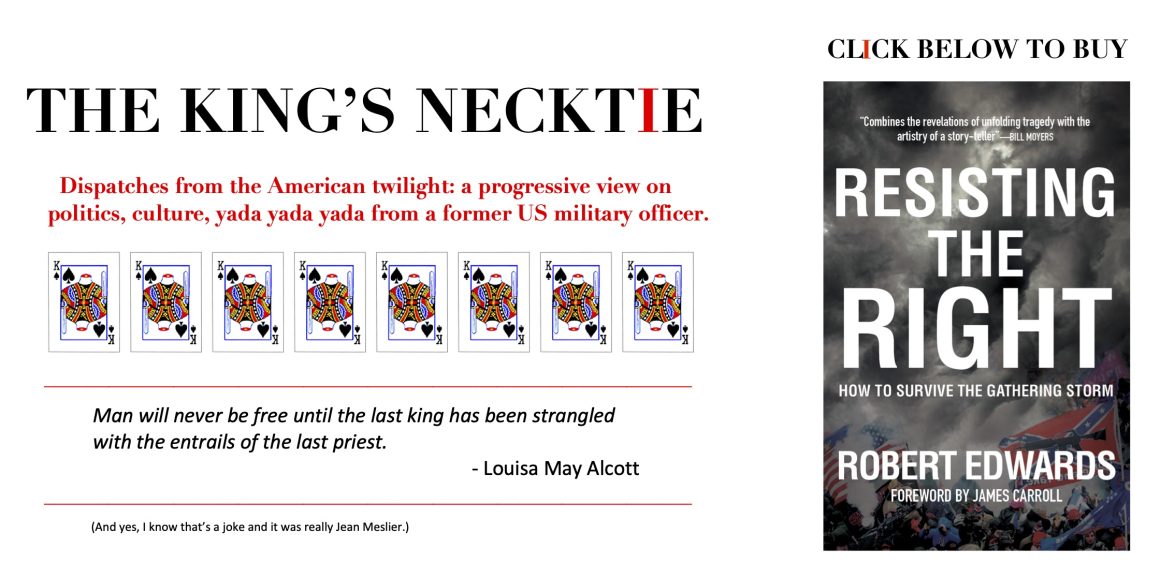
More recently, I wrote Resisting the Right: How to Survive the Gathering Storm as a kind of contingency plan for the worst case scenario, always hopeful and even guardedly optimistic that we would be wise enough to avert it. (It was certainly within our power to do so.) Unfortunately, that optimism has proven misplaced. But when I was researching the book, I spoke to people like Zoharah Simmons, an icon of the Civil Rights movement; Jon Else, who worked with SNCC and the Southern Christian Leadership Conference in that same movement; Alix Kates Shulman, a central figure in Second Wave feminism; and the Rev. Dr. Norvel Goff, Jr., a prominent leader in the NAACP and deacon of Mother Emanuel AME Church in Charleston, SC at the time of the horrific 2015 mass murder there. To a man and woman, all of them echoed some variation of what James Carroll, the esteemed author and a veteran of the Catholic Left and the antiwar and Civil Rights movements, told me for that same book:
Don’t focus on the outcome. Because if you start by doing that, you’ll be too discouraged to keep going. Focus on the importance of standing for the principle, and the truth, that’s at stake in the present moment.
Along those lines, there is a brief essay from Rebecca Solnit rocketing around the Internet this morning, and I have taken solace from it. It begins:
They want you to feel powerless and to surrender and to let them trample everything and you are not going to let them. You are not giving up, and neither am I. The fact that we cannot save everything does not mean we cannot save anything and everything we can save is worth saving. You may need to grieve or scream or take time off, but you have a role no matter what, and right now good friends and good principles are worth gathering in. Remember what you love. Remember what loves you. Remember in this tide of hate what love is. The pain you feel is because of what you love.
All of my interviewees for Resisting the Right stressed the fact that a pro-democracy movement like the one needed to beat Trumpism does not require a re-invention of the wheel: there are numerous historical models, from the aforementioned Civil Rights Movement in the US, to Solidarity in Poland, to the People Power movement in the Philippines. People across the globe and throughout history have faced down tremendously brutal and entrenched authoritarian movements and prevailed. We can take inspiration and guidance from their examples.
Solnit makes that same point, writing that “People kept the faith in the dictatorships of South America in the 1970s and 1980s, in the East Bloc countries and the USSR, women are protesting right now in Iran and people there are writing poetry.” She goes on:
The Wobblies used to say don’t mourn, organize, but you can do both at once and you don’t have to organize right away in this moment of furious mourning. You can be heartbroken or furious or both at once; you can scream in your car or on a cliff; you can also get up tomorrow and water the flowerpots and call someone who’s upset and check your equipment for going onward….
There is no alternative to persevering, and that does not require you to feel good. You can keep walking whether it’s sunny or raining. Take care of yourself and remember that taking care of something else is an important part of taking care of yourself, because you are interwoven with the ten trillion things in this single garment of destiny that has been stained and torn, but is still being woven and mended and washed.
In case there was any doubt, last night brought it home: There is a deep sickness in America, deeper even than we knew or feared. It will not be rooted out, let alone eradicated (or even contained), overnight. But we have no choice but to carry on.
 thekingsnecktie.com
Thanks for this, Bob…we needed something relatively reassuring.
LikeLike
Thank you, Kent!
LikeLike