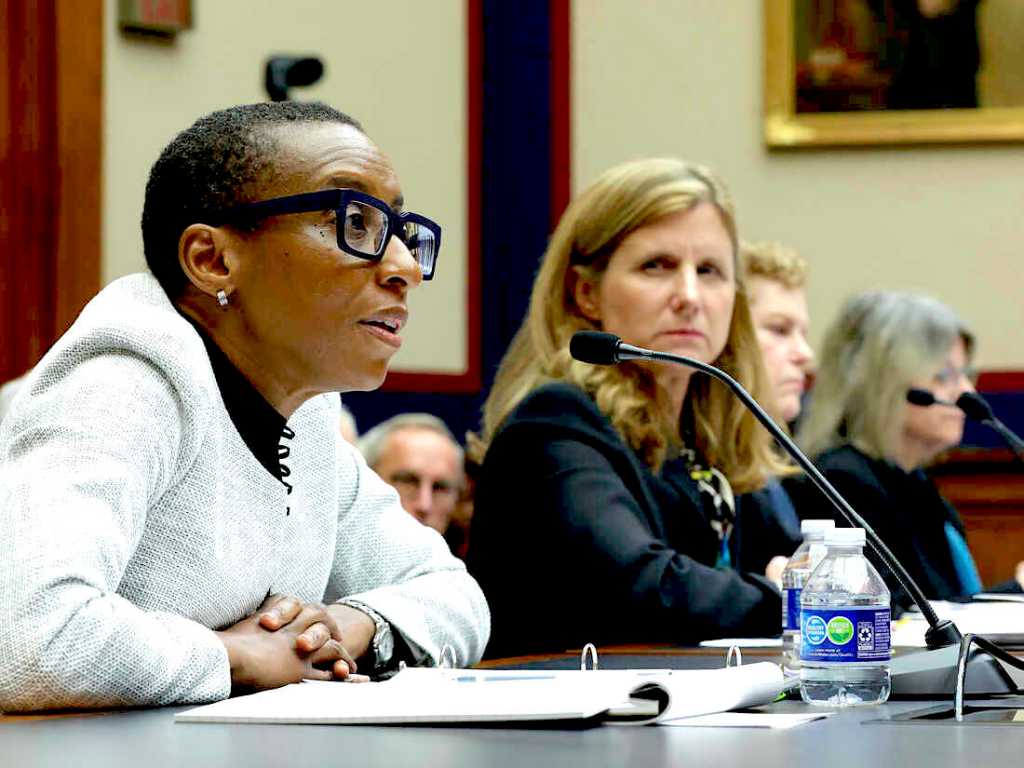
With apologies to Dave Matthews, so much to say, so much to say, so much to say about the recent brouhaha involving the Congressional testimony of the presidents of three high-profile universities on the topic of antisemitism on campus.
I’LL COME IN AGAIN
Where to begin?
1. Bad Faith Actors
Well, you might be shocked to hear this, but clearly the Republican congressmembers of the House Education and Workforce Committee—led by Rep. Elise Stefanik (R-NY), the Charlotte Corday of MAGA Nation—were not so much conducting the people’s business as grandstanding for the GOP base over the make-believe issue of “wokeness.” They did so with a bad faith attack on representatives of academia, one of conservatives’ favorite bogeymen. (Or should I say, “bogeywomen.” The icing on the cake for Trumpies was that all three university presidents were female, and one was Black.)
More concretely, Republicans would like to find justification for cutting federal funding to protect the civil rights of marginalized groups across the board. So the hearing was less about protecting minorities than about hurting them.
2. Fail to Prepare and Prepare
But surely these presidents—brilliant and accomplished lifelong academics representing Harvard, MIT, and Penn, even if they were all relatively new in their positions—knew what they were in for and had been prepped by communications staff, publicists, and PR folks. (Reportedly they had been.) They had to know they were going to face an inquisition; how could they not expect it? So it was especially surprising that by and large they were unable to handle gotcha questions like “Is genocide bad?”, even if those questions were wildly disingenuous.
Even if these presidents were stuck in an ivory tower mentality and out of touch with Real ‘Merica—a point the GOP was keen to make, whether it was true or not—surely they had advisors who could have armed them with soundbite-sized, TV-ready answers that exposed the dishonesty of their interlocutors. Right???
I have a lot of sympathy for the presidents, and the bad spot they were in, and the complex points they were trying to make and the villainy of the GOP congressmembers they were trying to make them to. But it was hard to watch them fail to deflect the obvious attempts to bait them, and their inability to offer pithy ripostes in defense of their positions that would shut those Trumpies up.
To be fair, though, it’s hard to be pithy when the positions you are trying to defend are complicated and not easily reduced to bumper sticker slogans. Which brings me to my third point.
3. Got Milk?
Given the premise of the hearing, and the self-serving intentions of the committee’s right wing members, it should come as no surprise that nuance was so missing-in-action that it might as well have been on the side of a milk carton.
The presidents tried to explain the complexity of protecting freedom of expression—a lodestar for academia—while keeping at bay the kind of on-campus hostility that gives anyone in their communities well-founded fears for their safety, not to mention proscribing so-called “hate speech” that incites actual violence. Sadly they did so in rather clinical terms that allowed Stefanik & Co. to paint them as callous and indifferent to hate speech, unacceptably tolerant of antisemitism in particular, and generally out of touch with real life. (Stefanik herself is a Harvard grad who certainly knows better. Previously she was a “moderate”—whatever that means in the contemporary GOP—before realizing that puckering up and kissing Trump’s big white ass cheeks is the way to power in that organization.)
So, yeah, pretty much a shitshow all around. It was big enough news that “SNL” parodied it in its cold open the following Saturday, taking shots at both the Republicans’ wanton dishonesty and the presidents’ verbal clumsiness. Philanthropists withdrew or threatened to withdraw vast sums of money that they would normally donate to these schools…..which is their right, whatever you think of the reasons for so doing, and of the potential chilling effect of those withdrawals. As a result of the outcry, President Magill was forced to resign as president of Penn. Harvard president Claudine Gay is under similar pressure, with the university’s governing body set to decide her fate today, and more than 650 faculty members signing a letter of support for her, and hundreds of Black alumni and allies of Harvard doing likewise, according to the Washington Post. (No word yet on the fate of Buffalo Bills coach Sean McDermott and his admiration for the 9/11 hijackers.)
And plenty of thoughtful people on all points of the political spectrum are upset by all of it.
Many were outraged that the presidents of three of the most prestigious universities in this country were unwilling to agree plainly that calls for genocide—against anyone, but particularly against an ethnic group that has already been the target of a pretty successful genocide within the lifetime of many living Americans—are unacceptable on their campuses. That hue and cry exacerbated already raw feelings over what many perceived as the weakness and timidity with which many US universities responded to the October 7 attack in the first place.
Others were outraged that these presidents were subjected to this auto-da-fé at all. The academy is supposed to be the one place, above all others, where competing intellectual visions are given free rein, and allowed (and even encouraged) to flourish in vigorous, open, civilized debate. So the effort to suppress free expression in that realm above all is itself highly offensive and alarming.
And no clear consensus emerged as a result of this fiasco, let alone a deeper collective understanding of the issues.
THE RELATIVE VALUE OF SUNLIGHT AS A DISINFECTANT
So what to make of all this?
My wife Ferne Pearlstein and I have spent a lot of time thinking about free speech. It was a crucial subtopic of our 2016 feature documentary The Last Laugh, which examined what is or isn’t off-limits for comedy, beginning with the Holocaust, and the implications for other taboo subjects in a society that purports to venerate freedom of expression.
What we learned was the same thing that most people who have delved into the topic have come away understanding: That there are no clear and obvious answers, no black-and-white lines that define every situation, and that it’s all about context and intent, which by definition require an appreciation of nuance. That is precisely what was missing in last week’s Congressional contretemps, and much of the reaction to it.
So some remedial instruction seems to be in order.
Freedom of speech is not absolute. There are plenty of forms of speech that are necessarily off limits, such as slander, libel, fraud, and above all, the fomenting of violence. The line is actually pretty easy to understand: it’s where mere expression of ideas crosses into active incitement of harm, physical and otherwise.
The hard part is identifying where that line is.
But to call for the extermination of a people—be they Jewish, Palestinian, Armenian, Tutsi, or what have you—seems to fit the definition.
One need not even deploy the G-word to find speech that is causing harm in the present, highly volatile moment. Since the Hamas attack of October 7, both antisemitism and Islamophobia have spiked in the US, with Jews and Arabs alike targeted in horrific and unconscionable ways, including murders and attempted murders. Therefore, “speech” is being scrutinized more heavily than usual…..or not, depending on how one looks at it.
In The Atlantic, Yair Rosenberg recently wrote an excellent piece called “How to Be Anti-Semitic and Get Away With It,” examining the ploys that antisemites use to spread their toxic beliefs under the guise of legitimate criticisms—of the Netanyahu government, for example. Bibi & Co. make it easy for these cretins, because they are doing plenty of stuff that is deserving of criticism. But it’s a helluva leap from opposing the indiscriminate bombing of civilians to promotingThe Protocols of the Elders of Zion.
Similarly, Islamophobes are happy to seize on the terrible acts of Hamas, Hezbollah, the mullahs of Teheran and the oligarchs of Riyadh to justify violent attacks on innocent Muslims and other Arabs, like the three young Palestinian students who were shot by an angry lunatic in Burlington, VT a few weeks ago.
So we are certainly in a time when incendiary speech rightly ought to be examined for the consequences it precipitates. Just not by grandstanding right wing politicians whose self-aggrandizing agenda is as plain as the fake nose on Bradley Cooper’s face.
A DISSENTING VIEW (DISSENT IS OK IN AMERICA, RIGHT?)
Claire O. Finkelstein is a professor of law and philosophy at Penn, chair of the law school’s committee on academic freedom, and a member of the university’s Open Expression Committee. In response to the controversy over last week’s hearing, she published an op-ed In the Washington Post provocatively titled “To Fight Antisemitism on Campuses, We Must Restrict Speech.”
On the issue of how American academia is policing hateful speech, Finkelstein asserts that “Congress could have assembled two dozen university presidents and likely would have received the same answer from each of them.”
But in making that observation, she was not endorsing it.
Finkelstein rues what she calls the elevation of free speech “to a near-sacred level on university campuses,” and argues that such speech, including but not limited to antisemitism, “cannot be fought on university campuses without restricting poisonous speech that targets Jews and other minorities.”
University presidents are resisting this conclusion. Rather than confront the conflict between the commitment to free speech and the commitment to eliminating the hostile environment facing Jewish students on campus, many simply affirm their commitment to both or buy time by setting up task forces to study the problem. Some have attempted to split the difference by saying they are institutionally committed to free speech but personally offended by antisemitism. Others have said the answer to hate speech is education and more speech.
Countering speech with more speech might just mean adding to the hateful rhetoric on campus and would not solve the problem. And university presidents can set up all the task forces, study groups and educational modules they like, but what kind of educational effort could possibly bring together warring groups that are busy calling for one another’s violent demise?
As centers of higher learning, these schools clearly want to foster free-thinking, and therefore have taken a very generous position toward tolerance of offensive speech. But as Finkelstein points out, these universities are also private organizations and no more obliged to honor the First Amendment than they are to honor the Second. Just because you can openly carry around an AR-15, doesn’t mean you can do it on Harvard’s campus, and just because you’re constitutionally protected if you support Holocaust denial, or creationism, or the Dallas Cowboys, doesn’t mean you have the right to do so within the UPenn community.
She makes a convincing case:
Though open expression and academic freedom are critically important values in higher education, there are other values that universities must promote as well. For example: encouraging civil dialogue across differences, cultivating critical listening skills, developing the skills to build community relationships, promoting the ability to engage in moral reflection and building resilience in the face of challenge. These normative skills cannot be taught effectively in an environment where students and faculty are hurling calls at one another for the elimination of ethnic, religious or racial subgroups.
What values do university presidents think are most important to prepare leaders in a democracy? The ability to shout intemperate slogans or the ability to engage in reasoned dialogue with people who have moral and political differences?
Ironically, this is not really too far afield from the point that those university presidents themselves were trying to make before Congress. The only difference is where they believe they need to draw the line.
Finkelstein writes that what she is most concerned about are “the legal and policy conclusions” that her own school’s president endorsed: “that speech calling for Jewish genocide does not violate campus policies at the University of Pennsylvania.” So in that regard, one can credibly fault the university presidents not only for clumsy messaging, but—perhaps—for having a message that was itself flawed.
But Finkelstein goes further still, arguing that not only overt calls for genocide but even calls for a new intifada or the chanting of the term “from the river to the sea” (which implies the elimination of the state of Israel) are calls for violence “against a discrete ethnic or religious group”—and deliberately vague by design, some might say, in order to dodge accountability. “Such speech,” she writes, “arguably incites violence, frequently inspires harassment of Jewish students and, without question, creates a hostile environment that can impair the equal educational opportunities of Jewish students.”
OK: arguably, but not inarguably.
That area is a bit grayer, taking us back to the subjectivity of where speech becomes incitement to harm in the first place. I don’t have the answer, but I’m damn sure Elise Stefanik doesn’t.
STAND BACK AND STAND BY
Obviously, we have to have limits on free expression, but the form and imposition of those limits ought to be minimal, and very carefully considered, as the repercussions—that is, of restricting or even merely chilling speech that ought not be thus curtailed—are severe.
But it’s a slippery slope—the slipperiest, in fact, a giant soaking-wet Slip’N Slide that runs all the way into censorship and authoritarianism. (The Slip ‘N Slide of Authoritarianism. Candidate for metaphor of the year, and the title of a book I wish I had time to write.)
Even as this latest Congressional drama unfolds, federal prosecutors (and the voting public) are wrestling with the question of whether or not Donald J. Trump’s incendiary words after his electoral defeat constituted an incitement to violence on January 6, 2021. (Spoiler alert: they did.) Also in play: the implications of his continuing pattern of public statements since then, including brazen threats against judges, witnesses, and his political enemies, promises of retribution, and none-too-subtle exhortations to physical uprising by his followers.
Like the crime boss he is, Trump has a lifetime of experience in choosing his words carefully (“Nice country you got here. Shame if something happened to it”), avoiding putting anything in writing, destroying anything that was, and otherwise weaseling out of incriminating evidence that would allow us to hold him culpable, even as he has overseen all manner of skullduggery, from tax fraud to sedition. That’s what RICO statutes are for.
Inarguably (yswidt?) we have to draw a line between permissible speech and that which foments bloodshed. But it is very easy for those with ill intent to exploit and distort and abuse that distinction to quash free expression for their own vile ends. Witness the reprehensible Ohio senator J.D. Vance, who last week called on the DOJ to prosecute the journalist Robert Kagan under the Insurrection Act for his recent, widely-discussed, depressingly grim article in the Washington Post predicting a Trump dictatorship, and suggesting the ways resistance to it will be futile.
Imagine if Kagan had suggested that resistance might not be.
So last week’s Congressional circus was highly instructive. People are dying in Gaza. Israelis are still held hostage. Both Jews and Arabs in the US are the targets of unconscionable attacks, both verbal and physical, some of them homicidal. In that climate, it’s not helpful to have a bunch of Republican politicians running roughshod over the complexities of the situation to try to score points with Fox News viewers. And their bad faith is a grim augury of how they would distort and weaponize freedom of expression, and institute un-American censorship thereof, should they regain power in these United States.
*********
Photo Claudine Gay, president of Harvard, Liz Magill president of Penn, Pamela Nadell (professor of history and Jewish studies at American University), and Sally Kornbluth, president of MIT, testifying before the House Education and Workforce Committee, December 5, 2023.
Credit: Kevin Dietsch/Getty Images
 thekingsnecktie.com
One thought on “It’s All About the Line”