
Last week in this blog I wrote—yet again—about the responsibility of the press to call out the threat that the Trumpist GOP poses to American democracy, instead of engaging in the outdated, pre-2016 faux objectivity and maddening bothsidesism that has helped bring us to this pretty pass in the first place.
It’s a safe bet I’ll harp on that topic again before November 2024. (Mark your calendars.)
But in the interest of being fair and balanced (cough cough), I’d be remiss if I didn’t note some recent examples of the press doing exactly what I asked.
In fact, the week that followed saw a veritable flood of articles on that very topic. “Après moi, le déluge” indeed, motherfuckers.
I’m not saying my essay moved the national conversation, post hoc ergo propter hoc. (French and Latin in the same essay? Gott im Himmel!) I’m just saying that clearly I have my grubby little index finger on the pulse of the nation. Which is good, because I am saving the finger next to it for messaging members of MAGA Nation when they scream by me on the New Jersey Turnpike in their black pickup trucks, flying “Let’s Go Brandon” flags and blasting Lee Greenwood.
In The New York Times, David Leonhardt had an excellent piece on the imminent threat of Trump 2.0, while The Bulwark’s Charlie Sykes published a column called “You Are Really Not Sufficiently Alarmed.” The Atlantic devoted an entire issue to the topic, featuring an all-star cast including Applebaum, Serwer, Foer, Packer, Gellman, Frum, Coppins, Dickerson, and more.
Most widely commented upon of all, Robert Kagan had a long and terrifying piece in The Washington Post titled “A Trump Dictatorship Is Increasingly Inevitable. We Should Stop Pretending” that was so grim that it left numerous friends of mine in the fetal position all week. As a wakeup call—its obvious intent—it was powerful, to be sure, but for my money almost too defeatist and depressing, running the risk of making progressives throw up their hands in surrender.
Kagan’s fellow WaPo columnist Greg Sargent certainly saw it that way, responding with a piece of his own titled “Enough With All the Fatalism About a Trump Dictatorship”:
The impulse to sound alarms—to break voters out of their “it can’t happen here” doldrums—is understandable. But it’s also possible to take this too far, and here it’s worth registering an irony: Ruth Ben-Ghiat, a scholar of strongman rule, has noted that a time-tested tactic of authoritarian leaders is to disarm the electorate by suggesting their glorious triumph is inevitable.
“Authoritarians create a climate where they seem unstoppable,” Ben-Ghiat told me. “Creating an aura of destiny around the leader galvanizes his supporters by making his movement seem much stronger than it actually is. The manipulation of perception is everything.”
But we need not take sides in the Kagan vs. Sargent cage match: both have the same Paul Revere-like aim, differing only in how they think we best organize ourselves to forestall Trump’s return. (Sykes, too, subsequently tempered his position, with a follow-up called “The Case Against Despair,” writing that, “Alarm is justified. But fatalism is deadly.”)
So by all means, let’s wake up to the very real danger that Trump poses, and do something about it. But let’s not psych ourselves out and create a self-fulfilling prophecy that hands him power—again—by virtue of our own anxiety and paralysis.
The good news is that the MSM are sounding the alarm at all. In fact, the sudden ubiquity of reportage on the topic was so striking that it became a story in itself, as reported by MSNBC’s Hayes Brown, who wrote that “Trump’s second term threats are the story of 2024.”
Will these pieces have any impact beyond the left-leaning chattering classes who were already scared shitless over the prospect of a second Trump administration?
I don’t know. But they’re a start.
A LOVE SUPREME
I hasten to note another recent example of how the American press did an outstanding job, if not exactly on the topic of the MAGA menace, then at the very least related to it, and that is ProPublica’s reportage on corruption in the Supreme Court.
Strike that—I don’t want to tar the whole Mudville Nine. PP’s reporting concerned howling breaches of ethics by the two most right wing justices on the Court, Samuel “Abortion Ain’t in the Constitution” Alito and Clarence “Coke Can” Thomas. Those breaches including flying on private jets and going on all-expenses-paid fishing vacations on the dime of billionaire Republican donors who had business before the Court (Alito), and accepting gifts including luxury vacations, private school tuition for a grand nephew, and the purchase of his mother’s home by a different Republican billionaire donor (Thomas). Neither justice recused himself from the relevant cases involving those donors or their associates, nor even disclosed those gifts. And that’s not even getting into the activities of Mrs. Thomas, a prominent player in the attempt to steal the 2020 election.
It goes without saying that if a liberal justice had done such things, Fox Nation would be howling for impeachment, if not the guillotine. (As it is, the best they can do is try to gin up a false equivalence, without a millimeter of traction.)
But Pro Publica’s work on these stories shows how journalism can actually have a concrete impact on our democracy.
As a result of that outstanding reporting, Congress got up in arms—because much of the American public got up in arms, at least the part that is not comatose, or in a pact with Satan—and began putting pressure on the Court to clean up its act. Congress even summoned John Roberts to testify, or should I say, politely asked, and John imperiously declined because, absent a subpoena, Supreme Court justices have that kind of privilege. But Roberts clearly felt the heat, because not long afterward he announced that the Court was instituting a written, binding code of ethics for its justices, something that had never been necessary in the previous 234 years of existence, when that quaint little thing called “shame” was still operative.
I have little doubt that Alito and Thomas (and perhaps other justices as well) will continue to try to get around the system and allow money and influence to poison their duties: we are in scorpion-and-frog territory here. But all politics is about measures and countermeasures. This was a significant win, and it is already bearing fruit.
I hear your muttering.
Is this just a small thing, you ask, getting the Supreme Court to do the bare minimum, ethics-wise, that is required of almost every other federal employee? Au contraire. It’s a BFD, as Joe Biden would say…..and that dramatic, overdue, and fairly humiliating concession by Roberts and the Court is 100% due to the dogged reporting of the outstanding journalists at Pro Publica.
In fact, let’s call them by their names: Joshua Kaplan, Justin Elliott and Alex Mierjeski. Well done, fellas. More, please.
I note this example very deliberately, because far from rebutting my previous point about the shortcomings of the American press when it comes to the current democratic emergency, it is a demonstration of the vast good that the press can—and must—do.
A TISKET, A TASKET
The press still has some sins to repent for, of course. Mehdi Hasan’s show was just canceled by MSNBC, robbing us of one of the sharpest progressive voices on American airwaves—hardly the act of a network that its right wing critics would have us believe is the left’s version of Fox. (NB—and more Latin: it ain’t, by a mile.)
Meanwhile, Media Matters’ Matt Gertz compared the relatively little attention the mainstream US media paid to Trump’s recent comment calling his political opponents “vermin,” as opposed to the vast coverage of Hillary Clinton’s widely misunderstood “basket of deplorables” comment in 2016.
The contrast is eye-popping—and outrageous. Media Matters found that the major US broadcast news programs “aired 54 minutes of coverage of Clinton’s ‘deplorables’ comment but just 3 minutes regarding Trump’s ‘vermin’ remark.” (See below.)
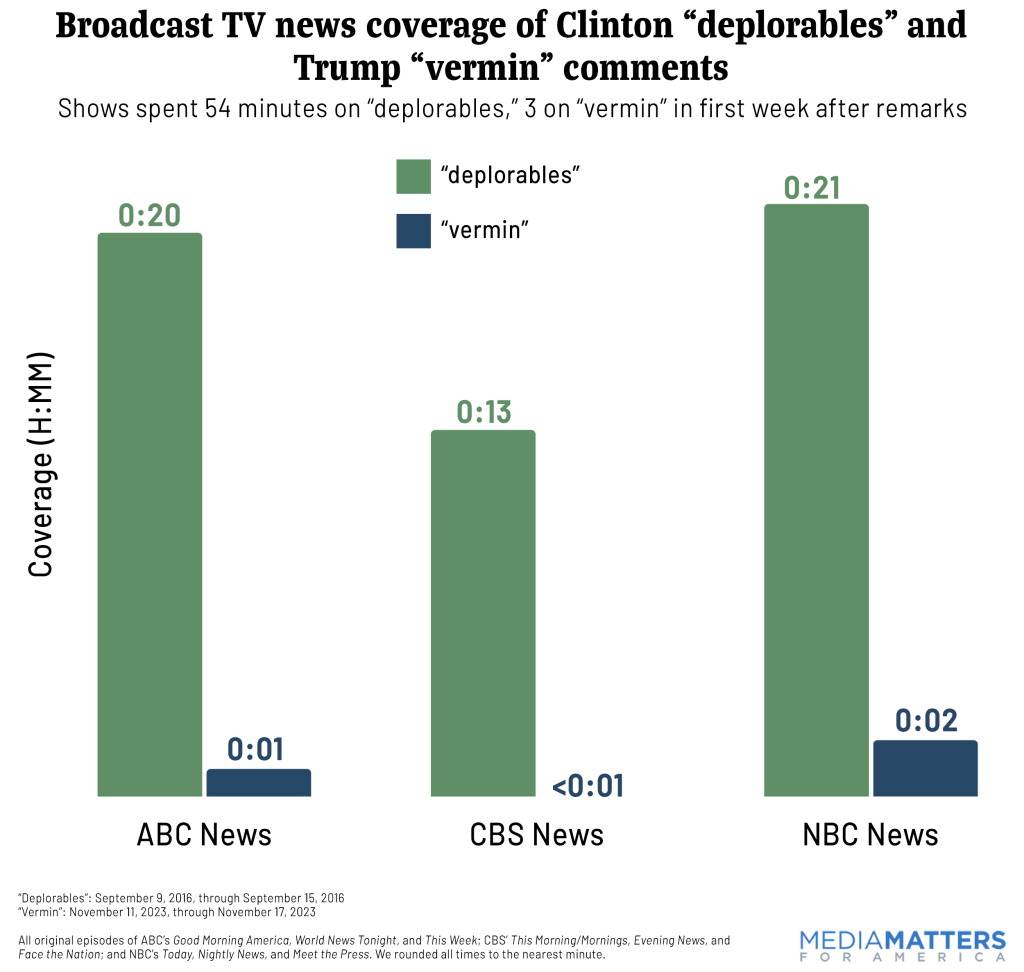
For what it’s worth, to my ears, Clinton was—correctly—applying the term “deplorable” to Trump’s neo-fascist, white nationalist supporters, not to conservative white people in general, even though the latter is how it was invariably reported. I longed for Hillary or her surrogates to point that out and own the remark, but they never really did. Trump, by contrast, was undeniably talking about anyone who dares oppose him, and in terminology that very specifically and deliberately recalled the Nazis’ characterization of their domestic enemies.
Kinda seems like the sort of thing that should be called to the attention of the American people, n’est-ce pas?
We learned way back in 1990, via Trump’s ex-wife Ivana, that Donald had kept a book of speeches by his bedside—uh, another worrying tell. He now seems very clearly to be following the Mein Kampf model in telling us exactly what he will do if he regains power.
If only there were a public institution devoted to spreading the word about such things.
KILLING CASSANDRA
I am not hard on the press for the fun of it, and certainly not—like the right wing—in an effort to destroy its credibility and the obstacle it presents to the autocratic project. On the contrary: I am hard on the press precisely BECAUSE I know the obstacle it presents to the autocratic project, and the good it can do in stopping that project in its tracks. We saw it with ProPublica and the Supreme Court.
When it comes to the broader future of democracy at large, if we are to keep Robert Kagan’s dire prediction from coming true, we’re going to need a lot more of that over the next eleven months.
Res ipsa loquitur.
***********
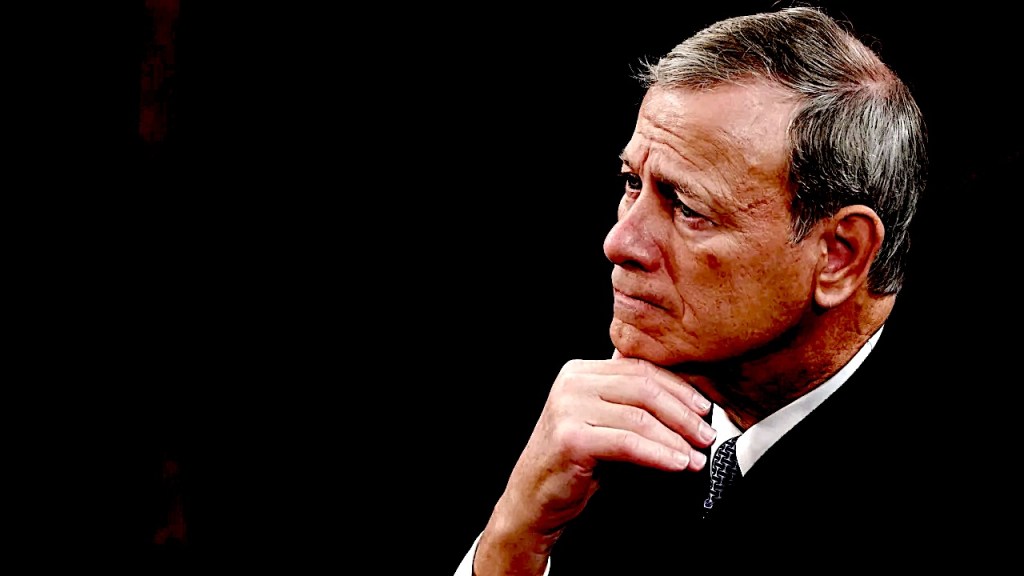
Photo: Chief Justice John Roberts. Credit: Sarah Silbiger/Bloomberg/Getty Images.
Thanks to Genie Smith for pointing me to the Media Matters reportage on Trump’s “vermin” speech contrasted with Clinton’s “deplorables” comment.
Copy editing courtesy of the intrepid Gina Patacca.
 thekingsnecktie.com