Faithful readers of this blog would be forgiven for thinking that, after a week that saw the long-awaited Big Indictment of Trump, one could turn to these pages for some pontification about it it. It’s coming, trust me. For now, The Washington Post summarized it neatly, noting that while Trump’s previous two indictments—for hush money paid to a porn star and the theft of classified documents—were serious, this one is “fundamentally more consequential.”
Tuesday’s indictment accuses a former president of the United States with attempting to subvert the democracy upon which the nation rests. And with Trump again running for the White House, the charges he faces pose an extraordinary test to the rule of law, experts say. “This gets right to the question of how elections work, how power is transferred peacefully,” said Jon Grinspan, a curator of political history at the National Museum of American History. “This is really a question about the functioning of American democracy.”
Laurence Tribe, a Harvard University legal scholar, said, “The crimes indicted are an order of magnitude beyond anything that has been committed against this country by any American citizen, let alone a former president.”
The big question now is: will it make any difference? There will be plenty of time for us to ponder that in the weeks and months ahead.
In the mean time, I want to write some more about music.
ELVIS WAS A HERO TO MOST
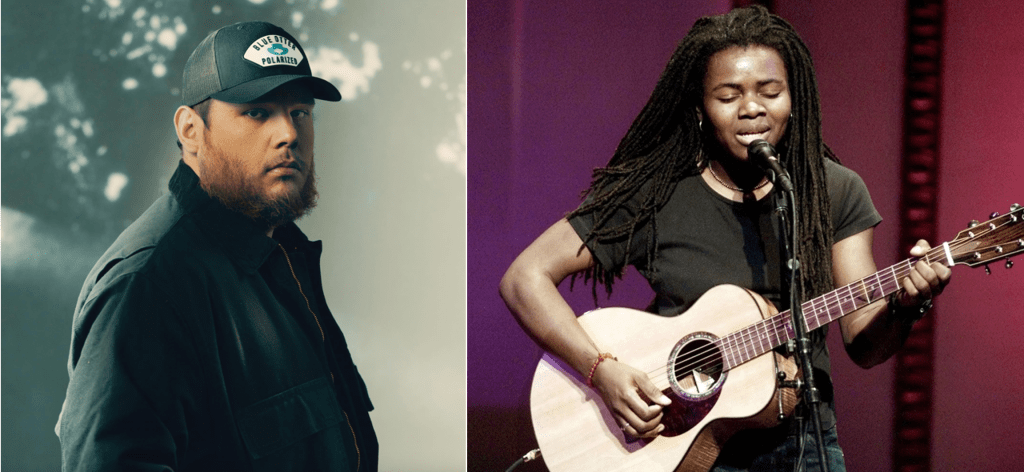
I’ve been on vacation in Massachusetts, and the other day as the wife and I strolled down the main street of some little seaside town, a huge black pickup truck roared past us with two giant American flags flying from its back, blasting Luke Combs‘ version of Tracy Chapman’s “Fast Car.” No “Let’s Go Brandon” decals, but I’m pretty sure I know how that guy voted, twice.
(Actually, even without the flags and the song, it’s been my experience that the make, model, and muffler status of a speeding black pickup is a pretty good giveaway.)
I’m trying hard to think of a hit song that’s a weirder cover. And it wasn’t just a hit: Combs’s track spent four weeks at number one on Billboard’s country chart, and is still in the top five as I write this, making it the most successful cover on that chart ever.
We all know that in Western pop music there is a looooong tradition of White musicians ripping off Black ones. That is a harsh characterization, but a correct one in many cases. Even the most generous interpretation—in which a genuinely talented White artist with real understanding of, and affection for, music rooted in Black culture achieves massive success by playing it—is discomfort-making. Elvis, the Stones, Paul Simon, Eminem….the examples are infinite, because almost all popular American music is rooted in Black culture. The list of grievances of Black people in the United States is pretty long, so that one might not crack the top ten, but it is certainly infuriating nonetheless.
Even so, this one is extra strange. Dreadlocked Black lesbians aren’t exactly a mainstay of country radio. Has a hit song been this misunderstood and usurped since “Born in the USA”? (Silver medal: “Every Breath You Take.”)
Tracy Chapman had a top ten hit on the pop charts with her original version back in 1988, and won a Grammy for Best Female Pop Vocal Performance, capping a debut album that was a generational juggernaut. She has been very complimentary of Comb’s version and gracious toward him, and it’s great that she’s getting this payday, royalties-wise. I don’t know if, privately, she relishes the irony or is infuriated by it, but practicing a kind of civility that is demanded of women and people of color in this country.
Lots of other people have noted the irony— many of them bitterly—of a giantly popular White male country star having a monster hit with a song by an artist from a marginalized community that many in the country audience openly despise, particularly at a time when those overlapping communities—Black, LGBTQIA+, and politically progressive—are under renewed attack as pluralistic democracy fights for its very life. That is indisputable.
But then again, if you listen to the lyrics, it’s not so weird at all that this song is a hit on country radio, even beyond the obvious quality of the composition, bittersweet melody, and infectious guitar lick. It’s a song about being downtrodden, about having a shitty life, about sick parents and bad jobs and romances turned sour, and being stuck in a life that’s going nowhere and dreaming of a better one. In that regard, the fact that it speaks to the country audience is not surprising at all.
In fact, “Fast Car” is squarely in the tradition of country & western songs, per 1971’s “You Never Even Call Me By My Name,” written by Steve Goodman and an uncredited John Prine, and covered by David Allan Coe (who had a hit with it), sometimes called the “perfect country song,” because it sums the genre up in the single line:
“I was drunk the day my ma got out of prison.”
“Fast Car” is a song about the broken American dream. Should we be taken aback that it resonates across cultural lines…..or just frustrated that the implications of that appear lost on a great many listeners?
LUKE, I’M YOUR DIDDY
Country music ain’t what it used to be, of course. Hank Williams and Johnny Cash and Willie and Waylon and the boys—to say nothing of Loretta Lynn, June Carter, and Patsy and Dolly—have largely been replaced by glossy, formulaic “New Country” which is all but indistinguishable from mainstream pop. It’s ubiquitous even in big cities and in the North; it’s the music of Republicanism and has become a tribal marker as much as anything else.
For my taste, Combs’s recording is rather boring in its faithfulness to the original arrangement, which raises the question: why bother? I suppose the obvious answer is that when a White dude does it, it can shoot to the top of the country charts. I don’t question the love for the song that he has expressed, reportedly one of the first he learned to play when he picked up the guitar. I just think it would have been more interesting if he’d had some sort of new take on it, beyond his Y chromosome and pigmentation. In fact, the most interesting thing about the cover is its absolute faithfulness, right down to the fact that Combs didn’t even change the sex of the narrator. (“So I work in a market as a checkout girl.”) I’m surprised country fans are cool with that.
Is that snotty stereotyping on my part? Uh, OK. I grew up in the South of the 1960s and ‘70s. I was born at night, but it wuddn’t last night.
But maybe Luke is just the white sheep of the Combs family.
If we get beyond the Elvis-ness of it all, and accept that the poignant lyrics of “Fast Car” do speak to people across lines of race and sex and ethnicity, maybe it’s possible to turn that bitter irony into a dawning realization that we’ve been the victims of a very very long con in this country….maybe going all the way back to its very dawn.
Memo from the Department of Blinding Obviousness: In the US, the powers that be have always used race to divide us. Poor White people and poor Black people who are natural allies have been successfully kept from making common cause by the plutocracy, and there can be no better example than Trump’s ascent to the White House in 2016. Was there alienation and anger among working class White people when they went to the polls that year? Sure. Did it make sense for them to turn for salvation to self-styled Richie Rich from Manhattan who had a golden toilet and whose entire persona centered on bragging about how elite he was? You tell me. To that point, subsequent scholarship has shown that racial panic, not economics, was the greatest indicator of support for Trump. As a certain Southern gas station attendant-turned- US Marine used to say, surprise surprise surprise.
So I’d like to think that Luke Combs’s “Fast Car” isn’t so weird at all, but a reminder that ordinary working Americans of all races actually are all in the same boat—er, Chevrolet. Then maybe one day we’ll turn on country radio and hear Tracy’s “Talkin’ Bout a Revolution”:
Talking about a revolution? It sounds like a whisper / While they’re standing in the welfare lines / Crying at the doorsteps of those armies of salvation / Wasting time in the unemployment lines, sitting around waiting for a promotion / Poor people gonna rise up and get their share / Poor people gonna rise up and take what’s theirs
Maybe, and wouldn’t that be something?
Except if “Talkin’ Bout a Revolution” were to crack the country charts, I fear the “revolution” in question would be the Capitol insurrection kind, with Confederate flags and AR-15s.
SIDE BY SIDE ON MY PIANO KEYBOARD, OH LORD
In closing, let me circle back to the J6 indictment. If the election of Donald Trump in 2016 was a shocking demonstration of the comfort level with fascism of an alarmingly large swath of the American people, the possibility that we might re-install him as president in 2024 after the events of the last eight years is almost incomprehensible. Even if it is just a fanatical minority that brings it about, it would require a blind tribalism and submersion in an alternate reality that beggars the imagination. But as the great Adam Serwer writes in The Atlantic: “Those defending Trump after his indictment over his attempted autogolpe are not opposing the politicization of justice; they are demanding it.”
We’re not really capable of that, are we? I like to think not. But then I think of that Trump supporter in the black pickup blasting “Fast Car.”
The indictment is an essential step toward trying to preserve our democracy. The trial will be a crucial test, and irrespective of its outcome, election day will foretell whether the republic is going to stand or not. Here’s David Remnick of The New Yorker:
So far, tens of millions of Americans are willing to overlook not only the multiple criminal indictments of Donald Trump but also his lethal mismanagement of covid-19; his inhumane handling of children at the border; his myriad statements of bigotry and misogyny; his assaults on the free press and the rule of law; his indifference to national security and the climate emergency; his affection for autocrats around the world, his impeachments; his many schemes to enrich his family.
According to the Times poll, Biden and Trump are tied in a hypothetical rematch at forty-three per cent. Sooner or later, a great reckoning is coming.
If we inexplicably return this traitorous cretin to the White House, ain’t a NASCAR racing car fast enough to get me outta here.*
********
*Just kidding. If that happens, exodus is not the answer. The struggle will only be beginning.
 thekingsnecktie.com