Christopher Nolan does not know who I am, but he has been messing with me for the better part of two decades.
THE BATMAN MOVIE THAT NEVER WAS
Around 2002, when Warner Bros. decided to reboot the Batman franchise, my agent at CAA put me up for the job of writing the new movie that would eventually be called Batman Begins (2004). I pitched them a take that began: “With Batman, the darker the better. He is after all, a man who turns into a bat.”
My idea was to pit our hero against a much more chilling, realistic villain—someone like a Hannibal Lecter—and make their battle a gothic, Edgar Allan Poe-style detective story with the Caped Crusader hunting this Jack the Ripper-like serial killer. The intent was to be genuinely creepy and scary, more like a smart horror film—think Seven—than a superhero movie. (I was subsequently informed that there was already a contemporary Batman graphic novel that took that approach, by Frank Miller, perhaps? It’s not really my milieu.)
In my version, (the) Batman is old and retired, having given away the Wayne fortune and decamped to a Buddhist monastery for a life of asceticism to try to put his demons to rest. He has left Gotham City in the hands of the Boy Wonder, who is now a grown-ass man who insists on being called Robin-Man. (He is the Superhero Formerly Known as Prince.) But Batman casts a long shadow. Everywhere Robin goes, he is compared to his mentor, assaulted with questions about the old man, deluged with requests to recount the good old days, and so forth. He’s annoyed by it.
Meanwhile, the serial killer menacing Gotham taunts Robin with clues about his next victim—more Son of Sam or Zodiac than the Riddler. When he takes Robin hostage and tortures him in a Silence of the Lambs-like lair, an arthritic, AARP-eligible Batman returns to save the day. His bones creak a bit, and he has to rely on ingenuity as much as sheer brawn (see: Wizards-era Michael Jordan). He is also not entirely pleased with the way his surrogate son has been running the family business. For one thing, Robin has taken this merchandising thing to the extreme: Gotham City is awash in Robin lunchboxes, Robin candy bars, Robin lawn fertilizer, Robin-endorsed Viagra, etc etc. He even sold naming rights to the Federal Express Batcave. The crimefighting world has changed as well. With Robin-Man around, some critics argue, can’t we cut the police budget? Gotham is also being hit with lawsuits and insurance claims arising from this freelance civilian involvement in law enforcement. Some of the super-villains are able to tie up their cases in the courts for years because of irregularities in the way Batman bulled his way through the Constitution in apprehending them.
Anyway, blah blah blah. Spoiler alert: I didn’t get the gig. (Bonus: I was told the studio thought my take was “too conventional.”) Instead, Warners hired the Anglo-American writer/director Christopher Nolan, fresh off the success of Memento and Insomnia.
You know the rest.
THE VIEW FROM THE GRASSY KNOLL
A few years later, around 2007 or so, CAA sent me American Prometheus, the Pulitzer Prize-winning biography of Robert Oppenheimer by Kai Bird and Martin Sherwin, published the previous year. Sam Mendes was attached to direct it for Dreamworks, and I was put up for the job of adapting it for the screen.
I loved the book, which struck me as one of the most important cautionary tales—if not the most important—of postwar American life. It felt especially central to the issues roiling our country in the era of Iraq and WMD: tribalism and the hyperpartisan state of American politics; fearmongering and the right to dissent; the weaponization of disinformation and character assassination; and the insidious subordination of facts, science, and empirical truth itself to a political agenda. It has only grown more relevant in the intervening years.
I had a nice meeting with Mr. Mendes, but ultimately the playwright Jeffrey Hatcher got the job. But by then I was obsessed with the Oppenheimer story. I kept my eye on the project over the next few years, hoping Dreamworks’ option would lapse and I could snap it up. Sure enough it did, around 2010, and I grabbed it, in partnership with my friend, the producer Carol Polakoff. We got a grant from Sundance and the Sloan Foundation (thank you, Doron Weber and Anne Lai) and I wrote a script. Several drafts, in fact. It was a true labor of love.
Carol and I labored for six or seven years to set up our version of American Prometheus, but were repeatedly told that the story was too dark, too uncommercial, too cerebral, lacked anyone in a cape or with a radioactive spider bite—the usual objections. Over those years, I also became friends with the authors, which—aside from the sheer privilege of immersing myself in the Oppenheimer saga—was for me the great joy that came out of that endeavor. In fact, my infant daughter’s first solid food was Marty Sherwin’s homemade matzoh ball soup, served at his Washington DC home in 2012. (Tragically, he passed away from lung cancer in October 2021.)
My version of American Prometheus was highly non-linear and used the 1954 security clearance hearing—the part of the story that interested me the most—as a framing device for intertwined narratives. (Hmmm, what a good idea.) One of my thoughts was to stage the story in modern dress, as if it were a contemporary production of a Shakespearean drama: Leslie Groves in camouflage fatigues, the security clearance hearing as it might have been covered by Fox News, and so forth.
You may be beginning to understand why my version didn’t get made.
From the start I was adamant about directing it myself, although as a show of good faith Carol and I talked to a few bigshot helmers (that’s Variety-speak, folks) who liked the script and were interested in coming aboard. One was Oliver Stone, who—incredibly—wanted to know how much of the dialogue in our security hearing scenes was verbatim from the historical record, and how much I had invented.
That’s right: the director of JFK was grilling me about historical accuracy.
But Carol and I never could get traction. We renewed the option a time or two over those years, but eventually we had to let it lapse. We asked Kai and Marty to give us a head’s up if another suitor appeared and they graciously agreed. One did, and we lost the property to him for a while, then joined forces for a bit, but the project petered out again. C’est la showbiz. A few more years went by, until one day in October 2021, Kai emailed me to let me know the terrible news that Marty had passed away, just as they got confirmation that a new filmmaker was optioning the book and going into production.
Christopher Nolan.
What could Carol and I say except vaya con dios? When one of the biggest and most respected film directors in the world wants to adapt your book—certainly in the top three or four in the English language, by any measure—you’ve hit the jackpot. (Yeah, there may be a few more adored arthouse darlings, but short of Scorsese or Spielberg, no one has the unique combination of commercial and critical clout that Chris Nolan does.) I told Kai that he could be sure that Nolan would do a superb job, which was no less than their book deserved, and would deliver a film that would be seen by millions, probably be in the running for a bunch of Oscars, and go into the canon.
I am certainly not in Chris’s directorial league (although I am very comfortable playing shortstop for the Peoria Mudsquids down here in single A), but it turns out I am a pretty good prognosticator.
THE DAY AFTER TRINITY
SPOILERS AHEAD, real ones this time. You have been warned.
If most Americans knew anything at all about Oppenheimer before this movie, it was that a) he built the atomic bomb, and b) wasn’t he some kind of Communist, or maybe even a Soviet spy? It is a bitter irony that tarring him with that lie is exactly what his enemies hoped to achieve, and a testament to how successfully they did their job. Hell, until I read American Prometheus, in my forties, I was a victim of—and accomplice to—that exact travesty. (And my undergraduate degree is in history. Shameful.)
Oppenheimer’s story is compelling from the cradle to the grave, but here I will jump ahead to the pertinent part, with apologies to anyone who already knows these rough outlines.
At the end of World War II, Robert Oppenheimer was a household name, the most famous and admired scientist on the planet, viewed by many as the savior of Western civilization. (More on that in a moment.) Undeniably he loved the spotlight, but was also wrought over the weapon he had unleashed on the world. By contrast, from the very dawn of the Atomic Age, American chauvinists—giddy at the idea of an all-powerful “Doomsday Weapon”—fantasized that somehow the US could maintain its nuclear monopoly forever. Drunk on the notion of this godlike power, they imagined that the Bomb was, in Oppenheimer’s scathing critique, like a pistol the United States could wave at the rest of the world to get whatever we wanted. The absurd conviction that no other nation had any right to such a weapon was twinned with the delusion that the US could somehow prevent them from acquiring it. The appeal of this “Doomsday Weapon” was so alluring that it overwhelmed reason.
Like all America’s nuclear scientists, except maybe Edward Teller, Oppenheimer knew this was madness. In hopes of avoiding a deadly arms race, he began speaking out in favor of international control of nuclear weapons, knowing that the Russians would soon get the Bomb no matter how much American hawks insisted they wouldn’t. In particular he was against development of the hydrogen bomb—the Super, as it was known among nuclear scientists of that time—believing it an instrument of such genocidal power that it made a mockery of any pretense of purely “military” use, and was therefore both strategically unnecessary and morally indefensible.
The US security establishment had long been leery of Oppenheimer because of his left-wing associations, and his fame and esteem made him a dangerous obstacle to the aggressive foreign policy they intended to pursue. In fact, Oppenheimer was the most dangerous foe imaginable precisely because of that fame and esteem. The hawks had a beautiful story that served their purposes perfectly—the triumph of American know-how in the desert of Los Alamos, culminating in a mushroom cloud over Japan. It wouldn’t do to have the hero of that story going around making noises about disarmament and the folly of building more and more and bigger and better bombs.
For his temerity in taking those positions, Robert Oppenheimer—the reluctant father of those very weapons—would be hounded, defamed, and ultimately destroyed in a McCarthyite auto-da-fé.
For his part, Oppenheimer foolishly thought his fame would protect him. It did not. Inarguably arrogant and enamored of his fame and influence, he had long been making compromises and rationalizations to maintain his privileged position in the national security apparatus. He did not recognize the danger he was in, nor the self-destructive folly of trying to appease his tormentors to maintain that position.
In some ways, Oppie and Lewis Strauss, the head of AEC who engineered his destruction, were quite alike: both strivers, both from assimilated Jewish families, and both very eager to be accepted as Washington insiders. But politically they were polar opposites, with Strauss a fanatic anti-communist who wanted the US to stockpile A-bombs as fast as we could. He was also known for being vindictive and ruthless toward his enemies. (In Nolan’s movie, he is played by Robert Downey Jr., whose name is being engraved on a Best Supporting Actor Oscar right now, according to the Philip K. Dick Minority Report Department of Pre-Nomination Certainty.)
Yet for all his villainy, Strauss truly believed that Oppenheimer was a danger to the United States, that nuclear war with the Soviets was inevitable, and that the US had been chosen by God to control the world’s nuclear arsenal. He was crazy, but sincere—a combination that ought to be familiar to many of us in the present day.
Nolan’s movie proceeds at such a breakneck, metabolism-of-a-thriller pace that some of the details of this part of the story are inevitably elided, so please indulge me while I go into a few of them here.
Oppenheimer’s brother Frank warned Robert that Strauss was gunning for him and advocated a pre-emptive strike, telling him that he should resign from the AEC in protest of the security clearance hearing—a trial in all but name. But a confident Oppie saw no reason why he should martyr himself the way Frank had by refusing to cooperate with the HUAC, and argued he could do more good for the cause of peace by maintaining his position and working within the system—another echo of our present moment. Frank—who deserves a biopic of his own—had always been in the shadow of his more famous older brother. But now it was he who had the much clearer vision of the ugliness that lay ahead.
On Christmas Eve 1953 FBI agents arrived at Oppenheimer’s Princeton home and seized all his classified papers. It was clear that this whole “security hearing” was going to be rigged. Strauss was allowed to handpick the panel that would hear the case; by contrast, Oppie’s defense team wasn’t even given access to his own file. As Oppenheimer strategized with his lawyers ahead of the hearing, the FBI was listening in on their conversations and feeding reports to Strauss, who continued to orchestrate a smear campaign in the press, even spreading false rumors that Oppie might defect to the USSR on a submarine. Strauss’s tactics were so extreme that even the FBI was troubled by them. (You know you’ve crossed a line when J. Edgar Hoover thinks you’re out of control.)
Like his brother, Oppie’s friends and family pleaded with him not to go through with this kayfabe. He couldn’t win, so why not use this opportunity to take a public stand against not only the arms race but McCarthyism as well? Einstein himself advised Oppenehimer to give the government the middle finger and not dignify its attack by participating in the hearing. (“Tell them to go to hell” were his exact words.) But a wrenched Oppenheimer, deeply invested in his role within the national security apparatus, insisted on “clearing his name,” as he saw it. In the same way he once thought he could outsmart the FBI and Army counterintelligence, he stubbornly believed that he could prevail….or perhaps was just unwilling to surrender the fame and influence he held so dear. As a disappointed Einstein later quipped to a colleague, and alluded to in Nolan’s film, “Oppenheimer’s problem is that he loves a woman who doesn’t love him back: the US government.”
AMERICAN DREYFUS
The top secret government hearing of April 1954 to determine Oppenheimer’s loyalty and patriotism is one of the darkest episodes in postwar American history, a kangaroo court that recalled the inquisition of Galileo (or of Dreyfus), resulting in his public disgrace, effectively ending his career, and all but breaking him as a human being. Oppenheimer was stripped of his security clearance just one day before it was due to expire anyway; the panel specifically cited his dissent on the H-bomb as one of the main reasons for the decision, asserting that it showed his disloyalty to the United States. That is to say, in the end, Oppenheimer was punished not for any breaches of security, which the prosecution failed to prove, but simply for holding an opinion that certain elements of the government disliked. In the broader sense, he was persecuted for the greater, unforgivable sin of opposing the bellicose orthodoxy of American exceptionalism. Yet his defrocking from the nuclear priesthood did not change the inconvenient but undeniable facts that he had been so ungracious as to point out.
But Oppie also knew how much he contributed to his own Shakespearean downfall, abetting his enemies with his hubris, his errors in judgment, and his desperate desire to cling to his position of power. In fact, “Shakespearean” may be understating it. Oppenheimer’s fall is a tale straight out of a Greek tragedy.
(In The New Republic, Martin Filler reminds us that Oppenheimer’s willingness to bend to the demands of his tormentors extended to naming names, arguing: “It was only because his security clearance was revoked at the end of the show trial that he is now seen principally as a victim of McCarthyism, and thus escaped obloquy akin to that heaped on the theater and film director Elia Kazan, who had informed on colleagues to the House Un-American Activities Committee two years earlier.”)
An even more tragic coda was Oppenheimer’s infuriating refusal to speak out after hisexcommunication, as so many—like Frank—urged him to do. After his public shaming, Oppenheimer and Kitty largely retreated to the rustic cabin he had built in the Virgin Islands, where he spent most of his remaining years until his death in 1967 from throat cancer. (He was a heavy, lifelong smoker.) Ironically, though now freed from any constraints on his public statements, and with nothing left to lose, he chose to keep quiet, still hoping to rehabilitate his image and show everyone that he was a real patriot after all—a company man to the bitter end. In the process, maddeningly, he gave his enemies an even bigger victory than they actually won, clinging to the useless hope that he could “earn” his way back into the system by trying to appease the very people who had destroyed him.
That is why, for me, the story of Oppenheimer, and the subordination of scientific truth for the sake of politics, is the essential story of postwar American history, and could not possibly be more topical for the current moment in American life.
HOW I LEARNED TO STOP WORRYING
I would be less than honest—or human—if I didn’t admit that the acclaim for Oppenheimer stings a little. Imagine if you spent seven years trying to make a musical about, say, Genghis Khan, and then Lin-Manuel Miranda came along and made it. (Opening number: “Oh My Lord / It’s a Mongol Horde.”)
I hear that Chris Nolan is a lovely guy, which is especially high praise for a gigantic A-list Hollywood director. He is certainly a brilliant filmmaker. Back in 2000, I loved Memento so much that I bought a VHS tape of it and digitized it into Final Cut Pro (!) so I could recut it in chronological order and see if it still made sense. (I didn’t actually do that, as my wife likes to remind me, but I like saying that I did. Print the legend.)
Part of me dreaded seeing his Oppenheimer movie. If it was a masterpiece, I’d be gutted; if it was a disaster (you thought I was gonna saw “bomb,” didn’t you?) that might be even worse. I had briefly hoped that Nolan would confine his film to the story of Los Alamos, as the trailers understandably do, and leave the 1954 hearing alone. Of course he did not. It was naive to imagine that he would not seize on the hearing as the centerpiece of his movie; its inherent drama is patently obvious, and an artist of his acumen was not likely to miss it.
But I am happy to report that, as soon as the movie started, I settled in, forgot my own pity party, and just enjoyed watching this incredibly compelling story that I know so well, told so well onscreen.
Nolan eschews the recently popular Capote model of biopic, which limits itself to the carefully circumscribed story of just one instructive episode in a famous figure’s life. His is a maximalist vision. So much is crammed into this film that it might obviously have been a miniseries, except that that is not Nolan’s métier. Frankly, it would not have been nearly so impactful—a reminder of the now oft-dismissed power of cinema, rumors of its demise being greatly exaggerated.
For those who know American Prometheus and the Oppenheimer story, the film is chock-a-block with faithful details. A favorite for me: In The Day After Trinity, the Oscar-nominated 1980 feature documentary about Oppie by my friend and mentor Jon Else, there is an interview with Frank Oppenheimer, who lived until 1985, matter-of-factly dismissing the famous anecdote of his brother somewhat pretentiously quoting the Bhagavad Gita at the time of the Trinity test: “Now I am become Death, destroyer of worlds.” Frank laughs, ruefully: “I think all we said was, ‘It worked’.” The fictional Frank has that line of dialogue in Nolan’s film, amid the collective shock after the first atomic blast— a nuclear “shot,” as the scientists would come to call them—on July 16, 1945.
(NB: Else also directed Wonders Are Many, a feature documentary about John Adams’ Oppenheimer opera Doctor Atomic.)
But even in a three-hour movie you can’t jam in every great thing from Kai and Marty’s 700-page book, a masterpiece in its own right. For my taste, I could have used more time on the Chevalier incident, in its various Rashomon versions, as it is the central episode in the allegations that Oppenheimer had “spied” for the USSR. Among those details: the FBI’s postwar interrogation of Chevalier that led to the security hearing; other G-men trying to get Frank to flip on his brother with the promise of an end to his blacklisting (Frank angrily refused); the loathsome government lawyer Roger Robb making the Kafkaesque allegation that Oppenheimer’s lack of a Communist Party membership card was in fact proof that he was a secret member of the Party; and Oppie disastrously changing his story about the Chevalier incident, not knowing his original conversation with Boris Pash was on tape. Confronted with those decade-old recordings, he could only stammer and fall back on the defense that he was simply trying to protect his friend. But by not telling the whole truth back in 1943, he was also of course trying to protect himself, and not lose the power and the “insider” status he loved.
Ironically, it was that very effort to hold onto his status that later made him lose it.
OMISSION IMPOSSIBLE
I do have one complaint about Christopher Nolan’s otherwise superb film that I feel compelled to raise.
In a pivotal scene where Oppenheimer and the other national security muckety mucks meet with Secretary of War Henry Stimson to discuss whether to drop the Bomb on Japan, Stimson blithely tells the group that he has classified information (which he says he cannot share) confirming that the Japanese will never surrender, implying that either an invasion or the use of the Bomb will be necessary. That was certainly the conventional wisdom, then and now.
The hair on my neck stood up when the principled and honorable Stimson (an excellent James Remar, who has spent most of his career playing villains) uttered those lines, as that is the central fiction of the Pacific war that has been drilled into the collective American consciousness. Nolan leaves it hanging for a great many minutes, and the whole time I was waiting and hoping he would close the loop. Eventually he did, but only sort of.
Quite a bit later, after the Bomb has been dropped, a wrenched Oppenheimer off-handedly mentions that Stimson is now telling him that Japan was essentially defeated. The remark is so casual and lacking in detail that it will almost certainly go by most audience members, particularly as it is not explored or explained any further. But it is one of the most crucial myths that a film like this could have obliterated.
Like the rest of the American people, Oppenheimer had been told that dropping the atomic bomb on Japan was necessary to save the lives of hundreds of thousands of GIs, and Japanese too, in case anyone cared. (He and the other top atomic advisers were told that before Hiroshima; the public, after.) Ever since, it has been an almost-universally accepted fiction in the American narrative. But subsequent scholarship and declassified files eventually revealed that Washington knew from coded messages intercepted late in the war that Tokyo was ready to surrender before we dropped the Bomb; its only condition was that the Emperor be allowed to stay on the throne. Belying the myth that the Bomb won the war, Japan remained unwilling to waive that demand and surrender even after having not just one but TWO atomic bombs dropped on it. Tokyo capitulated only when Washington relented and agreed to leave the Emperor in place, if only as a figurehead.
In other words, we got the terms of surrender after dropping two atomic bombs on Japan that we had been offered before we dropped them.
Would we have as readily dropped the Bomb on the already defeated white people of Germany as we did on the similarly defeated yellow people of Japan? That continues to be an open question. In any event, the United States remains the only country to have ever actually used nuclear weapons on human beings.
But from the very moment that Hiroshima was vaporized, the narrative that the Bomb saved untold lives and won the war has been an article of faith so ingrained in us as Americans that it is rarely challenged or even discussed, even in the most left-leaning circles. That was, of course, the version of events that Washington knew it had to sell in order to justify the instant incineration of hundreds of thousands of civilians (on the heels of the months-long Allied firebombing of other Japanese cities). It simply must be so in order for the United States to maintain its image of itself as moral and good. Which is why even to this day, to question the idea that the Bomb “won” the war remains not only blasphemy, but almost never even raised. But it simply isn’t true.
(Ironically, Kai and Marty have been among the most devoted champions of correcting the historical record, against ferocious pushback from conservatives—in academia, in government, and in the public at large—who are invested in maintaining this unconscionable deception of the American public. For more, see American Prometheusitself, as well as James Carroll’s epic history of the Cold War and the arms race, House of War.)
Oppenheimer was devastated to have been an unwitting part of this charade. In fact, it was his discovery of this lie—in the wake of the Soviet acquisition of the atomic bomb, and in midst of the American push to build a hydrogen one—that helped spur his public opposition to the Super. Fool me once, as they say. Since that guilt and regret is so central to his dramatic arc in Oppenheimer, it’s puzzling that this point is not included.
The decision not to spell this out and dispel the Big Lie of the Pacific War, now approaching its 80th birthday—especially after having Stimson restate it onscreen—stands as a glaring omission in an otherwise important film. It is a truly lost opportunity to rectify the way the American people view not only the use of the Bomb, but the way we think about nuclear weapons going forward. If we were “forced” the use the Bomb once (er, twice), circumstances might arise where we are “forced” to do so again. Except we weren’t.
Perhaps as Christopher Nolan promotes his movie over the coming months—a task that will largely fall to him, since the actors are prohibited from doing so, due to the SAG strike—he can raise this important issue, using the bully pulpit that he has. I hope he will.
ONE MINUTE TO MIDNIGHT
Though few recognized it at the time, Oppenheimer’s destruction would be a harbinger of the future, when the McCarthyism that ruined him would go on to become the dominant mode of politics in America. The right wing hysteria that we are seeing now in our country is a tradition that goes way back—to the era of FDR and even before, almost to the founding of the United States. In that sorrowful trajectory, Oppie’s downfall was a watershed moment that had a chilling effect on dissent in the United States, and a terrible roadside marker along the destructive path on which we remain to this day.
In the decades since, Oppenheimer has been somewhat vindicated. In 1959 Lewis Strauss was denied a Cabinet post that he coveted (as Secretary of Commerce) because of the bad will in the scientific community over what he had done five years before. In 1964 Oppenheimer received the Enrico Fermi Award from President Lyndon Johnson. When Oppie died in 1967, Senator William Fulbright of Arkansas said on the floor of the US Senate, “Let us remember not only what his special genius did for us; let us remember what we did to him.” Just last year the AEC officially “nullified” the removal of Oppenheimer’s security clearance, thanks in great part to Kai and Marty’s efforts lobbying on his behalf.
Even so, today we continue to see the relentless march of jingoism, and the expenditure of trillions of dollars on ever more powerful and deadly high-tech weapons at the cost of other urgent national priorities. At the same time, with the COVID-19 pandemic, and the ferocious campaign to deny the reality of the climate emergency, we have seen in our country a vast wave of anti-intellectualism, refusal to accept scientific reality, and wanton spread of misinformation—and not just misinformation, but malicious, deliberately anti-scientific disinformation. (See also: the right wing attacks on Dr. Anthony Fauci, which mirror those on Oppenheimer.) It is no comfort that this movement includes both misguided true believers on the model of Lewis Strauss, and cynical opportunists who would exploit public paranoia and ignorance for their own gain. In fact, that makes it even worse.
WHO OWNS HISTORY?
No film in recent memory has galvanized the public like Oppenheimer. It’s on the lips of everyone from morning show DJs to late night comics, politicians, teachers, teenagers, and the man on the street. My Gen Z nieces and nephews are making plans for viewing parties. There are lines down the block outside theaters all over the country, and the IMAX Theater at Lincoln Square is booked for weeks. Cillian Murphy said it was the best script he’d ever read; Paul Schrader has said it’s the greatest film of the 21st century. It is already the Oscar favorite in a dozen categories.
I’d be less than human if I didn’t cop to a certain envy; call it Pete Best Syndrome. But I am reminded of the story of Mike Nichols (as told in Mark Harris’s recent biography), who had turned down The Exorcist in order to direct The Day of the Dolphin, which turned out to be a massive flop. Seeing the lines down the block where The Exorcist was playing, Nichols lamented his decision to Elaine May, who quipped, “Oh Mike, don’t feel bad. If you had directed The Exorcist, it would have been a flop too.”
So we are fortunate that a filmmaker of Christopher Nolan’s talent and renown tackled this story. I’m currently focusing on my new Batman idea, in which Bruce Wayne defies his fellow billionaires by joining with Bernie and Elizabeth Warren to lobby for the elimination of the carried interest loophole. (Larry David to play Bernie.) I’ve got a good feeling about it.
The selfless way to look at it is that Nolan’s movie will raise public awareness of this story in a way I never could have. I hope it does. At a time when the Russian use of tactical nuclear weapons in Ukraine is being openly discussed, when the US continues to amass strategic nuclear weapons while demanding that other countries stop, when not only science but reason itself is under assault and the forces of paranoia are stronger than ever, it’s a story that should be seared into the minds of every living American. By dint of his profile and clout and the willingness of the otherwise crass entertainment industry to get the hell out of his way, the ability Nolan has to do so is far beyond what I could possibly have done, even at my most optimistic, aspirational, or self-deluded.
It seems clear even at this early stage that his movie will permanently remake the public image and understanding of Oppenheimer in the American consciousness, the same way—to reach back to my earlier metaphor—Lin-Manuel Miranda did with the once-neglected Alexander Hamilton. That is an enormous public service. It isn’t often that anything in pop culture takes on such important issues of national concern and stimulates public conversation like this. I urge everyone to see the film—and Jon Else’s documentary, which is streaming for free on The Criterion Channel until July 31—and to read Kai and Marty’s book. I am saddened only that Marty did not live to see it get the cinematic treatment it deserves. I am also hopeful that, as the movie goes on to collect its slew of Oscars, the issue of the deceitful rationalization of the atomic bombings of Japan will arise in the national conversation, and that myth destroyed, and history corrected. It would be a shame to throw away that shot.
In the meantime, let us gaze upon this American Prometheus and take warning from how he was destroyed by a vicious political establishment that ignored science, and how his own ego and attachment to power contributed to that downfall in his tragic belief that compromise and appeasement could succeed. Let us remember how that establishment exploited and then crushed the very man who built this great doomsday weapon for them, preying on those vulnerabilities; how it foolishly imagined the US could maintain its nuclear monopoly forever; and how it dragged us into a terrible arms race that even now keeps the human race perched on the edge of extinction in a ball of flame and heat and light.
“It worked” indeed.
********
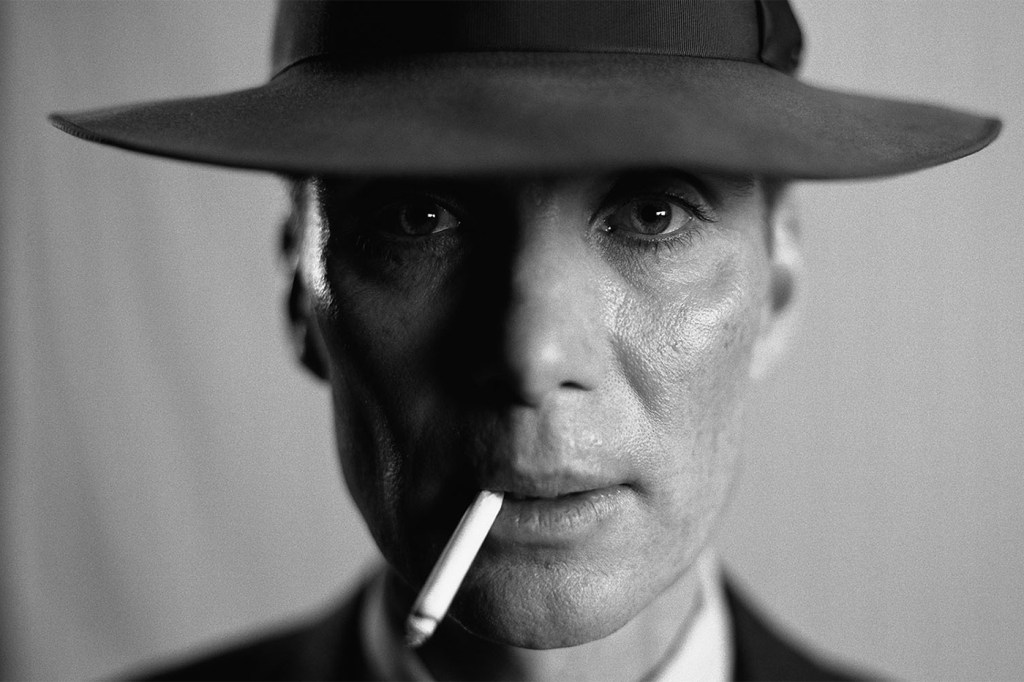
Photo: Cillian Murphy, recreating the famous 1947 photo of Oppenheimer by Alfred Eisenstadt for Life magazine that serves as the cover of American Prometheus.
 thekingsnecktie.com